Showing posts with label Languages. Show all posts

Monday, 23 October 2023

Quenya translation - "Aiwë" ("Int én bec"): Traducción al quenya de un poema en irlandés antiguo / Medieval poem in Old Irish translated into Quenya

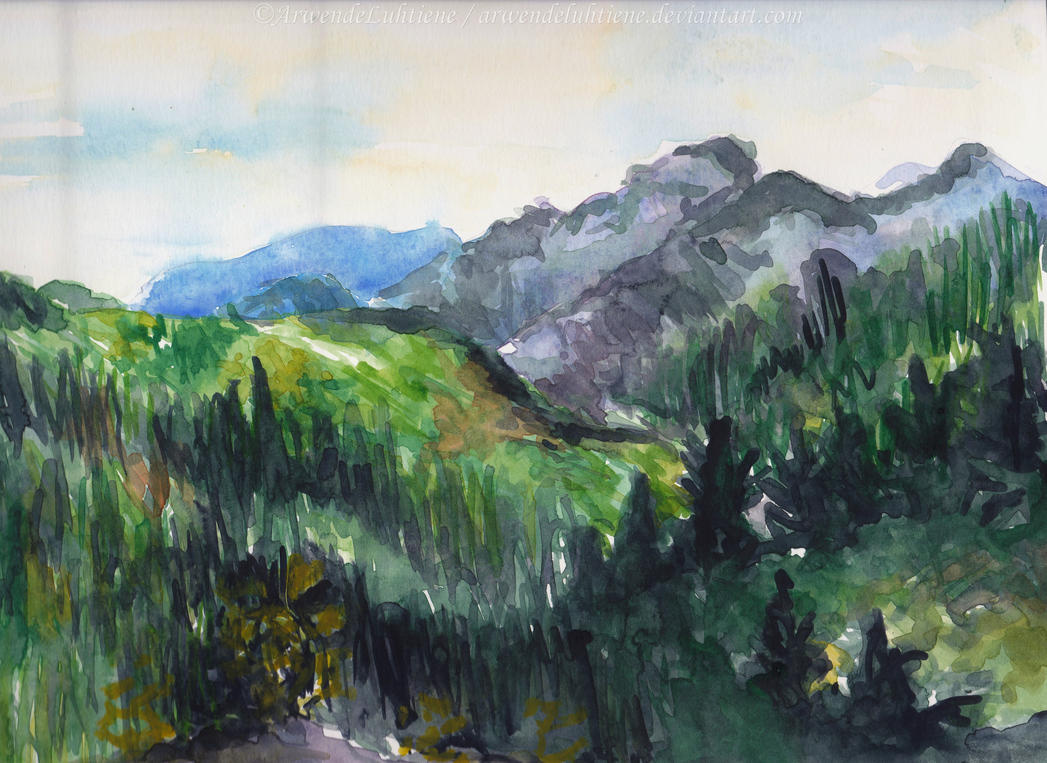
Fig. 1 - I made this watercolour illustrating my interpretation of the titular blackbird and the image that is evoked in the poem 'Int én bec'. ArtStation. DeviantArt. Instagram.

 'Int én bec
  ro.léic feit
  do rind guip
  glanbuidi
  fo.ceird faíd
  ós Loch Laíg
  lon do chraíb
  charnbuidi.' 
 
"The little bird / has whistled / from point of beak / bright yellow; / lanza un canto / sobre el Lago Laoi, / un mirlo desde una rama / heaped with yellow (blossom)." 
 
"El pajarito / ha silbado / desde la punta de un pico / amarillo brillante; / throws out a cry / over Loch Laoi, / a blackbird from branch / repleta de [flores] amarillas." 
 
I aiwë
ilírnë maicavë
colmello penta
calima malino;
hortëas lirilla
olla Ailin Rotiltundo,
aiwe-morna olwa
lótëa malinello.
 
 
(English version, Spanish below) A year ago, in October 2022, I finished writing and revising a new translation article which combined my interests for both Quenya and Celtic languages, particularly Irish. Back when I was first learning Irish in the late 2000s-early 2010s, I dabbled in translating a couple of poems from Tolkien's The Lord of the Rings into Irish that I will probably also share on here sometime (that's how geeky translating practice should work, right xD?). And this time, I tried my luck at translating one of my favourite Medieval Irish poems into Quenya 🍀🍃🐤✨. This translation, alongside a watercolour that I made expressly for the article (see Fig. 1) were published in the Summer 2023 edition of Estel (no. 99), the biannual magazine of the Spanish Tolkien Society (Sociedad Tolkien Española, STE) (Figs. 2-3). 
 
The poem that I translated, which you can read here above, alongside the English translation and my own translations into Spanish and, specially, Quenya, is called 'Int én bec' (literally, "The Little Bird", also known as "The Blackbird of Belfast Lake"), a c. 9th Century poem in Old Irish written by an anonymous monk and found as a mid-text annotation in manuscripts of the Book of Ballymote (see Fig. 4) and the Book of Uí Maine. In this essay and translation, which I show in PDF format in this post below (pages 61-66 of the magazine, and also posted as a separate file), I delve in more detail about the historical context of this poem and a description of its metrical form, before showing my translation into Quenya with an accompanying analysis. Hope you enjoy it 😊!   
 

Fig. 2 - The article in Estel 99

Fig. 3 - The article in Estel 99
 
Fig. 4 - Book of Ballymote, first page (f. 8r).

 (Spanish version) Hace un año, en octubre de 2022, terminé de escribir y revisar un nuevo artículo de traducción, combinando mi interés tanto por el quenya como por las lenguas celtas, particularmente por el irlandés. A finales de los 2000 y principios de los 2010, cuando estaba yendo a clases de irlandés (moderno), ya se me ocurrió traducir unos cuantos poemas de El Señor de los Anillos de Tolkien (¡qué mejor que Tolkien y otros fandoms como práctica!), traducciones que también compartiré en este blog en algún momento. Y esta vez,  decidí hacer el trabajo inverso y probar a traducir uno de mis poemas favoritos de la Irlanda medieval al quenya 🍀🍃🐤✨. Esta traducción, junto con una acuarela que hice expresamente para el artículo (ver Fig. 1) se publicó finalmente en la edición de verano de 2023 de la Estel (nº 99), la revista bianual de la Sociedad Tolkien Española (STE) (Figs. 2-3).

El poema que he traducido, que podéis también leer más arriba en este post, se llama 'Int én bec' (literalmente, "El pajarito", y también conocido como "El mirlo del lago de Belfast"). Se trata de un poema de alrededor del siglo IX, escrito en irlandés antiguo por un monje anónimo, y se encontró como una anotación en medio de una página en los manuscritos del Libro de Ballymote (ver Fig. 4) y el Libro de Uí Maine

En este ensayo y traducción, que adjunto como  PDFs más abajo en este post (en las páginas 61-66 del PDF de la revista adjunta, y en un fichero por separado), he profundizado más en el contexto histórico de esta poema y la descripción de su forma métrica, para luego ya pasar a mi propuesta de traducción al quenya y su análisis correspondiente. ¡Espero que lo disfrutéis 😊!

This essay is for the moment in Spanish only, similarly to most of my essays and presentations for the magazine and the events of the Spanish Tolkien Society, but ideally I'd like to translate them all into English as well sometime, hopefully soonish.

 
PDF of the magazine (my article is on pages 61-66):
 
 
 And the separate file with just my draft article before publishing:


-On the use of my essays, studies and translations: Please, do not use this work without my permission without any credit. If you're interested and want to share it or expand on this idea, you're of course allowed to reference it if you credit me and link to this post. It would also be nice if you contacted me beforehand. DO NOT publish as if it were your own work, always quote and link.

Tuesday, 27 April 2021

Quenya translation - Lairë Nerion Imnetyalo: Traducción al quenya de un poema de Sor Juana Inés de la Cruz / Poem by Sor Juana Inés de la Cruz translated into Quenya


(English version, Spanish below) Back in 2020, fellow Tolkienite and feminist Pilar Erika 'Tarmariel Luinilmë' and I worked on a Quenya translation which got published in the Winter 2020 edition of the Estel (no. 94), the biannual magazine of the Spanish Tolkien Society (Sociedad Tolkien Española, STE). We translated excerpts of one of the poems of Sor Juana Inés de la Cruz, a 17th Century Mexican nun who was also a subversive feminist and LGBT+ poetess and writer. We had a blast with this work, as it combines some of our favourite topics - feminism and herstory, Tolkien and fandoms, rare and invented languages, and translating 😊💜📖.

In this essay and translation, which I show as a PDF here in this post (pages 41-46 of the magazine, also posted as a separate file), we have included an intro about the life and works of Sor Juana Inés, as well as the Quenya translation per se and its analysis. The poem we chose to translate is 'Hombres necios', the renowned (and rightly so) poem with its spot-on feminist critique against the hypocrisy of men - A poem which, unfortunately, still rings very true in our 21st Century.
 
If you want to learn more about the awesome Juana Inés, I recommend Pilar Erika's slideshow presentation on her life and works on her Blogger, which she presented as part of a series of talks organized by feminist organization Dando Voz al Silencio in Madrid back in 2018. Her post on this work is also here.
 
This is also my second Quenya post (translating a page of Astérix in Britannia was the first xD), and given my love for rare, ancient and invented languages, I'm totally planning on expanding the language and translation series on here and sharing more Quenya posts, as well as Irish and Vulcan shenanigans!

This essay is, for the moment being, in Spanish only, but I am planning on translating it into English as well sometime in the future 🙂! 
 

(Spanish version) En 2020, Pilar Erika 'Tarmariel Luinilmë' y yo, las dos tolkienianas y feministas, estuvimos trabajando en una traducción al quenya que se publicó en la edición de invierno de 2020 de la Estel (nº 94), la revista bianual de la Sociedad Tolkien Española (STE). Tradujimos unos fragmentos de uno de los poemas de Sor Juana Inés de la Cruz, la poeta y escritora mexicana del siglo XVII que se hizo monja para poder escribir, y que, a pesar de la sociedad tan patriarcal y jerárquica en la que le tocó vivir, era tanto una feminista subversiva como un ejemplo de persona LGBT+ histórica (sin planearlo también llega este post cerca del día de la visibilidad lésbica, el 26 de abril ^^).  Nos lo pasamos muy bien en este trabajo, ya que combina varios de nuestros temas favoritos: El feminismo y la visibilización de mujeres en la historia, Tolkien y los fandoms, las lenguas raras e inventadas, y la traducción 😊💜📖.

En este ensayo y traducción, que adjunto como  PDFs más abajo en este post (en las páginas 41-46 del PDF de la revista adjunta, y también en el fichero por separado), hemos incluido primero una introducción sobre la vida y obra de Sor Juana Inés, y después la traducción al quenya y su análisis. El poema que escogimos para traducir es 'Hombres necios', el famoso poema (y con razón) con su crítica feminista tan acertada acerca de la hipocresía y los dobles raseroes de los hombres. Un poema que por desgracia sigue siendo muy relevante en nuestro siglo XXI. 

Si queréis leer más sobre la genial Juana Inés, recomiendo la presentación de Pilar Erika sobre su vida y obra en su Blogger, que presentó  en 2018 en una jornada de charlas organizadas por la organización feminista Dando Voz al Silencio, en Madrid (yo presenté otra charla centrada en la escritora también feminista Christine de Pizan, del siglo XIV).
 
Este es mi segundo post sobre quenya (la traducción de un fragmento del cómic de Astérix en Britania fie el primero xD), y dado que soy muy fan de las lenguas antiguas, raras e inventadas, está en mis planes totalmente expandir la sección de lenguas y traducciones en este blog y compartir más posts sobre quenya, irlandés y vulcano xD


 PDF of the magazine (our article is on pages 41-46): 

And the separate file:

 
-On the use of my essays, studies and translations: DO NOT use this work without my permission. If you're interested and want to share it or expand on this idea, you're allowed to reference it if you credit me and link to this post. It would also be nice if you contacted me beforehand. DO NOT publish as if it were your own work, always quote and link.

Sunday, 28 March 2021

Goodreads reviews - The Vulcan Language

Book: The Vulcan Language4/5. Goodreads review also here

This book is a compilation from the Vulcan Language Institute which includes a Vulcan grammar, various glossaries, and also a section about Vulcan lore and culture.

Pros
-The geeky factor. I mean, it's a VULCAN grammar, and I'm having a blast learning this language :D . This book and the content on the website is a great opportunity to learn Vulcan.

-There are quite a lot of vocabulary lists, including separate topics (food, occupations, science, etc), as well as a general dictionary.

-Quite a lot of the grammar lessons include exercises, and there are also some sections with Vulcan and English dialogue (both dialogue from the TOS movies and original translations of Star Trek Spock quotes), useful for practice and translations.

-And finally, the last section of Vulcan lore includes interesting info about the history and culture of Star Trek Vulcans.

Cons 

-Although you can learn Vulcan fairly easily with these lessons once you know where everything is, the grammar in this book is often badly disorganized, and the grammar itself does not follow a logical (no pun intended xD) order at all sometimes - Basic topics such as pronunciation and punctuation come after a whole section introducing various topics of Vulcan grammar, the basic copulative sentence also comes after more complex topics such as a whole summary of verbs and verb-to-noun formations, grammar and quote sections are mixed together...

It's definitely not the most logical or helpful way to organize a grammar, and it shows that this book was basically a copy-paste of the website contents of the Vulcan Language Institute which is lacking the very much needed effort of organizing it all together better so that it’s easier to follow and to learn the language :S As a working grammar it does need some work.

-Some topics such as stress were ambiguously explained or missing, and I had to make use of YouTube videos in order to understand it better. Videos are also a great help to learn Vulcan and complement this book nicely, though!

-The culture and lore section could be a bit better organized as well. The rather random order of topics also shows the copy-paste nature of this book, but most of all what I sorely missed was notes and references to where all the lore info came from. While I could recognize the TV series Trek canon that I know when I came across it, I was often left wondering about where many bits of information came from, be it from the series (also, which series), the book and extended material canon, or fanon. The way this section is written and organized, there’s a bit of everything mixed up and it’s hard to know which is which.

Topics such as the kolinahr, pon farr and kul-ut-kal-if-fi (more on Vulcan culture regarding women and feminism will be coming on here sometime in the future, because I have a lot of things to say :S xD) I found to be well-researched in the TV canon (probably because there’s also more material available), and include useful bilingual texts in Vulcan and English. Other topics contain a lot more extended-material-canon and fanon info that I also appreciated as a compilation, and I do think it’s also valid information when it delves deeper into a topic which was not as explored in the series, and especially when it does so without contradicting the series canon – but it kept bugging me a lot not to have notes, references and a bibliography just to know where everything comes from (as Memory Alpha and Beta do).

-Finally, there are also some typos and inaccuracies in this lore section (the stated lore contradicts the TV canon a couple of times, that I could find), and a couple in the grammar section as well.

Overall, I think this is a great way to learn Vulcan and delve into Star Trek's Vulcan lore, and I totally recommend this. I just wish the grammar were better organized in a more practical and (ahem) logical way, and that the lore and culture section included notes and references (and a bibliography for everything) detailing where each piece of information comes from. But apart from that, I'm pretty hyped about learning Vulcan :D Dif-tor heh smusma! 

Wednesday, 15 April 2015

Tolkien essays - Las Traducciones de Rivendell

This below is an essay I wrote in 2011 for the seasonal magazine of the Spanish Tolkien Society, Estel (No. 72, pdf included below as well). I tackled the Spanish translation of 'Rivendell', a place name that, contrary to pretty much the rest of toponyms in Tolkien's world, keeps being wrongly translated - in my opinion - in most of the Spanish Tolkien material, books and film dubbing alike. 

In the 6-page essay, I talk about Tolkien's own translating advice and guidelines, describe the way that 'Rivendell' has been translated into a number of languages, focus on the Spanish translation choices and give my opinion on the matter and my personal choices in order to translate the name of the Elven settlement in Eriador.

This essay is, for the moment being, in Spanish only, but I am open to translate it into English in the future if someone expresses that interest :).

'The Hidden Valley' by ArwendeLuhtiene (me) on DeviantArt

-Estel No. 72. My essay is on the pages 2-5:


And a pdf version of the essay (once again, in Spanish):

Tuesday, 8 July 2014

Quenya translation - Diálogo de Astérix en Quenya: Eleniono Tecië mi i Lambë Eldaiva / Translating Astérix into Quenya


I've been studying Tolkien's Quenya for a while, and one day I decided to translate something. So I ended up translating some frames from one of my fave Astérix comic books: The meeting of Anticlimax and Astérix in Astérix in Britain (Astérix chez les Bretons in the French original). It's nice to be a geeky erudite :) 

 The tricky part about translating Astérix comic books, in my opinion, revolves around all the set phrases, idioms and double-meaning jokes. So I wanted to base my tolkienized translation on at least two different translations. As well as the original French version of the comic book, I used the English and the Spanish translations in order to create the Quenya translation - I like the Spanish translations of Astérix books because they're reasonably literal and quite close to the original; on the other hand, I find that the English translations deviate quite a bit from the original more than once, so that was the version I ended up using the less for my translation. 

 The final study includes the comic panels with the Quenya dialogue superimposed (bigger pic of the panels below as well), the English and Spanish translations, a brief analysis of my own Quenya translation, and a list of the dictionaries/glossaries and the rest of bibliography I used.   I initially published this translation here as a pdf file back in 2014 (the English version is below), but I recently updated it and got it published in the Summer 2019 Estel, the official seasonal magazine of the Spanish Tolkien Society (Sociedad Tolkien Española), so here's the updated version from the magazine :D :


In English (earlier version, not updated):

Closer look at the panels with  my Quenya translation (Open in a new tab for a larger image):
And bonus pics of the newly received magazine with the article :D ^^
  
 
-On the use of my essays and studies: DO NOT use this work without my permission. If you're interested in it and want to share it or expand on this idea, you're allowed to reference it AS LONG AS you credit me and link to this post. It would also be nice if you contacted me beforehand. DO NOT publish as if it were your own work, always quote and link.

Tuesday, 4 February 2014

The Wheel of the Year: Imbolc

  
My reenactment of the Goddess Brighid (IG)
 First of all, belated happy Imbolc to all those who celebrate this neopagan/neodruidic feast, or to those who simply feel interested about the Celtic calendar and the goddess Brighid! And for those in the Southern hemisphere, a happy (belated) Lughnasadh as well!
Imbolc blessing. Found on Pinterest.
  As a pure agnostic-atheist neodruidess, I celebrate this feast from a purely seasonal, spiritual (rather than religious) and culturally interested point of view, more than from a neopagan one - although I do like to delve into Neopaganism, as well as Celtic culture and general mythology, and Brighid is one of my favourite goddesses. What I sometimes do on these couple of days (1st-2nd February) is walk in the garden to welcome the first signs of Spring and tie a ribbon in one of the trees on the 31st January (or 1st February sometimes, it depends), following the Imbolc tradition of hanging a strip of cloth or ribbon in a tree to seek blessings and protection from the Goddess. I'm not much into rituals myself, but I quite like this particular tradition and have sometimes done it, it seems like a very druidic and drawn-to-nature thing to do, same as having a small altar of seasonal plants or decorating a Yule tree.
My 2014 Imbolc ribbon.
  So to celebrate one of my favourite festivals in the Wheel of the Year, I've thought about a couple of posts to talk about Imbolc and the goddess Brighid.

  A couple of years ago, on my final year of Irish in the Official Language School (EOI) in Madrid, we organized a couple of shows, and one of them was about the druids and the Celtic calendar This is what my teacher Emily Allen and I wrote about Imbolc (in Irish, English and Spanish), and the Power Point slides I created:

   -Sources include Wikipedia and some books. Irish translation is original. 
My slide. Images from Google.

Tosaíonn Imbolc ar an gcéad lá de mhí Feabhra agus baineann sé le teacht an t-Earraigh, go mbíonn na laethanta níos faide, níl sé chomh fuar, agus feictear na chéad bláthanna ag teacht anuas. Tagann an focal ‘Imbolc’ ón t-Sean-Ghaeilge, “i mbolg”, agus tagraíonn sé do na caoraigh a bheith ag iompar.

Imbolc begins on the 1st of February, and it's related to the coming of Spring, now that the days are becoming longer, it's not so cold and the first flowers begin to sprout forth. The word 'Imbolc' comes from the ancient Gaelic "i mbolg", and it refers to the pregnancy of ewes.

Imbolc comienza el día 1 de Febrero y está relacionado con la llegada de la primavera. Los días comienzan a ser más largos, no hace tanto frío y empiezan a aparecer las primeras flores. La palabra 'Imbolc' viene del Gaélico antiguo, “i mbolg”, y se refiere a la gestación de las ovejas.