
I've still got a handful of Goodreads reviews I haven't posted on here, so here's another post of that! A Whovian one, with several Big Finish short trips featuring the First Doctor and most of his companions (Barbara, Ian, Susan, Vicki, Steven, Polly and Ben). I have listened to all First Doctor short trips to date, but I haven't reviewed all of them except for the star ratings, so here below I'll be listing both the audios I'll be discussing here, and those I have also listened to, but haven't reviewed yet, in case I end up expanding this post in the future!
The audios I will be discussing:

- Etheria (2015, short trip #5.09, featuring One, Vicki and Steven).
- Falling (2017, short trip #7.05, featuring One, Polly and Ben).
- O Tannenbaum (2017, short trip #7.12, featuring One and Steven).
- A Small Semblance of Home (2018, short trip #8.09, featuring One, Barbara, Ian and Susan).
The audios I haven't written a review for, as yet:

- Flywheel Revolution (2015, short trip #5.01, featuring One, rated it 5/5).
- The Horror at Bletchington Station (2016, short trips rarities #3.1, featuring One and Dodo; marked it with 2/5, rating may change when revisiting it).
- This Sporting Life (2016, short trip #6.05, featuring One and Steven, rated it 5/5).
- Peace in Our Time (2020, short trip #9.12, featuring One and Steven, rated it 4/5).
- Out of the Deep (2020, short trip #10.06, featuring One and Steven, rated it 3/5).
- Home Again, Home Again (2020, subscriber short trip #43, featuring One, Barbara, Ian and Susan, rated it 5/5).
So let's go with those first four audios! Spoilers for the plots!
1. Audio: Etheria (2015, short trip #5.09, featuring One, Vicki and Steven). Written by Nick Wallace and performed by Peter Purves (who plays Steven Taylor in Doctor Who).

3/5. Goodreads review also here.
+1 Engaging narration style by Peter Purves, who played Steven Taylor in the series. For short trips he also always does the voices of the First Doctor and, in this case, also for Vicki.
Note: I recently found out via several sources about Purves' numerous infidelities during his first marriage with several female coworkers from Doctor Who and Blue Peter, and, while I quite like the character of Steven Taylor, I was also pretty disappointed by the actor's behaviour and nonchalantly phrased views on this matter :S. Similarly, yeah, we can note that William Hartnell was noticeably old-fashioned in his views (as Anneke Wills and Michael Craze commented on, for example), and his mindset included conservative sexist and racist notions. But in this particular case, seeing as Peter Purves features pretty heavily in these First Doctor
audiodramas, I'm dropping a comment on Purves specifically because, apart from the character vs actor/writer exercise we're often forced to make when we enjoy fandoms, we should also hold the cast of our fave fandoms accountable for their problematic
aspects, or at least not let those aspects be hidden under the rug as they often are
😬.
+1 This
story features mainly Vicki, and I really like Steven as well, but Vicki
instantly makes anything 100% better in my personal experience 😃 xD

+-1
I enjoyed the idea of the plot, involving the TARDIS team being held
captive by Space Pirates and exposed to an oniric substance that makes
the Doctor and Vicki believe they're on a supernatural-behaving planet
on a quest to find the TARDIS, as well as rescue captive Steven.
However, the plot also dragged at times for me, and I didn't find it as
engaging as other Big Finish stories.
-1 Casual sexism, patriarchal
'chivalry' edition: At the end, there's a moment when the Doctor asks
Steven to 'escort' Vicki to the TARDIS while he deals with the
antagonists. Couldn't he have said something along the lines of 'Vicki,
Steven, wait for me in the TARDIS'?? Additionally grating seeing as
rescuing Steven was what the story was all about, and Vicki was the most proactive of the two companions throughout it.
 |
| Vicki can definitely handle herself, thank you xD |
-1 Vicki is the only female character in the tale.
2. Audio: Falling (2017, short trip #7.05, featuring One, Polly and Ben). Written by Jonathan Barnes and performed by Anneke Wills (who plays Polly Wright in Doctor Who).

+1 Engaging narration style by Anneke Wills, who plays Polly in Doctor Who, and here she also does the voices of Ben and the First Doctor.
+1
Interesting structure with flashbacks and flashforwards - Polly, years
after stopping her travels with the Doctor, now married to Ben and on
the verge of moving houses, finds a memento which makes her recall a
former adventure with the Doctor.
 |
| Maybe they'll go to India next, like the canonical reference in Sarah-Jane Adventures? |
+1 Continuity and parallels: There's some foreshadowing about the First Doctor's regeneration, encountering in a rather dreamlike adventure an alien angel-like creature with emerald-feathered wings who, similarly to the Ood with Ten, reminds the Doctor that his present incarnation is close to its end (this adventure supposedly happens exactly before 'The Tenth Planet'). The angel also mentions that he is the last of his species, another foreshadowing for the New!Who post Time-War Doctor.
First an alien angel, then the future Twelfth Doctor...One is probably pretty fed up with everyone trying to convince him into accepting to go through his first regeneration 😅 xD

+-1 Companion Ben Jackson is in my opinion a bit too idealized in this story, with Polly's narration emphasizing more than once how reliable, kind, brave and loyal he is. Ben does show all of these traits in the series, and Polly most definitely also holds her own in the series regarding agency and intelligence, but Ben also pretty patronizing towards Polly more often than I'd prefer, exhibiting casual sexism and male entitlement (the infamous "this is no job for a bird" line comes to mind, not to mention his 'you want to be careful who you encourage' stellar introduction 🙃), and, apart from some negative reactions from Polly, the series usually frames this as romantic chemistry, pretty much 😬. In view of this, I feel like some of these Short Trips I have listened to forget or want to ignore those more problematic traits in favour of portraying him as the ideal boyfriend/husband/man Polly can always rely on :S
 |
| And Ben's attitude in that respect is a pity, because if it weren't for that I guess they would make a cute couple. But Ben tends to make it more difficult by being unnecessarily chauvinistic and patronizing from time to time, when Polly clearly also holds her own perfectly, and Ben also gets scared sometimes, as humans do. Sigh. |
In this story especially, seeing as Polly and Ben are married in 'present time' and the flashbacks also tend to focus on their budding relationship. The relationship portrayed - albeit maybe idealized in this way - is not particularly problematic, though, with Polly seemingly retaining agency and an active life. Polly Wright has lost her surname and become Polly Jackson, however 😕, as usual in English-speaking countries (a custom which, yep, is inherently patriarchal).
3. Audio: O Tannenbaum (2017, short trip #7.12, featuring One and Steven). Written by Anthony Keetch and performed by Peter Purves.

Christmas-themed stories are generally not my cup of tea, and, apart from that, I found a couple of problematic issues in this particular one. But I also found Peter Purves' narration to be engaging, and I quite enjoyed Steven's pov in this story.
+1 Great narration and acting by Peter Purves aka Steven Taylor. His First Doctor impression has really grown on me, and I personally think he gets Hartnell's vocal mannerisms quite well. I enjoyed Steven's point of view and the fact that we learned a bit more about his backstory.
+1 Enjoyed the dynamic between the Doctor and Steven in general. There's a moment when Steven thinks about getting into a snowball fight with the Doctor but thinks better of it because he doesn't want to get him grumpier 🤣 Meanwhile, Steven is also cold and just wants to go to the beach xD
 |
| Get Steven to the beach already, Doctor xD! |
+1 We get some cute caring!Doctor moments when interacting with a little girl ("I returned downstairs to find that the Doctor, a man who could terrify Daleks and bring down Galactic empires, was captivating a little girl with a rabbit made from his handkerchief"). Being Christmas, the little girl - Gretta - also wonders whether the Doctor is Father Christmas xD
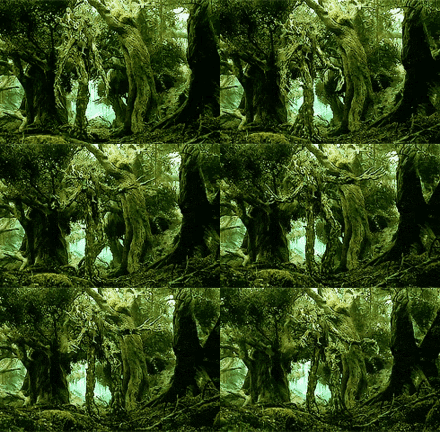
+1 The Doctor mentions the pagan origins of the Yule tree. Fed up as I am to see narrow-minded Christian people getting affronted every single year when anyone dares to comment on the pre-Christian origins of 'their' Winter holiday, I appreciated that moment very much xD
 |
| One is offending the narrow-minded religious folks and being happy about it xD |
 |
| Treebeard approves |
+-1 This is more of an exploration of the more problematic aspects of the dynamic between the Doctor and Steven more than an actual fault of the audio - When describing the dynamic from Steven's pov, we see how it is
sometimes not as equal or healthy as he (and I) would like - More than once Steven
feels like he has to tread carefully in order not to make the Doctor
grumpy, and when the danger is over, the Doctor decides when they're
going back to the TARDIS, with Steven reluctantly following because if
not he would have to put up with a 'barrage of petulance for being
late', while thinking about how he would like to 'hang out with more
people doing non-threatening things' for a while longer 😕. The series also explored the more fraught aspects of this dynamic at the end of 'The Massacre (of Saint Bartholomew's Eve)', with Steven being fed up at the Doctor's attitude after experimenting several rather traumatic adventures one after the other.
 |
| The First Doctor (alongside other incarnations) be often like that, sigh. |
And now for the things I didn't like as much from the story 😅:
-1 There's only one female character in the story, the young girl, and she doesn't do much more than be frightened of the whole situation in general :S
+-1 Like I said, Christmas-themed stories are not really my fave genre, as they're often full of highly idealized and normartive issues regarding established societal holidays+the family system. It's nothing particularly overboard in this case, and I actually enjoyed some of the Christmass-y moments (such as the little girl mistaking One for Father Christmas or Steven saying the famous ending line from 'The Feast of Steven' in 'The Daleks' Master Plan' serial - "Merry Christmas to all of you at home" - as a way to finish this story). But yeah 😅

-1 The aspect I found the cringiest in this tale is that the Doctor solves the violent situation between the humans and the trees by invoking these holiday values in a way that I found pretty problematic - The trees got initially violent because the little girl's father had felled one to be the Christmas tree for their cottage, and the Doctor claims...that the trees should not be feeling attacked basically because humans have always thought of Yule/Christmas trees in terms of light, love and hospitality 🙃🤷♀️. But that doesn't take away the fact that a sentient tree was killed all the same (and personally, for a reason that's way more unnecessary and problematic than needing timber or fire wood, just saying), and as such, the trees had a pretty valid reason to feel attacked.
 |
| That's a bit like telling Treebeard and Co that in Maiar culture Saruman's destruction of trees comes from a place of love and hospitality, so they shouldn't be bothered 😅 |
I approved of the Doctor's typically epic pacifist speech about how it's not always right to answer violence with violence and how communication is key in order to understand each other, and so on, but in the context of this plot, it rang in a rather oddly fashion in the context of the final lesson of the story - which is that the trees basically end up being all friendly because the Doctor convinces them that sporadically killing them for decoration/superstition/tradition reasons is done in a way that has 'nothing to do with malice, cruelty or wanton destruction', so it's OK! Cringy af. I also personally beg to differ in our real life context about this topic, because, even when they're not sentient, what is felling trees in order to decorate your house for a month, tops, if not falling under the category of wanton destruction, a little bit 😅?
And the fact that the trees are freaking sentient in this story complicates things even more. I mean, that's a
bit like the Doctor concluding that if a person happened to be killed as part of a
holiday which was theoretically about "love and light" and all-round
"positive values", that would make it all good and no one should feel
attacked - which sounds pretty absurd and very un-Doctorly indeed, right? (only, human sacrifices at festivities that are theoretically about light and prosperity have happened historically more than we'd like to think, in too many places 😬).

I would have preferred that the end result would have been that both parties would have simply apologized for their respective misunderstadings and errors, come to terms with their respective violence, and reached an actual truce where trees are also not happy to provide some of their own for the humans' festivities, because the humans would have understood that..murdering sentient trees because of Christmas is unnecessary and a little bit wrong 🙃. They did reach a truce in this case, but I'm not that much of a fan of a solution along the lines of 'because this religion/holiday actually means well, you shouldn't feel attacked for their actual violence' :S Christmas comes before anything else! Lol nope.
-1 And finally, the Doctor includes the infamous 'smacked bottom' line in his scolding speech against the trees' violence, and I really hate that (sexist) Hartnell line, so I'm definitely not a fan of that addition, and I don't like the idea that One would say that line often 😑 (ew).
4. A Small Semblance of Home (2018, short trip #8.09, featuring One, Barbara, Ian and Susan). Written by Paul Phipps and performed by Carole Ann Ford (who plays Susan Foreman in Doctor Who).

+1 Engaging and enjoyable narration style by Carole Ann Ford, who played Susan Foreman, the Doctor's granddaughter from Gallifrey, in the series. In this audio she also voices the First Doctor, Barbara and Ian.
 |
| The first TARDIS Team! |
+1 In this story, the First Doctor searches for tea leaves, planning to include tea in the TARDIS food machine (apparently they didn't have it before! 🤣), in order to make Barbara (and Ian) feel more at home, and it's such a British trope thing to do xDD
“I
know things haven’t been easy, my dear, and that’s why I’ve been
looking for this plant, these tea leaves, because I knew it was the one
thing I could do to make this silly old ship a little more comforting
for you.” (I think that Barbara and Ian would also appreciate it if you knew how to drive the TARDIS and didn't put them in danger every single time, though 😅).
+1 It's also a story that
mainly revolves around Barbara and her inner thoughts and feelings about
her adventures with the Doctor. And it's always refreshing to encounter a story that focuses on how the female characters feel and think, so yay.
 |
| Yay for Barbara! |
+1 Female bonding, with Susan and Barbara talking about their feelings and experiences in several scenes. This story also includes some backstory of Barbara's life, especially the positive dynamic with her mother (mother-daughter female bonding ftw!), with whom she used to have lunch on Sundays and talk about her week:
“One day, one day I’ll tell you all about my travels, all my adventures through time and space. One day I’ll make you tea and share all of the stories your daughter can tell.”
+-1 While the fact that the Doctor plans to get tea for Barbara and Ian is cute, he also behaves in a problematic fashion in this story, following a trend that he can also see repeated in several of his TV serials, such as 'The Daleks'. In this case, he may have the ultimate intention of making Barbara and Ian feel more comfortable around the TARDIS and less homesick, but the way he accomplishes this is not any different from the way he drags his companions off at any moment's notice to fulfil the rest of his personal scientific projects, without taking into account what their companions might feel like doing, or how tired they might be 😬.
 |
| Tell him, Barbara! |
Ian and Barbara actually spend quite a section of this story complaining exactly about that issue and confront the Doctor about his more self-centered and inconsiderate attitude when it comes to his 'personal projects'. And there's the problematic fact that the Doctor seems to think that his companions will feel 100% happy and satisfied with the surprise that he plans for them (and especially for Barbara), without the need to change anything about the rest of the situation that bothers them 😬. What's more, Susan also ends up resorting to having to justify her grandfather's behaviour on his behalf, asking Ian and Barbara to basically put up with everything because 'he must have a good reason for it' 🙃.
“Doctor, wait! You’ve got to
stop this! Barbara’s exhausted, and so am I! Everywhere we land, no
matter how cold or how wet, you get us looking for this blasted plant!
(…) You’re obsessed! It’s like Skaro all over again”
“I’ve apologized for that. You have no idea about the reasons behind my work. How dare you!”
This was a losing battle. It always was when the Doctor employed his ‘my ship, my rules’ argument.”
Here, I also can't but think of the analogy where this kind of strategy is favoured by many abusive men towards their (most often) female partners, resorting to the easy tactic of offering punctual gifts and surprises - which, being self-planned, can also be more ego power trips than actual consideration towards their partner - to compensate for a problematic behaviour they don't really plan on changing, or believe that they have to change :S. I'm obviously not saying that this is a perfect analogy with One because it isn't by any means - I wouldn't say the Doctor's abusive, but in both cases we can see similar traits based on (often male) entitlement, being inconsiderate and self-centered, and not wanting to be accountable for one's actions.
Which can make for dysfunctional dynamics, and more than one companion has confronted him (her/them) about it when it gets too blatant or constant, starting with Barbara and Ian themselves (Steven also had several goes at it, as discussed above in 'O Tannenbaum'). Seeing as several (mostly male) incarnations of the Doctor do fall for this behaviour more often than we'd like, it's also nice to see Doctor Who content addressing the titular character's more problematic traits, so Barbara and Ian confronting the Doctor about it was a very good addition, even though the 'I got tea leaves for you' happy ending of this short story did take the very needed accountability off the Doctor's shoulders a little too fast for my liking.
 |
| And now have some caring Ian and Barbara as a palate cleanser after that discussion xD |
-1 The adventure portion of the tale features pretty traditional gender roles throughout 😬 The women scream (Susan does, as typically required for her character in the TV series in every single occasion 🙃), and the women get captured, while the men climb trees, defend themselves and try to rescue the women. The antagonists are a group of cavepeople (of caveMEN, because they all seem to be male) with apparently pretty regressive views on the matter as well (which I guess can be expected, but still, always grating). While the TV serials of 60s Who (and later) has depended on traditional gender roles more often than we'd like, undersusing more than one awesome female character as a result, we also know that in spite of those imposed gender roles and behaviour Barbara succeeds in being badass af in more than one occasion, so I found it more than a bit unnecessary to resort to a strictly traditional gender role viewpoint here, when the story is mainly focused on Barbara, too.
 |
| Barbara is badass, case in point |
+1 The Doctor starts by trying to have a peaceful conversation with the antagonists and then manages their escape with a non-violent ploy, which is a nice way of critisizing the more violent leanings of the human antagonists of this tale, as per the typical pacifist and anti-war stance in Doctor Who.
+1 Other fun tidbits: Apparently, the Doctor gets in the habit of choosing his companions' (Ian's, at least) clothes for them? xD Especially when it comes to compensating for clothes that got destroyed in alien planet shenanigans xDD
“Ah, good morning, Chesterton! I see you’ve found the new cardigan I left for you. Very fetching! Very fetching indeed!”


