Let's return to this blog after handing in my PhD thesis with a fourth post about my visits to the British Museum (Anglosaxons, Vikings, Egypt and Greece)! Today's historical pic-overload will be about one of my favourite Ancient culture, the Celts, including pics from my visits in
2014 and 2019.
This will be quite a lengthy post, as I took a *lot* of pics xD I will include the descriptions from the museum both as text mostly as quotes in italics. As usual, click on the pics and/or open in a new tab for larger size, especially to read the text!
Celtic culture: Around 450 BC people in Iron Age Europe began decorating objects in a new style known today as 'Celtic' or 'La Tène' art. These designs generally featured abstract flowing patterns and entwined plant motifs, although styles varied from one region to another. Objects decorated in this fashion were often made using complex methods and requrired great skill. Across Europe, Celtic art continued to develop and influence decorative style well into the Medieval period.
The culture of the Celtic-speaking peoples of Britain and Ireland was distinctive in many ways. They developed a new art style that fused traditional swirling and geometric designs with Roman motifs and Germanic-style interlaced animals, while characteristic dress accessories and techniques like enamelling were popular. They also exploited links with the distant Mediterranean, trading resources like leather and tin from south-west Britain for wine and oil.


Open ring (pennanular) brooches:
Open ring brooches were the distinctive dress fasteners of
Celtic-speaking Britain and Ireland. Imagery shows men and women wearing
them at the shoulder or breast with the pin pointing horizontally or
diagonally upwards, perhaps depending upon gender or regional taste.
The
positioning and use of pennanular brooches was indeed differentiated
both by gender and social status :S Men usually wore them at the
shoulder, while women wore them at the breast (well, tough, because I prefer
to wear them at the shoulder xD), with the pin pointing up. This seems to have been regulated by law, as the Brehon Law (Medieval Ireland's law codes) addressed the potential injury from some of these very long and very pointy brooch pins at crowds, stating that the wearer would not be at fault if the pin didn't protrude beyond the shoulder, and if it was worn 'in these ways by the sexes': "Men are exempted from liability to fine from injury from the pin of their brooch if they have the brooch on their shoulder so as not to project beyond it. Women also are exempt if they have their brooch similarly at their bosom." (source).
So, if a woman had her brooch at her shoulder without the pin protruding and someone injured themself from it, she would be fined, while a man would not. As usual, gendering stuff sucks and is illogical af. Why does it matter if a brooch is worn at the shoulder or chest by any gender? What should be more important is to ensure that the pins, which could get incredibly long and incredibly pointy, as illustrated above, would have toppers or something to protect other people from potential injuries in crowds! The priorities, people, the priorities!
 |
Oh no, I was wearing it wrong all along xDD
|

 |
Depiction of Warrior queen Boudicca with a pennanular brooch
|
The Londesborough brooch, c. AD 750-850:
This brooch is a richly-decorated example of a type that was popular in Ireland. Its ornament, mixing intricate spirals, interlace and animal designs, is typical of the fusion of styles which characterized the art of Ireland and north and west Britain at this time. Used to fasten a cloak, the gilded silver, glass and amber settings would have proclaimed its wearer's high status.
Silver disc-headed pin, AD 400s:
This massive
Irish dress pin owes much to Roman influence. The silver used to make it
was rare in Ireland and probably came from melted-down Roman plate or
coins. Its decoration of chip-carved spirals, scrolls and stylized leaf
and fruit motifs derives from late Roman military belt fittings, while
the red enamel inlay and crescent-like pelta motifs on the pin head were
inherited from Iron Age Celtic culture. 
Stone relief of three mother-goddesses, 2nd-3rd Century AD, Lincoln: Unlike the mother goddesses of the Classical world (Hekate wants a word xD), the native Mothers of Britain and Gaul were often represented in groups of three, seated and holding in their laps children or other attributes signifying fertility and good fortune, such as fruit or grain.
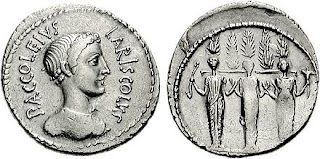 |
A 1st-century BC denarius (RRC 486/1) depicting the head of Diana (corresponding to the Greek triad of Hekate-Persephone-Ártemis/Selene) and her triple cult statue (Source)
|
 |
Greek triad of Hekate-Persephone-Ártemis/Selene (Source)
| |
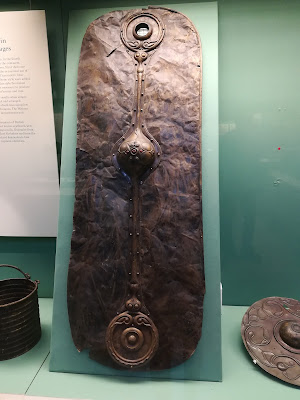
The Battersea shield, found in the River Thames at Battersea Bridge, London, around 350-50 BC: The Battersea shield is one of the finest examples of the art of the La Tène period in Britain. It was deposited in the river as an offering to the Gods. The shield is decorated with three raised circular panels. The decoration is enhanced with inlayed red glass or enamel. The thin metal and short length of the shield would not have provided adequate protection in battle. Instead, the shield was probably made for flamboyant display (or directly as a religious offering). It is made of several bronze sheets and a binding strip, help together with bronze rivets. Originally, these bronze sheets would have formed the facing for a wooden base, which no longer survives.
"The Battersea shield is actually the metal cover
that attached to the front of a wooden shield. It is made from sections
of sheet bronze, held together with bronze rivets. The decoration is
contained within three roundels and includes 27 studs of opaque red
enamel. Analysis of the chemical composition of the enamel suggests that
the shield was made no later than the 2nd Century BC." (Source)


 |
| Depiction of a Celtic nobleman with a shield and sword that are directly inspired by the Battersea shield and the Waterloo Bridge helmet. Both objects seem to have been especially made to be religious offerings and do not seem to have ever been intended to have been used in battle, however. |
|

Waterloo Bridge helmet (150-50 BC): "This object was dredged from the
river Thames at Waterloo Bridge in the 1860s. It is made from pieces of
sheet bronze joined together with bronze rivets. The horns represent
ferocity and were designed to enhance aggression, although the helmet is
unlikely to have been worn in battle. It was probably a special
religious offering." (Source)


Shield facing in sheet bronze (400-300 BC): The boss is ornamented with complex raised and engraved motifs highlighted with red coral studs. It exhibits great style, quality and technical expertise, yet re-used sheet bronze forms the facing. The outline of a stylized boar disappears behind the boss: it is preserved in differential corrosion.

Wrought iron frame with oxhead terminals. La Tène, 50-25 BC: The frame may have been used to spit-roast meat. Traces of wood preserved in the corrosion may indicate that it was an altar.
Ireland: In Ireland it is even more difficult than in Britain to decide where the Bronze Age ended and the Iron Age began. Most finds are from lakes or rivers or bogs and lack a secure context so that they are dated to the Iron Age on functional or stylistic grounds. Metalsmiths developed a recognizable regional style which shares some characteristic artefact-types and decorative techniques with Northern Britain. Horse-bits are more numerous than any other Iron Age artefact showing how horses were important to the way of life at that time. (...) Equally distinctive is the engraved decoration and cast shape of the Irish scabbard style which was developed from the 3rd century BC. In contrast to Northern Britain, brooches as well as pins were used to fasten and ornament costume and characteristic forms were developed.
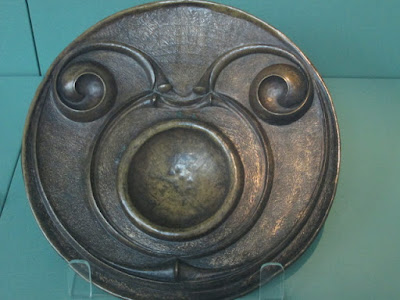
Left: Irish disc; Right: La Tène sword (Ireland): The disc is an object of unkown function and iconography unique to Ireland. The convex circular disc is made of sheet bronze engraved with a basket-weave pattern. The circular scoop has been placed off-centre and surrounded by a repeated scroll motif in high-relief.
Helmet, AD 50-150: Copper alloy helmet with repoussé ornament on the neck guard (I love this helmet, it looks so much like a modern baseball cap xD). Originally the cross-hatched studs were covered with opaque red glass.
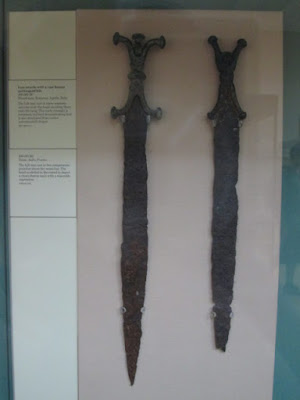
Iron swords, AD 50-200, from Cumbria and North Yorkshire: Left - The cast hilt and scabbard fittings are inlaid with red and yellow enamel. The front plate and suspension have engraved decoration; Right - This iron sword has brass hilt fittings and a scabbard with cast pierced suspension loop.
Sword blade (La Tène, 250-120 BC), suspension belt (La Tène, 300-150 BC) and iron daggers (400-300 BC):
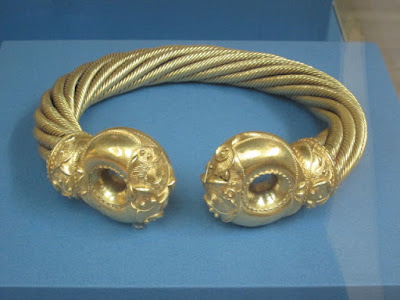
The Ipswich torcs (75 BC): All were made from two twisted solid gold bars. Four have cast terminals ornamented in high relief: they can be paired but their patterns are not identical.

The neck-ring was made in two stages. Two pairs of solid gold bars were twisted to the right and then the two strands were twisted in the opposite direction, to the left, to create a more decorative effect.
 |
Depiction of Queen Boudicca, wearing a gold torc
|
This hoard contains several sets of a torc and two brooches that were originally chained together. The jewellery was probably made for two important people, perhaps a king and a queen. They lived at about the same time as the Roman army, led by Julius Caesar, conquered France Gaul and twice invaded England Britannia in 55-54 BC. The necklaces were crafted differently from other torcs made in Britain at this time, such as those from Ipswich. Roman jewellery-making techniques were used and they were not decorated with native Iron Age designs. (...) Gold brooches of this type were also rare. Only two other Iron Age examples have been found in Britain.
Mirrors:
Gold torcs of the Castro culture of north-western Iberia (300-159 BC): Each neck-ring is made of solid wire with a diamond-shaped section. The terminals are made of sheet gold and are hollow. One has compass-drawn engraved ornament, enhanced with granulation, on the face.
The Chertsey shield (400-200 BC): This shield was made around 2400 years ago and it is the only shield from the period to be made entirely of bronze. Other bronze shields had wooden backings. It was probably made for display rather than for battle. The shield was deliberately placed in the River Thames as a offering to the Gods.
Circular shield boss in sheet bronze (350-150 BC): With repoussé ornament in the form of stylized bird -heads:
Iron sword with cast bronze anthropoid handle (200-100 BC): The hilt was cast as one component with the head cast separately. It is one of the earliest representations of a human head in the British Iron Age.
Gold lunula (Copper Age/Early Bronze Age, 2400-2000 BC):
These distinctive crescent-shaped ornaments were a specialty of Irish smiths, although some are known from Western Britain. Some were engraved with geometric designs near each end. They may have been worn as neck-rings but most of the decoration would have been hidden. Lunulae could have served as signs of rank, or been used during ceremonial occasions.
 |
| Imaginative illustration of 'An Arch Druid in His Judicial Habit', from The Costume of the Original Inhabitants of the British Islands by S.R. Meyrick and C.H. Smith (1815), the gold gorget collar copying Irish Bronze Age examples | |








 ,
,


