Showing posts with label Classic Who. Show all posts

Tuesday, 27 December 2016

Doctor Who magazine feminist overviews - 504 (The Cybermen)

Apart from reviewing Doctor Who episodes from a feminist point of view, I've been thinking of doing some similar overviews (only a bit shorter and more schematic) of the Doctor Who Magazine numbers, so here's the first one :)
Description of issue
  • Yes (Feminist content, empowered female characters, representation and/or subversion)
-Inside back cover: Silurian warrior queen. Points for #Women Leaders and for #Non-objectified and realistic female warriors.


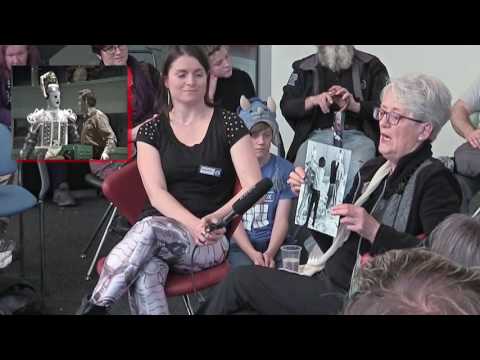
-Evolution of the Cybermen: This feature interviews the creator of the first Cybermen designs, who is actually a woman , Sandra Reid/Tynan

-Comic ('Moving In'): Subversion of traditional gender roles with the Twelfth Doctor cooking (open in new tab for larger image):

-Silver Nemesis: I haven't seen this episode yet, so I can't really comment on it, but the things I've liked in the review feature: Ace as an empowered, non-objectified female companion; Lady Peinforte, a 17th Century noblewoman, is skilled in archery; and a society-critical anti-marriage quote: "Am I to remain a prisoner in my own house, while world dominion awaits beyond the door? I would have married if I'd wanted that!". Lady Peinforte is a 'villain', a 'sorceress and poisoner', so she's not seen in a good light (as is so usual when it comes to independent powerful women in history and tales :/), but this quote is definitely feminism material (apart from the villain-related 'world domination' thing, of course xD).


  • For consideration (potentially problematic content)
-Evolution of the Cybermen: Alexandra Reid on thinking that the ‘girls’ skirts were too short’ (she's referring to companion Polly wearing miniskirts):

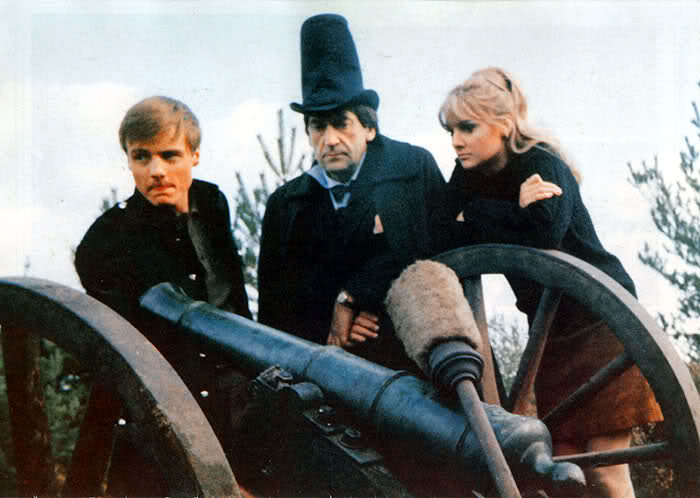
I appreciate the designer noting that retrograde religious 'pro-modesty' mindsets are harmful and wrong. They totally are. One should definitely not judge a woman for wearing miniskirts or shorter skirts, if she likes wearing them.

 However, the context should also be taken into consideration in order to ascertain if the character is being sexualized or not. For example, female Starfleet officers (Star Trek) wearing miniskirts is unrealistic and ridiculous - and thus, objectifying - because the logical thing would be to wear protective and practical clothing in that context (weather, risk of injury to the exposed or poorly protected legs, lack of mobility, among others). Doctor Who's context also involves adventures, running, danger and hazardous situations and environments, so I guess that if a female character were wearing, say, a short skirt with bare legs or very thin leggings, that could pose a problem (again, weather, higher risk of injury, lack of mobility). 

This of course depends on the kind of adventure - Amy Pond, for example, often wears short skirts with leggings, and, as a daily wearer of this kind of look, I can say that, if the skirt is reasonably elastic and the leggings are warm enough, this look is quite realistic when it comes to running, moving around, and protecting yourself from scratches and (non-extreme) weather.

 Other important point to consider about this issue is to see if, by contrast, all male characters are always wearing pants and generally comfy and practical clothing while the women are generally wearing more revealing clothing just because they're women (double standard) and they must be seen as adequately attractive for the male gaze (a quote by Frazer Hines (see below) supports that quite a handful of men see it like that :/ And is character, incidentally, wore a kilt, so double double standard because he, as a man, doesn't get that kind of comments for showing his legs). So context definitely has a say in this matter.
  • Nope (Presence of sexism - Such as objectification and sexualization, double standards, glorification of gender roles, problematic relationships, etc. Presence of racism, heteronormativity, classism and/or other problematic content)
-Evolution of the Cybermen: Like I commented above, Frazer Hines (Jamie McCrimmon) makes quite a problematic objectifying comment about him and Patrick Troughton ‘not complaining’ about Deborah Watling (Victoria) wearing miniskirts.
This makes one think just how many people were thinking that these girls were wearing miniskirts for their watching pleasure (this is a current issue, don't be mistaken), and also to what extent were these actresses given miniskirts as part of their costumes so that they'd look attractive to the male gaze (this is also a current issue), because, like I also mentioned before, some of these adventures don't partcularly ask for a short skirt with bare legs, so there must be another - societally more important - factors at play :/
Hines 'wasn't complaning' about his female colleagues showing their legs, but I guess people didn't just go around being disrespectful and objectifying to him for the very same reason - because he's *gasp* male
-Cyber-Plans: Torchwood’s Cyberwoman is an excellent and oh-so-subtle example of objectification and double standards. Male Cybermen are - obviously! - never objectified and are always wearing realistic, practical and non-sexualized armour and outfits. But the (sexist) genius who thought about this design must have thought that women were a different story, and that the male gaze as paramount:


Also, it's worth noting that Cybermen are called ‘Cyber-men’ even though both men and women are converted, at least in New!Who. An example of the sexist use of the masculine as a generalized term to refer to both men and women. Also, if converted women wear the boob-plate-free Cyber-outfits that everyone wears, Torchwood's Cyberwoman is not only sexualized - she is also incoherent.

-Comic ('Moving In'): Even though the Doctor cooks the family meal in this comic strip (and has been subverting this role in other comic stories as well), regarding  the ‘family’ proper the wife - Mrs Collins - is  the only one to cook in the house (we're to assume that she's a stay-at-home wife and mother). We're talking about the 70s and all, but the fact that too many women, housewives or not, are still the ones primarily taking care of the cooking and other housework stuff today is an important and very current issue. The traditional gender role involving women=cooking and women=housework is still going strong in too many cases (and that's why it's so important to show subversion, such as the Doctor's in this strip).

This comic also feeds us the cliché that the women (stay-at-home or not, but mainly stay-at-home in this context) are really the ones to ‘have the power’ and ‘take the decisions at home'. Even though the husband has the societal upper hand (male privilege) and the money is his (even though the women may administer it - that's less work for the dude, really, I'm sure many think of it that way), we're often told that the wives are the ones with the ‘power’, the ones who ‘rule over’ their husbands. 

This misleading cliché bothers me to no end, because in a patriarchal system the truth is the complete opposite. In a patriarchal-based system men have the real executive power, while women’s potential 'power' is only (relatively) valid in private spheres, and this kind of power often comes from indirect methods (persuasion and/or advice, for example), or from patriarchal-based methods (seduction, the only kind of power – alongside deception and indirect persuasion – that women really have in this system). So don't give me this kind of rubbish. Housewives who are 100% financially dependent on their husbands do not have the 'real power' in the equation (and 'choice' - because I can already hear the liberal-choice-feminists complaining - has nothing constructive to add on the matter because 'choice' doesn't immediately mean 'feminist' or 'anti-system'). Husbands in such a situation may want to humour their wives so that they think that they have the kind of 'real' power to make the decisions, or they may be afraid of them (as the controlling party often is when it comes to the controlled party who may rebel and strike back), but if they wanted they could easily show that the 'power' is theirs simply because they're in possession of the money and the societal privilege.

 That's why being financially independent is so important if you're a woman.
1) Being financially dependent makes you way easier to control and oppress. You literally have no freedom if you don't have any economical means of your own. You're depending on the goodwill of the one who holds the money, usually the man.
2) Stay-at-home women are being oppressed in the patriarchy system by definition, ‘choice’ or ‘no choice’, because that's how the patriarchal system works. The one without the money (in this case, the woman) is the one with the least power of decision.
3) And this is, again, for choice-feminists and liberal feminism: Of course a woman can 'choose' to be a housewife, but 1) Choices don't come from a vacuum and 2) Shouting 'choice!' is derailing because we’re talking about the system and not about ‘personal choice here.

-Silver Nemesis: Like I said, I haven't watched the episode yet, but Lady Peinforte seems to fall into the 'villainous sorceress' stereotypical category that so many women fill when they display independence and power.
  • Bonus geeky stuff I liked
Twelve is Team Cap :)! Suits him :D


Tuesday, 1 December 2015

Doctor Who feminist reviews - 'Mighty Kublai Khan'

-Doctor: First
-Companions: Susan (the Doctor's granddaughter), Barbara Wright (Susan's history teacher) and Ian Chesterton (Susan's science teacher).
-Episode: 'Mighty Kublai Khan' (Classic Who, 1964. Season 1 Marco Polo story part 6/7). Only some pictures and the audio narration remain.

My first Classic Who review! And yes, I'm starting with part 6/7 because 1) Timey-wimey stuff xD and 2) I read an article in September's Doctor Who magazine (DWM), which led to me watching-listening to the episode, which led to this review.

Synopsis here. This review contains SPOILERS.

-Sexism, feminist content and the role of women:
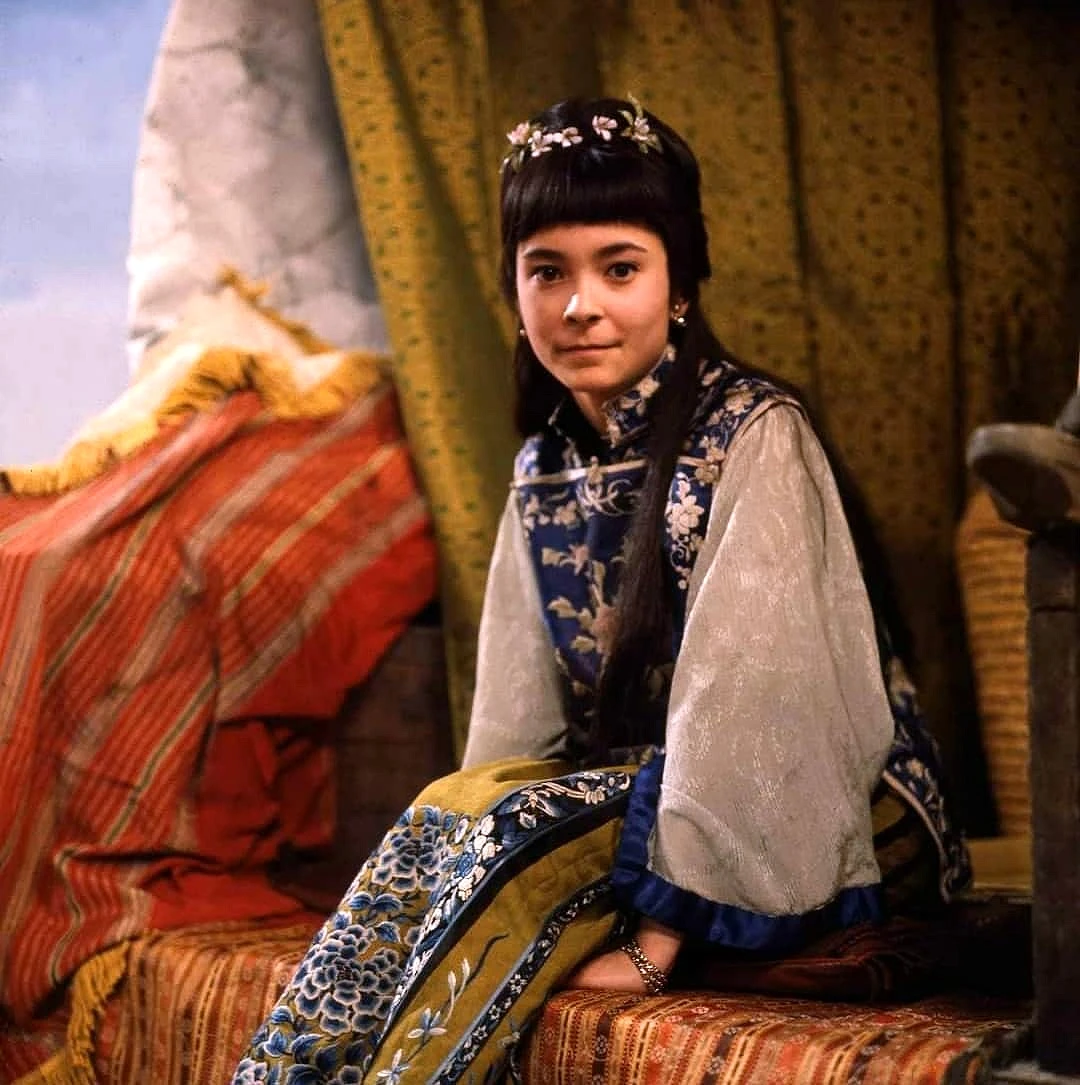
  • Number of women: 3 - Susan, Barbara and Ping-Cho. Court noblewomen in the background.
  • Bechdel test and female bonding: Yes - Susan and Barbara. Susan and Ping-Cho (very briefly, and one-sided, with Ping-Cho saying 'Goodbye, Susan' to a sleeping Susan in the room they share, just as she is ready to escape from the inn).
  •  Empowered traits in at least one female character? Susan and Barbara speak out against a sexist arranged marriage and Ping-Cho shows agency when trying to escape said marriage.
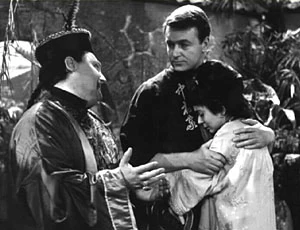
  • Feminist content in the script:  Criticism of arranged marriages. Susan and Barbara speak out against Ping-Cho’s arranged marriage with a man way older than her, and Barbara says that Ian and the Doctor are against the arranged marriage as well:
"TEGANA: Ah, all their sympathies are with Ping-Cho. They are all against this marriage. 
POLO: Then why did Ian go back to look for her? 
TEGANA: Exactly. 
(Susan and Barbara enter, laughing.) 
TEGANA: I'm glad to see that your humour is not impaired by our misfortune. 
BARBARA: What do you mean? What misfortune? 
TEGANA: Well, your friend Ian has not returned. We can only assume that he's failed to find Ping-Cho. 
BARBARA: Oh, you haven't given him enough time yet. 
SUSAN: Anyway, I'm glad. I hope he doesn't. 
TEGANA: Oh, I see. You want to see her alone, do you? Without friends? She might be kidnapped, murdered. 
SUSAN: Well, that won't happen to her. She's got money. She can buy a safe passage home. 
TEGANA: Money! Are we all sit in fear for her, and her intended husband sits in despair? 
SUSAN: Oh, even you couldn't be so cruel as to want her to marry a man four times her age. 
TEGANA: Even I? I thank you, lady. And this is your opinion too, I suppose? 
BARBARA (snarky): I suppose so. 
POLO: One moment. Are you opposed to Ping-Cho's marriage? 
BARBARA: Look, why are we- 
POLO: Answer my question please. 
BARBARA: Yes I am. Completely opposed to it. 
TEGANA: How very unusual for you and Ian to disagree. 
BARBARA: It isn't unusual at all. We don't agree about everything. And in this case, we're in complete agreement. All of us. 
POLO: This marriage has the Khan's blessing. Am I to understand that you oppose it? Am I? 
BARBARA: Yes. 
POLO: All four of you? 
BARBARA: Yes, all four of us."
You go, girls!
  • Role of women in the episode
   - Susan fulfills a pretty passive role, being captured by Tegana at the beginning of the episode and threatened before the Doctor, Ian and Barbara in exchange for the TARDIS (damsel in distress trope). She does show assertiveness later in the episode when speaking out alongside Barbara against Ping-Cho's arranged marriage.
    -Although Ian does most of the action, going back for the escaping Ping-Cho, siding with her to search for the stolen TARDIS and confronting Tegana at the end, Barbara also takes some part in the events, speaking to Ian about the need to convince Marco Polo that they’re time travellers in order to recover the TARDIS ('Listen, we need the TARDIS. You must talk to Marco.'). But, although Ian seems to talk with her in a reasonably equal level and actually seems to want for her to try to convince Marco alongside him, Barbara merely advises Ian on what to do, but probably because, thanks to gender roles, Marco would hardly want to listen to her, not because of a lack of assertiveness: Afterwards, Barbara speaks out in a wonderfuly assertive way, alongside Susan, against Ping-Cho’s arranged marriage.
The damsel in distress trope appear twice in this eppisode, but that doesn't prevent all three female characters from showing some assertiveness and agency at least once!
   - Ping-Cho shows agency when trying to escape her arranged marriage with an older man by fleeing Marco’s caravan and attempting to join another, but is also portrayed as naïve (being tricked by the false caravan member - Kuiju, Tegana's accomplice-, who robs her) and her position in that society is, as expected, one of little power (for example, the man at the Cheng-Ting way station, Wang Lo, grabs hold of her and prevents her escape when he finds out she has run away, and Ian has to come to her rescue - another damsel in distress trope). She continues showing agency when siding with Ian, though. She also confronts Kuiju at the end of the episode, helping to disarm him and asking for her money back.

"IAN: Ping-Cho, why did you do it? 
PING-CHO: The key. And I can't marry a man old enough to be my grandfather. I can't. Please don't take me back. Please."
  • Level of sexism: Women are viewed as inferior in that society and time, as can be expected.
- Patronizing attitudes towards Susan and Barbara from characters such as Marco Polo, Mongol warlord Tegana and Kublai Khan (patriarchal chivalry in the latter's case: 'These gracious ladies also accompany you, Marco?').

- Male characters, such as Kuiju and Wang Lo, call Ping-Cho ‘little one’ and 'foolish child'/'silly child' in a patronizing and demeaning way.   In contrast, Ian treats Ping-Cho in a more equal (or at least respectful) way, and ultimately includes her in his plans to retrieve the stolen TARDIS and sides with her in order to confront Kuiju. 
Ian gains points by including Ping-Cho's in his plans to regain the TARDIS
-The Doctor also addresses Susan in a gruff manner in one occassion ('Oh, do be quiet, child.'). He seems to be like that with everyone from time to time, though, and he shows concern for Susan's safety and affection towards her at the beginning of the episode, handing over the TARDIS key to Tegana and Marco Polo immediately ('Tell that man to take his hands off my grandchild! (...) So long as you're safe, Susan. That's all that matters.').

-Racial issuesMany of the actors portraying Oriental characters are Caucasian or have non-Asian ethnicities. This is addressed by the episode's director, Waris Hussein, in DWM 485: "Waris is relieved to see a few Oriental-sounding names. "Can you imagine! Today they'd be rioting in the streets if we cast all these people as Orientals. I mean, Derren Nesbitt as Tegana. And Kublai Khan was played by Martin Miller, a nice little Jewish guy from Hampstead." "

In the story proper, though, "[Marco Polo's story] showed a mixed-ethnic group rather than a stereotypical collection of one race." (Source)

-Class issues:  
The Doctor opposes the Khan’s order to kneel and humble himself before him, and I loved that part, not only because of the Doctor's snark, but also because I choose to read it as a potential criticism of the classism and ridiculous snobbish attitudes of the 'royalty' sector, and not only as a humourous moment where the Doctor can't kneel down because of his sore back and ends up bonding with the Khan over their shared ailments.
"VIZIER: When great Kublai Khan appears, you will make your obeisance to him. so that he may look kindly upon you, and spare your worthless lives. 
DOCTOR: Pray then, what am I supposed to do, sir? 
VIZIER: Kow-tow. Kneel upon the ground and touch your forehead upon the floor three times. 
DOCTOR: I shall do no such thing! 
VIZIER: Kublai Khan is the mightiest man the world has ever seen. Not to pay him homage will cost you your head. 
DOCTOR: Well, if it breaks my back, then he can take all of me. So why waste time on small items?
(...)
(Everyone kneels down except the Doctor)" 

Bonus Doctor snark:
"KHAN: Doctor? Oh, is he? Are you, perchance, a physician? 
DOCTOR: I am not a doctor of medicine, sire, otherwise I should be able to cure these pains."

-Morals, empathy and integrity: The Doctor doesn't hesitate to hand over the TARDIS key to Marco and Tegana in order to save Susan. Susan, Barbara, Ian and the Doctor express their opposition and distaste about Ping-Cho's arranged marriage. Ian refuses to kill Kiuju ("IAN: I'll kill him. TEGANA: Do so. He is of no importance. (Ian pushes Kiuju away)").

Overall:
  • Things I liked
 -Susan and Barbara critisizing arranged marriages.
-The Doctor's snark and his refusal to kneel before the Khan.
-Ian's conversation with Marco about them being time-travellers.

"IAN: I come from another time. Our caravan, it not only covers distance, it can cross time. 
POLO: Travel into the past and the future? 
IAN: Yes. I know it's difficult to believe, but it's the truth."

Can't really judge about the episode in general (acting, cinematography, etc) without being able to see it, unfortunately, so that ends today's review. As to 'things I didn't like', I guess I'd include everything under the 'level of sexism' section (which is objective historical sexism which was to be expected and can be critisized), plus Tegana's character in general.