Showing posts with label Sexism. Show all posts

Wednesday, 22 February 2023

Goodreads reviews - Doctor Who audiodramas: First Doctor era Short Trips


I've still got a handful of Goodreads reviews I haven't posted on here, so here's another post of that! A Whovian one, with several Big Finish short trips featuring the First Doctor and most of his companions (Barbara, Ian, Susan, Vicki, Steven, Polly and Ben). I have listened to all First Doctor short trips to date, but I haven't reviewed all of them except for the star ratings, so here below I'll be listing both the audios I'll be discussing here, and those I have also listened to, but haven't reviewed yet, in case I end up expanding this post in the future!

The audios I will be discussing: 


  •  Etheria (2015, short trip #5.09, featuring One, Vicki and Steven).
  • Falling (2017, short trip #7.05, featuring One, Polly and Ben).
  • O Tannenbaum (2017, short trip #7.12, featuring One and Steven).
  • A Small Semblance of Home (2018, short trip #8.09, featuring One, Barbara, Ian and Susan).
     

The audios I haven't written a review for, as yet: 


So let's go with those first four audios! Spoilers for the plots!

1. Audio: Etheria (2015, short trip #5.09, featuring One, Vicki and Steven). Written by Nick Wallace and performed by Peter Purves (who plays Steven Taylor in Doctor Who).

3/5. Goodreads review also here

+1 Engaging narration style by Peter Purves, who played Steven Taylor in the series. For short trips he also always does the voices of the First Doctor and, in this case, also for Vicki.

Note: I recently found out via several sources about Purves' numerous infidelities during his first marriage with several female coworkers from Doctor Who and Blue Peter, and, while I quite like the character of Steven Taylor, I was also pretty disappointed by the actor's behaviour and nonchalantly phrased views on this matter :S. Similarly, yeah, we can note that William Hartnell was noticeably old-fashioned in his views (as Anneke Wills and Michael Craze commented on, for example), and his mindset included conservative sexist and racist notions. But in this particular case, seeing as Peter Purves features pretty heavily in these First Doctor audiodramas, I'm dropping a comment on Purves specifically because, apart from the character vs actor/writer exercise we're often forced to make when we enjoy fandoms, we should also hold the cast of our fave fandoms accountable for their problematic aspects, or at least not let those aspects be hidden under the rug  as they often are 😬.

+1 This story features mainly Vicki, and I really like Steven as well, but Vicki instantly makes anything 100% better in my personal experience 😃 xD

+-1 I enjoyed the idea of the plot, involving the TARDIS team being held captive by Space Pirates and exposed to an oniric substance that makes the Doctor and Vicki believe they're on a supernatural-behaving planet on a quest to find the TARDIS, as well as rescue captive Steven. However, the plot also dragged at times for me, and I didn't find it as engaging as other Big Finish stories.

-1 Casual sexism, patriarchal 'chivalry' edition: At the end, there's a moment when the Doctor asks Steven to 'escort' Vicki to the TARDIS while he deals with the antagonists. Couldn't he have said something along the lines of 'Vicki, Steven, wait for me in the TARDIS'?? Additionally grating seeing as rescuing Steven was what the story was all about, and Vicki was the most proactive of the two companions throughout it.

Vicki can definitely handle herself, thank you xD

 -1 Vicki is the only female character in the tale. 


2. Audio: Falling (2017, short trip #7.05, featuring One, Polly and Ben). Written by Jonathan Barnes and performed by Anneke Wills (who plays Polly Wright in Doctor Who). 


3/5. Goodreads review also here

+1 Engaging narration style by Anneke Wills, who plays Polly in Doctor Who, and here she also does the voices of Ben and the First Doctor.

+1 Interesting structure with flashbacks and flashforwards - Polly, years after stopping her travels with the Doctor, now married to Ben and on the verge of moving houses, finds a memento which makes her recall a former adventure with the Doctor.

Maybe they'll go to India next, like the canonical reference in Sarah-Jane Adventures?

 +1 Continuity and parallels: There's some foreshadowing about the First Doctor's regeneration, encountering in a rather dreamlike adventure an alien angel-like creature with emerald-feathered wings who, similarly to the Ood with Ten, reminds the Doctor that his present incarnation is close to its end (this adventure supposedly happens exactly before 'The Tenth Planet'). The angel also mentions that he is the last of his species, another foreshadowing for the New!Who post Time-War Doctor

First an alien angel, then the future Twelfth Doctor...One is probably pretty fed up with everyone trying to convince him into accepting to go through his first regeneration 😅 xD

+-1 Companion Ben Jackson is in my opinion a bit too idealized in this story, with Polly's narration emphasizing more than once how reliable, kind, brave and loyal he is. Ben does show all of these traits in the series, and Polly most definitely also holds her own in the series regarding agency and intelligence, but Ben also pretty patronizing towards Polly more often than I'd prefer, exhibiting casual sexism and male entitlement (the infamous "this is no job for a bird" line comes to mind, not to mention his 'you want to be careful who you encourage' stellar introduction 🙃), and, apart from some negative reactions from Polly, the series usually frames this as romantic chemistry, pretty much 😬. In view of this, I feel like some of these Short Trips I have listened to forget or want to ignore those more problematic traits in favour of portraying him as the ideal boyfriend/husband/man Polly can always rely on :S 

And Ben's attitude in that respect is a pity, because if it weren't for that I guess they would make a cute couple. But Ben tends to make it more difficult by being unnecessarily chauvinistic and patronizing from time to time, when Polly clearly also holds her own perfectly, and Ben also gets scared sometimes, as humans do. Sigh.

In this story especially, seeing as Polly and Ben are married in 'present time' and the flashbacks also tend to focus on their budding relationship. The relationship portrayed - albeit maybe idealized in this way - is not particularly problematic, though, with Polly seemingly retaining agency and an active life. Polly Wright has lost her surname and become Polly Jackson, however 😕, as usual in English-speaking countries (a custom which, yep, is inherently patriarchal). 


3. Audio: O Tannenbaum (2017, short trip #7.12, featuring One and Steven). Written by Anthony Keetch and performed by Peter Purves


2.5/5. Goodreads review also here.

Christmas-themed stories are generally not my cup of tea, and, apart from that, I found a couple of problematic issues in this particular one. But I also found Peter Purves' narration to be engaging, and I quite enjoyed Steven's pov in this story.

+1 Great narration and acting by Peter Purves aka Steven Taylor. His First Doctor impression has really grown on me, and I personally think he gets Hartnell's vocal mannerisms quite well. I enjoyed Steven's point of view and the fact that we learned a bit more about his backstory

+1 Enjoyed the dynamic between the Doctor and Steven in general. There's a moment when Steven thinks about getting into a snowball fight with the Doctor but thinks better of it because he doesn't want to get him grumpier 🤣 Meanwhile, Steven is also cold and just wants to go to the beach xD

Get Steven to the beach already, Doctor xD!

+1 We get some cute caring!Doctor moments when interacting with a little girl ("I returned downstairs to find that the Doctor, a man who could terrify Daleks and bring down Galactic empires, was captivating a little girl with a rabbit made from his handkerchief"). Being Christmas, the little girl - Gretta - also wonders whether the Doctor is Father Christmas xD

+1 The Doctor mentions the pagan origins of the Yule tree. Fed up as I am to see narrow-minded Christian people getting affronted every single year when anyone dares to comment on the pre-Christian origins of 'their' Winter holiday, I appreciated that moment very much xD 

One is offending the narrow-minded religious folks and being happy about it xD

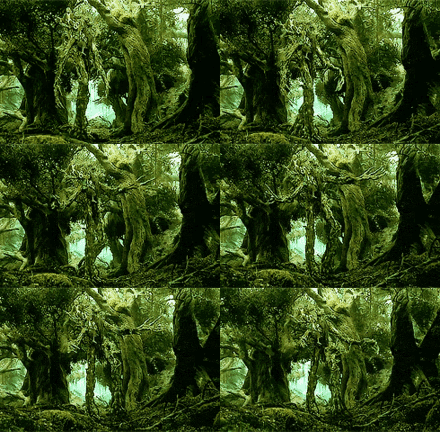
+1 There's some typically Whovian subversion of the good/evil binarism in the plot, as well as some environment-related social criticism (but not as much as I would have liked, as I'll discuss below): The antagonists are alien trees who attack people back when being felled (Whovian Ents, kinda!), and rather than being 2D 'baddies', they have motivations and a backstory behind their violence. And the Doctor speaks Tree - of course he does 😂

Treebeard approves

+-1 This is more of an exploration of the more problematic aspects of the dynamic between the Doctor and Steven more than an actual fault of the audio -  When describing the dynamic from Steven's pov, we see how it is sometimes not as equal or healthy as he (and I) would like - More than once Steven feels like he has to tread carefully in order not to make the Doctor grumpy, and when the danger is over, the Doctor decides when they're going back to the TARDIS, with Steven reluctantly following because if not he would have to put up with a 'barrage of petulance for being late', while thinking about how he would like to 'hang out with more people doing non-threatening things' for a while longer 😕. The series also explored the more fraught aspects of this dynamic at the end of 'The Massacre (of Saint Bartholomew's Eve)', with Steven being fed up at the Doctor's attitude after experimenting several rather traumatic adventures one after the other.

The First Doctor (alongside other incarnations) be often like that, sigh.

And now for the things I didn't like as much from the story 😅:

-1 There's only one female character in the story, the young girl, and she doesn't do much more than be frightened of the whole situation in general :S

+-1 Like I said, Christmas-themed stories are not really my fave genre, as they're often full of highly idealized and normartive issues regarding established societal holidays+the family system. It's nothing particularly overboard in this case, and I actually enjoyed some of the Christmass-y moments (such as the little girl mistaking One for Father Christmas or Steven saying the famous ending line from 'The Feast of Steven' in 'The Daleks' Master Plan' serial - "Merry Christmas to all of you at home" - as a way to finish this story). But yeah 😅

-1 The aspect I found the cringiest in this tale is that the Doctor solves the violent situation between the humans and the trees by invoking these holiday values in a way that I found pretty problematic - The trees got initially violent because the little girl's father had felled one to be the Christmas tree for their cottage, and the Doctor claims...that the trees should not be feeling attacked basically because humans have always thought of Yule/Christmas trees in terms of light, love and hospitality 🙃🤷‍♀️. But that doesn't take away the fact that a sentient tree was killed all the same (and personally, for a reason that's way more unnecessary and problematic than needing timber or fire wood, just saying), and as such, the trees had a pretty valid reason to feel attacked.

That's a bit like telling Treebeard and Co that in Maiar culture Saruman's destruction of trees comes from a place of love and hospitality, so they shouldn't be bothered 😅

I approved of the Doctor's typically epic pacifist speech about how it's not always right to answer violence with violence and how communication is key in order to understand each other, and so on, but in the context of this plot, it rang in a rather oddly fashion in the context of the final lesson of the story - which is that the trees basically end up being all friendly because the Doctor convinces them that sporadically killing them for decoration/superstition/tradition reasons is done in a way that has 'nothing to do with malice, cruelty or wanton destruction', so it's OK! Cringy af. I also personally beg to differ in our real life context about this topic, because, even when they're not sentient, what is felling trees in order to decorate your house for a month, tops, if not falling under the category of wanton destruction, a little bit 😅?  

And the fact that the trees are freaking sentient in this story complicates things even more. I mean, that's a bit like the Doctor concluding that if a person happened to be killed as part of a holiday which was theoretically about "love and light" and all-round "positive values", that would make it all good and no one should feel attacked - which sounds pretty absurd and very un-Doctorly indeed, right? (only, human sacrifices at festivities that are theoretically about light and prosperity have happened historically more than we'd like to think, in too many places 😬).

I would have preferred that the end result would have been that both parties would have simply  apologized for their respective misunderstadings and errors, come to terms with their respective violence, and reached an actual truce where trees are also not happy to provide some of their own for the humans' festivities, because the humans would have understood that..murdering sentient trees because of Christmas is unnecessary and a little bit wrong 🙃. They did reach a truce in this case, but I'm not that much of a fan of a solution along the lines of 'because this religion/holiday actually means well, you shouldn't feel attacked for their actual violence' :S Christmas comes before anything else! Lol nope. 

-1 And finally, the Doctor includes the infamous 'smacked bottom' line in his scolding speech against the trees' violence, and I really hate that (sexist) Hartnell line, so I'm definitely not a fan of that addition, and I don't like the idea that One would say that line often 😑 (ew).


4. A Small Semblance of Home (2018, short trip #8.09, featuring One, Barbara, Ian and Susan). Written by Paul Phipps and performed by Carole Ann Ford (who plays Susan Foreman in Doctor Who). 

3/5. Goodreads review also here.

+1 Engaging and enjoyable narration style by Carole Ann Ford, who played Susan Foreman, the Doctor's granddaughter from Gallifrey, in the series. In this audio she also voices the First Doctor, Barbara and Ian.

The first TARDIS Team!

+1 In this story, the First Doctor searches for tea leaves, planning to include tea in the TARDIS food machine (apparently they didn't have it before! 🤣), in order to make Barbara (and Ian) feel more at home, and it's such a British trope thing to do xDD 

“I know things haven’t been easy, my dear, and that’s why I’ve been looking for this plant, these tea leaves, because I knew it was the one thing I could do to make this silly old ship a little more comforting for you.” (I think that Barbara and Ian would also appreciate it if you knew how to drive the TARDIS and didn't put them in danger every single time, though 😅).

+1 It's also a story that mainly revolves around Barbara and her inner thoughts and feelings about her adventures with the Doctor. And it's always refreshing to encounter a story that focuses on how the female characters feel and think, so yay. 

Yay for Barbara!
In this tale, Barbara expresses her sense of wonder about her adventures, but she also feels tired by the non-stop action and especially disorientated for the relative way in which she's experiencing time (she keeps a notebook in which she tries to keep track of time). She also talks about being pretty tired (as is Ian) of the Doctor's bouts of self-centered 'scientific projects' which have them dragged off from planet to planet non-stop. I feel like it's very interesting and necessary to not only portray and focus on the good, exciting things about time-travelling in the TARDIS, but also show the realism of the companions feeling exhausted by the continuous adrenaline or fed up with some of the Doctor's more inconsiderate traits.

+1 Female bonding, with Susan and Barbara talking about their feelings and experiences in several scenes. This story also includes some backstory of Barbara's life, especially the positive dynamic with her mother (mother-daughter female bonding ftw!), with whom she used to have lunch on Sundays and talk about her week:

“One day, one day I’ll tell you all about my travels, all my adventures through time and space. One day I’ll make you tea and share all of the stories your daughter can tell.”

+-1 While the fact that the Doctor plans to get tea for Barbara and Ian is cute, he also behaves in a problematic fashion in this story, following a trend that he can also see repeated in several of his TV serials, such as 'The Daleks'. In this case, he may have the ultimate intention of making Barbara and Ian feel more comfortable around the TARDIS and less homesick, but the way he accomplishes this is not any different from the way he drags his companions off at any moment's notice to fulfil the rest of his personal scientific projects, without taking into account what their companions might feel like doing, or how tired they might be 😬.

Tell him, Barbara!

Ian and Barbara actually spend quite a section of this story complaining exactly about that issue and confront the Doctor about his more self-centered and inconsiderate attitude when it comes to his 'personal projects'. And there's the problematic fact that the Doctor seems to think that his companions will feel 100% happy and satisfied with the surprise that he plans for them (and especially for Barbara), without the need to change anything about the rest of the situation that bothers them 😬. What's more, Susan also ends up resorting to having to justify her grandfather's behaviour on his behalf, asking Ian and Barbara to basically put up with everything because 'he must have a good reason for it' 🙃. 

 “Doctor, wait! You’ve got to stop this! Barbara’s exhausted, and so am I! Everywhere we land, no matter how cold or how wet, you get us looking for this blasted plant! (…) You’re obsessed! It’s like Skaro all over again”
“I’ve apologized for that. You have no idea about the reasons behind my work. How dare you!”
This was a losing battle. It always was when the Doctor employed his ‘my ship, my rules’ argument.”

Here, I also can't but think of the analogy where this kind of strategy is favoured by many abusive men towards their (most often) female partners, resorting to the easy tactic of offering punctual gifts and surprises - which, being self-planned, can also be more ego power trips than actual consideration towards their partner - to compensate for a problematic behaviour they don't really plan on changing, or believe that they have to change :S. I'm obviously not saying that this is a perfect analogy with One because it isn't by any means - I wouldn't say the Doctor's abusive, but in both cases we can see similar traits based on (often male) entitlement, being inconsiderate and self-centered, and not wanting to be accountable for one's actions. 

Which can make for dysfunctional dynamics, and more than one companion has confronted him (her/them) about it when it gets too blatant or constant, starting with Barbara and Ian themselves (Steven also had several goes at it, as discussed above in 'O Tannenbaum'). Seeing as several (mostly male) incarnations of the Doctor do fall for this behaviour more often than we'd like, it's also nice to see Doctor Who content addressing the titular character's more problematic traits, so Barbara and Ian confronting the Doctor about it was a very good addition, even though the 'I got tea leaves for you' happy ending of this short story did take the very needed accountability off the Doctor's shoulders a little too fast for my liking.

And now have some caring Ian and Barbara as a palate cleanser after that discussion xD

 -1 The adventure portion of the tale features pretty traditional gender roles throughout 😬 The women scream (Susan does, as typically required for her character in the TV series in every single occasion 🙃), and the women get captured, while the men climb trees, defend themselves and try to rescue the women. The antagonists are a group of cavepeople (of caveMEN, because they all seem to be male) with apparently pretty regressive views on the matter as well (which I guess can be expected, but still, always grating). While the TV serials of 60s Who (and later) has depended on traditional gender roles more often than we'd like, undersusing more than one awesome female character as a result, we also know that in spite of those imposed gender roles and behaviour Barbara succeeds in being badass af in more than one occasion, so I found it more than a bit unnecessary to resort to a strictly traditional gender role viewpoint here, when the story is mainly focused on Barbara, too.

Barbara is badass, case in point

 +1 The Doctor starts by trying to have a peaceful conversation with the antagonists and then manages their escape with a non-violent ploy, which is a nice way of critisizing the more violent leanings of the human antagonists of this tale, as per the typical pacifist and anti-war stance in Doctor Who.

+1 Other fun tidbits: Apparently, the Doctor gets in the habit of choosing his companions' (Ian's, at least) clothes for them? xD Especially when it comes to compensating for clothes that got destroyed in alien planet shenanigans xDD 

“Ah, good morning, Chesterton! I see you’ve found the new cardigan I left for you. Very fetching! Very fetching indeed!”


Friday, 22 July 2022

Goodreads feminist reviews - Tolkien illustrated books: Beren and Lúthien


Cover of Beren and Lúthien, by Alan Lee.

A new Tolkien post for today ✨! These were originally separate reviews on Goodreads, but I decided to make a couple of individual longer posts to talk about some of the illustrated Tolkien books published in the last few years: In this post I'll be talking about Beren and Lúthien (which should be frankly rather titled Lúthien and Beren, but ah well), and in the next post I'll be commenting on The Fall of Gondolin from the 'Tales of Middle-earth' series, and the newly illustrated edition of Unfinished Tales from 2020, which I got as a gift after finally defending my Astrophysics PhD thesis. 

As a Tolkien collector, I wanted to have all three of these books mainly because of the new illustrations by Alan Lee (alongside John Howe and Ted Nasmith for the latest edition of Unfinished Tales), but in these reviews I'm also going to gauge the pros and cons of these books regarding their material, organization, format and commentary, and how worth it they are, in my opinion, either as reading material for a Tolkienite in general, as source material for a Tolkienite scholar, or as an additional book for a Tolkien book collector. Random feminist ramblings will also feature, of course, and there will be an specific focus on these reviews regarding the representation and portrayal of female characters, as usual.

  • 1) Beren and Lúthien

Book: Beren and Lúthien (2017), by J.R.R. Tolkien, edited by Christopher Tolkien and illustrated by Alan Lee The second of the 'Tales of Middle-earth' series edited by Christopher Tolkien (volumes I-III) and Brian Sibley (volume IV, pending publication).


3/5. Goodreads review also here

- Is buying this book worth it? My opinion on content and format:

To be honest, when I thumbed through this book I felt like it was kind of a rip-off, and, as much as I like Lúthien (not Beren that much, really, or the romance, but more on that below xD), I personally don't quite get the aim of this book, apart from the fact that it contains a series of new illustrations by Alan Lee, and thus it's another book that Tolkien fans can add to their collection (and that the Tolkien State can easily profit from with minimal work, I guess. There I said it 🙃 xD). 

The thing that differentiates this second volume of the 'Tales of Middle-earth' series from its predecessor, The Children of Húrin, similarly edited by Christopher Tolkien and illustrated by Alan Lee, is that the rendition of Children of Húrin was a new and expanded one, containing a sizeable amount of new material and commentaries, as well as gorgeous illustrations by Lee. But in Beren and Lúthien (which I was initially pretty hyped about when I heard about its publication because my namesake Lúthien is one of my favourite Tolkien women), all texts found in the book were already published in former books, such as The Book of Lost Tales II, The Lays of Beleriand and other books in the History of Middle-earth series, with minimal or no changes, just a new organization. 

However, even so, the idea of a book containing a compendium of all versions of the tale of Lúthien and Beren, alongside updated and expanded commentary, and brand-new illustrations by Alan Lee, does sound pretty amazing and very much worthwhile for Tolkien scholars and fans alike, right? For me, such a book sounds very enticing because it would mean I would have pretty much all material regarding the evolution of the story of Lúthien in one book, something helpful to use as source for my Tolkien women-related personal projects, for example. But the main problem with this book for me is that an organized compendium it is not.

 The material included in this book is instead often heavily abridged, featuring selections and excerpts from different versions of the tale of Lúthien, but neither in their entirety (one version was presented in their entirety, and most were not, which seemed odd), nor quite in chronological order of publication, nor in o rather in order regarding the events of the story per se (confusing in the chosen inconsistency). 

While the early version of The Book of Lost Tales II is presented in full, whihle no other version is, which seemed odd and strangely inconsistent. the Lay of Leithian from Lays of Beleriand appears only as excerpts and sections that often focus more on tangencial characters and storylines, like Gorlim or the mention of Fingolfin's death, rather than on Lúthien and Beren's story and quest per se, although the selection did include at least part of the sections featuring Lúthien's confrontations with Sauron and Morgoth. The final version from Quenta Silmarillion is mentioned in commentary, but no selections of text appear, and then there are some short excerpts from various books of the History of Middle-earth. The overall format was quite confusing to me, both in the decision to show some versions complete and others simply as excerpts (excerpts which also appear in different sections of the book, interwoven with other versions), as also in the way that the book seems to not quite decide whether it wants to tackle the different versions in chronological order, or rather offer selections from different versions following the events of the tale. And it ended up doing neither in a consistent way.

Furthermore, I felt like the commentary in this book didn't add a lot of new information either, and I didn't find it very engaging or informative, as I was expecting something more in-depth about the tale, the characters and/or the evolution of the different existing versions, Children of Húrin style. That alone would have made this book rather more worth it, but to me it fell very short both regarding content, format, organization, and the quality of the commentary. When I bought the book, I already knew this was no Children of Húrin and so wasn't expecting to find a lot of new material, but I did expect a better format and more engaging commentary, and the book did not deliver those for me. So frankly, I don't think it's fair to ask for (the original price of) 20 pounds for a not that well-organized, abridged, selected remix of existing material 😕. 

Alan Lee's watercolour painting of Lúthien dancing in the forest of Neldoreth, from LOTR: The Fellowship of the Ring.

- How is Lúthien portrayed in this book? Text selections and illustrations

Still, I didn't want to give this book less than 3 stars on Goodreads because it has Lúthien in it. However, the way the texts are selected, there isn't as much emphasis as there should be about Lúthien's power and overall badassery, in my opinion. Both the text and the illustrations (more on that below) tend to focus instead on the more traditional aspects of her character, societally: Her beauty, her romantic plot, her dancing skills and her singing (but not so much her singing Songs of Power that topple down the fortresses of Dark Lords! 😐). Then again, that's what I'm always thinking practically every time I encounter something Lúthien-related. Most emphasis is often on the romance and her beauty and dancing, not on her power, magic and epic confrontations against Sauron, Carcharoth and Morgoth, which for me are the absolute highlight of Lúthien's character ✨✊. 

ILLUSTRATIONS

Alan Lee's illustrations were easily my favourite part from this book - and the main reason why I got it, apart from the inclusion of Lúthien -, although I also ended up a bit disappointed about the selection of illustrations for this book as well, as I had overrated the hype of the excellent combo that Alan Lee+Lúthien would make, especially considering that I adore his watercolour painting of Lúthien from The Fellowship of the Ring (see above). 

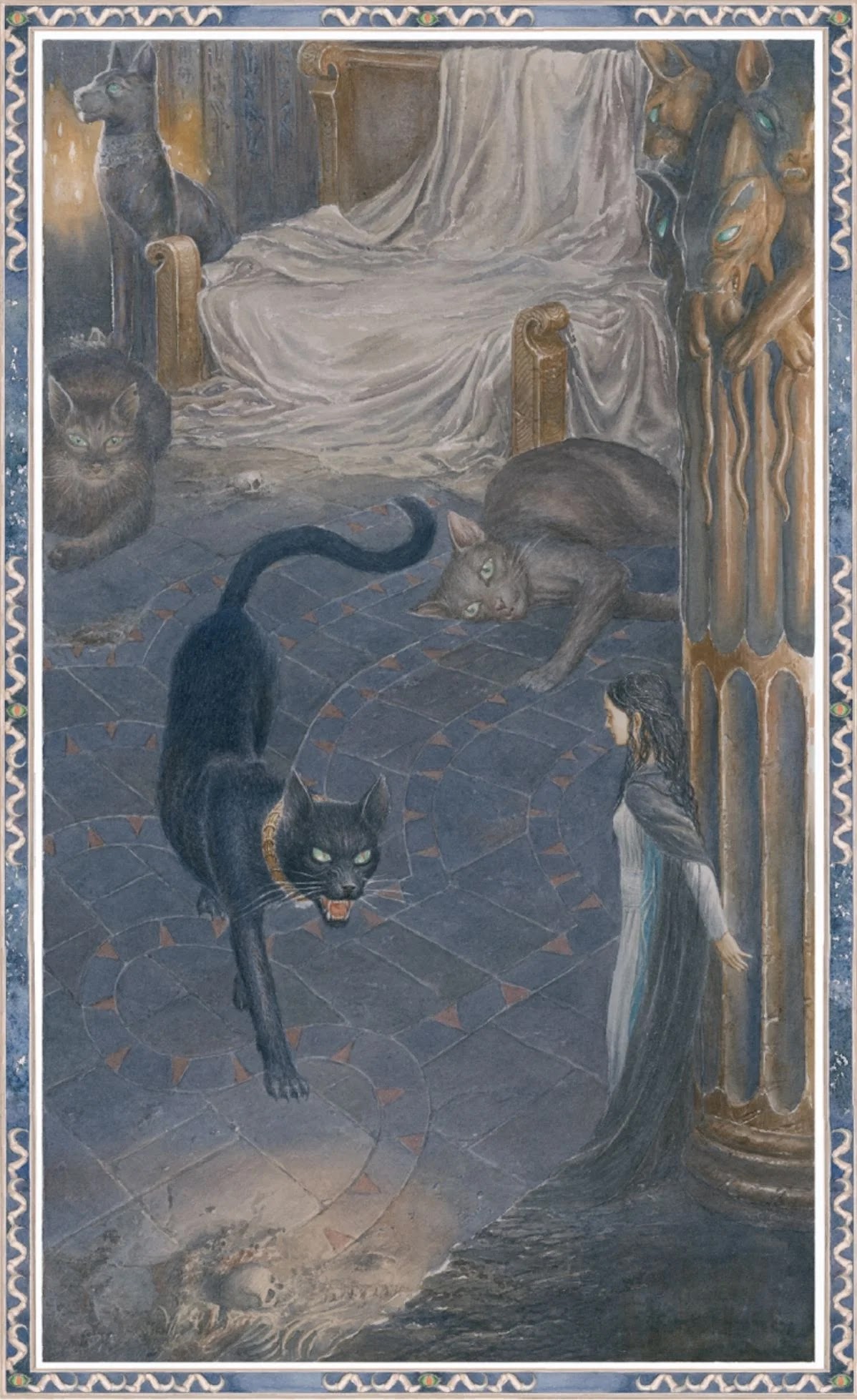
Firstly, quite a lot of the selection of illustrations for this book - including at least four colour plates - choose to depict male Elves, wolves, ravens and the like (not even Beren) instead of Lúthien. Lúthien does appear in six colour-plates and three graphite drawings. But, somehow bafflingly, in three of these six colour-plates, she is drawn small and hard to distinguish, with the main focus given to the scenery around her or to other characters. And in six out of the nine depictions of her, she is shown in the traditional mode mentioned above: Dancing - both in a graphite sketch (Fig. 1, below), and in a colour plate (Fig. 2) which focuses more on the forest of Neldoreth than in Lúthien herself, shown quite difficult to distinguish -; cowering in Tevildo's palace (Fig. 3) (and yes, she shows continuous agency in getting in there in the first place, but she was portrayed in a less badass manner in that particular version with Tevildo compared to the final one with Sauron); thrown to the ground in the very background (again, very hard to distinguish) after the attack of Celegorm and Curufin (Fig. 4); looking after wounded Beren (Fig. 5); and on the main illustration from the cover (Figs. 6a and 6b), where Lúthien does take center stage, but is also shown sitting sidesaddle on Huan (I've personally always imagined practical, intelligent Lúthien to ride Huan astride instead of sidesaddle, similarly to Ted Nasmith's illustrations), and holding hands with Beren, focusing on her role as romantic interest

Fig. 1: Graphite drawing - Lúthien dancing in Neldoreth with Daeron playing the pipes. Beren being creepy eavesdropping somewhere. Is stalking and invading women's personal spaces unsolicited romantic? Hardly.
Fig. 2: Watercolour plate - Lúthien dancing among the hemlocks in the forest of Neldoreth. Lúthien is painted small and hard to distinguish (I think that if she were dressed in her frequent azure and flax blues she would be easier to spot), alongside Daeron at the harp. The main focus is on the forest glade itself.

Fig. 3: Watercolour plate - Lúthien, discovered in spite of her shadowy cloak, cowers from Tevildo, Prince of Cats, the predecessor of Sauron.

Fig. 4: Celegorm and Curufin, creeps extraordinaire, shoot Beren after trying to kidnap Lúthien. Lúthien is with Beren and Huan in the background, hardly visible, the focus being on Celegorm and Curufin riding away after their attack.
Fig. 5: Graphite sketch - Lúthien uses her healing skills and magic to cure Beren

Fig. 6a: Cover of Beren and Lúthien (earlier version than the final painting shown in the actual cover), with Lúthien riding Huan sidesaddle and holding hands with Beren.

While there's obviously nothing inherently wrong in being beautiful, enjoying dancing, possessing healing abilities or engaging in a romantic relationship (although I tend to draw the line at problematic relationships 🙃), it's often telling how it's the more traditionally feminine attributes and characteristics of Lúthien the ones which are depicted and highlighted the most often both in the text selections and in art. This is particularly baffling to me in Lúthien's case because she literally has goddess-level magic powers (she and her mother Melian - an actual Maia, technically a goddess - are the most powerful enchantressses and magic-users in Beleriand, and the fact that Lúthien bests both Sauron and Morgoth means that yes, she's more powerful than both of them as well). Lúthien also often puts to use her 'traditionally feminine' skillset to create magic that is incredibly powerful both in the offensive and defensive areas, and is characterized in a subversive way as someone who wears flowing dresses and likes dancing and singing, *and* (not 'but') she is also incredibly courageous, capable, powerful, and continuously shows agency and an active, determined will wherever she goes (until she is eventually shoehorned in her own story into a traditionally romantic story with all its tropes, even with all her badassery, but ah well, that's my pet peeve xD).  

And so, in light of the fact that Lúthien is also often characterized in an incredibly badass and subversive manner in the Lay of Leithian, one thing that will forever mystify me about Tolkien artists - both professional and hobbyists - when it comes to depicting Lúthien Tinúviel is why they hardly ever fully exploit ✨✊the gold mine of awesome✨✊ that is portraying Lúthien going through all the badass af actions she can add to her personal CV: From bringing down the whole fortress of Sauron with a Song of Power (#BossLady, she created the hashtag alongside Galadriel), to escaping single-handedly from her imprisonment in Doriath with just her hair, to smiting down Carcharoth, to using her shapeshifting magic to create disguises to enter Angband, to performing her sadly rarely depicted magically-charged, literally 'winged dance' around Morgoth, the Balrogs and all the Orcs in Angband while singing more Songs of Power and kicking another Dark Lord's ass (in contrast to the more frequently portrayed male-gazey 'seductive dance' she initially entinces Morgoth with as her cover), reimagining Lúthien as a warrior as well as a powerful enchantress, there are so many options here.      And yet, for each artwork that depicts one of these scenes, there's a handful with Lúthien being beautiful, being a romantic love interest, being sad, dancing and singing in a non-offensive manner, looking after Beren, being sad again. I personally think it's a shame and a waste.

My cosplay of Lúthien, badass magical edition. Source

Going back to the illustrations of this book, Alan Lee does choose three of these scenarios for his selection, in two colour plates and one graphite drawing, and does depict Lúthien in her more active, badass roles. But I still found these examples to be fewer than I expected, and sometimes also executed in a way that didn't quite focus primarily on Lúthien or do her full justice, in my opinion. In one colour plate (Fig. 7) she's shown suspended in the air against Morgoth, showing the surprisingly rarely depicted scene of Lúthien rising 'wingéd' in front of the Dark Lord of Angband while singing her Song of Power. Lúthien does radiate power and agency in this illustration, my favourite from the whole book. In another graphite sketch, Lúthien is shown transformed into the female bat Thuringwethil, servant of Sauron, flying alongside transformed Beren towards Angband (Fig. 8). But in another plate (Fig. 9), Lee chooses to show the fortress of Sauron from a full panoramic view with Lúthien standing on the bridge as a mere blob, focusing more on Sauron's fortress instead of depicting the also massively underused-in-artwork epic moment where Lúthien takes down Sauron's fortress with her singing magic. While I also get the effect of showing Lúthien as a barely discernible speck in the midst of this huge dark fortress she is going to destroy just by singing, don't tell me that's not a freaking epic scene to fully paint, with Lúthien front and center and zoomed-in, because it is. My favourite Lúthien cosplay pictures are a tribute to that xD (see above).

Fig. 7: Watercolour plate - Lúthien is shown center-stage in this painting rising with a powerful, defiant pose in her 'wingéd dance' and singing her Song of Power against Morgoth. Various creatures are shown asleeep inside Angband, and Beren is huddled in the forefront alongside asleep Balrogs, Orcs and the like.
Fig. 8: Graphite drawing - Lúthien flies towards Angband transformed into Thuringwethil, bat servant of Sauron, with Beren disguised as a werewolf below her.
Fig. 9: Watercolour plate - Lúthien approaches Tol-in-Gaurhoth, the fortress of Sauron, determined to free Beren even if that means crushing the whole fortress down to its foundations (queen xD). The focus of the painting is the fortress rather than Lúthien, however.

CONTENT
 
Now we've talked about Lee's illustrations depicting Lúthien, how is Lúthien portrayed in the text selections and commentary in this book?  Well, as I said before, for some reason the selections do tend to omit the more badass, powerful and subversive aspects of Lúthien's characterization and her ample participation in the Quest of the Silmaril, especially in the final versions where she is the most active and overtly badass (so many people tend to put Beren centerfront when it was actually Lúthien with Huan who did like 90+% of the work, and that's being generous). The commentary did not add any particularly new or interesting info about her either, that I recall. 
 
Bonus rant incoming about how the relationship between Beren and Lúthien is so romanticized near everywhere and hardly anyone seems to feel like there are actually problematic points going on there. Because I adore Lúthien, but I don't much care for Beren, and I actually overtly dislike more than one point about the romantic relationship as portrayed in all the versions of the tale 😬. This is not an specific issue of this book, but rather of the different versions of the tale of Lúthien and Beren on their own. However, I feel that the way the excerpts from the different versions were selected for this book does highlight some of these issues, alongside the oftentimes found shoehorning of Lúthien into her more 'traditionally feminine' characterization and roles that I described above.

Some examples of why I don't really like this romance (I was initially supposed to review *three* books here lol, but then a feminist analysis appeared xD):

All extraordinary women deserve to be admired and respected the way Galadriel is, to be honest. Become even 1% less extraordinary just because of a relationship? She says nope can do.

-It's the epytome of the trope of the extraordinary woman whose considerable powers and skills (be they magical, warlike, intellectual, or a combination of all these) are at the service of the more objectively mediocre man. A man who 99% of the time also ends up - or even begins by - being in a romantic relationship with her simply because he's worth it (being a man), and also because the extraordinary woman often and very bafflingly (well, men often write them, so that's why) doesn't have standards, doesn't recognize red flags and accepts the first dude that falls for her no matter what 🙃 (if we ignore the Friendzoned Nice Guy act of Daeron, that is :S xD). I'm sorry, but that's the tea. I love Lúthien's epicness and power, but she basically does all Beren's work, with the added aggravating fact that said more mediocre man is often talked about as the actual main character and hero, both in the tales, in the commentary, by Tolkien in his letters, by part of the fandom

And your treatment in Multiverse of Madness wasn't fair either, Wanda.

Related to this, in one of the quotes selected for this book, in one of his letters Tolkien actually refers to Lúthien, with all her power, 'a mere maiden even if an elf of royalty', and centers his conversation on how heroic Beren is: "Beren is the outlawed mortal who succeeds (with the help of Lúthien, a mere maiden even if an elf of royalty) where all the armies and warriors have failed: he penetrates the stronghold of the Enemy and wrests one of the Silmarilli from the Iron Crown. Thus he wins the hand of Lúthien". Um, wtf. Lúthien's literally a powerful half-goddess with way more offensive capabilities, experience and wisdom than Beren ever had, but she's also called a 'mere maiden' who 'helped' Beren the Hero out because of her gender, while the mortal, power-free male is hailed as the brave hero, and nothing 'mere' about it, apparently, in spite of doing like 5% of the work during the Quest, and that's being generous (Lúthien allowed them to be able to enter Angband!). And let's also remember that in the fandom Lúthien's also often branded as a 'Mary Sue' because of the sheer power she wields and her many capabilities - because the Valar forbid a powerful woman (whose power and skills make total sense in terms of her nature and characterization) exist among an ocean of societally-accepted powerful men, am I right?

River relates and yes, I am right.

-The romance and the dynamic between Beren and Lúthien (or rather, of Beren with Lúthien) is just problematic when you delve minimally into it, quite frankly. They look like a power couple, but are they really? Prior to even meeting and during their very first meeting, Beren shows more than one sign of male entitlement and the consistent red flag behaviour of a creep and a stalker, spying and following her around while she thinks she's dancing and singing alone in her forest (the audacity of women being alone and tempting men with their looks and songs, am I right), and then, in all versions of the tale, basically sexually assaulting her when he calls to her, pursues her, grabs her and kisses her without a by your leave. Why Lúthien would find that attractive is beyond me (well, a man did write her, and, even taking into account her subversive active personality and amazing skill, that shows).  

If powerful demigoddesses aren't safe dancing alone at night in a realm magically protected by another goddess, who is??

One quote from an early version from The Book of Lost Tales II describes the interaction thusly: "Thus suddenly did he lay his hand upon her slender arm beneath the leaves, and with a cry she started away from him and flitted as fast as she could in the wan light (...). The tender touch of her arm made Beren yet more eager than before to find her, and he followed swiftly and yet not swiftly enough, for in the end she escaped him, and reached the dwellings of her father in fear; nor did she dance alone in the woods for many a day after." I think all women can relate to this feeling. And yet the interaction is painted as high romance, the ultimate heroic fantasy romance. In the very same page of this version, Tinúviel keeps getting stalked by Beren for months, and yet she grows fond and unafraid of him because of his 'sad, yearning face' and, without even knowing who he is or what his intentions are (I mean, those are clear anyway, he's obsessed with her :S) ends up feeling flattered that he likes to observe her dancing. That is so not relatable. Male writing in action.

*channelling Thranduil's I'm done with everything 24/7 attitude* Sure thing, serial stalking and non-con grabbing and kissing is romantic af. Why Tolkien, why.

After this non-consensual grabbing and kissing as a means of romantic meeting (not), Lúthien is then supposed to fall in love with him completely at first sight (because that's the natural reaction when a male stranger who's obsessed with your beauty and little else stalks you for months and then grabs you and kisses you when you were just minding your business), then she's putting all her power at the service of a quest devised by men who presume to treat her as a possession which passes from one man (Thingol the father of the millenium) to another (entitled lover-husband wannabe Beren) as recompense in exchange for a pretty jewel, and ultimately expected to sacrifice her everything, losing her actual lifestyle and immortality for this man who met her by forcibly kissing her. Romantic? Not to me.

And that's the tea

And then the woman who's being treated as a thing by near everyone in this tale does the majority of the work to succeed in this quest, involving a lot of misogynistic-flavoured obstacles and a lot of hard work, including but not limited to (brace yourselves):  

  • Having to break free of her father's imprisonment (because men still think they own women no matter how powerful they are, and Thingol sucks as a father)
  • Being kidnapped and forcibly detained by rapey Feänorians (a dog is literally her only ally. Celegorm was so set on raping Lúthien that Huan had to literally stand guard at her door 24/7 till they escaped, and bare his teeth and snarl at his former master so that he would leave her alone. Yay :|)
  • Having to destroy Sauron's fortress to rescue her lover while Sauron is beeing leery about what he would do with her (didn't know what was coming for him, did Mairon)
  • Curing said injured lover from another attack from the Feänorians who intended to kidnap her again (side note, they suck big time, but so do many men in The Silmarillion welp)
  • Transforming herself and Beren into servants of Sauron (10 points to cosplay magic xD)
  • Taking down a huge wolf guarding the gate of Angband (Lúthien literally multitasking with the badass shit and taking down dark creature after dark creature, and Beren literally wanted to abandon her and go alone lol)
  • Feigning to have come all the way to Angband to seduce the leery creep Morgoth into complacency (totally empowering for women, huh! And the entitled idiot believes her)
  • And then throwing all her singing and epic flying dancing magic at him and literally putting him and every creature in Angband to freaking sleep, Balrogs and all (after which Beren cuts the Silmaril from the crown because he wants to be helpful and get brownie points or something, but then again, he also causes the whole of Angband to wake again because he's kinda dumb with his plans, so maybe not)
  • Then curing Beren again when his hand is bitten by Carcharoth because he woke up the whole of Angband again (seriously, Lúthien should have cut the Silmaril from the crown while she was at it)
Then, finally, the pretty crystal is in the hands of the father and Beren - yes, Beren, as we saw before - gets hailed as a courageous hero while Lúthien's literally standing by hyping him up (male writing), and Lúthien gets successfully exchanged aka married to him. Tell me how any of this is fair and how Lúthien's OK with it, because I don't get it. 
 
"Beren is the hero of the Quest of the Silmaril" Dude, Lúthien is literally *right there*. She literally does *everything* and doesn't at least get hyped and praised, as she should? I'm suing.

Lúthien then of course also gives away her immortality in exhange of a mortal life with Beren because Elven women do that as an instinctual feminine thing when they're in love, we're told, but male Elves are rather more reticent about it (ahem, Aegnor). And she ends up living a very traditionally-structured life isolated from her mother (do I care about Thingol? Nope), friends and family, as a wife and a mother and a beautiful woman who dances and sings for Beren but never again shows the amazing feats of power featured in the Quest, with a short life and a very beautiful Silmaril to briefly wear until it shortens her already brief new mortal life. Yay!

While there's nothing wrong per se with actually choosing to marry, be a mother or partake in traditional activities that one may actually enjoy, having such an incredibly powerful woman simply end up like that because that's the societally accepted happy ending? Anticlimactic is the word (and Galadriel didn't have to tone down shit when she got married, btw, so it's doable). And all this time? Beren of course deserves such an extraordinary woman as Lúthien, so much so that she as a result should certainly work so much and sacrifice so much for him because he's so worth it.  Because everything is of little value in exchange for the promise of the traditional married heternormative life every woman longs for from the beginning (this is literally what Tolkien says in the infamous letter 42 - Tolkien's work is great and all, but if you also want a taste of stagnating conservative values about gender roles and relationships, that's the letter you want to peruse :S!). 

Totally a 100% great deal for every woman!

 When it comes to this tale, I would honestly, really love to see a power couple with two people who work together and take down the bad guys and go through obstacles as a tandem, and genuinely appreciate and love each other. But in this case, that's not what I see, unfortunately. While I love Lúthien being a badass who ends up doing nearly all the heavy lifting, the balance dynamic still comes off quite unequal instead of just subversive and indicative of a more egalitarian dynamic, and this is because the motivations for the Quest are masculine codes of 'honour' and female ownership, and she multitasks through it all at the service of said men, who just seem to see her as a pretty object. 

And the famed romance is still based on 'she's beautiful and he wanted a piece of that, and she fell in love at first sight in response because a man wrote her', and that isn't deep enough ot believable enough for me, I have to say. Because we also need to highlight the fact that Beren's main motivation to want to marry Lúthien is that she's incredibly beautiful, dances really well, and well, that's all there needs to be! He does call refer to her as brave sometimes, if I remember correctly (although Huan is the one who's mainly hyping her up), but in a truly equal dynamic firstly he would not have outright stalked and assaulted her, right? 🙃 

Secondly they would preferably have things in common that would help build a significant relationship, but their dynamic post-stalking and pre-quest involves Lúthien dancing for him (mainly) and sporadically with him, and them 'being in love' in a generic way. Which I guess could work in a kinda bland way (except for the fact that Lúthien's dancing wasn't originally intended to entertain or titillate a man - although Nice Guy Daeron might have thought otherwise as well :S), but there are other red flags, as we have discussed. And thirdly, if he really liked her as a person, he would very probably want to hype her up and talk to her and about her regarding how badass, witty and powerful she is, and...he doesn't really do that, and if he did it was so sporadical I have forgotten about it (Lúthien's dog friend Huan does hype her up, a lot more. Heh). Because she's beautiful, and that's the main reason why this romance exists for him, it seems ("I desire thy daughter Tinúviel, for she is the fairest and most sweet of all maidens I have seen or dreamed of", he says in Book of Lost Tales II, for example).

This gif is a must, come on xD

In conclusion, I love the character of Lúthien in itself, how utterly powerful and capable she is, but I resent and hate the way her character is made to revolve around entitled problematic men, and how all the men in the tale are constantly throwing obstacles in her path. No to Thingol, the controlling father. No to Daeron, the 'friendzoned' Nice Guy who doesn't get any in spite of offering free music for her dancing (the audacity. Pay me back for my free karaokes!). No to Beren, the stalker entitled guy who thinks he deserves the extraordinary woman just because she's beautiful and he called to her, who insists on the stupid quest when he could have opted out and stayed with Lúthien on their own terms, and who then made dumb decisions in the midst of Lúthien's unlauded multitasking (let's leave Lúthien asleep because I can totally handle Angband after the Sauron fiasco she rescued me from! Then let's sing so loud the creatures of Morgoth might hear me, and Lúthien too! Then let's prick Morgoth's foot after Lúthien's hard work while trying to pry off a second Silmaril you didn't even need!). No to Celegorm and Curufin, the rapey entitled brats. Yes to Huan, the only ally Lúthien seems to have, a freaking giant hound. Yes to Melian, who does support her daughter, but who, in spite of being an actual goddess, seems to need to answer to the commands of her Elven husband (hello, Patriarchy). And of course, no to Sauron and Morgoth, who get their asses kicked by Lúthien's badassery but not before they can tell the readers and Lúthien about their creepy lustful and rapey intentions towards her. But hey, at least the narration is honest about it and Lúthien is adequately creeped out and responds by taking them down. Beren basically stalks the shit out of her for months and assaults her by taking her in his arms and kissing her without her freaking consent, and it's all apparently 'so romantic'? So much that as a response she sacrifices her everything for him, including her freaking immortality? For a dude apparently only interested in how beautiful she is?? Yep, after so many years I'm still so not getting it, but now I'm kinda repeating myself xDD. 

I could definitely go on about how the fact that JRR Tolkien considered his wife Edith to be the inspiration for Lúthien and called himself Beren in association, and how we can definitely see a projection of some points of their dynamic (not all of them unproblematic) and his idea of an ideal F/M romantic relationship by comparing his real life relationship with his story of Lúthien and Beren as a romantic duo. But that is a whole different (but related) can of worms to analyse, and I do have at least a post about Edith planned, so that's enough controversial Tolkien women opinions for today, folks 😅 😂 xD!

Lúthien out xD