Showing posts with label MCU. Show all posts

Friday, 22 April 2022

Goodreads feminist reviews - Doctor Strange and Philosophy


Book: Doctor Strange and Philosophy: The Other Book of Forbidden Knowledge (2018), ed. Mark D. White


3.5-4/5. Goodreads review also here.

 This is an anthology of 22 essays having to do with the crossover of philosophy and Doctor Strange (including themes from both the 2016 movie and the comics). As with any book which contains a number of essays written by different authors, some of the essays in this book I quite liked, others I liked, others were more meh, and some I actively disliked. 

Philosophy is also a hit and miss subject for me depending on the specific branch and how it's approached - I tend to really like ethics, and also prefer the more scientific areas of philosophical study (such as speculative physics or various themes in metaphysics), but there's a number of other topics - and specifically also the manner in which they are generally expressed - which are quite liable to either frustrate or bore me in various degrees - an important factor as to why is that I may have a pet peeve about random white dudes stating subjective thoughts, opinions and beliefs as absolute Truths, as philosophers often do :S xD

But anyway xD, some thoughts about the book (warning, LONG xD) -

Both a meme and a great study of ethics 

+1 Like I mentioned above, in this book I especially enjoyed the essays which discussed ethics (virtue ethics, deontology and consequentialism, in this case), as well as those delving into scientific matters and speculative physics. I particularly liked one essay which discussed quantum mechanics and the MCU Multiverse, and another one which considered what the plot of the 2016 Doctor Strange movie can tell us about the scientific method, regarding how new empirical evidence can lead to new theories and scientific approaches in our understanding of the world (couple of quotes below).


+1 Another essay I really enjoyed, written by one of the three female contributors of this book (note on that below), tackles gender and race biases in both philosophy and superhero comics - both worlds historically majorly male and white -, and the ways in which the Doctor Strange movie subverts some of these biases (such as making the Ancient One - an authority and knowledge figure - female, or greatly improving the role and status of Wong as a Master sorcerer in contrast to his role as the manservant of Strange in the comics). The essay also tackles the problem of whitewashing in movies (while I adore Tilda Swinton both in general and as the Ancient One, and I love that they chose to make the Ancient One female, I also think that they could just as easily have chosen a female actress of Asian descent, with no problematic stereotypes involved). Overall, this essay was a great feminist and intersectional read (couple of excerpts below).

 "What if it's a woman? You know, why can't it be? You know already the idea that the Ancient One is the head of all sorcerers; now that person is also a woman. I'm already interested, and I'm already feeling liberated from the chains of cliché." (The Art of Doctor Strange)

Tilda Swinton's Ancient One in the MCU

-1 Unfortunately, gender bias in philosophy and the comic book world, as criticized in this essay, is fully present in this book as well, ironically. Out of 22 essays, it seems that only three were written by women, and if I remember correctly, only one female philosopher is mentioned in the whole book :S

More women than 14%? Yes xD

+1 A couple of other essays also accurately commented on how Nietzche was an infamous misogynist and Heidegger supported Nazi mindsets, comments which I appreciated because we need to hold historical figures accountable for their problematic aspects.

-1 Something which I lacked in an essay tackling St Augustine, another infamous misogynist who was quite pedestalized in an essay which discussed more religious interpretations :S - I also fully disagreed with that essay's idea that the journey and character development of Strange mirrored 'St' Augustine's life, but ah well xD.

Please, but "St" women-should-not-be-educated Augustine wishes he were this cool. Also, Strange did appreciably grow out of his initial male entitlement, can Augustine say the same? No.
 

-1 And regarding social activism topics, I also have to say that I deeply disliked one essay which had the baffling objective of convincing the reader that the servile role of Wong in the comics as the personal manservant of Strange, in itself an issue deeply steeped in classism and a racialized context, is not wrong or problematic at all and actually empowers the character of Wong! We can encounter deep and meaningful friendships when a master/servant dynamic is also (regrettably) involved, such as Frodo and Sam from The Lord of the Rings. *But* the fact that this kind of dynamic might evolve to develop a meaningful interaction does not mean that we should not also be fully critical of the power dynamic and the classism and racialized/gendered aspects of a master/servant relationship in the first place.

MCU's Strange and Wong be like wtf

This particular essay I found deeply offensive in its endeavour to claim that it's actually servitude which gives Wong's life meaning and boosts his self-confidence and self empowerment (wtf), and that both parts of the master/servant dynamic get benefits out of the arrangement. It's a neoliberal-oriented 'choice' approach that ultimately completely glosses over the fact that it's a classist and racist system which has made Wong into Strange's servant in the comics, same as his father was the servant of the Ancient One, and his father before him, and so on. If we take this 'choice' approach and make minimal parallels with say, oppressed women in a patriarchal society, or enslaved black people in the USA, I think it becomes clear enough how offensive and illogical this interpretation is - the ludicrous idea that oppression and a servile function to the privileged groups actually gives your life meaning and that you reap ample positive benefits out of a deeply unequal power dynamic.

Wong is certainly Strange's friend in the MCU, but he's also been a Master Sorcerer in his own right from the beginning, and the actual Sorcerer Supreme since the Blip. So yasss.

Thank Agamotto that the role of Wong was vastly improved in the MCU. I can't help but wonder whether the author of this essay would think that now Wong's life does not have meaning because he's a powerful Master sorcerer in his own right, and is now the actual Sorcerer Supreme. Heh.

"From the comic books, Wong came across quite like a manservant or sidekick. I think with our version, we're happily putting that to bed and updating his story for a modern audience. (...) He is someone who is very serious about his job. He's very otherwordly, wise (...) There's a quiet confidence to Wong. He's stoic. He's foerever watching and loyal. I think he comes from a long line of that." (Benedict Wong, The Art of Doctor Strange)

-1 And now comes the big topic. While there were at least three essays in the book which tackled this matter more accurately, or at least following the reasoning I would have chosen, there is a discourse which I kept finding in several other essays which frustrated me time and time again. According to all these essays, the scientific aspect of Doctor Strange, initially a brilliant neurosurgeon, is something which went hand in hand with his arrogance, narcissism and materialistic view of the world. This materialism and his scientific aspect, as linked to the mechanistic current ('we are made of matter, and nothing more'), would be then opposed to the greater empathy, integrity and altruism that Strange shows as the movie progresses, which these essays repeteadly linked to his newfound 'enlightenment' and 'interest in spirituality', and the broadening of his mind.

Nope, Strange is still all about the science and the knowledge, his improving his attitude and his ethics has nothing to do with embracing the study of magic, which he approaches in a similar way as his former medicine studies, anyway.

While some of the points and philosophical stances described in these essays were interesting from a purely philosophical point of view, it's a huge misconstruction to say that science equals a lack of altruism or a greater materialistic and shallow mindset (wtf), and that it's an 'interest in spirituality' which makes someone more altruistic and empathetic. That's just both offensive and factually wrong. Like the Ancient One tells Strange, it's 'arrogance and fear' and his narcissism which have kept him from expanding his mind, not his interest in empirical science.

Why do people keep associating science with a lack of empathy or a more materialistic view of the world, wtf. Doctor Strange keeps a scientific mindset all the time, it's his entitlement and narcissism which get better disregardless of that!


'Which is?' 'It's not about you'.
 

 And even though the 2016 movie's director, Scott Derrickson, also commented on this inaccurate correlation between 'selfishness and skepticism' and 'altruism and spiritual enlightement' as Strange's journey (for example, in the art book), in my opinion the movie itself does a great job in addressing Strange's journey from narcissism, selfishness and materialism to a more altruistic, accountable and ethical mindset, yes, but it's not necessarily linked with a journey of 'spiritual enlightement', or 'from skepticism to mysticism', more than a combination of changing his entitled and arrogant attitude and becoming 'more self-reflective' as a result of suffering 'personal loss and trauma', as Derrickson also comments on, and widening his understanding of the universe by considering areas of study that he was unaware of. But in the MCU and Marvel comics universe, magic and the Multiverse are real and liable to be studied in an empirical fashion - just like science is.

Thus, it's also a huge false equivalence to link the evolution of Doctor Strange as a sorcerer to the potential higher merits of real world spirituality (and pseudoscience) as opposed to empirical science. The essays seemed to repeteadly link Strange's scathing remarks about the unscientific nature of chakras or acupuncture (I mean, both things *are* objectively pseudoscience) with a narrow-minded view of the world which needed to be expanded. Being open-minded is the actual point of scientific curiosity, skepticism, and the scientific method, and that is exactly what Doctor Strange does - When shown actual empirical evidence that the Multiverse exists, and seeing that in the Marvel universe it is actually possible to draw energy from other dimensions to create 'magic' (thus linking magic way more to technology and science than spirituality), he just expands his view of the universe when shown that there's more to what he had learned, and includes the study of magic to his existing knowledge (excerpts below from the essay about the scientific method I also mentioned earlier in this review).
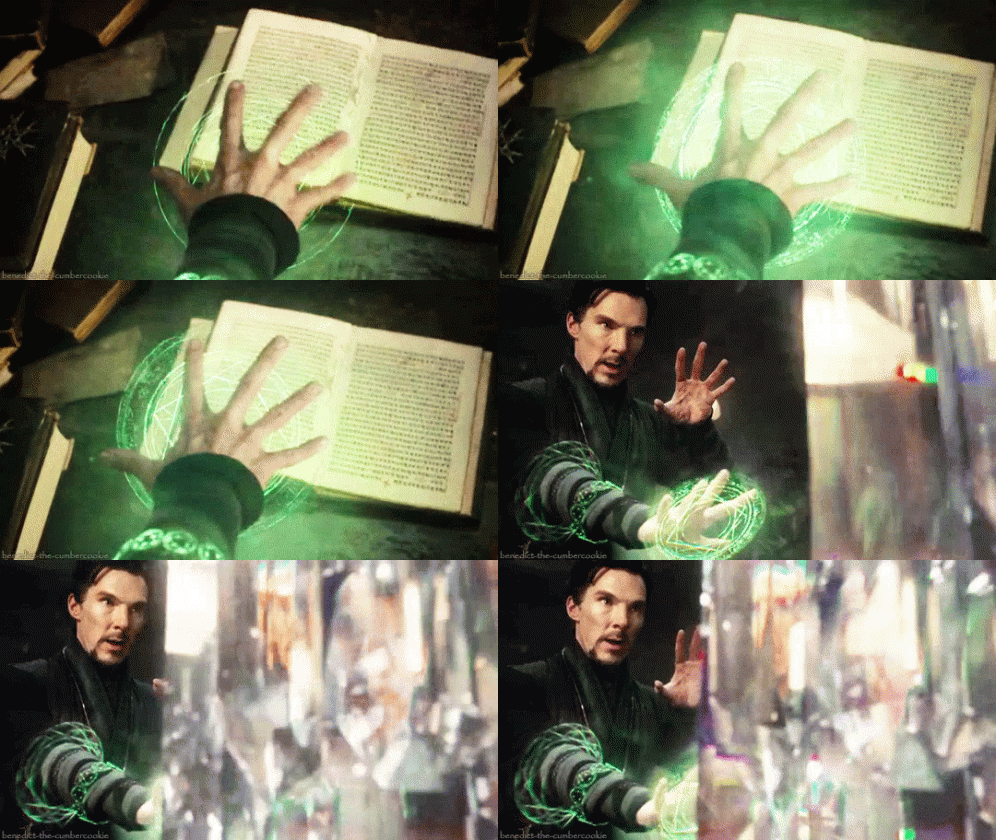
Strange does not ditch modern medicine to embrace acupuncture, chakras and spirituality. He actually studies and performs magic following a very similar method to the science and technology we're more accustomed to, and he's shown actual empirical evidence and contrasted information about it.

Hell yeah to the scientific method

 In our real world, however, the theory addressing the existence of a Multiverse is an actual field of study in speculative physics, yes (and other essay in this book talks about this in the context of cosmology and quantum mechanics), but it *is* speculative. And spirituality, while valid on its own, simply and objectively cannot replace science if what we seek is the empirical understanding of the universe. Strange's Sorcerer path *is* undeniably heavily inspired and linked with Eastern martial arts and spirituality, both in aesthetics and ethos, but the way he studies and harnesses magic is rather more in line with science and technology than with actual spirituality as we would understand it in the real world (as is also the way with many MCU perceptions of magic as science and technology 'not yet understood', as also portrayed in the Thor movies). Overall, the whole discourse when these particular essays (and there were a few :S) tackled this topic was a huge false equivalence fest.

-1 I also disliked the way that a couple of essays seemed to need to add the disclaimer that 'religion and science are not incompatible, in fact they are fully compatible because I will now give you some examples of historical scientists who also believed in God or were interested in spirituality or alchemy'. Obviously, individual people are entitled to their personal spiritual or religious beliefs (as long as they don't try to impose those beliefs on anyone else or enforce inequality against oppressed groups, which is the flavour of criticism I go for when I say I'm critical of religion). But the issue regarding the science-vs-religion discussion often doesn't have to do with individual beliefs, it has to do with the fact that enforced religious systems have historically hindered or prohibited science systematically, by imposing unscientific mythological concepts as Truths, and literally persecuting and murdering people who offered advances in science instead of abiding with those religious 'truths' as to the nature of the universe (and also persecuting religious beliefs which deviate from the systemic dogma). The fact that Newton believed in God (totally fine, but irrelevant in this discussion), or that Descartes (rather unscientifically) claimed that God is an innate proof of our reasoning nature (which let's be real, it's a bit wtf xD) are really neither here not there regarding this issue :S
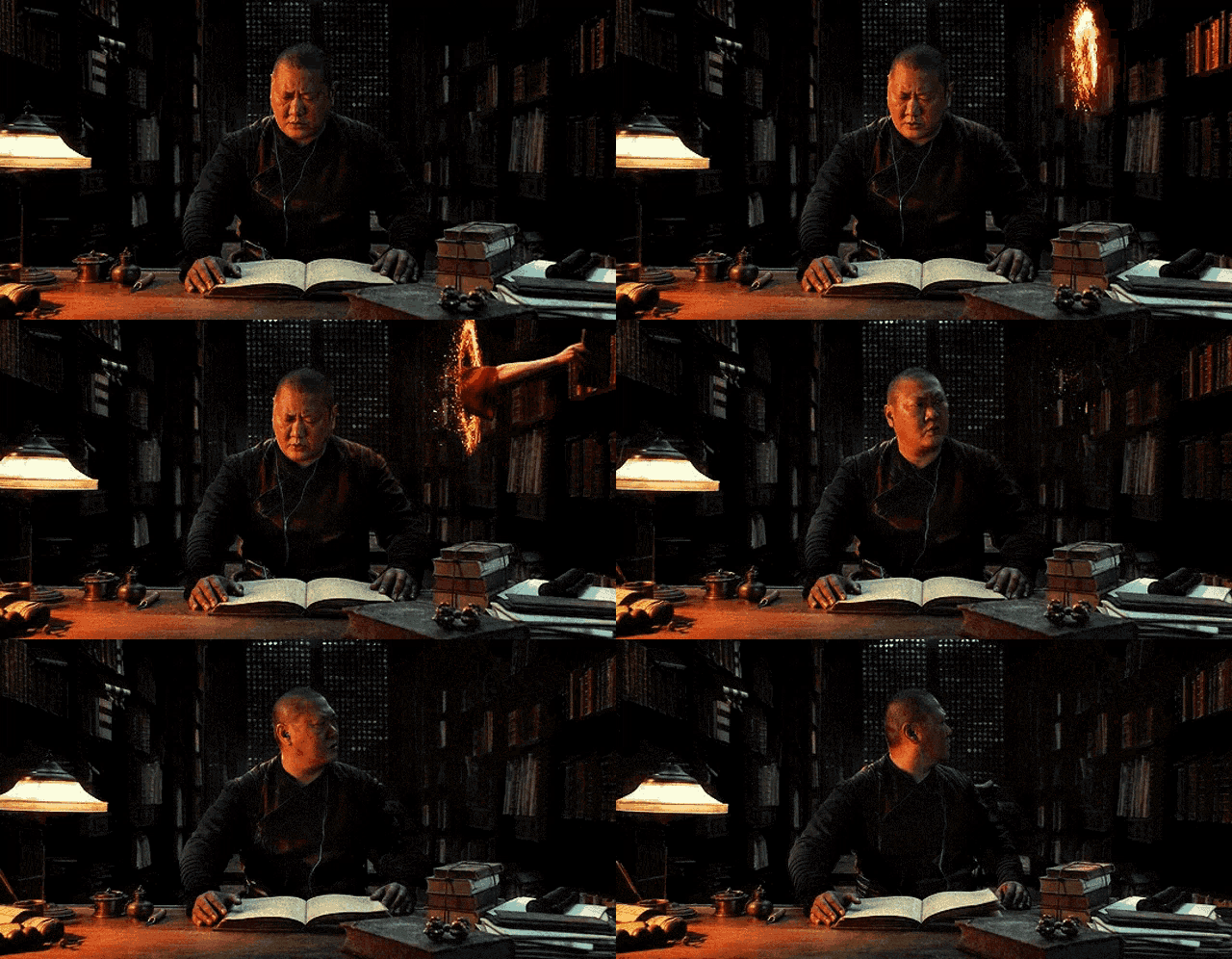
Anyway, have another gif about sorcerers and books xD
 
+1 While discussing the influence of the pacifist-oriented ethics of Eastern martial arts on Strange's ethos as a sorcerer as well as a surgeon, there's a reference and quote to the 1970s series 'Kung Fu', which I really like, so kudos for that!


- And finally, this is more an anecdotic discussion than something I liked or didn't like - There's one essay which discussed mind-body dualism as illustrated in Doctor Strange by the astral bodies. However, the author seemed to keep trying to rationalize the way astral bodies were portrayed in the movie, not just comparing them to philosophical theories of dualism as an interesting exercise, but actually trying to find logical consistency between them, as if the portrayal in the movie would either confirm or discredit said theories of dualism.

The Ancient One show Strange his astral form

While the astral bodies in Doctor Strange are clearly inspired both by spirituality currents and by various philosophical explorations about mind-body dualism, as a fantasy and sci-fi movie it doesn't need to be fully consistent with all these currents, nor do we really need to judge the accuracy of the depiction of Strange's astral body and its properties in regards to what philosophy has had to say about dualism - especially considering that dualism is, as of now, mostly devoid of any empirical scientific proof! The exercise of questioning how Strange's astral body is or isn't consistent with existing philosophical theories of dualism and transference between the mind and the body is certainly interesting for purely academic purposes, but the way the author seemed to be actually thorough and serious about how a fantasy and sci-fi movie with astral bodies confirmed or denied real life philosophical theories of dualism both puzzled and amused me xD

Saturday, 5 May 2018

MCU warrior-women outfit analysis - Iron Man I (2008)

✨⚔️This series is about⚔️✨: Warrior women and realistic female armour has always been one of my favourite topics to discuss, so this is what this series is about, focused on the women of the Marvel Cinematic Universe (MCU). We'll be analysing and commenting on the outfits and armour warrior women and action women wear and the way they are depicted in each of the MCU movies. I will also be commenting on unrealistic outfits for female characters who are not warrior or action women, but who find themselves in the midst of action scenes which involve running, for example (and you can't do that very easily in heels or tube skirts, now can you). 
 
A more in-depth description about this series in my first post about it, here


Well, this one will be quick (by my standards xD) because there's practically no warrior or action women around, apart from a female soldier extra at the start of the movie and a brief foray of Pepper Potts into the final action scenes (not part of the action per se, but the 'women running in thin stiletto heels' must be always criticized 🙄😬 xD). In fact, this being one of the most infamously sexist moviesin the MCU, most women are there to provide ample examples of casual gratuitous sexism - To be harassed, used, exploited and ogled at, as well as to fulfil the roles of the (future) love interest, personal assistant and emotional support who caters to every of our entitled male hero's wishes (hello, Pepper, you deserve so much better in this movie).

I'm going to focus on our small number of action women and how they are portrayed, but regarding general feminist criticism, I agree 100% with this post's discussion of Iron Man's sexism and racism/colonialism. I'd especially like to highlight this quote:

"Had the intent truly been to show Stark to be an ass, and not to use his mistreatment of women as proof of his success and charm, then some of the women would have registered disgust or discomfort in his company. By portraying women as being universally susceptible to the 'seductiveness' of Stark's misogyny, the film implies that all women either like being belittled, don't have the dignity to stand up for themselves, or are too empty-headed to notice a pig when he stares them in the face chest."

Peggy for sure doesn't agree with that kind of bullshit
 
Yep. My main issue with the casual sexism as portrayed in the movie was that the women didn't seem to mind being harassed, belittled, sexualized and used - they reacted favourably because it was the 'desirable' Tony Stark doing it (for example, this idea is handled better with Jim Kirk from Star Trek AOS - He begins as a cocky playboy wannabe but not all women he hits on are cool with his behaviour - nor is he into the Stark level of casual sexism or lacks so many morals at the start of his story, but that's another topic and another fandom xD). And of course, even though there are more than a handful of problematic aspects in Pepper and Tony's interactions, of course it's romantic story material from the start (I also 100% agree with the paragraph on Pepper in the above linked post).

Anyway, let's move on to the actual focus of this post xD:
  • Number of warrior/action women: 1 - A female soldier extra. Pepper Potts gets involved a bit in the action, but barely.
 1. The lone female soldier

  • Context: The movie starts with Tony Stark being driven in a military humvee in Afghanistan. A female soldier is the driver of the transport he's in. She's the only female soldier in the car and practically the only female soldier to appear in the whole movie (if we're not counting a couple bringing a stretcher at the airport - it's also pretty sad that it's all full of men no problem, but I have to be squinting at all the extras while pausing the film in order to find someone who's a woman). And she's basically there to be workplace harassed by Stark so that the audience knows that 'wow, he's an incorrigible - but still adorkable - playboy who hits on all the women'.  
The only other women in the military in the whole movie are army medics


"A female soldier giggles coquettishly when he throws some low-grade harassment her way, because what soldier wouldn't love to hear words like 'Now that I know you're a woman, I can't take my eyes off you. Does that make you feel uncomfortable?' drifting her way over the romantic rumbling of the humvee she's driving" Source

  • Armour/outfit analysis: The only positive thing about how this character is treated is that she's actually wearing a realistic military uniform, same as the rest of the men. According to the context, she's wearing practical clothing that don't sexualize her or impede her mobility. And because she's non-sexualized, Stark obviously mistakes her for a man at first because it's so hard to recognize that someone is a woman when she's wearing practical outfits that actually give her protection and mobility, right? I guess that's just why they need to sexualize action women so much everywhere, it's actually about not mistaking them for men! 🙄
Not impressed.
Her response to Stark formerly mistaking her for a man is also problematic - 'I'm an airman', she says, having to prove her validity, worth and professionalism by using the masculine (faux) generic. Yes, the military already usually uses masculine generics for everything 😕. But another interesting point is that apparently the only way to be seen as an equal by her all-male entourage is to define herself according to male terms and using male language. Being a woman means being sexualized and reduced to her 'bone structure' (something which the filmmakers have also made her react happily to, yay). Being an 'airman' is her proactive job. And this is a thing, unfortunately - many women actually prefer to use masculine generics for their jobs - even if the feminine version of the word is ridiculously straightforward - because they think they will be taken more seriously that way. And hey, using masculine non-inclusive faux generics actually doesn't help society to see women as equals, or even neutral language more common. At least, that's my standpoint.
 
-About the character as a warrior/action woman:
  • Representation: Female soldier. I'm anti-militaristic, but always nice to see parity (if you can call ONE female soldier parity, which you really can't either *eyeroll*).
  • Female bonding/Bechdel with other (warrior) women: Nope. Surrounded by men.
  • Token warrior woman? Yep, practically the only female soldier in the movie.
  • Love interest/catering to men as main plot function? Harassed by Tony Stark while doing her job, laughs it off and is actually portrayed as being flattered by it because every woman wants to be talked in a condescending, sexualized manner by Tony Stark, of course they do. 
So -
+1 Non-sexualized, realistic outfit.
-1 Her minimal role is full of sexism and normalizes workplace harassment in a positive light.
-1 No female bonding or positive interactions with other women.

 2. Pepper Potts and her stiletto heels
Running in heels. That infamous sexist trope.
-Context: Pepper becomes embroiled in the movie's final showdown and turns up to investigate the antagonist's doings alongside Coulson and Co. from SHIELD. The antagonist ends up attacking them. She has to run from explosions and from the suited-up 'baddie'. In heels.
And not just any heels. THESE heels o_O
-Outfit analysis: As is unfortunately usual for many office and business jobs, pencil skirts (sometimes also pant suits) and stiletto heels are part of the daily 'uniform' of Pepper as a rich and important man's personal assistant. This is an example of the glaring double standard sexist-fest that is compulsory stiletto heels and skirts as part of many women's jobs - imagine having to wear uncomfortable and mobility-impairing contraptions just because of your gender, because if you're a woman, no matter if your job involves standing up of walking a lot (servers, assistants, secretaries, flight stewardesses, you name it), it's apparently super important to enhance your sexiness first and foremost. This has become so warped in our society that stiletto heels and pencil skirts have also come to mean 'professionalism' and 'smartness' as well as 'sexiness' and 'femininity', and are basically the 'female uniform' for many other occupations (from lawyers to businesswomen to politicians) where the woman in question wants to look adequately 'competent' and 'to be taken seriously'.  
 
And it's worth mentioning that in this movie we also get the delightful example of Stark's private plane's stewardesses, who sport high thin stilettos (and whose job apparently also includes pole dancing for the boss 😣).

So comfortable
But Pepper doesn't only have to brave through wearing stilettos and mobility-impairing skirts through her daily job, no. She also has to dive into - and run from - the action scenes of the last part of the movie in a tube-skirted dress and thin high heels. Because it's a cliché in this kind of man-made movies - as well as practical af, huh?! - to see women running from the danger and the baddies in stilettos.

"And as the tension mounts towards the film’s climax, watching her totter in heels to help save the day is unnerving–at least they could have given her some boots."  Source

(sarcasm all around once more)
(and again xD)
It was definitely ridiculous to have to see yet another woman run around in ridiculous thin heels without anyone questioning the absurdness of it all (couldn't Coulson or any of the agents give her another pair of shoes? Especially knowing they were going to face danger?? I guess maintaining her sexiness was the priority there :/). She is 100% ill-equipped for these action scenes - Even though she's not an 'action woman' per se, but she's very much in the *midst* of a pretty intense action area. And she is also very ill-equipped for an ardous daily job that requires moving and standing around a lot, just saying. 
Spot the differences between Coulson and Pepper
-About the character:
  • Representation: She's competent in everything that she does, does have a role in thwarting the antagonist in the final showdown, and will become CEO of Stark Industries, but we cannot forget that her role as Stark's personal assistant and love interest means that most if not all of her actions revolve around the male hero's plot and decisions.  Pepper has the wit and cool-headedness to evade the antagonist in a scene prior to the final showdown, and the agency to go arrest him with SHIELD, so yay for Pepper there (and in heels no less), but she also kinda fulfills the 'damsel in distress' trope for a good chunk of said action scenes, surrounded by male agents with guns and hunted by the weaponized baddie.
  • Female bonding/Bechdel with other women: Talks briefly with a journalist seduced by Stark (which shows us that Pepper knows exactly what kind of playboy life Stark has going on - one aspect of her job is to usher all his one-night stands out - and still finds his male entitlement, ego remotely attractive. And not only that, but the only scene where women talk is full of female competition, hell yeah! 😬). 

Pepper having a go at Stark's one-night conquests because hell yeah let's be jealous that your entitled womanizer boss sleeps with other women! "Why is she not referring to Stark as the trash in this situation? He's the one that continues to treat women as throwaway objects he's entitled to" Indeed (Source)
  • Love interest/catering to men as main plot function? Yep. Her job is literally that. She doesn't really have a life of her own portrayed, and repeatedly has to put up with all the problematic stuff Stark comes up with because her job as his personal assistant is to attend to his every whim with a competent air, a ready smile, and a pair of stiletto heels always at the ready. Also a model of the female character who helps 'make the man better' with her emotional support and her putting up with too much of his shit (she does challenge some of his decisions, but yeah).  
  • Additional notes (you know I had to xD): 
  •  To those usually saying Stark appreciates and respects her competence, and that he gets more character development in that direction - that may be so, and I don't deny that Iron Man gets some character development going on in this MCU arch (without really making him accountable for his former higher levels of obnoxious sexism, if I may add, tho). But Pepper's still fulfilling the traditional role of the woman who does all the men's work while not being the actual boss, CEO or not. Not her actual company, but her boss-boyfriend's company. Yes, she wields power, as so many female PA's, consorts and the like do - But not her actual power, at the end of the day. Women with actual power are actually often portrayed as 'evil', 'bossy' and 'controlling', but because Pepper has Stark as her superior, that's all right if she displays her competence and skills. And it's also all right that she shows a lot of competence while catering to each and every one of the male protagonist's needs, paperwork and wishes, of course ("I don't think you could tie your shoes without me" and such are shown as proof of Pepper's competence, not Stark's utter incompetence when it comes to boring bureocratic matters other women handle for him).
  • She's also treated in a pretty controlling and manipulative way by Stark in more than one occasion in this movie ("I don't like it when you have plans" and several other quotes come to mind). Yes, Stark gets character development, especially regarding his moral compass, and that's great, but his entitlement and flyboy attitude are still there in more than one way, and he is never held accountable for his casual sexism and use of women in the same way he is for his prior pro-weapons stance (if at all). They want to sell us Pepper's constant calm competence and apparent no-nonsense attitude as proof of her empowerment, maybe also to show us that everything's super normal and healthy where Stark is involved, a good foundation for a relationship (especially now that he's becoming the better hero!). But with that kind of discourse they're also hiding under the rug all of Stark's bullshit behaviour (for ex., the rather creepy scene where he pressures Pepper to fix his heart reactor or else he will go into cardiac arrest; the party scene where Pepper is uncomfortable to dance publicly in a backless dress with her boss, while privileged manly womanizer Stark is not only unaffected by sexist double standards of what people may think, but also suggests that maybe if he fired her she would feel better about the flirty scenario; or the cringeworthy entitlement in the very last scene where he very unsubtly asks Pepper to be his girlfriend), as well as promoting the idea that PA's are super happy to have demanding narcissistic womanizer bosses, so much they end up hardcore crushing on them! Yes, Pepper refuses Stark's offer at the end of the movie ("No matter how proud she might be of the ‘man he’s become’ Pepper’s not about to get into a relationship with a man who treats her like shit (hurrah), even if she might still work for him." Source). But as we know, that won't last long 😬
So - 

+1 Capable and competent. She's also pretty cool-headed in a crisis, even though -
-1 SHE HAS TO RUN IN HEELS EVERYWHERE. Also, job, plot and love story revolve around narcissistic womanizer dude who's never really accountable for his sexist behaviour.
-1 No female bonding or positive interactions with other women in this movie.

Sunday, 17 December 2017

MCU warrior-women outfit analysis - Thor I (2011): Frigga

Intro about the series
As a sword-fighter, archer, Amazon feminist and warrior-woman enthusiast, warrior women and realistic female armour has always been one of my favourite topics to discuss and I've been wanting to start a series here for ages, analysing and commenting on the outfits warrior/action women wear and the way they are depicted in media such as TV series, movies and comic books (the latter is nothing less than a bleak territory for realistic armour and non-sexualized warrior women, so I guess I'll be having tons of fun with those :S). The main issues these posts will tackle are:
  • What is the level of realism and practicality of this armour/outfit? Is she portrayed in non-sexualized, active poses?
  • What is the level of objectification/sexualization of the armour? This translates in lack of mobility, realism and practicality in many ways. Is there male gaze involved in the way the warrior woman is portrayed? How about the poses and gestures
  • Double standards - How are the male warriors portrayed in contrast to the women? Do they also wear impractical and/or sexualized armour/outfits, or are they wearing practical, realistic armour? 
  • Other issues sometimes also discussed - Is the warrior woman a token female warrior, or is there more representation in the series/movie/comic? Another kinds of representation (ethnicity/race, age, sexual orientation, etc)? Is she a 2D 'strong woman' character with little depth, plot and/or development? Is her main function that of a love interest to a male character? Does she evolve from a 'strong' warrior woman to a more traditionally 'feminine' role, especially when romance is involved in the plot? 
  • Also going to comment on unrealistic outfits for female characters who are not warrior or action women, but who find themselves in the midst of action scenes which involve running, for example (and you can't do that very easily in heels or tube skirts, for example).
  •  General feminist rambles about the characters will sometimes also feature.
I decided to begin with the Marvel Cinematic Universe, and I've chosen Thor I (2011) as the first movie to analyse, so let's get started with it!
  • Number of warrior women: 2 - Lady Sif and Frigga (minor appearance of her warrior aspect) (Sif will have her own post)
  1.  Frigga
 Frigga's warrior aspect features mostly in Thor: The Dark World, but she is a warrior queen with a warlike 'cameo' in this film, so of course I'm going to include her because she's awesome (and deserved a better husband and a better plot, but that's another story - one that I'm only too happy to elaborate about at the end of this post for a bit, because I really don't like Odin :S xD):
  • Armour/outfit analysis
-Context: Frigga's warlike cameo involves her taking a sword in her non-warrior 'casual Asgardian day clothes' in order to defend the comatose Odin from being attacked by Frost Giants. She takes a frost giant down, but is thrown to the ground by Laufey (Frigga being a warrior (alien) goddess with extra magic powers, one would think she would be more of a match for him, but maybe she was caught tired and at unawares from having had to watch over Odin all that time? Or is it just the trope of 'woman shown as a warrior for brief cameo until male action character(s) (Loki and Thor, in this case) save(s) the day?' :S)

-Outfit analysis: Not much to discuss here. Frigga isn't wearing armour or a fighting outfit in this scene, being caught at unawares in non-fighting Asgardian clothes, with long hair in a low half-up/low ponytail,  long skirts and potentially heeled shoes (she wears heels in her warrior outfit in The Dark World, so even though I couldn't catch a moment where her shoes are visible, she might be wearing heels here too, the curve of her foot as she advances towards the Frost Giants kinda looks like it :S). 

Skirts and loose hair are not the best elements for a fight, but can perfectly work for a honed warrior if caught at unawares. Preferably not for an actual planned fight, though!


-About the character as a warrior:
  • Representation:  (Consort) queen with a warlike aspect. Middle-aged warrior woman (which is always really nice to see represented). 
  • Female bonding/Bechdel with other (warrior) women: Briefly talks with Lady Sif at the end of the movie.
  • Token warrior woman? Well, even though one could think that Asgardian warrior women wouldn't be out of the norm, Frigga is isolated, alongside Sif, among an ocean of male warriors in both Thor I and II.
  • Love interest/catering to men as main plot function? She fulfills the role of the queen consort, wife and mother in this movie, and most of her screen time in this movie shows her taking care of her comatose husband Odin, so unfortunately yes :S. 
  • Other: Her warrior abilities seem kinda underused and underwhelming in this movie in order to give her sons more space for action and 'saving the day' scenes :S  
-Feminist ramble about another issues concerning the character:

  Frigga is such an interesting, badass female character, following the archetype of the powerful warrior-queen goddess figure, that it seems a shame to relegate her to traditional roles of consort, wife and mother (this happens a lot, though, both in mythology and real life :/). I'm not saying women with children and/or in a relationship cannot be interesting and badass (I mean, look at Lagertha and many other women), but it'd be nice to see more of them have plot points that don't revolve mainly around men, and to see them being less relegated to traditional gender roles and having a more equal relationship with their partners (Frigga going with Odin into battle in the intro of the movie, for example, and/or going to Jotunheim to rescue Thor an Co. alongside Odin, would've been a nice way to showcase her warrior aspect more, as well as a more egalitarian partnership) - Also, Frigga is to me way more interesting than Odin - Intelligent, capable, badass, kind...you name it. Also definitely the better parent and the one who actually cared about giving affection - and skills - to her sons, especially regarding Loki; but thanks to patriarchy all her sons are primarily supposed to care about is their (shitty) father's approval. Even Frigga is brainwashed about this and insists that their sons 'make their father proud' even though the only thing their father seems to do for them is to give them massive daddy issues :S. So it's pretty unfair to see her take a secondary place in the shadow of her (morally shady and shitty father) husband (does it show that I really don't like Odin xDD?).
 
Historically, many women in patriarchal marriages have been often relegated and limited to their roles of wife and mother, especially when their whole lives revolving around catering to their husbands and rearing children with little room for anything else :S - Frigga is seen in her (absolutely badass) warrior and enchantress aspect from time to time, but we don't see her doing 'me stuff', or ruling-related stuff, or anything apart from basically appearing in second plane as the consort and wife to Odin, or discussing stuff with her sons (which I find way more interesting, of course, and the relationship between Loki and Frigga is everything, but it isn't enough). Odin has his own life with his exploits and ruling and stuff - Does Frigga?

   She isn't even portrayed sitting in a throne at Odin's side (actually, it seems like she doesn't even have a throne), and is shown standing and in a lower level than Odin in both Thor I and II. She does not act as the ruler when Odin is comatose in Thor I - With Thor banished, it's the remaining male heir, Loki, who becomes acting king, and not her. And she doesn't have a say in either Thor's banishment in Thor I (she is angry with Odin in a deleted scene but can do nothing to overrule his decision) or Loki's imprisonment in Thor II (she is literally told to leave when Odin is judging Loki) - like so many woman consorts, she doesn't have the executive power to make actual decisions most of the time, having to rely on the ever-present tactic of trying to convince the ruling husband to change his mind if she wants things differently - And she doesn't seem to be able to achieve much anyway: She asked him to tell Loki about his true parentage from the beginning, to no avail; her words do nothing to sway Odin about Thor's banishment - Odin actually claims that 'he is king' and the one making the decisions because Frigga wouldn't have the heart to fulfil that role, and she has to put up with this and later tell Loki that 'there's a purpose to everything your father does '-; she also has to visit Loki behind Odin's back using magic because she's not even allowed to visit him,  let alone have a say about his fate. So yeah, Frigga's capabilities and badassery are massively limited by her status as Odin's consort, only allowed to show a less traditional powerful warrior and enchantress mode in limited ocassions, and it's such a shame, because she's amazing.