Showing posts with label Brighid. Show all posts

Monday, 9 October 2017

National Museum of Scotland: Celts, Picts, Vikings and Anglosaxons

This past September I visited Edinburgh's National Museum (National Museum of Scotland), and I really liked the archaeology and Scottish history collection.  This is probably the museum I've enjoyed the most alongside the British Museum and the Hallstatt museum - It was really well organized and presented, and included a lot of stuff from some of my favourite cultures. I focused on the 'Early Peoples' exhibit, with Celtic, Pict, Viking and Anglosaxon pieces, spanning from around 8000 BC to AD 1100; and the 'Kingdom of the Scots', from 1100 to 1707

More info about the pieces either in the signs (click on pics or open in new tab for a bigger size) or linked in descriptions:

"Buried at the beginning of the 10th century in Dumfries and Galloway, the Galloway Hoard lay undisturbed for a thousand years before being unearthed by a metal detectorist in September 2014.

This discovery comprises more than 100 objects, including a rich Viking Age hoard of silver jewellery and ingots. It also contains a range of precious metal and jewelled items, including a rare gold ingot, a unique gold bird-shaped pin and a decorated silver-gilt vessel, the only complete lidded vessel of its type ever discovered in Britain and Ireland.

This vessel contains further unusual objects: beads; amulets of glass and rock crystal; a silver penannular brooch; another gold ingot; five Anglo-Saxon disc brooches of a kind not found in Scotland before; and two examples of a new type of quatrefoil brooch. Carefully wrapped in fragile textile bundles are a rock crystal flask or jar and jewelled aestels, pointers used to read and mark places within medieval manuscripts." (Source)


1) 'Early Peoples' (not in chronological order)

  • I was lucky to see irl one of my favourite depictions of Brigantia, goddess of the Brigantes (a Britannian tribe) and a warlike version of the Irish goddess Brighid:


"[Brghid's] British and continental counterpart Brigantia seems to have been the Celtic equivalent of the Roman Minerva and the Greek Athena, goddesses with very similar functions and apparently embodying the same concept of elevated state, whether physical or psychological."
(Wikipedia: http://en.wikipedia.org/wiki/Brighid)

Brigantia, the North British warlike version of the Irish Brighid, worshipped mainly by the Brigantes tribe. was equated by the Romans with warlike, lofty goddesses of their own, such as Minerva, goddess of strategical battle, wisdom and crafts, Bellona, the ancient Roman goddess of war, and Victoria, the personified goddess of victory. Roman reliefs of Brigantia show her in depictions heavily influenced by these Classical goddesses, dressed in a long tunic, armed with helmet, spear and shield and carrying a globe of victory in her left hand. The Romans also equated warlike Gaulish goddesses, such as Epona and Belisama, with Minerva.


  • Pictish stones


A female aristocrat, Hilton of Cabdoll:

"This hoard of treasure was discovered during excavations on St Ninian’s Isle, Shetland, in 1958. It consists of 28 silver and silver-gilt objects, all decorated, made during the second half of the eighth century. Most of the objects are considered to be Pictish, which means they would have been made and used in the eastern and northern areas of Scotland.

There are twelve brooches in the treasure. In early historic Scotland, brooches such as these did much more than act as cloak fasteners. The size and quality of the decoration signified the wearer’s status and position in society. The number and quality of the brooches found strengthens the suggestion that the treasure came from an aristocratic household." (Source)


"The Deskford carnyx is the head of an Iron Age trumpet. Found in the north-east of Scotland around 1816, it is a masterpiece of early Celtic art, shaped to resemble a wild boar with its upturned snout and decoration mirroring the folds of skin around a boar’s face. It is a complex composite construction, wrought from sheet bronze and brass. This helps us date it, because brass is not native to Scotland: it represents recycled Roman metal. Along with other evidence, this suggests a date between c. AD 80 and 250 for its construction. Today only the head survives: it lacks the erect crest, ears, enamelled eyes, wooden tongue and long cylindrical tube which it once had." (Source)


  • Woman's grave, Cnip (875 to 925):


  • Anglosaxon loot (1-2); Irish loot/gifts featuring brooches and pins (3-7); Scandinavian personal possessions (8-17):


  • Emulating Southern English fashions (2-7) and gift exchanges (8-12):


  • Prestige imports (4-10); Irish and Irish-style objects from the 1st millennium AD (11-15)


  • Viking sword hilt and other weapons:


  • Alphabets: Runes and ogham


  • Jewelry and adornments:

  • Weapons:


2) 'Kingdom of the Scots' (not in chronological order)
  • Queen Mary harp:
"This harp, or clarsach, may have been made in the West Highlands in the 15th century. The woodwork is richly decorated with scroll-work and carvings of animals. (...) This harp was traditionally said to have been given by Mary, Queen of Scots to Beatrix Gardyne of Banchory, while on a hunting trip to Atholl, c. 1563. It is also said to have been adorned at one time with a gold portrait of Mary, which could be the real reason for its association with her. " (Source)


  • Pictish stones:


  • Scandinavian pieces from Shetland, featuring combs:


"Found on Lewis in 1831, the Lewis Chesspieces are probably the most well-known archaeological find from Scotland. The chesspieces consist of elaborately worked walrus ivory and whales' teeth in the form of seated kings and queens, bishops, knights on their mounts, standing warders and pawns in the shape of obelisks.  The hoard is likely to be made up of four chess sets. Eleven pieces are owned by National Museums Scotland and the remaining 82 reside at the British Museum.

Believed to be Scandinavian in origin, the Lewis chesspieces were probably made in Trondheim in Norway during the late 12th and early 13th centuries. At that time, the area in which they were buried was part of the Kingdom of Norway, not Scotland. It is possible that the chesspieces belonged to a merchant travelling from Norway to Ireland, and it seems likely that they were buried for safe keeping en route." (Source)

  • Medieval longsowrd (Claymore):

  • Cloak rings:


Thursday, 11 February 2016

Celtic goddesses: Brigid (final part)

  • Brighid part 4: Brighid as a Sun Goddess. Parallels in other mythologies and religions.
Former posts: 1, 2 and 3.

-Disclaimer: This post is written for cultural fun because I enjoy studying and comparing goddesses from different mythologies, who also serve as empowering role models for women. I don't own any of the images, which were credited to the best of my ability. Religious spam of any kind is not welcome, thanks.

1) Brighid as a solar goddess: 
   Brighid is one of the so-called 'Solar goddesses' present in many mythologies. Solar goddesses are associated with life and light, fertility and healing, sovereignity and protective battle skills and crafts. As 'Solar' goddesses, many of these are directly related to the Sun (Belisama, Brighid, Amaterasu, Sunna and other Sun goddesses). Others are also related to the Moon, the stars and the sky in general (Nut, Isis, Zaria, Varda-Elbereth from Tolkien's legendarium).  

 Life, fertility and healing are common aspects of solar deities (male solar deities such as Belenos and Lugh also have important life-giving and fertility aspects), an easy link to make given their light symbolism. Given the Sun's fiery nature as well as its life-giving qualities, solar deities are also associated with power and strength, and with warfare (Brighid, Athena-Minerva and most solar deities have this aspect) - Although they are normally seen as warrior-protectors rather than deities associated with battle-frenzy and slaughter (such as Mórrígán, Ares or Kali).  Fire and the Sun are also symbols of inspiration and creativity, so many solar deities are patrons and patronesses of craftspeople, poets and artists (Brighid, Athena).

-List of some Solar goddesses (Sun/light/sky, crafts and warrior-protector goddesses):
   Goddesses in parentheses are not 'solar' goddesses per se, but share a fair number of the light/sky/fertility/warrior-protector aspects of solar deities.
A Sun Goddess (author unknown to me)
  • Celtic mythology: Áine, Belisama, Brighid/Brigantia/Britannia, (Ceridhwen), Danu, (Epona), Etain, Sulis/Suleviae, Olwen. (Many Celtic deities have a solar aspect, even if they're not mainly Sun-goddesses).
  • Egyptian mythology: Bast, Hathor, Isis, Nut, Sekhmet.
  • Scandinavian mythology: Freya, Sól/Sunna.
  • Classical/pre-hellenic/Scythian/Etruscan mythology: Alectrona, pre-hellenic Artemis, Athena/Minerva, Eos, Hemera,  (pre-hellenic Hera), Thesan (Etruscan), Victoria, Iris, Medusa.
  • Chinese mythology: Xihe.
  • Japanese mythology: Amaterasu, Marici.
  • African mythology: Anyanwu, Mawu.
  • Australian mythology: Gnowee, Wala, Wuriupranili, Yhi, Djanggawul Sisters.
  • Indian mythology: Aditi, Devi, Saranyu.
  • Baltic mythology: Saule, Zaria.
  • Slavic mythology: Mater Sva, Koliada, Solntse, Xatel-Ekwa.
  • Sami mythology: Beiwe.
  • Alaskan mythology: Akycha
  • Native American mythology: Hekoolas, Uelanuhi.
  • Inuit mythology: Malina.
  • Semitic (Canaanite/Sumerian/Babilonian/Hitite/...) mythology: (Astarte), Arinna, (Inanna/Ishtar), Shapash, Wurusemu. 
  • Tolkien's mythology: Arien/Urwendi, Varda/Elbereth, Ilmarë.
I've chosen four goddesses or divine figures - Athena-Minerva from Classical mythology, Isis from Egyptian mythology and Varda-Elbereth and Arien from J.R.R Tolkien's universe - who in my opinion share quite a lot of traits, aspects and functions with the Celtic Brighid:

2) Brighid and Brigantia vs Athena/Minerva and Victoria (Classical mythology)
            
Left: Pallas Athene (Klimt). Right: Relief sculpture of Brigantia heavily influenced by Minerva (Roman, 3rd Century AD).

"[Brghid's] British and continental counterpart Brigantia seems to have been the Celtic equivalent of the Roman Minerva and the Greek Athena, goddesses with very similar functions and apparently embodying the same concept of elevated state, whether physical or psychological."
(Wikipedia: http://en.wikipedia.org/wiki/Brighid)

Brigantia, the North British warlike version of the Irish Brighid, worshipped mainly by the Brigantes tribe. was equated by the Romans with warlike, lofty goddesses of their own, such as Minerva, goddess of strategical battle, wisdom and crafts, Bellona, the ancient Roman goddess of war, and Victoria, the personified goddess of victory. Roman reliefs of Brigantia show her in depictions heavily influenced by these Classical goddesses, dressed in a long tunic, armed with helmet, spear and shield and carrying a globe of victory in her left hand. The Romans also equated warlike Gaulish goddesses, such as Epona and Belisama, with Minerva.

Other aspects of the Irish Brighid can also easily compared with Classical goddesses, such as Athena-Minerva: Apart from their warrior-protector aspect, both are patronesses of crafts and arts, are associated with laws and wisdom, and they also share fertility symbolisms such as the snake (Athena's status as a 'virgin' or unmarried woman isn't linked to patriarchal ideas of 'virtue' and 'modesty', but rather harks back to her Pre-Hellenic status of life-giving mother goddess, where 'virgin' simply means 'a young woman who is not tied to a man', with no additional connotations of repressive notions of 'modesty' or sexual inexperience - 'virgin' mother goddesses are actually able to create life on their own, and many additionally have an active sexuality).

2) Brighid vs Isis (Egyptian mythology) 

Up: Brighid (author unknown to me as yet). Down: Isis (credited on the pic).

While Athena and Brighid primarily share their protector-warrior and patroness of crafts aspects, Brighid and the Egyptian goddess Isis are very similar in their life-giving, fertility, healing and creative aspects. They share quite a number of near-equal symbolisms: 

As Solar goddesses, they both wear Sun-and-fire-related headdresses - Brighid wears a flame on her brow while Isis wears a Sun disc -, together with other solar symbols (Brighid's solar cross and Isis Solar Barque, for example. Isis is also associated with the wind and stars). Magic is another strong characteristic of Isis, and Brighid, while not as strongly associated magic and called an 'enchantress' per se, can also be linked to magic through her creative and solar aspects. 

While Brighid shares her warrior aspect with other solar Egyptian goddesses such as Sekhmet the lioness (also linked to fertility and the cycle of life and death) or Neith, rather than with Isis, sovereignity is another aspect these two goddesses have in common:  Isis is usually depicted with a throne sign in her head, or seated upon one, and, like many Celtic goddesses, Brighid has an important aspect as guardian of the land (especially in her role as warrior) and a goddess of sovereignity who bestows power upon rulers (this role is also linked to her life-giving fecundity aspect). 

These two goddesses also share common symbols which have to do with life (and the cycle of life and death), fertility and healing in many mythologies and religions: 
-The snake, a recurring fertility and healing symbol.
-Horns and cow imagery: Isis wears horns with her solar disk and assimilates many roles of cow-goddess Hathor, while Brighid's feast Imbolc has to do with the time when ewes get pregnant. Cows are also strong fertility symbols in Celtic myth.
-Water and the Moon: Brighid is primarily a fire solar goddess, but water and the Moon as symbols of fertility (and also the cycle of life and death) are also recurring in Celtic myth. 
-Birds and feathers: The swan (solar animal, transformation, the start of a new day), and the cockerel (which signals a new day) are associated with Brighid, and she is sometimes depicted (as in the image above) wearing feathers in her healing cloak. Similarly, Isis is often depicted with wings and is associated with the vulture (cycle of life and death, renewal),  hawk (rebirth), and swallow (fertility, healing). Both goddesses are also associated with geese (a sacred animal in Celtic culture).

3) Brighid vs Varda-Elbereth and Arien-Urwendi (Tolkien's mythology)
Left: Varda by Hannah Lehmusto ; Right: 'Naked Flame' (Arien) by Iomehir
Brighid by Tattered Dreams

-Varda Elentári (in Sindarin known as Elbereth Gilthoniel) is a character of Tolkien's universe, the most powerful and highest in rank among the Valier (female angelic spirits who dwell on Arda and are heavily inspired by mythological goddesses). Her name means 'The Exalted One' and she is associated with all forms of light, and especially with the sky and the stars, some of which she created. She also took part in the creation of the Sun and Moon. Apart from light and the sky, she is associated, alongside her spouse Manwë, with music and poetry, and with sovereignity.

 Lastly, influenced as she is with solar and sky goddesses from different mythologies, in my opinion Varda also shows a more offensive aspect as warrior-protector. This can be seen in the earlier version of the legendarium (Book of Lost Tales I), where she is described accompanying Manwë in a chariot in pursuit of Morgoth "bearing a blazing star before him as a torch". Morgoth, the Dark Lord of The Silmarillion, is described as fearing Varda above anyone else, and the peoples of Middle-earth (especially Elves and Hobbits such as Frodo Baggins and Samwise Gamgee) worship her and call for her aid when they are in danger, seeking her protection.

"(...) Varda, Lady of the Stars, who knows all the regions of Eä. (...) In light is her power and her joy. Out of the deeps of Eä she came to the aid of Manwë; for Melkor she knew from before the making of the Music and rejected him, and he hated her, and feared her more than all others whom Eru made (...) Of all the Great Ones who dwell in this world the Elves hold Varda most in reverence and love. Elbereth they name her, and they call upon her name out of the shadows of Middle-earth (...)" (Silmarillion, 26)
Varda by ANeDe on DeviantArt
I personally can see a lot of parallelisms between Brighid and Varda-Elbereth: The most important one is the fact that they are strongly associated with light and creation. They also share aspects that have to do with arts (especially music and poetry) and sovereignity. As light deities (Varda is not considered as a 'goddess' per se in the legendarium, but as an angelic spirit, but she's clearly inspired by goddesses), they also share a more offensive aspect as (warrior)-protectors. And lastly, Varda and Brighid's name have the same meaning: Both mean 'The Exalted One'. One of Varda's early names in early Elvish is actually Bridhil, very similar in form to Brighid.  'Bridhil' means 'The Bright One', which is an alternative meaning of the Celtic name 'Brighid' (and Tolkien said he wasn't influenced by Celtic language and culture - One of my life aims is to refute that xD).

-Arien is the Maia of the Sun (Maiar are angelic spirits of lesser rank and power than the Valar) in Tolkien's legendarium. Heavily inspired by Solar goddesses in different mythologies, especially Sunna from Scandinavian myth, Arien is described as a fiery and powerful spirit who guides the vessel of the Sun, Anar.  Her offensive-warrior aspect is another important feature, opposing male forces who wish to take her power or autonomy, such as Morgoth and the spirit of the Moon, Tilion.

"The maiden whom the Valar chose from among the Maiar to guide the vessel of the Sun was named Arien (...) Arien the maiden was mightier than he [Tilion, the Maia of the Moon], and she was chosen because she had not feared the heats of Laurelin, and was unhurt by them, being from the beginning a spirit of fire, whom Melkor had not deceived nor drawn to his service. Too bright were the eyes of Arien for even the Eldar to look on, and leaving Valinor she forsook the form and raiment which like the Valar she had worn there, and she was as a naked flame, terrible in the fullness of her splendour."
(Silmarillion, 99-101)
Maiden of Sunlight by Jerrel Salvatierra
As a Solar goddess, Brighid can be easily compared to Tolkien's Arien - Both of them share Solar-related characteristics, apart from the obvious shared elements of light and fire, such as strength, power, autonomy and creation (more associated with Varda than Arien, though).
  • Brief addition as quotes: Brighid and Saint Brigid
Depiction of Saint Brighid, the assimilated Goddess Brighid in Irish Christianity. She is protrayed with the symbolism she shares with the Goddess: Corn, candles and fire (fertility, creation, inspiration, life-giving aspect), the harp (arts, poetry, inspiration), the sword (her former aspect as warrior protector).

  • Origin from Celtic religion and the goddess Brighid:

"Due to the original differences between the Roman church and that which was once an extremely divergent type of Christianity practiced in the Western Isles, particularly Ireland, many of the older deities made the transition from Gods and Goddesses to saints, some experiencing Church-inflicted gender changes on the way. Often thinly-disguised pagan worship was continued in monasteries and convents which were built on or near the sites sacred to the Celtic pantheon."

(Order of Bards, Ovates and Druids, Brigid: Survival of a Goddess)

"In the Middle Ages, Brigid was syncretized with a Christian saint. According to medievalist Pamela Berger, Christian "monks took the ancient figure of the mother goddess and grafted her name and functions onto her Christian counterpart, St. Brigid of Kildare"
(Wikipedia, http://en.wikipedia.org/wiki/Brigid)

"[Brighid's] evolution from Goddess to saint linked Pagan Celtic and Christian traditions much the same way the Cauldron of Cerridwen and the Holy Grail were combined in Arthurian legend. She acts as a bridge between the two worlds and successfully made the transition back to Goddess again with most of Her traditions retained. The worship of Saint Brigid has persisted up until the early 20th century with Her Irish cult nearly supplanting that of Mary. She is commemorated in both Ireland and the highlands and islands of Scotland."
(Order of Bards, Ovates and Druids, Brigid: Survival of a Goddess)

  • Shared aspects with the Goddess:


Saint Brighid by Kathrin Burleson
 
"Brigid’s role as Mother Goddess was never completely eradicated and reappears throughout Her entire career as a Catholic saint. As Saint Brigid, there are rays of sunlight coming from Her head, as portrayed as a Goddess. Themes of milk, fire, Sun and serpents followed Her on this path, adding to Her ever-growing popularity. Compassion, generosity, hospitality, spinning and weaving, smithwork, healing and agriculture ran throughout Her various lives and evolution."
(Order of Bards, Ovates and Druids, Brigid: Survival of a Goddess)

"Her symbolism as a Sun Goddess remains, also, in the form of Brigid’s crosses (...) One of the stories of Her life as a saint supports Her original attribute as a solar deity."
(Order of Bards, Ovates and Druids, Brigid: Survival of a Goddess)

"Both the goddess and saint are associated with holy wells, at Kildare and many other sites in the Celtic lands."
(Wikipedia, http://en.wikipedia.org/wiki/Brigid)
  • Worship:
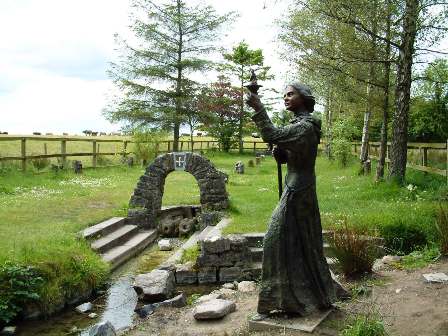
Statue of (Saint) Brighid at Kildare. Sculptor: Annette McCormack

"The eternal flame at Her convent at Kildare suggests its existence as having been pagan and/or Druidic. The shrine at Kildare is assumed to be a Christian survival of an ancient college of vestal priestesses who were trained and then scattered throughout the land to tend sacred wells, groves, caves and hills. These priestesses were originally committed to thirty years in service but, after this period, were free to marry and leave. The first ten years were spent in training, ten in the practice of their duties and the final ten in teaching others, similar to the three degrees of initiation found in most traditions.

These women preserved old traditions, studied sciences and healing remedies and, perhaps, even the laws of state."

(Order of Bards, Ovates and Druids, Brigid: Survival of a Goddess)


"St. Brigid is associated with perpetual, sacred flames, such as the one maintained by 19 nuns at her sanctuary in Kildare, Ireland. The sacred flame at Kildare was said by Giraldus Cambrensis and other chroniclers to have been surrounded by a hedge, which no man could cross. (...) The tradition of female priestesses tending sacred, naturally-occurring eternal flames is a feature of ancient Indo-European pre-Christian spirituality."  
(Wikipedia, http://en.wikipedia.org/wiki/Brigid)

"The shift from Mother Goddess to Virgin Mother to Virgin Saint presented difficulty. Even though it insured Her survival and the emergence of Her power in Neo-Paganism, the emphasis on virginity stemmed completely from the Christian patriarchy. She derived power at the expense of other women, removing motherhood from its revered position in Celtic society."
(Order of Bards, Ovates and Druids, Brigid: Survival of a Goddess)

  • Sources and links:
-Wikipedia, Brighid
-Order of Bards, Ovates and Druids -  Brigid: Survival of a Goddess
-Wikipedia, Solar Deity
-Wikipedia, List of Solar Deities, Solar Goddesses
-Sun Goddesses
-Wikipedia, Brigantia
-Wikipedia, Isis
-Goddess Gift - Symbols of Isis
-Animal symbols
-Essay on Brighid by Susan Morgan Black. Downloadable as pdf.
-J.R.R Tolkien, The Silmarillion
-J.R.R. Tolkien, Book of Lost Tales I
-J.R.R. Tolkien, Morgoth's Ring
-Tolkien Gateway, Varda
-Tolkien Gateway, Arien
-My study about Warrior-women in Tolkien's works (uploads pending).