Showing posts with label women in STEM. Show all posts

Thursday, 26 December 2024

Astrophysics - PhD project and A&A papers


The cover and backcover of my PhD thesis. The graph in the backcover depicts the Li envelopes that I obtained as the main final results of this project.

  Back in Spring 2022, I defended my thesis on stellar Astrophysics, as I talk about in this post 🌟🪐🔭📚📐📊. During my doctorate years, and also during the first couple of years after my defense, I have been presenting the results of my PhD project in poster and presentation form for several scientific reunions, conferences, meetings and seminars: For example for the 2022 Scientific Reunion of the Spanish Astronomical Society (XV Reunión Científica de la SEA), or for open-doors seminars at the Universidad Complutense de Madrid (UCM)You can also find most of these on my ORCID here.  

In these posters and presentations I also talk about my two first-author papers, which contain a sizeable part of the analysis and results that I worked on for my PhD project since 2015,  corresponding to the full contents of chapter 2 of the written thesis. As I explain in more detail in the post on my thesis, the aim of my project, entitled The lithium-age relation: Calibration with open clusters and associations, was to study lithium (Li) as an age indicator for pre- and main-sequence late-type stars (FGKM) with the ultimate objective of calibrating an empirical Li-age relation that would help to estimate age ranges for both field stars and other open clusters. I worked with a large sample of 42 stellar open clusters and associations using data from the Gaia-ESO Survey (GES) and the Gaia mission

The two published papers describe the thorough membership analysis that we conducted to obtain lists of robust candidate members for each cluster, making use of all available parameters derived from GES spectroscopic observations, firstly from the iDR4 data release (Paper I, published in 2020, including the preliminary analysis of 20 open clusters), and then using the final iDR6 data release for the second paper (Paper II, published in 2024), which encompasses 42 open clusters and associations and contains the final analysis and cluster membership included in the thesis. Both papers describe in detail the various criteria used to obtain the lists of cluster candidates, from kinematics to the analysis of the astrometry and photometry provided by Gaia, gravity indicators, metallicity, and Li content. 

 All membership analyses were additionally complemented with detailed bibliographical searches and contrasted with existing membership studies which used data from Gaia to arrive to their own lists of cluster members. Apart from the bibliography and citations, both papers also include extensive appendices with detailed individual notes and all graphs and diagrams for each open cluster, as well as long tables which detail the results of all membership criteria for each and every star in all sample clusters, list all final cluster members, and also indicate individual cases of interest, such as binary stars or Li-rich giants.

Apart from these two articles that were published, a third and final article completing the analysis and results of the thesis project exists in draft and revised form, but currently remains unpublished. All future work for this project, and my Astrophysics research activity in general, is also on hold for the moment being (academia, am I right 🙃), and my career has currently veered towards the education and teaching fields, so we'll see how the future goes in all of these respects. In the meantime, you can check out both of my first-author papers down below, including links and the appended PDFs 👇.

PAPER I: Gutiérrez Albarrán et al, 2020: ADS; DOI (A&A); PDF

Appended PDF here:


PAPER II: Gutiérrez Albarrán et al, 2024: ADS; DOI (A&A); PDF

 
First page of my second first-author paper

  This second paper is a bit too long to append here (just 80 pages, including all the appendices xD), but you can read it as a PDF file, and download it here below as well 👇:


And I also mention these papers in the PDF presentations for the 2022-23 open-doors seminars on Astrophysics science research at the UCM, which also include a summary of my thesis project:


✨Read the full post about my thesis and PhD defense here

Read and download my PhD thesis here as a Google Drive file, and also find it on ADS and on the UCM E-prints.

✨ My first author scientific papers published in 2020 and 2024

You can also find my list of publications, including articles and conference proceedings, on ORCID , ADS, and Scopus.

Monday, 2 September 2024

Astrophysics - 2024 Open-doors seminars on science research at the UCM faculty of Physics

Source

 Similarly to the last couple of years, this past April I participated in an open-doors seminar, alongside other participants from the Astrophysics and Geophysics department of the Universidad Complutense de Madrid (UCM), talking about Astrophysics research in general, and our work in particular 🌟🪐🔭📚📐📊. I participated as a postdoc associate of the department (I defended my thesis in this group) with a short talk about the contents of a new upcoming paper (as of today, already published) summarizing part of my thesis project. These 2024 open-doors introductory seminars about academic research in several scientific areas (XII Jornadas de introducción a la investigación) spanned a whole week, and you can find all talks from our department listed here below 👇 . All PDF presentations from this seminar can also be accessed following this link 🌟:

 Here's the PDF presentation from my contribution at the seminar (which you can also find here). It's quite similar to last year's presentation at the 2023 open-doors seminar, plus the additions about the new paper(s):


✨Read the full post about my thesis and PhD defense here

Read and download my PhD thesis here as a Google Drive file, and also find it on ADS and on the UCM E-prints.

✨ Also, my first author scientific paper published in 2020, and the recently published 2024 first author paper.

You can also find my list of publications, including articles and conference proceedings, on ORCID and Scopus.

Sunday, 19 March 2023

Astrophysics - 2023 Open-doors seminars on science research at the UCM faculty of Physics

Another Astrophysics post 😃🌟🪐🔭📚📐📊! As part of the Astrophysics and Geophysics department of the Universidad Complutense de Madrid (UCM), last Wednesday I participated with a short talk about my recently defended thesis project in an open-doors seminar where several members from the university department talked about Astrophysics research in general, and their work in particular. These open-doors introductory seminars about academic research in several scientific areas (XI Jornadas de introducción a la investigación) spanned the whole week, and you can find all talks from our department listed here below 👇 . All PDF presentations from this seminar can also be accessed following this link 🌟.

Source

Here's the PDF presentation from my contribution at the seminar (which you can also find here), summarizing my thesis project. I posted a very similar presentation (although this one is updated a bit) a while back in my post about the 2022 SEA conference:


 And to finish this short post, some more images from the seminar, featuring the list of talks from our Astrophysics department from that day, the cover of my thesis project alongside all the most recent theses that have been defended the past few years, and the first page of my 2020 refereed Astronomy&Astrophysics article:


✨Read the full post about my thesis and PhD defense here

Read and download my PhD thesis here as a Google Drive file, and also find it on ADS and on the UCM E-prints.

✨ My first author scientific papers published in 2020 and 2024

You can also find my list of publications, including articles and conference proceedings, on ORCID , ADS, and Scopus.

Saturday, 10 September 2022

Astrophysics - PhD project, SEA 2022 and conference posters 📃🌟

After my post about my thesis and PhD defense, here's another post about my thesis project, now summarized in poster form for the 15th Scientific Reunion of the Spanish Astronomical Society (XV Reunión Científica de la SEA), which took place this week  🌟🪐🔭📚📐📊.

 Over the years, I have made several posters and presentations for several conferences, meetings and seminars, ever since I started my PhD project in 2015, some of which you can find on my ORCID here. This is the most updated version of the poster, now the thesis is complete 😃.

 I uploaded this poster for the SEA meeting, alongside a series of slides summarizing the analysis and results from my thesis, on Zenodo here (and also posted about it on Twitter here), and you can also read both the poster and the slides below in this post 😊👇

The summary of the poster which was presented at the conference proper:


Here's the full poster, which was uploaded to Zenodo:


And here are the slides summarizing my PhD project, which you can also find on Zenodo:


✨Read the full post about my thesis and PhD defense here

Read and download my PhD thesis here as a Google Drive file, and also find it on ADS and on the UCM E-prints.

✨ My first author scientific papers published in 2020 and 2024

You can also find my list of publications, including articles and conference proceedings, on ORCID , ADS, and Scopus.

Sunday, 14 August 2022

I'm a Doctor (not *that* Doctor)! Astrophysics PhD defense 📃🌟🪐


I would like to begin to redress the fact that I don't often blog about science here with a post about my thesis defense 😃🌟🪐🔭📚📐📃📊. A thesis on Stellar Astrophysics that I finally defended the last 10th of May after years of working on my PhD project, so I can now call myself a Doctor in Astrophysics 😄 (as a Whovian, this translates to 🎵Doo-wee-ooo!🎵 xDD). 

Result!

Come on, you knew I had to make that pun xD
 These years of being a PhD student have featured a lot of data analysis and graphs, a first author scientific paper published in 2020, a series of posters and presentations for various meetings and conferences, (a pandemic in progress 😬), an intense last half a year of analysis, then 3 intensive months of non-stop writing the whole thesis 😅📝💻, a few months of revisions, and various steps of logistics and printing shenanigans. Phew!
 
 
🌟Download links

The cover and backcover of my PhD thesis. The cover includes an image of a stellar spectrum measured by GES, and the graph in the backcover depict the Li envelopes that I obtained as the main final results of this project.
 
As you can see in the image above, the title of my thesis is The lithium-age relation: Calibration with open clusters and associations. In this large scale work we have calibrated a series of 42 stellar open clusters and associations observed by the last data release of the Gaia-ESO (GES) Survey, GES iDR6, covering an age range from 1 Myr to 5 Gyr. We have studied lithium as an age indicator for pre- and main-sequence FGKM late-type stars, with the ultimate aim of calibrating an empirical Li-age relation that would help to estimate age ranges for both field stars and other open clusters.
 
 You can read and download the thesis here:
 

Read and download my PhD thesis here as a Google Drive file, on ADS, and on the UCM E-prints.


Browse and download all the data tables here as Google Drive files, in .FITS and Excel .xlsx formats.


✨Also, my thesis as part of the list of Stellar Astrophysics PhD projects supervised by David Montes. You can also download the thesis there, as well as look at the list of publications.

This meme seems fitting, considering my childhood self kept drawing huge stars, vaguely spherical planets and especially purple Saturn's 😁🤣👌🌟🪐📝


🌟Format and abstract:

I organized my thesis as follows: After the initial quotes (including Doctor Who and Tolkien, of course xD) and the acknowledgments, this book begins with an abstract in both Spanish and English summarizing the context, aims, methods and results of my PhD project. The thesis has 5 chapters, 6 appendixes, and finally, a bibliography with all the references that I used in this work.

As well as briefly describing the content of the chapters and appendixes, I'm also adding a slightly more summarized version of the first paragraphs from the abstract, so as to better contextualize and explain a bit of what my thesis is about in this post:

A stellar spectrum measured by GES, indicating a significant Li I line at 6707.76 Å, as well as the adjacent Fe I line at 6707.43 Å.

Lithium is a very fragile element that is easily destroyed in stellar interiors. In solar-type and lower mass stars, lithium is slowly being depleted and its surface abundance decreases over time. For this reason, lithium is a very sensitive tracer of stellar evolution, and is especially relevant in the determination of the age of stellar clusters

The lithium abundance observed in pre- and main-sequence late-type stars is strongly age-dependent, but also shows a complex pattern depending on several parameters, such as rotation, chromospheric activity, metallicity, mixing mechanisms, and convection structure. The best way to calibrate these effects is to analyse coeval groups of stars, such as open clusters and associations.

For all the analysis in this thesis we have used the latest data release provided by the Gaia-ESO Survey (GES), GES iDR6, as well as the data provided by Gaia EDR3. GES is a large, public spectroscopic survey that provides an homogeneous overview of the distribution of kinematics, dynamical structure and chemical compositions in the Galaxy, and has measured data for a great number of stars, as well as near 100 open clusters, from 2011 until 2018. This survey uses the multi-object spectrograph FLAMES on the Very Large Telescope (ESO, Chile) to obtain both high resolution spectra with UVES (Ultraviolet and Visual Echelle Spectrograph) and medium resolution spectra with GIRAFFE

An artist’s concept of the Gaia spacecraft. Credit: ESA

Chapter 1 introduces an  overview of all the topics and scientific background that a reader could need to better understand and contextualize this work: From stellar nucleosynthesis to lithium depletion, the Li-age relation, the dependence of Li on parameters such as rotation, activity and metallicity, and an overview of GES, Gaia and other missions and surveys from which we used data in our analysis.

Chapter 2 begins by describing the star cluster sample that we used throughout the whole project and then details the throrough membership analysis that we conducted to obtain lists of robust candidate members for each cluster. To obtain these lists of clusters members, we made use of all available parameters derived from the GES spectroscopic observations, and we explored numerous criteria: Kinematics, analysis of the astrometry and photometry provided by Gaia, gravity indicators, metallicity, and Li content. All these membership analyses were complemented with detailed bibliographical searches and contrasted with existing membership studies using data from Gaia

In Chapter 3 we then conducted a comparative study that allowed us to quantify the observable lithium dispersion in each cluster, and analyse in detail its dependence with several other stellar parameters derived from GES: rotation, accretion indicators, chromospheric activity (Hα), and metallicity. We were in this way able to confirm the correlations and findings of earlier publications regarding the dependence of Li with rotation and activity, and we additionally observed the effects of metallicity in the Li depletion of coeval clusters. In this chapter we also included a general overview of the evolution of rotation (gyrochronology) and activity across age and their dependence with colour and stellar mass, making use of rotation-colour and activity-colour diagrams. 

The empirical Li envelopes obtained in this project, plotted in a EW(Li) vs Teff diagram

 The identification of likely candidate members of all clusters and the characterizations of the properties of these candidates finally allowed us to calibrate a Li-age relation in Chapter 4. We did this by obtaining a series of empirical lithium envelopes for key ages in our cluster sample. We also constrained the lithium depletion boundary (LDB) for those clusters in the 15-500 Myr age range with the aid of several models. One of the applications of these lithium envelopes when it comes to using lithium as an effective age indicator is to plot field stars whose age is yet unknown in EW(Li) vs Teff diagrams, and use the Li envelopes as a guide to estimate their ages.

In the last chapter, Chapter 5, we summarized our results and described our future work. Our main objective regarding future work is to use this Li-age relation and the empirical envelopes we have obtained to infer age ranges for GES field stars whose ages are still unknown, as well as identify their potential membership to stellar kinematic groups of different ages

As for the appendixes, Appendix A includes the list of publications (which I'll also add below), Appendix B contains individual notes for each sample cluster, detailing the membership analysis, relevant particular cases, a thorough comparison with other membership studies from the literature, and also individual cases regarding the study of rotation and activity. Then we have Appendixes C and E, with all the individual graphs and diagrams pertaining to the membership analysis for each cluster (Appendix C), as well as the dependence of the Li content on rotation and activity (Appendix E). Appendix D, for its part, describes the format and content of all the long data tables (available online, link also above in this post) including all GES and Gaia parameters used in this work, as well as detailed information on membership analysis, the lists of final candidate members, and particular cases of interest (Li-rich giant contaminants, strong accretors and binaries). Finally, Appendix F lists in table format the obtained empirical envelopes from Chapter 4.

🌟List of publications:

The PDF below shows the list of publications during my PhD years. The most important one is a first author scientific paper, published in 2020 in the refereed journal Astronomy&Astrophysics (A&A). This paper describes the membership analysis of 20 out of the 42 open clusters in my thesis, using the data from the fourth data release from GES, iDR4  - This cluster calibration work was later updated and expanded 22 more clusters, and using the data from GES iDR6 and Gaia EDR3, as described above.

As part of the GES consortium, I also became a coauthor of five more articles published in refereed journals (four in A&A and one in the Monthly Notices of the Royal Astronomical Society). The PDF also lists and links to a series of posters and abstracts published as conference proceedings and/or presented at several conferences from 2015 to 2021.

You can also find my list of publications on ORCID and Scopus.


🌟My thesis project is also summarized in my PhD defense presentation, which you can also see here below:


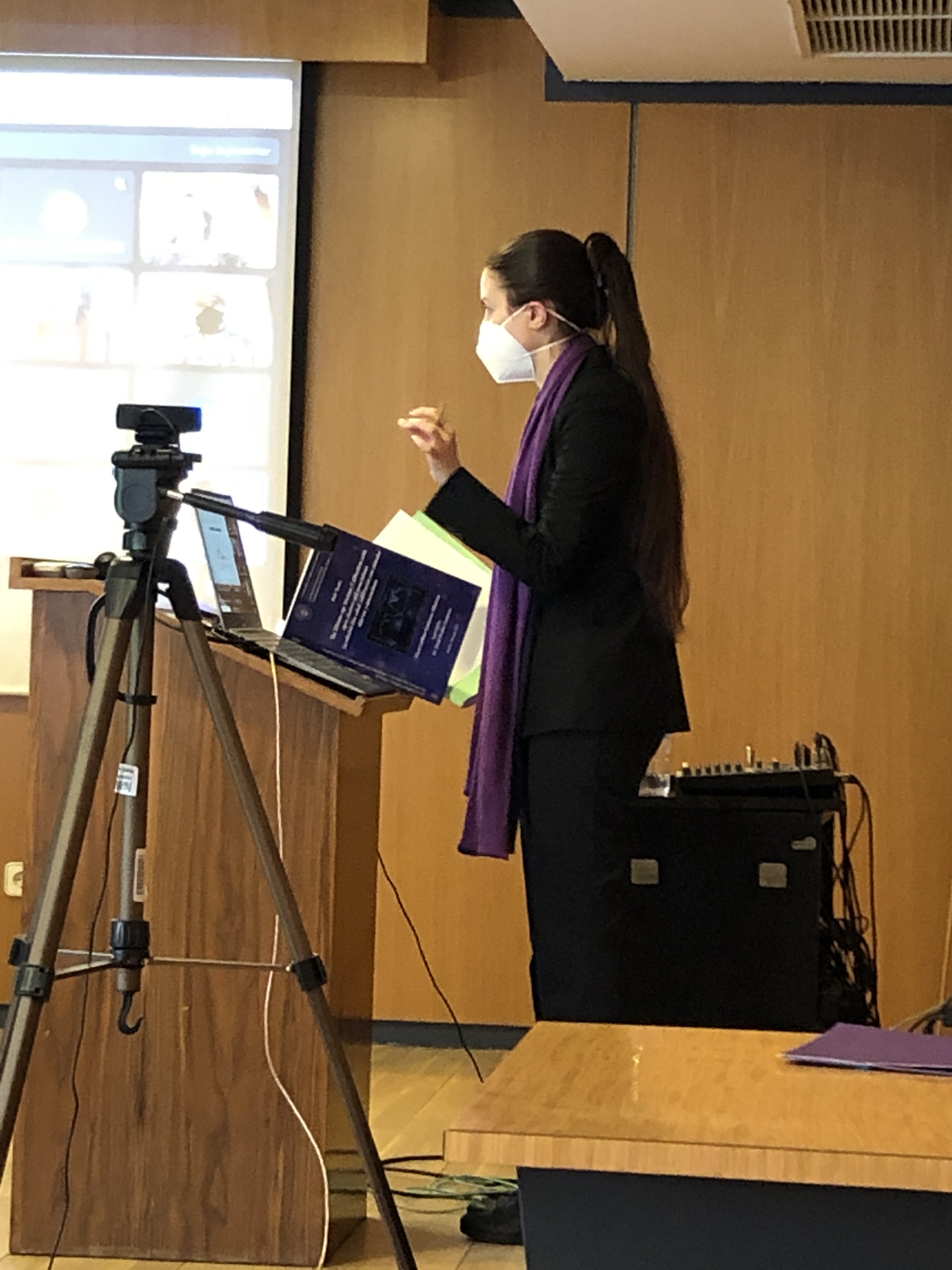
And finally, here are some pics from the thesis defense, taken by Dark Sapiens, Pilar Erika, and my supervisor David Montes:


So that's it for today's science post 😀🌟 🌌🔭! I'd like to post a bit more often about Astrophysics and science on here, and I was thinking about maybe starting by doing another post about the article that I got published in A&A back in 2020. This article is the first part  of the one that I'm writing right now, including all the final analysis and results of my PhD project, so we'll see when they appear on here! 

In the meantime -

Doctor out 😁✨💙🌈!


✨Read the full post about my thesis and PhD defense here

Read and download my PhD thesis here as a Google Drive file, and also find it on ADS and on the UCM E-prints.

✨ My first author scientific papers published in 2020 and 2024

You can also find my list of publications, including articles and conference proceedings, on ORCID , ADS, and Scopus.

Friday, 20 May 2022

Goodreads feminist reviews - Doctor Who audiodramas: The Blazing Hour

 Audio: The Blazing Hour, a Big Finish audiodrama from the 2021 Main Range series, featuring the Fifth Doctor and Turlough.

5/5. Goodreads review also here.  

 This story is a really good take on criticizing capitalism, colonialism and corrupt politicians. Peter Davison and Mark Strickson as Five and Turlough are on top form, with a great dynamic going on, and it's very refreshing that all the supporting cast are poc, with several female characters in varied roles as prime ministers, politicians, scientists and activists.

Representation matters 😃!

+1 In stark contrast to "Kerblam!" (welp), this story handles the criticism of a ruthless capitalist human colony system extremely well throughout. The story also includes a fleshed-out range of greymoral politician and corporate characters ranging from the overtly corrupt, to the incompetent and careless about life, to the more honourable. Unlike "Kerblam!", however, despite the existing 3D characterizations and greymorality amongst the cast, the story criticizes the more corrupt politician and corporate archetypes consistently when it's due, even though they may end up choosing a slightly less amoral and profit-exclusive action from time to time thanks to the influence of the Doctor and (mainly) their own self-survival selfish mindsets. 

For example, when an amoral and corrupt politician decides to sacrifice herself to help save the day, the Doctor, and especially Turlough, highlight the fact that her motivations where still mainly money and profit and her former problematic behaviour was not completely swept under the rug just for a 'redemption in death' trope, which was also refreshing. Meanwhile, anti-capitalist activists who also died in this story and showcased a much more moral and kind mindset throughout the plot's conflict were completely ignored by the final Prime Minister's official eulogy, as Turlough bitterly commented on. This kind of discourse was honestly sorely missed in "Kerblam!", which instead chose to coddle the capitalist higher-ups for making the slightest effort towards a potentially better (but for whom?) system.

I love Thirteen and the Fam, but Kerblam!'s way of tackling capitalism was not it

+1 The topic of profit over human (and alien native) life is repeteadly highlighted amid the social criticism themes of this story, and colonialism and classism are also strongly featured throughout. It's very refreshing that the most honourable politician characters happen to be members of the native species of the colonized planet, and activists against the capitalist system are also given positive characterizations.

+1 The story heavily tackles how a capitalist, colonialist and classist system can often put lives at risk by prioritizing profit, and the plot revolves around a catastrophic accident in an energy plant catalized by the corporate leaders in spite of the misgivings and warnings of the lead scientist of the project. While some have interpreted this plot as an anti-nuclear energy metaphor (the story uses "time energy" xD, but it's a valid comparison), Mark Strickson and the cast in general have spoken in the behind the scenes tracks about environmental factors and the need for green energy, speaking favourably about nuclear power as well. This story was indeed inspired by accidents such as Chernobyl, but, instead of being an anti-nuclear energy story, I personally interpret it as a criticism of how incompetent and amoral corporates in a capitalist society are quickly prone to putting lives in danger by throwing caution and safety to the wind and prioritizing profit, disregardless of the type of energy that the power plant may be using.

The Blazing Hour's excellent supporting cast. From top to bottom, left to right: Lynsey Murrell, Donna Berlin, Rakle Ayola, and Raj Ghatak.

+1 As mentioned above, the diversity representation among the cast is excellent, with a 100% poc supporting cast and women in many different roles, from the lead scientist to the president of the colony, several politicians and a member of the activist groups opposing the capitalist system. The fact that all the supporting cast are either of black or South Asian ethnicity, and that there are so many female characters in varied roles, puts a quick end to any possibility of negative stereotypes associated to either gender or race, in regards to the role, integrity values and personality of each character. As such, we have black actresses in positive roles of a competent and intelligent scientist or a brave activist (both roles very nicely played by Lynsey Murrell), not just as a moderately incompetent prime minister (Donna Berlin) or an amoral, self-serving politician (an excellent Rakle Ayola). Women also take a clear centre stage among the supporting cast, with only two distinct male characters, an incompetent corporate boss and a more principled native local leader, played by the same actor (Raj Ghatak). The voice work and variety of accents used by the supporting cast is so good you don't even realize many play at least two characters because all voices are so distinct.


+1 I also really liked the dynamic of Five and Turlough in this story. This is from the time at the end of Season 21 when they are having adventures alone, and in these audios with them you can clearly see that the bond between them has deepened, with Five being outright distraught and grieving for more than one episode when he is told that Turlough has allegedly died in the explosion caused by the accident, one of these scenes also acting as an additional stab in the feels with the reference to the companions he has formerly lost in this incarnation - most notably, Adric 😭 (a great characterization that is a refreshing change in contrast to the horrid treatment of Turlough's graphic torture and assault and the infuriating resulting emotional disconnect from the Doctor in books such as The King of Terror 😣 Although the Doctor isn't always the best when it comes to comforting and communicating with their companions when they are grieving, traumatized or struggling with mental health, truth be told :S - Tegan really needed that closure scene in Power of the Doctor 😭. So yeah, I really appreciated that Five was much more open emotionally in this respect throughout this audio).

Look at all the wholesome!

 +1 Turlough's dynamic with activist Fionn is also excellent, showing a partnership between a woman and a man that is refreshingly devoid of any sexism (or romance, for a change), and filled with mutual respect. It reminded me a bit of Turlough's dynamic with Norna on 'Frontios' quite a bit, although this one is more fleshed out.

+1 And as final related notes, I also liked the fact that when Turlough's legs get injured by the explosion and Fionn gets him a wheelchair to be able to get out of the building, she asks if he has a problem with it, and he remarks that not at all, as 'some of the best people use wheelchairs', and he's rather more worried about the fact that Fionn would have to wheel him around among the wreckage. 

 I also loved Turlough's characterization in this story, and you can really see his growth. Having evolved from his prior self-survival priorities (stemming greatly from his background and former trauma), he retains his sarcasm and more acerbic wit, but also showcases a greater willingness to make things right and take an active stand in trying to solve the situation, even though he still tends to berate himself for being a coward (which he honestly isn't, hot take. Like the Third Doctor said, bravery isn't about not being afraid, it's about being afraid and doing what you must in spite of it). Also, seeing as he originally comes from a high-class aristocratic family on his planet Trion, I also really liked to see how often and how intensely he criticized the self-serving attitude of the corrupt politician and corporate characters throughout the story, condemning that their one and only motivation seems to be only profit, money and power.

Sunday, 9 September 2018

'Women Who Dared' Oxford exhibition - Suffrage centenary and women in history


 Last August I went to Oxford to visit the Tolkien exhibition, and, by a lucky chance, there was also a feminist exhibition in honour of the suffrage centenary, called 'Women Who Dared', featuring both suffragette material and original manuscripts and books by and/or about women in history - writers, poetesses, scientists, pirates and soldiers. So I'm back to the blog with a pic spam about the exhibition :D! Enjoy :)


Suffrage-related shop goodies :)


And my Oxford haul, featuring both Tolkien and feminism :D:

Women in history represented in the exhibition:
  • Sappho, Ancient Greek poetess:
  •  Lady Ise, 9th-10th Century Japanese poetess:

  •  Christine de Pizan, the first Medieval European professional female writer (14th-15th Century), with feminist writings:

  • Mary Read and Anne Bonny, 17th-18th Century pirates:
  
  •  Hannah Snell, 18th Century soldier

  • Ada Lovelace, 19th Century mathematician and programming pioneer:
  • Mabel Purefoy FitzGerald, 19th-20th Century pathologist: