Showing posts with label anti-war. Show all posts

Monday, 12 August 2024

Goodreads reviews - Doctor Who: Winner Takes All (New Series Adventures, #3)

Book: Doctor Who: Winner Takes All, by Jacqueline Rayner.

3.5/5 Goodreads review also here.  

 This is the third book in the Doctor Who New Series Adventures series, featuring the Ninth Doctor and Rose Tyler. Some thoughts below, including spoilers:

This book has, in my opinion, an engaging plot, pretty good characterization, a proactive Rose, and features some interesting ethical themes, such as criticizing the violence of video games, anti-war mindsets as per usual, denouncing the behaviour of bullies, and tackling the ethical issue of controlling a person. The story also features a handful of problematic elements I didn't like, though, so full discussion of those will follow as well. Spoilers below!

Female representation:

  Rose Tyler is the main female protagonist as Nine's companion, and her mother Jackie Tyler makes a limited appearance as a secondary character (would have liked to see more of her, although the dynamic between her and Rose was lovely). Most female characters in this book, though, are extras, neighbours from the Powell Estate plus some random humans abducted for the game, plus a female Quevvil alien. All of these characters hardly talk or only have a very minimal part in the plot. The one who appears a bit more is incel-teenage Robert's mother Daisy, whom Rose befriends at very nearly the end of the book. Apart from Rose, most of the action and dialogue in this book goes to male characters, from the Doctor to Mickey Smith and his male friends, Robert, local bully Darren Pye, and male Quevvil characters.

+1 Rose is proactive and shows a lot of agency, wits and resourcefulness. She confronts a bully head on, rescues Mickey and the Doctor in a very resourceful way, engages actively in the adventure at hand (which involves saving human beings from aliens who are making them play as part of a video games against their enemies), and, even though she apparently seems to think that in the Doctor's mind she always plays the role of the one who 'needs to be rescued'  ('He gets to be the superhero. I get to be rescued'), the truth is that she always tries to find a solution on her own, instead of waiting to be rescued, and is a very proactive companion overall.

I quite enjoy how proactive and assertive Rose always is, both in the series and the extended universe.

+-1 In the last third of the book Rose becomes a playable character inside the video game they're trying to put a stop to and all her movements and actions are being controlled by the Doctor, who's very much not happy about it, but it's also worth mentioning that it's the main female character, who has been very proactive so far, who ends up in this more passive position involving a dodgy non-consent issue. At least the plot does explore at length how this loss of control and the feeling of someone else controlling her every move (even if it's her best friend) affects Rose, who describes the feeling as terrifying, uncomfortable and vexing. Even when the videogame effectively transforms her into 'Super Rose', with superhuman strength, speed, agility and stamina, something that she wishes she could be in real life, she still feels massively uncomfortable about the situation as she is unable to make any single choice or movement of her own. For his part, the Doctor continuously rages at the fact that he is forced to control Rose in this way and is very upset about the fact that the Quevvils are making him dehumanize Rose (and the other humans), and the issue of the indignity of treating human beings as puppets and toys is frequently brought up in the book, which I appreciated.

+1 Jackie Tyler also shows her usual upfront side and confronts neighbourhood bully Darren Pye when he has a go at Rose.

We stan badass Jackie Tyler

 +1 Female bonding and Bechdel: We see several instances of bonding between female characters throughout the book, featuring several women from Rose's neighbourhood, and also the scenes between Rose and Daisy, teenage Robert's mother. I particularly enjoyed the mother/daughter relationship between Rose and Jackie, here portrayed as healthier and more mature than is shown in other books and episodes, and they worry and care about each other in a very lovely way. 


Some problematic issues, from a feminist pov:

-1 True to his characterization in the series, Mickey Smith is portrayed with so much male entitlement going on his character is very jarring, even if he also has some better scenes in this book. He neglects the housework in his flat 100%, never seeming to clean anything and, in a grating scene, also expecting his (ex)girlfriend Rose to bring him the groceries his kitchen has been lacking for a good while ('[There won't be any biscuits] since I stopped doing the shopping for you'). In this grating scene, the Doctor goes all 'yay bros' with Mickey and sits down for a videogame session, casually and 'jokingly' telling Rose to 'Go and get us some milk and biscuits, will you Rose?'. Ugh. Just ugh.

Male entitlement and gender roles are so funny, aren't they.

 -1 Although Rose is labelled as Mickey's 'ex-girlfriend' in one instance, Rose also feels like they haven't properly split up, and, similarly to what happens in the series, the ambiguous triangle between Rose, the Doctor and Mickey frustrates me to no end and doesn't promote anything that's remotely healthy when it comes to relationship dynamics. Mickey is overtly jealous of the Doctor all the time, the Doctor bashes Mickey and has a go at his capabilities at any time he can (even though, to be fair to a character I don't particularly like - with Noel Clarke's real life beahviour also being an important factor why -, Mickey does play an important part in the story when it comes to saving the day with his computer and videogame skills). All in all, the Nine/Rose/Mickey scenario it's a very cringe-worthy situation that I don't particularly enjoy (more about that in my review of New Who's 'Rose').

Can we stop doing the triangle cliché, especially when it just promotes people being really ambiguous about their relationship status and not communicating? Crowley would never to the first one. He and Aziraphale are also not so great at communicating, though, in their own wholesome-r way, but they are also rather more justified because trauma baggage (sobs xD).

-1 There are a couple of mentions of domestic violence and feminicides which I feel are treated a bit more 'humorously' than they should: Mickey's (male) friends also think that he has more value among his peers for having dated the 'most beautiful girl of the neighbourhood', and what is worse, he is also seen as more virile and badass for potentially having murdered her (and maybe other blonde women), as was suspected of him during the disappearance in the TARDIS in S1 of New Who. What the actual f. Later on, we also briefly encounter a man who has wilfully sent his wife/girlfriend to die because he couldn't stand her, but lately comes to mildly regret it (poor him, I guess). If one is not going to full on denounce gender violence, I think that it is better not to mention it in the first place, and even more so seeing as this book was written by Jacqueline Rayner, the only female writer out of the six Nine&Rose novels, and one of the very few female writers in the Doctor Who book series :S.

+-1 Several male characters, especially Mickey and Robert (we'll talk about this incel below) are afraid to show fear and pain, and turn to bragging and creating Gary Stu stories where they're the hero to hide their insecurities. The book does add conscious criticism to these issues, though, with Rose innerly eye-rolling at how Mickey feels embarrassed for expressing vulnerability, and the Doctor at one point claiming that it's OK [for men, and everyone] to cry and be afraid ('It's OK to cry. I cry all the time').

-1 The whole depiction of teenage Robert's character is that of the ultimate incel and he got on my nerves constantly. He feels oppressed because all the pretty girls don't fawn at his feet in adoration, and wallows in self-pity at his lack of social skills to be suave and charming. He ends up being super creepy about Rose and at some point in his incel daydreams he actually wishes he could control and own her (similarly to other girls in his fantasies), something which, especially considering Rose's arc in the last third of the story, is not great. He dislikes his mother with a teenage passion because he feels that she coddles and embarrasses him and spoils his chances to be charming with the girls. All of these traits are combined in his daydream fantasies, Gary Stu fanfics where he's the hero and the Chosen One (ripping off Star Wars, Harry Potter and more) and goes on adventures without his mother, and gets all the girls, of course. There's nothing wrong about fanfics and daydreaming and self-inserts, but Robert fits the incel archetype to a T, and his entitlement and toxic masculinity shows in all of his self-insert adventures in a very obnoxious way. There is also a huge difference between having a crush and wanting said crush to fawn at your feet because you're theoretically entitled to that - that is young boys displaying all the misogyny and entitlement that they have been learning and not deconstructing in the slightest. It isn't adorkable teenage hormones, it's a string of abusive relationships in its making.

Me reading Robert's character

Not sure if the author was going for parody/criticism when it comes to this character, it kind of looks like that sometimes, but it can feel ambiguous at times, and in some respects, it actually looks like the character is meant to be kind of flawed but adorkable, with a hero-ish journey and ultimate character development as his intended arc. But because none of his incel traits are really challenged by any of the characters, and he never actually changes in that respect, this character started and ended being supremely cringeworthy to me, intended criticism or not.

-1 Finally there are two rather cringy and gratuitous mentions of 'alien bondage' (wtf) - featuring Mickey browsing the Internet looking for exactly that after a cringe-worthy first scene with the Doctor (and Rose) mentioning the topic.


Ethical issues:

+1 The whole premise of the book revolves around several interesting topics, from the inherent violence of video games and the dangerous effects they can have on people's ethical mindsets, to how human beings will readily turn to violence and bullying in real life more often than we'd like to think. It also tackles the very Whovian topic of a war between alien races which the Doctor will try to stop, and a very Hunger Games-esque plot where one of these alien races uses human beings as 'playable characters' in a videogame that is designed to kill and conquer their enemies.

And I love me some Hunger Games-flavoured dystopia as a social criticism vehicle

-1 However, the Doctor seems to think that 'I hate guns (...) which isn't to say that a bit of fantasy violence can't be therapeutic' (as opposed to the story's 'videogame', where the players turn out to be real living beings being killed in real time), and thus is initially happy to engage in killing 'alien baddies' with Mickey. While this statement may be sometimes true, in this particular case, it is also rather throwing under the bus the fact that more than one kind of 'normal' videogames (the kind where you're not actually killing real sentient beings) do normalize real violence in a very problematic way

'Never-fired-a-gun' Crowley would definitely have some thoughts on this matter

+1 Anti-war themes all round, with the Doctor and Rose criticizing the unnecessary conflict between the Quevvils and Mantodeans ('Technology like this, and they use it to further a war').

-1 However, the Doctor actually kind of commits genocide in order to save the human captives (atomizing most of the Quevvils when they're still teleporting) and also ignores the attacked Mantodeans at the end (which seem to have everything in control but even so, he doesn't think about them), going away in his TARDIS as soon as the humans were freed. That is a problematic issue, imo, and not very Doctor-y, especially for the Ninth Doctor, who is fresh out of the Time War and is viscerally opposed to the concept of genocide, to the point of choosing not to destroy the Daleks in 'Bad Wolf'/'Parting of the Ways' in S1. So this would definitely not be his first choice, and the nonchalance with which he did it is also massively out of character.

I mean, this is definitely one of Nine's best and most defining moments.

 +1 The Doctor's approach to Rose being happy (but also guilty about that happiness) when she thinks the bully who attacked her mother is dead was a very nice, nuanced scene: '(...) it's all right. You're still allowed to hate them. As long as you don't gloat at their downfall, that's all.'

 
+1 Mickey thinks about how the Doctor just expects him to put himself in danger and/or help him with his plans without asking for his opinion, and it's a very valid point (I hate to agree with Mickey as a rule, but here we are xD). Rose also wonders at some point whether the Doctor sees her as more than the validation he needs to be a hero in the eyes of someone else, and also feels angry at the lack of consideration that Nine sometimes has towards her, her mother or Mickey.

+1 As discussed above as well, this book fully tackles the issue of non-consent and dehumanization when it comes to controlling a person's movements and actions (the people in the videogame are real people controlled by others). The Doctor is forced to control both Rose and a Quevvil and he rages about the fact that he's controlling another being as if they were a 'toy' or a 'puppet' ('You don't treat someone like that. You don't treat a person like that. And they're making me do it, making me degrade her like that. (...) Making me sink to their level (...) Making people dance around like puppets, making me take away every scrap of dignity of my best friend...(...) We'll get out of this (...) But, back of our minds, it'll always be there'). He also gets angry when the Quevvils refer to the human victims as 'carriers' instead of seeing them as individuals. The narrator also shows Rose's point of view about how problematic that situation is and how helpless and annoyed she feels while being controlled.

Nine's disgust and anger at the Quevvils' tactics was very much in character, thankfully.

 -1 Even though this issue is amply discussed, the Doctor and Rose never actually discuss it in person when all is finished, which is not a very healthy decision (and it is their MO, because Nine actually says how they will never discuss it in person because they never do, even though it has left them both traumatized). Also, the Doctor makes a joke that is in very poor taste at the end of the ordeal, when Rose is not present, and to incel Robert of all people, saying that he wouldn't mind from time to time if he were able to control Rose in the way that he formerly raged about being forced to do just before (¿?), because it would lead to a lot less trouble :S. Not-so-great humour as a result of even more repressed, uncommunicated trauma? In any case, such an unnecessary thing to say. 

And see what I mean when I said that pretty much none of Robert's incel traits are challenged? The Doctor does teach him about how crying is healthy and several ethical dilemmas in their time together, which is all good, but if anything he is being enabled in this particular scene (ew), and he leaves the TARDIS at the end none the wiser that Rose is not head over heels over him (sigh), because he has fantasized about it from the very first time he saw her, so that's how it is, but from her point of view, Rose has just greeted him politely and met him for all of five minutes, and that's all there is to it. Ah well xD.

The Robert 'character development' arc? Needs some work. He basically needs to start viewing women as people, for a start. Same as he got the crash course on ethics regarding intergalactic alien wars. Can't be harder than that, right? (welp).

If you want to read more reviews of the Doctor Who New Series Adventures:

 -The Clockwise Man (New Series Adventures, #1)

-The Monsters Inside (New Series Adventures, #2)

Friday, 22 April 2022

Goodreads feminist reviews - Doctor Strange and Philosophy


Book: Doctor Strange and Philosophy: The Other Book of Forbidden Knowledge (2018), ed. Mark D. White


3.5-4/5. Goodreads review also here.

 This is an anthology of 22 essays having to do with the crossover of philosophy and Doctor Strange (including themes from both the 2016 movie and the comics). As with any book which contains a number of essays written by different authors, some of the essays in this book I quite liked, others I liked, others were more meh, and some I actively disliked. 

Philosophy is also a hit and miss subject for me depending on the specific branch and how it's approached - I tend to really like ethics, and also prefer the more scientific areas of philosophical study (such as speculative physics or various themes in metaphysics), but there's a number of other topics - and specifically also the manner in which they are generally expressed - which are quite liable to either frustrate or bore me in various degrees - an important factor as to why is that I may have a pet peeve about random white dudes stating subjective thoughts, opinions and beliefs as absolute Truths, as philosophers often do :S xD

But anyway xD, some thoughts about the book (warning, LONG xD) -

Both a meme and a great study of ethics 

+1 Like I mentioned above, in this book I especially enjoyed the essays which discussed ethics (virtue ethics, deontology and consequentialism, in this case), as well as those delving into scientific matters and speculative physics. I particularly liked one essay which discussed quantum mechanics and the MCU Multiverse, and another one which considered what the plot of the 2016 Doctor Strange movie can tell us about the scientific method, regarding how new empirical evidence can lead to new theories and scientific approaches in our understanding of the world (couple of quotes below).


+1 Another essay I really enjoyed, written by one of the three female contributors of this book (note on that below), tackles gender and race biases in both philosophy and superhero comics - both worlds historically majorly male and white -, and the ways in which the Doctor Strange movie subverts some of these biases (such as making the Ancient One - an authority and knowledge figure - female, or greatly improving the role and status of Wong as a Master sorcerer in contrast to his role as the manservant of Strange in the comics). The essay also tackles the problem of whitewashing in movies (while I adore Tilda Swinton both in general and as the Ancient One, and I love that they chose to make the Ancient One female, I also think that they could just as easily have chosen a female actress of Asian descent, with no problematic stereotypes involved). Overall, this essay was a great feminist and intersectional read (couple of excerpts below).

 "What if it's a woman? You know, why can't it be? You know already the idea that the Ancient One is the head of all sorcerers; now that person is also a woman. I'm already interested, and I'm already feeling liberated from the chains of cliché." (The Art of Doctor Strange)

Tilda Swinton's Ancient One in the MCU

-1 Unfortunately, gender bias in philosophy and the comic book world, as criticized in this essay, is fully present in this book as well, ironically. Out of 22 essays, it seems that only three were written by women, and if I remember correctly, only one female philosopher is mentioned in the whole book :S

More women than 14%? Yes xD

+1 A couple of other essays also accurately commented on how Nietzche was an infamous misogynist and Heidegger supported Nazi mindsets, comments which I appreciated because we need to hold historical figures accountable for their problematic aspects.

-1 Something which I lacked in an essay tackling St Augustine, another infamous misogynist who was quite pedestalized in an essay which discussed more religious interpretations :S - I also fully disagreed with that essay's idea that the journey and character development of Strange mirrored 'St' Augustine's life, but ah well xD.

Please, but "St" women-should-not-be-educated Augustine wishes he were this cool. Also, Strange did appreciably grow out of his initial male entitlement, can Augustine say the same? No.
 

-1 And regarding social activism topics, I also have to say that I deeply disliked one essay which had the baffling objective of convincing the reader that the servile role of Wong in the comics as the personal manservant of Strange, in itself an issue deeply steeped in classism and a racialized context, is not wrong or problematic at all and actually empowers the character of Wong! We can encounter deep and meaningful friendships when a master/servant dynamic is also (regrettably) involved, such as Frodo and Sam from The Lord of the Rings. *But* the fact that this kind of dynamic might evolve to develop a meaningful interaction does not mean that we should not also be fully critical of the power dynamic and the classism and racialized/gendered aspects of a master/servant relationship in the first place.

MCU's Strange and Wong be like wtf

This particular essay I found deeply offensive in its endeavour to claim that it's actually servitude which gives Wong's life meaning and boosts his self-confidence and self empowerment (wtf), and that both parts of the master/servant dynamic get benefits out of the arrangement. It's a neoliberal-oriented 'choice' approach that ultimately completely glosses over the fact that it's a classist and racist system which has made Wong into Strange's servant in the comics, same as his father was the servant of the Ancient One, and his father before him, and so on. If we take this 'choice' approach and make minimal parallels with say, oppressed women in a patriarchal society, or enslaved black people in the USA, I think it becomes clear enough how offensive and illogical this interpretation is - the ludicrous idea that oppression and a servile function to the privileged groups actually gives your life meaning and that you reap ample positive benefits out of a deeply unequal power dynamic.

Wong is certainly Strange's friend in the MCU, but he's also been a Master Sorcerer in his own right from the beginning, and the actual Sorcerer Supreme since the Blip. So yasss.

Thank Agamotto that the role of Wong was vastly improved in the MCU. I can't help but wonder whether the author of this essay would think that now Wong's life does not have meaning because he's a powerful Master sorcerer in his own right, and is now the actual Sorcerer Supreme. Heh.

"From the comic books, Wong came across quite like a manservant or sidekick. I think with our version, we're happily putting that to bed and updating his story for a modern audience. (...) He is someone who is very serious about his job. He's very otherwordly, wise (...) There's a quiet confidence to Wong. He's stoic. He's foerever watching and loyal. I think he comes from a long line of that." (Benedict Wong, The Art of Doctor Strange)

-1 And now comes the big topic. While there were at least three essays in the book which tackled this matter more accurately, or at least following the reasoning I would have chosen, there is a discourse which I kept finding in several other essays which frustrated me time and time again. According to all these essays, the scientific aspect of Doctor Strange, initially a brilliant neurosurgeon, is something which went hand in hand with his arrogance, narcissism and materialistic view of the world. This materialism and his scientific aspect, as linked to the mechanistic current ('we are made of matter, and nothing more'), would be then opposed to the greater empathy, integrity and altruism that Strange shows as the movie progresses, which these essays repeteadly linked to his newfound 'enlightenment' and 'interest in spirituality', and the broadening of his mind.

Nope, Strange is still all about the science and the knowledge, his improving his attitude and his ethics has nothing to do with embracing the study of magic, which he approaches in a similar way as his former medicine studies, anyway.

While some of the points and philosophical stances described in these essays were interesting from a purely philosophical point of view, it's a huge misconstruction to say that science equals a lack of altruism or a greater materialistic and shallow mindset (wtf), and that it's an 'interest in spirituality' which makes someone more altruistic and empathetic. That's just both offensive and factually wrong. Like the Ancient One tells Strange, it's 'arrogance and fear' and his narcissism which have kept him from expanding his mind, not his interest in empirical science.

Why do people keep associating science with a lack of empathy or a more materialistic view of the world, wtf. Doctor Strange keeps a scientific mindset all the time, it's his entitlement and narcissism which get better disregardless of that!


'Which is?' 'It's not about you'.
 

 And even though the 2016 movie's director, Scott Derrickson, also commented on this inaccurate correlation between 'selfishness and skepticism' and 'altruism and spiritual enlightement' as Strange's journey (for example, in the art book), in my opinion the movie itself does a great job in addressing Strange's journey from narcissism, selfishness and materialism to a more altruistic, accountable and ethical mindset, yes, but it's not necessarily linked with a journey of 'spiritual enlightement', or 'from skepticism to mysticism', more than a combination of changing his entitled and arrogant attitude and becoming 'more self-reflective' as a result of suffering 'personal loss and trauma', as Derrickson also comments on, and widening his understanding of the universe by considering areas of study that he was unaware of. But in the MCU and Marvel comics universe, magic and the Multiverse are real and liable to be studied in an empirical fashion - just like science is.

Thus, it's also a huge false equivalence to link the evolution of Doctor Strange as a sorcerer to the potential higher merits of real world spirituality (and pseudoscience) as opposed to empirical science. The essays seemed to repeteadly link Strange's scathing remarks about the unscientific nature of chakras or acupuncture (I mean, both things *are* objectively pseudoscience) with a narrow-minded view of the world which needed to be expanded. Being open-minded is the actual point of scientific curiosity, skepticism, and the scientific method, and that is exactly what Doctor Strange does - When shown actual empirical evidence that the Multiverse exists, and seeing that in the Marvel universe it is actually possible to draw energy from other dimensions to create 'magic' (thus linking magic way more to technology and science than spirituality), he just expands his view of the universe when shown that there's more to what he had learned, and includes the study of magic to his existing knowledge (excerpts below from the essay about the scientific method I also mentioned earlier in this review).

Strange does not ditch modern medicine to embrace acupuncture, chakras and spirituality. He actually studies and performs magic following a very similar method to the science and technology we're more accustomed to, and he's shown actual empirical evidence and contrasted information about it.

Hell yeah to the scientific method

 In our real world, however, the theory addressing the existence of a Multiverse is an actual field of study in speculative physics, yes (and other essay in this book talks about this in the context of cosmology and quantum mechanics), but it *is* speculative. And spirituality, while valid on its own, simply and objectively cannot replace science if what we seek is the empirical understanding of the universe. Strange's Sorcerer path *is* undeniably heavily inspired and linked with Eastern martial arts and spirituality, both in aesthetics and ethos, but the way he studies and harnesses magic is rather more in line with science and technology than with actual spirituality as we would understand it in the real world (as is also the way with many MCU perceptions of magic as science and technology 'not yet understood', as also portrayed in the Thor movies). Overall, the whole discourse when these particular essays (and there were a few :S) tackled this topic was a huge false equivalence fest.

-1 I also disliked the way that a couple of essays seemed to need to add the disclaimer that 'religion and science are not incompatible, in fact they are fully compatible because I will now give you some examples of historical scientists who also believed in God or were interested in spirituality or alchemy'. Obviously, individual people are entitled to their personal spiritual or religious beliefs (as long as they don't try to impose those beliefs on anyone else or enforce inequality against oppressed groups, which is the flavour of criticism I go for when I say I'm critical of religion). But the issue regarding the science-vs-religion discussion often doesn't have to do with individual beliefs, it has to do with the fact that enforced religious systems have historically hindered or prohibited science systematically, by imposing unscientific mythological concepts as Truths, and literally persecuting and murdering people who offered advances in science instead of abiding with those religious 'truths' as to the nature of the universe (and also persecuting religious beliefs which deviate from the systemic dogma). The fact that Newton believed in God (totally fine, but irrelevant in this discussion), or that Descartes (rather unscientifically) claimed that God is an innate proof of our reasoning nature (which let's be real, it's a bit wtf xD) are really neither here not there regarding this issue :S

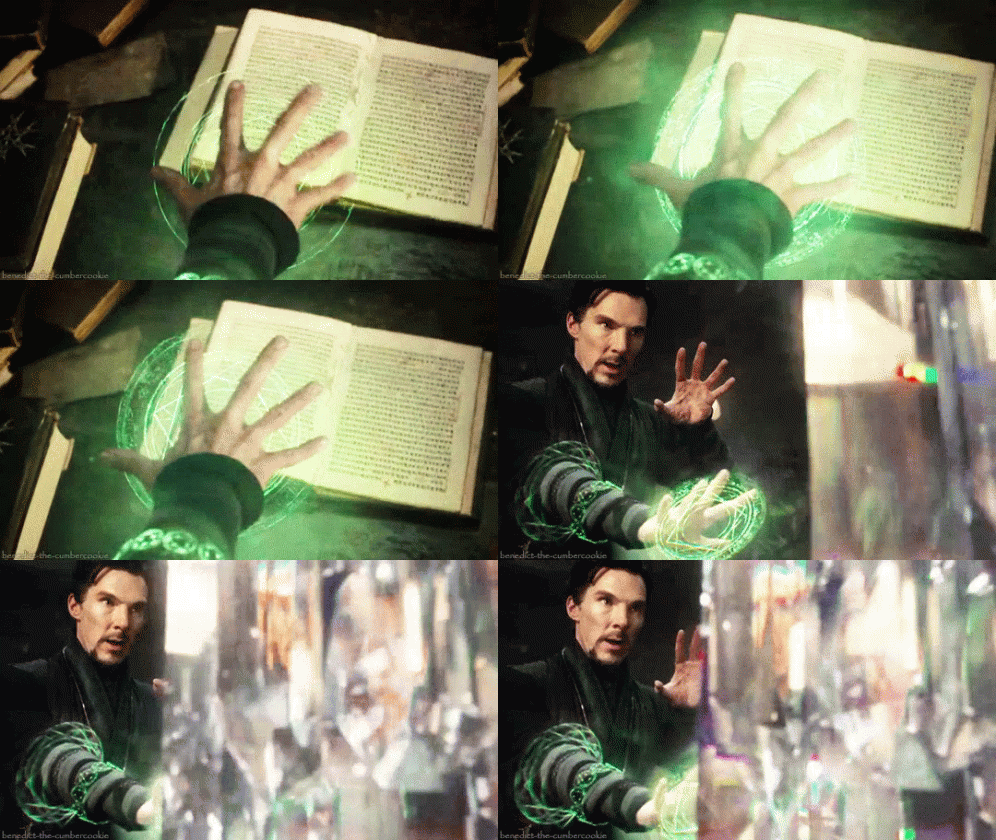
Anyway, have another gif about sorcerers and books xD
 
+1 While discussing the influence of the pacifist-oriented ethics of Eastern martial arts on Strange's ethos as a sorcerer as well as a surgeon, there's a reference and quote to the 1970s series 'Kung Fu', which I really like, so kudos for that!


- And finally, this is more an anecdotic discussion than something I liked or didn't like - There's one essay which discussed mind-body dualism as illustrated in Doctor Strange by the astral bodies. However, the author seemed to keep trying to rationalize the way astral bodies were portrayed in the movie, not just comparing them to philosophical theories of dualism as an interesting exercise, but actually trying to find logical consistency between them, as if the portrayal in the movie would either confirm or discredit said theories of dualism.

The Ancient One show Strange his astral form

While the astral bodies in Doctor Strange are clearly inspired both by spirituality currents and by various philosophical explorations about mind-body dualism, as a fantasy and sci-fi movie it doesn't need to be fully consistent with all these currents, nor do we really need to judge the accuracy of the depiction of Strange's astral body and its properties in regards to what philosophy has had to say about dualism - especially considering that dualism is, as of now, mostly devoid of any empirical scientific proof! The exercise of questioning how Strange's astral body is or isn't consistent with existing philosophical theories of dualism and transference between the mind and the body is certainly interesting for purely academic purposes, but the way the author seemed to be actually thorough and serious about how a fantasy and sci-fi movie with astral bodies confirmed or denied real life philosophical theories of dualism both puzzled and amused me xD

Tuesday, 24 August 2021

Goodreads feminist reviews - Warhammer Fantasy: Dragonmage (Storm of Magic II)

Caledorian High Elf riding a dragon (©Games Workshop)

Book: Dragonmage, by Chris Wraight.

 3.5/5. Goodreads review also here. A rather shorter review than the last Warhammer post, although  this review ended up inspiring a whole other post about Warhammer female representation in the miniature ranges xD

This review contains some spoilers of the plot of this book.

+1 Well-written and engaging, I especially liked how the initial battle scene was constructed, as well as the action scenes featuring the Caledorian dragons.

+1 I'm quite a fan of the Warhammer Fantasy dragons allied with the High Elves, and they feature quite a lot in this story (including a female dragon, which was my fave). The fact that they can communicate telepathically with the Elves make them not just cool steeds, but characters on their own right with their own distinct personalities.

-1 Of course, there's the fact that the bond between the High Elf and the dragon is not always one of mutual understanding. Even though they're far older and powerful, both physically and mentally, dragons are also seen pretty much as servants bent to the will of their Elven riders, and they're supposed to go fight the Elves' enemies whenever they're woken from their long sleep :S In the story's plot, the dragons ultimately were pretty proactive in this respect, but there's that too.

+-1 Female representation was minimal, to say the least, and there's of course no Bechdel 😕. Apart from the female dragon and mentions of house servants, there's only a main female character, a mage called Anlia. All the rest of players in this story - All the soldiers (we assume), the other mages, the Sword Masters of Hoeth, the Elven Lords, most dragons (we assume), most Chaotic antagonists (we assume), they're all men. At least the ones directly mentioned. Which amounts to pretty much the same thing when it comes to representation.

Anlia's powerful and proactive, yes, but her powers also keep being used by more than one man in order to achieve power and glory, and her backstory includes the trope of the too powerful woman who lost control and accidentally killed people (and this is not particularly subverted as Frozen's Elsa's story is). So she also spends the whole story being chased by her own people, who want to bring her to justice. And she does the men's work while pretty much being locked up in a tower, because assassin mages and emissaries from the White Tower will try to kill her as soon as she sets foot in a village for a stroll. To cap it all, it turns out (spoiler!), that she has been possessed by a Chaos daemon all this time (I really hope the 'being super powerful' stuff wasn't related to that :S), and said daemon ends up killing her just as she seemed to be finally enjoying her fully-fledged power. So yay 🙃😕.

I just wanted some badass-in-her-own-right female mage content, why can't I have nice things

+-1 There's no explicit sexualization in the descriptions, which is unfortunately quite rare in Warhammer books (and miniatures heh). Of course, Anlia is also repeteadly described as beautiful specifically, even though technically all High Elves, male and female, are supposed to be canonically very beautiful. But what else is there when it comes to the women, you understand, you have to remind people they're pretty 🙄 xD

That double standards is oBVIOUSly a classic

-1 There is a very cringy moment when the Ellyrian Elf Lord Anlia is working for gets into her bedroom uninvited at night to discuss plans and stuff, and Anlia jokes that he shouldn't be in a lady's room at that hour. The entitled Elf immediately replies without missing a beat that 'pah, if I were after that I would have had it a long time ago lol', and just eww 😣. If you're going to portray rape culture in your universe and your story, male writers, at least criticize it or something, make that inclusion to be about social criticism, and do it respectfully and productively. It isn't enough to say 'we're showing another example of how arrogant he is!' because Anlia, the recipient of this, doesn't seem to particularly mind about that incredibly creepy reply. it's all just so...cheap and disrespectful, the way it's handled. Can we please stop adding rape "humour" to fantasy stories? Thanks 😑.

Don't. Just don't. It really isn't funny and it doesn't add anything to the plot except to tell me that you don't care about women, really.

+1 There's some anti-war and anti-binarism content as well, from the part of a follower of the Caledorian Elf Lord. The story features the war between the Ellyrian and Caledorian factions, with two Elf Lords who are vying for the throne of the Phoenix King (same old story, time and again, eh). This character keeps seeing the war between both sides and all the hunger for power as unnecessary and horrible, and his inner commentary was one of the most interesting parts of the story for me. He's also the one riding the female dragon, so bonus point 👍 xD

Monday, 22 February 2021

Goodreads feminist reviews - Warhammer Fantasy: Blood of Aenarion (Tyrion & Teclis I)

Tyrion and Teclis (©Games Workshop)

Book: Blood of Aenarion. A Tyrion & Teclis novel, by William King.


3.5-4/5. Goodreads review also hereThis is the first part of the Tyrion & Teclis Warhammer Fantasy trilogy, telling the story of the famous High Elf twins Tyrion ('unparalleled swordsman and tactician') and Teclis ('greatest natural sorcerer of the age'). Some (lengthy xD) thoughts below, as always focusing on a feminist pov and tackling points such as representation and female characters, social criticism and other intersections, and other issues that interest me. This review contains spoilers of the plot of this book.

+1 Rereading for the second time, I still found this book to be well-written with an engaging plot, focusing on the teenage years of Tyrion and Teclis, their beginnings as the famed warrior and sorcerer they will become, and their first encounter with Demon N'Kari.

Tyrion leads the forces of Ulthuan (©Games Workshop)
  • Epics, war and the Good/Evil binary

+1 Anti-war and Good/Evil binary critical content: Even though this is a Warhammer epic book focusing on a fantasy society with a heroic ethos and including plenty of battle scenes, some parts of this book also challenged the Good/Evil binary and included some anti-war content:

-"Too many people kill without thinking in this world." White Lion (the elite guard of the Phoenix King) Korhien Ironglaive has more than one conversation with protegé Tyrion about the dangers of idealizing war and battle, the concepts of glory and prowess, and how killing people is not something to be enjoyed. I personally really appreciated these scenes in the context of what is basically a very binary, epic genre which often disregards these matters and amps the glory and honour of battling your enemies. In spite of these pep talks, though, Tyrion - the good guy protagonist with a charming personality - turns out to be one born for war who actually claims to enjoy battle and even killing the ones who oppose him or his country, and will end up conforming more to the epic ethos of the genre :S.

-Dark Elf assassin Urian also offers some critical content of the Good/Evil binary when he muses on the centuries-long feud between the High and Dark Elves and how masquerading as a High Elf noble for decades and living among his enemies has made him see that both groups are not as dissimilar or as black and white as they think they are.

  • Female characters: Representation, roles and sexism

Concept of a high Elf female mage (©Games Workshop, Warhammer Online)

+-1 Warhammer is not the best genre for a lot of (good) female representation, to be honest, as most in-universe societies, and the stories and authors, are overtly male-dominated and sexist tropes and sexualization are often to be found both in the miniature and online game designs/roles, and in the books.

+(-)1 This particular book is still quite male-dominated, but I found to be a bit better regarding positive female representation, even though many women in interesting, subversive and proactive roles are still little more than mentions. Still, contrary to other Warhammer books and *ahem* the miniatures Warhammer Fantasy's range of High Elves offered (which was minimal and literally extended - if I recall correctly - to the Everqueen, her guard, and a mage), there are mentions of female (arch)mages and loremistresses, sailors and captains of ship, huntresses and rangers, archers and warriors, priestesses, and women taking part in political circles. Like I said, most of these roles are little more than mentions, but the bar is so low sometimes in this genre that it's still a refreshing sight :S xD

+1 Female characters with interesting and proactive roles that I enjoyed: The main one is Lady Malene, a mage and loremistress who is also active in political circles and the leader of her House of Emeraldsea apart from her father, and is described as serious, capable, powerful and intelligent. She is the aunt of Tyrion and Teclis and mainly acts as Teclis' mentor in matters of magic. I also liked that she is in a relationship without losing any iniciative or her role being ever reduced to a love interest trope.

 Another character I liked is Joyelle, a ship captain who answers to Malene and is described as capable, tough and stern (in a good way, although Tyrion first wonders at the fact that the captain's answering to Malene instead of her (male) lover and bodyguard Korhien - sigh - and then remarks on the sterness of both women, feeling relieved at seeing smiling sailor girls in the ship as well *le double sigh*). There's also sailor Karaya, who acts as kind of a love interest for Tyrion but is seen as capable in her job and shows plenty of iniciative of her own during her scenes with Tyrion. 

High Elf female mage

-1 Female characters with problematic characterization and tropes: Enchantress Morathi, the Dark Elven Queen, is always a character that's super sexualized in the Warhammer world (often wearing little more than a metal bikini and loincloth), and who follows a lot of femme fatale tropes (even though she is also an intelligent and powerful leader). Her appearance in the intro also included the love/hate relationship with Aenarion, which is not my fave thing. N'Kari the demon is also super sexualized and male-gazey when in female form. And characters such as Lady Malene's daughter Liselle followed the trope of the shallow, vain female character more than anything else and was there mainly to be one of Tyrion's love interests.

-Bechdel test: Pass. Malene and Joyelle talk to each other, and I remember conversations between Malene and Liselle, and between Liselle and another noblewoman called Lady Melissa (although they were talking mainly about Tyrion there, so maybe that conversation doesn't count :S).

+-1 Male characters and their treatment of women: To finish talking about the treatment of women in this book, there's also the theme of how men treat and think of women. Some thoughts -


-Lady Malene's relationship with Korhien the White Lion is quite refreshing and healthy, and she's always seen as the authority figure in her group without question (the ship's crew and her entourage answer to her, for example). Teclis and Lady Malene also get on well in a mentor/pupil dynamic.

-Tyrion is written with the intention of being charming and likeable, but he also revels in violence quite a bit and is quite a womanizer, sometimes bordering on dudebro material. His one-off relationship with the sailor Karaya is a pretty healthy example of a casual encounter, but the one he later has with his cousin Liselle showcases his entitlement and internalized sexism more, as he clearly views her as vain and shallow and later thinks of her in a quite disparaging way, showing he was using her more than anything else. Lady Malene also tells him to make and effort not to extend his womanizing to his close kinswomen, but there he went anyway and with Malene's own daughter no less lol (le sigh).

-Dark Elf assassin Urian is probably the most blatantly misogynistic character in the book alongside fabled ancestor Aenarion (who clearly hates his second wife Morathi but still lusts after her and is quite abusive in the way he goes about it :S). Urian may give us some anti-binarism commentary which makes us relate a bit to him, but he's also a creep who's proud of the "harem of slave girls" he had back home to do as he pleased with (ugh), and who fantasizes about making stern Lady Malene, who dares distrust him, succumb to his (violent) charms. Eww.

-1 A bit related to this, even though I have a higher tolerance for it in reading form than visual, I personally find the gorier and more graphic side of Warhammer so not my cup of tea. Especifically the sections in which the writers indulge and focus too lengthily in torture scenes or anything related to the cult of pleasure of Slaanesh (which is always a good opportunity to also include sexualized women or sacrifice scenes, yay).

  • Poc and LGBT+ representation. Colonialism and xenophobia.

-1 No representation of poc except for very brief mentions of poc humans from the Warhammer equivalents of North Africa and China (merchants, traders and people who live in the foreigners' quartet of the High Elven capital Lothern). As per usual fantasy white-centrism, it is assumed that all High Elves are white (something that in my opinion doesn't make a whole lot of sense if we're talking about a whole species :S, but OK), and all Elves whose appearance is described have fair to very pale skin (Tyrion in book 2 has tanned skin from his journeys, but yeah).

Ulthuan and its colonies in a map of the Warhammer version of the world (©Games Workshop)
 
+1 Some critical content tackling racism and xenophobia between High Elves and humans is explored. Ulthuan (the Elven insular continent) is a nation with a colonialist history which now trades with other races but at the same time is politically aislacionist (more than once this goes hand in hand with the colonialism bit), and consequently off bounds to anyone who is not a High Elf everywhere in the country except in Lothern's "foreigners' quartet", where humans and even some Dwarfs are permitted to live (with the main aim of trading). When Tyrion visits said quartet and sees humans for the first time in his life, these topics of Elven aislacionism, xenophobia and prejudice come to play in the narration. Tyrion's first impression of the humans is coloured by the xenophobic and racist prejudice he has been taught in his society, seeing them as inferior in all things and comparing them to 'apes' and 'monkeys', to the extent that he is then surprised to meet humans who are more intelligent that he and many Elves gave them credit for. He in turn also experiences xenophobic violence and slurs ('elfie', 'cat-eyes' - because of the High Elves' almond-shaped eyes) from some drunken humans, so there's also a bit of that other side as well.

-1 Practically no representation of LGBT+ people. Demon N'Kari can easily be seen as genderfluid, as many demons often are, but is portrayed in a quite problematic light. N'Kari uses 'he/him' pronouns the most, but also appears in female form at least twice. The problem is, when N'Kari is female she is incredibly sexualized and cast in the 'seductive femme fatale' role as per male-dominated fantasy standards. The fact that N'Kari is a demon who serves Slaanesh, the Chaos deity of pleasure and all things lascivious and perverse, is not helping any matters. 

  • Other intersections: Class and ability

+1 There's also some social commentary regarding classism, the hypocrisy and snobbery of the aristocratic classes and the difficulty of learning how to navigate and survive in a world full of protocol and courtly intrigues, as rural-raised Tyrion and Teclis find out when they go to the capital to live with their wealthy relatives for a while.

Teclis (©Games Workshop)

+1 Ableism critical content: While Elves see themselves as the superior race for their beauty, longer life, and the fact that most never get ill, Tyrion's twin brother Teclis is frail and disabled (he gets ill often to the extent of being in the brink of death, has a severe limp and mobility problems, and is considered to be less canonically beautiful), and thus he has experienced constant disapproval and insult from his Elven fellows, who look down on him for being 'inferior'. Compared to his able-bodied, beautiful-even-among-the-Elves brother Tyrion, he feels insecure and bitter, but relies on his intelligence, acerbic wit and remarkable magical ability to shine.

Thankfully, the treatment of this issue was pretty positive, being critical of the classism and ableism of the High Elves from the pov of Teclis, who is never seen in a negative light by the narrator because of his health problems and disabilities. Teclis will also end up being the High Elven character who seems most understanding of humans (also seen as frail, uglier and inferior by the Elves) and one of the few Elves more interested in helping them and sharing his knowledge with them. There's also the fact that even though Teclis ends up gaining more health and mobility that allow him to do adventuring of his own and live a long life to perfect his lore and magic powers, he ultimately also gains a more able-bodied lifestyle mainly by his own agency, choice and powers (as well as receiving help in this book, for example, which is also a positive thing, of course).

+1 And finally, I also like that Tyrion and Teclis maintain a pretty healthy and supportive brotherly relationship in this and other respects, which is a refreshing subversion of the often competitive, love/hate trope dynamic based in jealousy issues of the 'golden, athletic brother pitted against the dark, bitter brother' (hello, Thor and Loki xD - that particular relationship also has its character development and is really interesting, of course, but I could not let that reference slide xD

 And finally, the IG storytime with more or less the same text content, but including direct quotes and a bit more specifics sometimes (also here)