
Book: Doctor Strange and Philosophy: The Other Book of Forbidden Knowledge (2018), ed. Mark D. White.

3.5-4/5. Goodreads review also here.
This is an anthology of 22 essays having to do with the crossover of philosophy and Doctor Strange (including themes from both the 2016 movie and the comics). As with any book which contains a number of essays written by different authors, some of the essays in this book I quite liked, others I liked, others were more meh, and some I actively disliked.
Philosophy is also a hit and miss subject for me depending on
the specific branch and how it's approached - I tend to really like
ethics, and also prefer the more scientific areas of philosophical study
(such as speculative physics or various themes in metaphysics), but
there's a number of other topics - and specifically also the manner in
which they are generally expressed - which are quite liable to either
frustrate or bore me in various degrees - an important factor as to why
is that I may have a pet peeve about random white dudes stating
subjective thoughts, opinions and beliefs as absolute Truths, as
philosophers often do :S xD
But anyway xD, some thoughts about the book (warning, LONG xD) -
 |
| Both a meme and a great study of ethics |
+1 Like I mentioned above, in this book I especially enjoyed the essays which discussed ethics (virtue ethics, deontology and consequentialism, in this case), as well as those delving into scientific matters and speculative physics. I particularly liked one essay which discussed quantum mechanics and the MCU Multiverse, and another one which considered what the plot of the 2016 Doctor Strange movie can tell us about the scientific method, regarding how new empirical evidence can lead to new theories and scientific approaches in our understanding of the world (couple of quotes below).


+1 Another essay I really enjoyed, written by one of the three female contributors of this book (note on that below), tackles gender and race biases in both philosophy and superhero comics - both worlds historically majorly male and white -, and the ways in which the Doctor Strange movie subverts some of these biases (such as making the Ancient One - an authority and knowledge figure - female, or greatly improving the role and status of Wong as a Master sorcerer in contrast to his role as the manservant of Strange in the comics). The essay also tackles the problem of whitewashing in movies (while I adore Tilda Swinton both in general and as the Ancient One, and I love that they chose to make the Ancient One female, I also think that they could just as easily have chosen a female actress of Asian descent, with no problematic stereotypes involved). Overall, this essay was a great feminist and intersectional read (couple of excerpts below).
"What if it's a woman? You know, why can't it be? You know already
the idea that the Ancient One is the head of all sorcerers; now that
person is also a woman. I'm already interested, and I'm already feeling
liberated from the chains of cliché." (The Art of Doctor Strange)
 |
| Tilda Swinton's Ancient One in the MCU |


-1 Unfortunately, gender bias in philosophy and the comic book world, as criticized in this essay, is fully present in this book as well, ironically. Out of 22 essays, it seems that only three were written by women, and if I remember correctly, only one female philosopher is mentioned in the whole book :S
 |
| More women than 14%? Yes xD |
+1
A couple of other essays also accurately commented on how Nietzche was
an infamous misogynist and Heidegger supported Nazi mindsets, comments
which I appreciated because we need to hold historical figures
accountable for their problematic aspects.
-1 Something which I
lacked in an essay tackling St Augustine, another infamous misogynist
who was quite pedestalized in an essay which discussed more religious
interpretations :S - I also fully disagreed with that essay's idea that
the journey and character development of Strange mirrored 'St'
Augustine's life, but ah well xD.
 |
| Please, but "St" women-should-not-be-educated Augustine wishes he were this cool. Also, Strange did appreciably grow out of his initial male entitlement, can Augustine say the same? No. |
-1 And regarding social activism topics, I also have to say that I deeply disliked one essay which had the baffling objective of convincing the reader that the servile role of Wong in the comics as the personal manservant of Strange, in itself an issue deeply steeped in classism and a racialized context, is not wrong or problematic at all and actually empowers the character of Wong! We can encounter deep and meaningful friendships when a master/servant dynamic is also (regrettably) involved, such as Frodo and Sam from The Lord of the Rings. *But* the fact that this kind of dynamic might evolve to develop a meaningful interaction does not mean that we should not also be fully critical of the power dynamic and the classism and racialized/gendered aspects of a master/servant relationship in the first place.
 |
| MCU's Strange and Wong be like wtf |
This
particular essay I found deeply offensive in its endeavour to claim that
it's actually servitude which gives Wong's life meaning and boosts his
self-confidence and self empowerment (wtf), and that both parts of the
master/servant dynamic get benefits out of the arrangement. It's a
neoliberal-oriented 'choice' approach that ultimately completely glosses
over the fact that it's a classist and racist system which has made
Wong into Strange's servant in the comics, same as his father was
the servant of the Ancient One, and his father before him, and so on. If
we take this 'choice' approach and make minimal parallels with say,
oppressed women in a patriarchal society, or enslaved black
people in the USA, I think it becomes clear enough how offensive and
illogical this interpretation is - the ludicrous idea that oppression and a servile
function to the privileged groups actually gives your life meaning and
that you reap ample positive benefits out of a deeply unequal power
dynamic.
 |
| Wong is certainly Strange's friend in the MCU, but he's also been a Master Sorcerer in his own right from the beginning, and the actual Sorcerer Supreme since the Blip. So yasss. |
Thank Agamotto that the role of Wong was vastly improved in the MCU. I can't help but wonder whether the author of this essay would think that now Wong's life does not have meaning because he's a powerful Master sorcerer in his own right, and is now the actual Sorcerer Supreme. Heh.
"From the comic books, Wong came across quite like a manservant or sidekick. I think with our version, we're happily putting that to bed and updating his story for a modern audience. (...) He is someone who is very serious about his job. He's very otherwordly, wise (...) There's a quiet confidence to Wong. He's stoic. He's foerever watching and loyal. I think he comes from a long line of that." (Benedict Wong, The Art of Doctor Strange)
-1 And now comes the big topic. While there were at
least three essays in the book which tackled this matter more
accurately, or at least following the reasoning I would have chosen,
there is a discourse which I kept finding in several other essays which
frustrated me time and time again. According to all these essays, the
scientific aspect of Doctor Strange, initially a brilliant neurosurgeon,
is something which went hand in hand with his arrogance, narcissism and
materialistic view of the world. This materialism and his scientific
aspect, as linked to the mechanistic current ('we are made of matter,
and nothing more'), would be then opposed to the greater empathy,
integrity and altruism that Strange shows as the movie progresses, which
these essays repeteadly linked to his newfound 'enlightenment' and
'interest in spirituality', and the broadening of his mind.
 |
| Nope, Strange is still all about the science and the knowledge, his improving his attitude and his ethics has nothing to do with embracing the study of magic, which he approaches in a similar way as his former medicine studies, anyway. |
While some of the points and philosophical stances described in these essays were interesting from a purely philosophical point of view, it's a huge misconstruction to say that science equals a lack of altruism or a greater materialistic and shallow mindset (wtf), and that it's an 'interest in spirituality' which makes someone more altruistic and empathetic. That's just both offensive and factually wrong. Like the Ancient One tells Strange, it's 'arrogance and fear' and his narcissism which have kept him from expanding his mind, not his interest in empirical science.
 |
| Why do people keep associating science with a lack of empathy or a more materialistic view of the world, wtf. Doctor Strange keeps a scientific mindset all the time, it's his entitlement and narcissism which get better disregardless of that! |
 |
| 'Which is?' 'It's not about you'. |
And even though the 2016 movie's director, Scott Derrickson, also commented on this inaccurate correlation between 'selfishness and skepticism' and 'altruism and spiritual enlightement' as Strange's journey
(for example, in the art book), in my opinion the movie
itself does a great job in addressing Strange's journey from narcissism, selfishness
and materialism to a more altruistic, accountable and ethical mindset,
yes, but it's not necessarily linked with a journey of 'spiritual
enlightement', or 'from skepticism to mysticism', more than a combination of changing his entitled and arrogant attitude and becoming 'more self-reflective' as a result of suffering 'personal loss and trauma', as Derrickson also comments on, and widening his understanding of the universe by considering areas of study that he was unaware of. But in the MCU and Marvel comics universe, magic and the Multiverse are real and liable to be studied in an empirical fashion - just like science is.
Thus, it's also a huge false equivalence to link the evolution of Doctor
Strange as a sorcerer to the potential higher merits of real world
spirituality (and pseudoscience) as opposed to empirical science. The
essays seemed to repeteadly link Strange's scathing remarks about the
unscientific nature of chakras or acupuncture (I mean, both things *are*
objectively pseudoscience) with a narrow-minded view of the world which
needed to be expanded. Being open-minded is the actual point of
scientific curiosity, skepticism, and the scientific method, and that is exactly what
Doctor Strange does - When shown actual empirical evidence that the
Multiverse exists, and seeing that in the Marvel universe it is actually
possible to draw energy from other dimensions to create 'magic' (thus
linking magic way more to technology and science than spirituality), he
just expands his view of the universe when shown that there's more to
what he had learned, and includes the study of magic to his existing
knowledge (excerpts below from the essay about the scientific method I also mentioned earlier in this review).
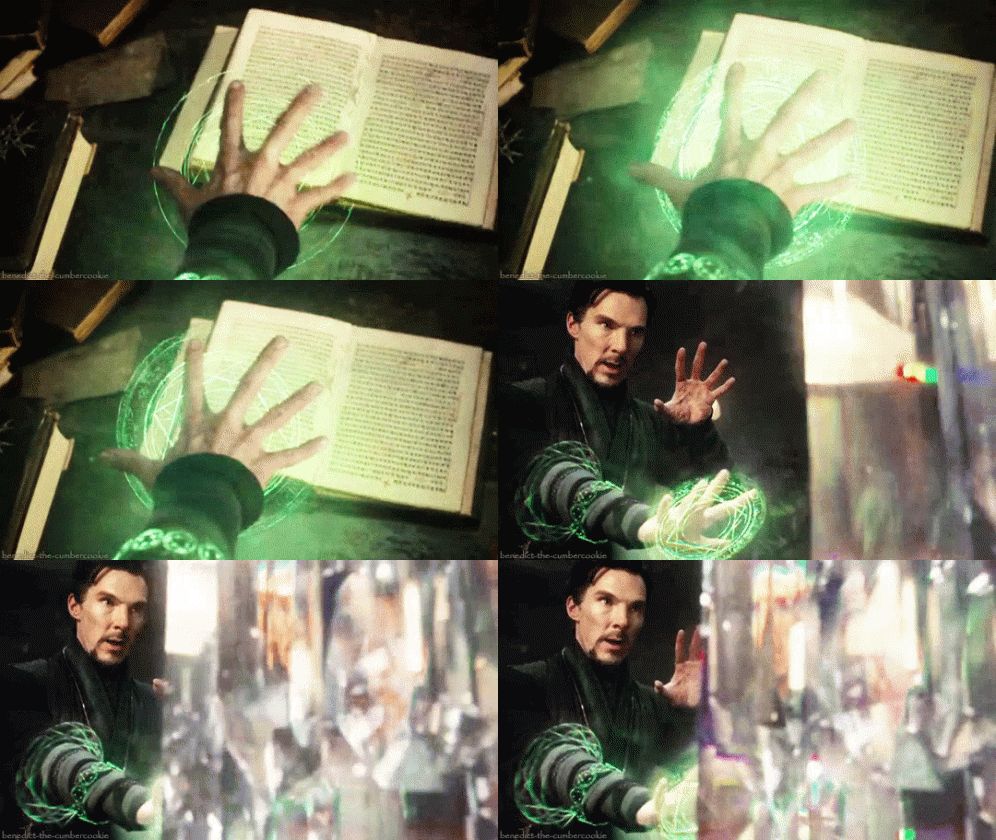 |
| Strange does not ditch modern medicine to embrace acupuncture, chakras and spirituality. He actually studies and performs magic following a very similar method to the science and technology we're more accustomed to, and he's shown actual empirical evidence and contrasted information about it. |


 |
| Hell yeah to the scientific method |
In our real world, however, the theory addressing the existence of a Multiverse is an actual field of study in speculative physics, yes (and other essay in this book talks about this in the context of cosmology and quantum mechanics), but it *is* speculative. And spirituality, while valid on its own, simply and objectively cannot replace science if what we seek is the empirical understanding of the universe. Strange's Sorcerer path *is* undeniably heavily inspired and linked with Eastern martial arts and spirituality, both in aesthetics and ethos, but the way he studies and harnesses magic is rather more in line with science and technology than with actual spirituality as we would understand it in the real world (as is also the way with many MCU perceptions of magic as science and technology 'not yet understood', as also portrayed in the Thor movies). Overall, the whole discourse when these particular essays (and there were a few :S) tackled this topic was a huge false equivalence fest.

-1 I also disliked the way that a couple of essays seemed to need to add the disclaimer that 'religion and science are not incompatible, in fact they are fully compatible because I will now give you some examples of historical scientists who also believed in God or were interested in spirituality or alchemy'. Obviously, individual people are entitled to their personal spiritual or religious beliefs (as long as they don't try to impose those beliefs on anyone else or enforce inequality against oppressed groups, which is the flavour of criticism I go for when I say I'm critical of religion). But the issue regarding the science-vs-religion discussion often doesn't have to do with individual beliefs, it has to do with the fact that enforced religious systems have historically hindered or prohibited science systematically, by imposing unscientific mythological concepts as Truths, and literally persecuting and murdering people who offered advances in science instead of abiding with those religious 'truths' as to the nature of the universe (and also persecuting religious beliefs which deviate from the systemic dogma). The fact that Newton believed in God (totally fine, but irrelevant in this discussion), or that Descartes (rather unscientifically) claimed that God is an innate proof of our reasoning nature (which let's be real, it's a bit wtf xD) are really neither here not there regarding this issue :S
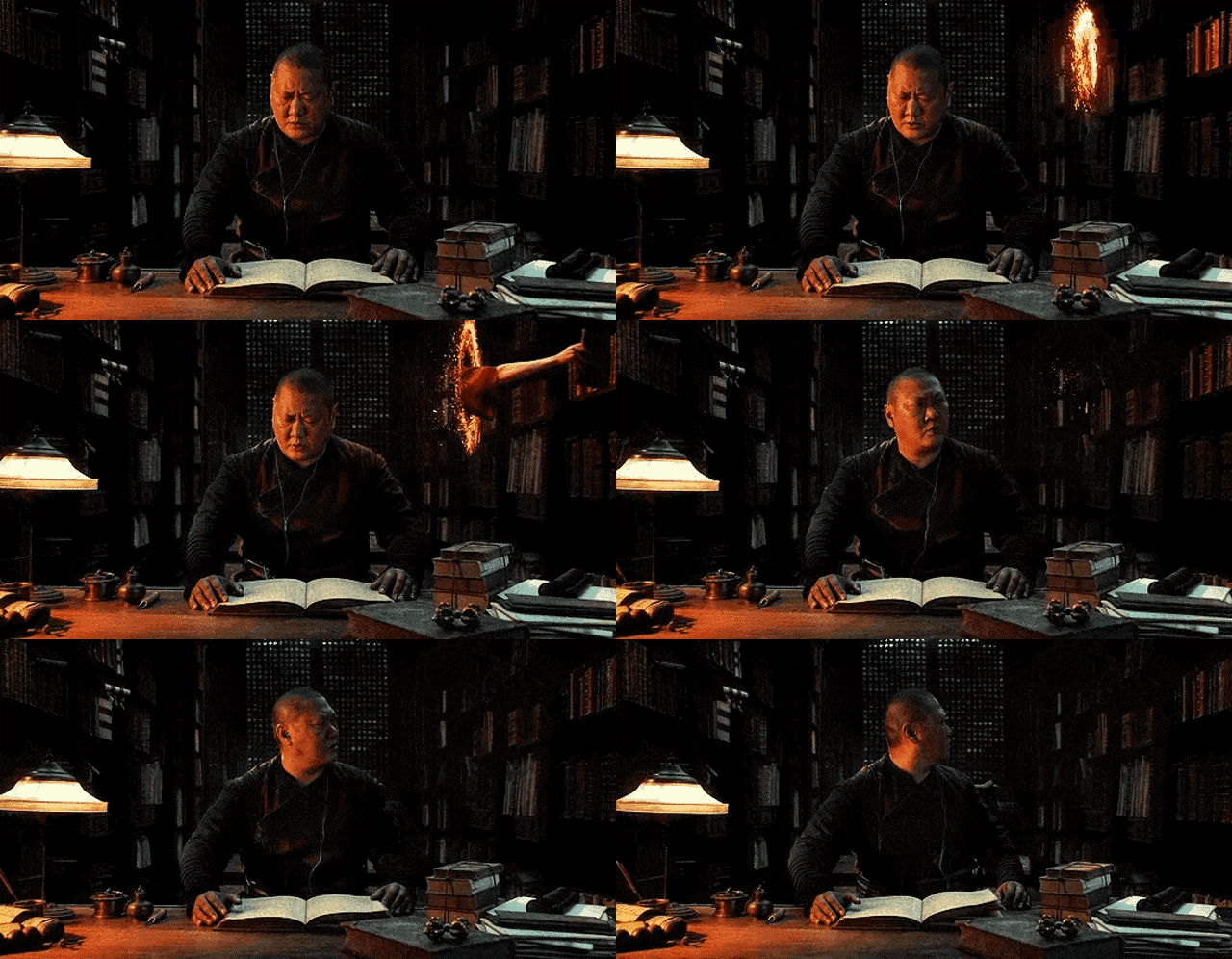 |
| Anyway, have another gif about sorcerers and books xD |


- And finally, this is more an anecdotic discussion than something I liked or didn't like - There's one essay which discussed mind-body dualism as illustrated in Doctor Strange by the astral bodies. However, the author seemed to keep trying to rationalize the way astral bodies were portrayed in the movie, not just comparing them to philosophical theories of dualism as an interesting exercise, but actually trying to find logical consistency between them, as if the portrayal in the movie would either confirm or discredit said theories of dualism.
 |
| The Ancient One show Strange his astral form |
While the astral bodies in Doctor Strange are
clearly inspired both by spirituality currents and by various
philosophical explorations about mind-body dualism, as a fantasy and
sci-fi movie it doesn't need to be fully consistent with all these
currents, nor do we really need to judge the accuracy of the depiction
of Strange's astral body and its properties in regards to what
philosophy has had to say about dualism - especially considering that
dualism is, as of now, mostly devoid of any empirical scientific proof! The
exercise of questioning how Strange's astral body is or isn't consistent
with existing philosophical theories of dualism and transference
between the mind and the body is certainly interesting for purely
academic purposes, but the way the author seemed to be actually thorough
and serious about how a fantasy and sci-fi movie with astral bodies
confirmed or denied real life philosophical theories of dualism both puzzled
and amused me xD


