Showing posts with label Prehistory. Show all posts

Tuesday, 17 September 2024

Goodreads reviews - Doctor Who: Only Human (New Series Adventures, #4)

Book: Doctor Who: Only Human, by Gareth Roberts.

2.5/5 Goodreads review also here.  

 This is the fourth book in the Doctor Who New Series Adventures series, featuring the Ninth Doctor and Rose Tyler. A lengthy review (as usual xD) below, including spoilers:

   My main qualm with this book is its author, Gareth Roberts, whose icky and problematic ideology (he has an unsavoury penchant for sexism and transphobia 😑) tends to end up reflected to a greater or lesser extent in his work (as is the usual thing with the majority of authors). So that was a qualm about rereading this book, which I did because of my recent project of (re)reading and reviewing all six Nine&Rose New Series Adventures novels (perfectionism ahoy xD). And yeah, in this book we can definitely see some sexist choices and stereotypes which I didn't love (as I will detail below).

   As to the more positive, the story and narration wasn't the most engaging of the six novels, in my personal opinion, but it was reasonably well written and the plot did hold my interest overall. The book tackles both history and science fiction, with a human colony from the far future who built a faulty ‘time engine’ and got stuck during the time of the Neanderthals and Homo sapiens. The plot explores interesting themes such as genetic engineering and the ethics of science, as well as the strife between Neanderthals and Homo sapiens, with the latter here portrayed as more violent, territorial and with genocidal intent against all 'lesser' human species, whom they other and regard and 'Them'.  Time travel shenanigans aside, the themes of competitive replacement and the dangers of dehumanization, seen through a fully Whovian ethics lens, are the central points of the story, and in that sense I did enjoy the book, even though it has its flaws, and some of them are pretty jarring.

Replacement of Neanderthals (yellow) by early modern humans (blue). Source.

➡️A quick aside on the Neanderthal extinction: There are many hypotheses for the extinction of the Neanderthals, among which we can name inbreeding and a small population size, violent conflict with Homo sapiens and competitive replacement - which is the hypothesis that is most explored in this book -, a change of climate, disease, natural catastrophes, and/or interbreeding and ultimate assimilation with early modern humans. Most likely, it was a combination of several of these factors which caused the extinction of the already low Neanderthal population.  In spite of the speculative nature of the dynamics of Neanderthals and early modern humans depicted in this book (violent replacement by Homo sapiens was first proposed in 1912-20 by Marcellin Boule, but other hypotheses as to the demise of the Neanderthals have since appeared), in my reading experience it's not often that Neanderthals are given the spotlight in this way, with the Homo sapiens as the more antagonistic people, so I found that to be a compelling part of the plot

  As to the main characters, Nine and Rose were well characterized overall, and while Jack Harkness did reflect some of the author's sexist ideas at times, his trademark (and creepy) approach to 'harassing everyone on first meeting them is such a good rep of pan(omni)sexuality' 😬 was toned down in this book with respect to the series and other media, which I appreciated. Other characters were more or less compelling regarding their characterization, with Neanderthal Das turning up to be an unexpected favourite with rather wholesome and endearing traits (I did enjoy the portrayal of the Neanderthal people in general), while I found others to be markedly more problematic in their characterization - Especially 'boss lady' Chantal Osterberg ticking off all of the stereotypical traits of the mad and amoral scientist who is also kind of a drop-dead beautiful femme fatale 🙄, and whose characterization I found to be not only rather lazy and two-dimensional, but also leaning on the more overtly sexist side.

More details below, so here be spoilers!

Female representation:

  Rose Tyler is one again the main female protagonist with her role as Nine's companion (see more about her below), with Chantal Osterberg, the leading scientist of the research colony of humans from the future (also see below), being the leading secondary character. Some other women in the colony appear in the story as well with more minimal roles, with scientist Lene having the most importance (even though her plot is pretty much reduced to being a wife and having to process her terminal illness 😕), and others just appearing very briefly (like the unfortunate Tina with her redshirt role). In late 20th century, a nurse called Weronika makes a brief appearance as a wannabe companion figure (not much more to her), Jackie Tyler in her youth also has a cameo (not in an excellent light), and Neanderthal Das finds her mate in Anna Marie, a 20th century woman who is described as fitting the Neanderthal beauty canon to a T, but who Harkness 'charmingly' describes as ugly, hairy, short and fat (nothing wrong at all with not conforming to limited societal beauty canons, I'm referring to the sexist way Roberts describes her through Harkness 😑). 

A Neanderthal woman (artist's impression, source).

  Finally, there's the women from the Neanderthal tribe (featuring Ka, who is in a relationship with one of the future human colonists, and Sakka) and the Homo sapiens tribes, featuring the matriarch-like figure of the wise-woman Nan (thus named because she has a grandson xD). Wise-women are mentioned to exist in both types of tribes, and Nan seems to be the leading voice of the tribe.  But in spite of this, and her statement that "Wise man! Man! Men in charge, we all know how that ends up!" (that's not what's always exactly portrayed in the book, either, with Rose also being forced to marry some man she doesn't know, see below, and Chantal being demonized in the book as the evil boss lady that wrecks stuff, but OK), well, in spite of that she ends up paired with a creepy middle-aged dude from the future (who harasses Rose continually, see below), and suddenly Nan seems to need a man in her life so much that she defers to him automatically, so it looks like she won't be the leading voice of the tribe for much longer. Sigh. But I guess that Roberts needed to have his performative phrase to assure us that he's not sexist at all 🤦!

➡️A quick aside on Prehistoric gender roles

  The societal structure of both Homo sapiens and Neanderthals would probably still be far from a feminist utopia with a harmonious and egalitarian goddess religion (paternity was probably ignored for a while and Prehistoric fertility goddess art is beautiful and fascinating and I love it, but fertility cults tend to also be more sinister than the 20th century New Age feminism portrayed them as, as I covered on these two posts: 1, 2). But even so, the hunter-gatherer tribes of the Paleolithic and Neolithic (mostly up to the Upper Paleolithic) also did not seem to uphold a gendered division of labour that was as rigid as it has been assumed for a long time, and mainly by male academics, who also consistently fail to identify all the cave paintings depicting huntresses as women (among other things) because of course "all men hunt and all women gather", thus quoth the 1960s academics, and that's it, survival of the tribe be damned 🙃 (more on archaeological sexist biases on my blog here and here). Yes, women did indeed hunt in early human societies 🏹 (and paint, and probably invent technology, and do stuff in general, because they have brains too, what a notion). I love this topic, so I will be making a separate post about it at some time, but here are some more interesting articles on Prehistoric huntresses: 1, 2, 3, 4. These include some pretty recent studies with fascinating updated information on women's active participation in hunting during Prehistoric times, and how we should be reenvisioning how gender roles and the division of labour could actually have been in Prehistoric societies

Artist's rendition of a Prehistoric huntress (Photo: Matthew Verdolivo, Source).

  However, the patriarchal bias remains in academic studies, with this (older) 2006 article stating that Neanderthal tribes had a less rigid gendered division of labour compared to Homo sapiens, with both men and women routinely participating in the hunting of big game (however, we do know with pretty good certainty that Homo sapiens women routinely hunted both big and small game, too), but then concluding that this 'relative lack of labour division' could have been a factor for the Neanderthal extinction (!), claiming that it resulted in 'a less efficient extraction of resources'. To me, and to other academic studies as well (many of them quite recent, like I said), it is rather more logical than better survival be instead achieved when the female part of the (small) population in each group, who is also fully capable of hunting - and even allegedly even having certain advantages for it, such as higher levels of estrogen providing Prehistoric huntresses with more stamina for longer runs - not be relegated to just gathering berries. But hey, academics, you do you 🤷‍♀️.

A depiction of a Paleolithic huntress. Source.

🌹 More on Rose:

+1 Rose is characterized fairly well, and, as per usual, shows the positive traits of agency, resourcefulness, curiosity, assertiveness, open-mindeness and intelligence she usually displays in the TV series, and also in this New Series Adventures book series.

-1 However, she also gets the short end of the stick, often in a very gendered way, in this plot. For one, Rose is continually sexually harassed by icky (but adorkably excentric!) lecherous colonist Quilley. This includes him ogling her constantly (there is a sentence that quite literally reads "he looked her fur-bikinied body up and down and made an indescribable lustful noise" ewwwww 😫), and also grabbing her at some point. Roberts already showing us he thinks sexism and harassment are funny, or something. Rose keeps being assertive and vocalizing how uncomfortable and angry he keeps making her, warning him to keep his hands off her, not to ogle her and to step out of her personal space (and then the sentence of "she was used to dealing with older men" while thinking about her discomfort as something that she has completely normalized is also just 😫). But this 'gag' drags on whenever this dude appears in the book, which is fucking exhausting and infuriating, and the Doctor generally doesn't seem to take this seriously, either, when he's present, which is also, well, promoting that Quilley's behaviour is more excentric than just plain wrong. Even when the Doctor deigns to comment negatively on his behaviour, it's centered more on 'relearn basic manners' (which OK, that too), rather than 'hello, can you please not harass my companion and women in general, thank you'.

Me reading Quilley's relentless creepy af characterization

  But this isn't the end for Rose having a (not) great time in this adventure. She then ends up in the Homo sapiens colony forcefully clad in a painfully stereotypical and anachronistic (and uncomfortable) fur bikini and having to marry the grandson of the tribe's wise-woman. A companion stuck in a sexualized outfit and an arranged marriage conundrum, what an incredibly forward and interesting thing for Roberts to write 🙃! The only way I would have found this interesting in some way would have involved a clear social criticism lens of women's societal roles and arranged marriages and so on, but that is clearly so not the intention here, it's done mostly for hilarious shenanigans once more. Rose does use her wits and agency to try to get out of this pickle, but she also ends up having to actually marry the guy because plot reasons, and said guy is so fit Rose does actually feel attracted to him and at the end is not that against him kissing her, so everything is all right, I guess 🙃! The Doctor also seems to think so, (jealously 😑) rolling his eyes at the 'terrible ordeal' Rose must be going through, and then relishing having a go at Rose's 'husband' during their escape (the Doctor a good ally is not in this book). While he is not the most toxic male character in the book as that is reserved for Quilley (low bar, though), said husband (name of Tillun) also not the brightest tool in the box and upholds more than one systemic patriarchal idea about gender roles and what a wife should be, too.

Rose is so NOT having a great time in this book
 
  So that's it for Rose having to go through shit, right? Wrong! She then loses her head - quite literally - thanks to the technological advances and the amoral inclinations of unhinged scientist Chantal, but what's more, this sizeable trauma is not addressed at all at the end of the book. To Rose's credit, who seems like she has to make use of extreme levels of agency, wits and a level-headed mind to go through Roberts' questionable plot choices in the story 😬, she still finds the way to be proactive by shallowing said trauma and kicking the baddie's ass and criticizing her twisted amoral discourse...with her head literally under her arm. Lol, I guess. The Doctor was also subjected to invasive probing by Chantal in this book (who is gorier and more disturbing than one might initially think), but it's still the female character who gets the short stick of the (heavily gendered) traumafest in this story, which is not fun. 

  And, important note, even if a female character manages to brave through all of the gendered clusterfuck of violence and oppression (that her author wishes her to go through) by displaying all her positive traits, it still says a lot about said author that she's subjected to all of it in the first place, and through a humorous lens more times than not, which is even worse, because the way in which patriarchal violence and oppression is approached in a story makes all the difference in the world (for example, Handmaid's Tale has a very clear aim of denouncing said violence and oppression, and so it is read and viewed very differently). So, male authors, and I'm not even saying 'please': Stop👏 writing👏 unnecessary👏 and👏 unwarranted👏 traumafests👏 for👏 your👏 female👏 characters👏 already!

🌹 More on the female villain 👩‍🔬: 

-1 While Missy is in my view an excellent example of how an amoral and ruthless female antagonist can totally work, the character of Chantal Osterberg is not doing it for me at all. She is much more two-dimensional than Missy and, like I mentioned before, seems to be constructed out of fairly stereotypical traits that are seen through a more sexist view (this is even lampshaded in the book, through the sentence "It was hard to threaten somebody who didn't posses a full personality" Lol 😅). Chantal is a brilliant scientist and the leading researcher and boss of her colony. She is also amoral, ruthless, unhinged and femme fatale-sexy, and that combo with Roberts' way of writing her ticked me off. Missy seem to conform to but at the same time fully subverts all of these gendered stereotypes for a female villain, and that is what makes her so complex and compelling, in my opinion, but I feel that Chantal is just another example of the stereotypical female villain written by a questionable male author.

Missy just does it right
 
+-1 Chantal's plan of using the energy of the time engine to breed a new species - Hy-Bractors - that would be superior to humans and replace them (she totally intends for the colony to be slaughtered by her creations, except for her), and then rationalizing her actions with elevated philosophical dialogue on how this is supposedly good for evolution and the future and sustainability of the Earth, is on par with the standard 'mad scientist' discourse, I guess, but also a bit meh and confusing overall. I also still don't quite get how the bloodthirsty, animalistic, barely intelligent Hy-Bractors, who are engineered to be brutally efficient in their "dispatch of inferior human competitors", are supposedly an upgrade on the "naturally violent, competitive, hunting brain" of the humans? The explanation didn't quite make sense to me, but anyway xD In any case, their scenes were much gorier than I usually like to go for, too, so that part of the story didn't thrill me. 

 Other problematic issues, from a feminist and queer pov:

 +-1 Jack Harkness: John Barrowman problematic real life personhood aside, I'm not the biggest fan of Captain Jack as a character, although I'm at least relieved this book toned down his boisterous persona a bit, especially regarding RTD's questionable choice of portraying a pan/omnisexual character as flirting with (which is often more like harassing) everyone who he passes on his way 😬. He does get the chance to brag about his tight trousers, throw a couple of innuendos around (not so many, small mercies), and provide the Doctor and Rose with a naked diversion (sigh xD).

-1 One thing that really bugged me about Jack in this book is his treatment of Das's girlfriend/fianceé Anna Marie. It's fascinating how Jack is canonically supposed to literally want to jump everything sentient that moves (that is a queerphobic stereotype in itself, too, because pan/omnisexuality does *not* mean wanting to literally sleep with everyone on the face of the Earth), but yet he takes his time to wonder and get scandalized about how anyone can be attracted to Neanderthal Das, who has a 'feminine' high-pitched voice and is short and stocky without a waist, and how any man can be attracted to Anna Marie, who is, in his words, plain and fat and has facial hair and "a face only a mother or a Neanderthal could love" 😐. Aren't you supposed to be canonically attracted to everyone, dude?? I guess that means only canonically attractive people, or? 🙄 Jack Harkness definitely serves as a conduct for Roberts misogyny here. Also, Jack mainly mentions attraction to women in this book (except for a couple of mentions about the Doctor), which is an additional point of weirdness considering that the book was written by a gay author.

Definitely choose Bill Potts for Whovian queer rep done *right*

-1 Another eyebrow-raising thing is that the book is supposedly revolving around the racially-motivated strife between Neanderthals and Homo sapiens, with the story sympathizing with the Neanderthals, portrayed, perhaps in a more idealized way than what have been in real life (I tend to believe that utopia is hard to come by anywhere), as the more pacifist, friendly and harmonious society of the two, while the Homo sapiens tribes are depicted as way more violent and territorial, accepting only new people if they are human and married to someone in their tribe. And yet, Roberts also makes use of 'man/woman' descriptors only for Homo sapiens tribe members, and constantly uses 'male/female' to describe the Neanderthals - a distinction which markedly dehumanizes them and makes them more comparable to animals than actual humans 😬.

Neanderthal women. Source.

 ✨Ethical issues

 +-1 "'And what about them? They die, and it's history, and no one cares. Just a little bit of genocide along the way to building a mighty space empire? And that's just "the way it is here"?'" The book, via the voices of Rose and the Doctor, generally tackles moral dilemmas with the usual Whovian ethical messages, such as its anti-war stance and the belief that the ends don't justify the means. A central ethical theme is the persecution of the Neanderthals by the Homo sapiens for deeming them 'inferior', and the Doctor and Rose share a few important conversations about genocide and the problematic nature of humans in this respect. The Hy-Bractor 'monster' antagonists are annihilated in their majority in the end, though, which might have been the only way in the story to avoid the slaughter of both the Homo sapiens and Neanderthals, but it's still tackled by the Doctor with more nonchalance that should be expected.

+1 Another interesting topic discussed in the story is the exploration of the human colony, where people are not only genetically engineered to live longer and be canonically beautiful, but also supress their emotions with a constant use of chemicals to avoid any 'wrong-feeling', stripping them not only of empathy and meaningful inter-dynamics, but also of the capacity for agency and individual judgment, as they blindly conform to anything their boss and leader demands.

An Homo sapiens woman (artist's impression, source).

+1 Finally, Neanderthal Das initially faces persecution for being different among modern humans, which is linked to their original persecution and ultimate demise as a cause of the Homo sapiens, according to the book. Das, however, manages to get a happy ending where he not only doesn't miss his original home, but relishes in modern technology and society and thinks that nothing is better than a life where you can buy junk food and watch TV in your sofa after work instead of a life dedicated to hunting to survive 😂. This character is an interesting take, as it strongtly defies the common stereotype of Neanderthals as savage and stupid compared to the way more intelligent Homo sapiens (this is also contested by research on their culture), with Das very quickly acclimating to modern human life with hardly any problems. Fortunately, this character also does not display a stereotypical 'Neanderthal sexist attitude' for humorous kicks (which is a relief, because we do have sexism for humorous kicks in this book otherwise). For example, he manages to understand the concept of consent and healthy relationships much better than Jack Harkness from the 51st Century, for one, which is ironic to say the least.

If you want to read more reviews of the Doctor Who New Series Adventures:

 -The Clockwise Man (New Series Adventures, #1)

-The Monsters Inside (New Series Adventures, #2) 

 -Winner Takes All (New Series Adventures, #3) 

Saturday, 7 March 2020

Goodreads reviews - Arte sin Artistas (Paleolithic art exhibition II).

In the latest post I finally uploaded some pictures from an exhibition on Paleolithic art I visited back in 2012-13 at the Museo Arqueológico Regional of Alcalá de Henares (Madrid). I ended up taking home the huge book containing both the catalogue from the exhibition as well as a series of 24 essays by various authors on several subtopics about Paleolithic art. I talked about it on IG stories, including some excerpts and commentary, as well as on Goodreads.

Book: Arte sin artistas: Una mirada al Paleolítico (Art Without Artists: Exploring the Paleolithic Period). Goodreads review here
So here's the combination of the IG stories (which are in Spanish, seeing as the book was originally written in this language) and the points from the Goodreads review, extended here with more related topics:

GENERAL

+1 Well organized book with quite a lot of interesting material. It includes the whole catalogue of the exhibition as well as 24 essays on different subtopics about Paleolithic art (some of them more generic, others more specific). 
+-1 There are a couple of typos/obsolete usages (such as 'homo sapiens sapiens' instead of the modern usage of 'homo sapiens'), but in general the essays also seem to be well-researched.

THE COVER and other general points about female representation

+1 I really liked that they chose to depict a female Magdalenian shaman painting part of the Altamira caves as the cover of both this book and the official cover illustration for the exhibition. History and archaeology are still male-dominated fields where female erasure and gender bias are so commonplace. There is often little female representation both in the historical subjects discussed among  the people working in the fields, so this was quite a refreshing choice which I applaud. 
 
 It's rather sad, however, that the people (men, in this case) who made this decision were also worried about the controversy this cover could cause (as we know, women weren't invented until the 20th Century and those who were were only there to have children and cook, so suddenly seeing one in a prehistorical cave doing other stuff must have been quite shocking xD). They thought this choice would probably be perceived as a 'provocation', and were thus quick to assure the reader that they were not stating that it was in fact a woman who painted the Altamira cave paintings. While I agree with the fact that we cannot know for certain who it was and it's always great to be as objective as possible while listing all possible interpretations, it's also illustrative that many people, be it in the history/archaeology fields or in society in general, are usually quick to automatically assume that it was men who wrote/did/made basically everything, and that isn't generally considered as a gender bias (when it actually is), or seen as any kind of controversy or provocation :S
 
And also, regarding the idea that seeing a woman painting caves would be extremely far-fetched - Apart from the fact that there were at least some huntresses and women in what society sees as 'traditionally masculine' occupations in patriarchal societies with 'masculine' and 'feminine' gender roles (and we are not sure about the level of patriarchy in the Upper Paleolithic societies, either), even if most women were mainly relegated to traditionally 'female' chores and roles such as gathering, cooking, childbearing/care and textiles (not surprisingly, these roles are never questioned when assumed in all cases)...Wouldn't it make a hell of a lot of sense that women were also (maybe even mainly!) involved in cave painting and portable art, seeing as they would stay more often in the caves than the male hunters, and would potentially also have crafting tools at hand to make portable art if they were also mainly in charge of the textile area? Or that they would also have a say in the ample feminine and/or fertility representations found in Paleolithic art, given that they would be pretty familiar with their bodies and the process of pregnancy? Why would it be so far-fetched to assume that, but it's never a stretch to state that women stayed in the caves doing textile feminine stuff and looking after children in all cases?
 
Dancing Women (Roca dels Moros, El Cogul, Spain)  
 
 I think it's important to note that gender bias means that people working in the archeology and history fields often quote the 'we cannot say this for certain' phrase when they encounter something that doesn't fit the normative view (Patriarchal with gender roles, white, heterosexual, cisgender, etc), but when it comes to constructed gender roles and stereotypes, many are also pretty quick to assume a lot of things which may discard more than one case, just because it doesn't follow the established societal rules they themselves swear by (and while we may guess in a more or less optimistic take, we actually do not know enough about Upper Paleolithic society to state the level of patriarchy or gender roles they had going on anyway, and this could also vary depending on the location, etc). 
 
                       Depictions of Paleolithic huntresses in Madrid's Archaeological Museum
 
 For more about this topic of gender bias in archeology and history, taking this very same exhibition as an example, also see this awesome video essay by PutoMikel


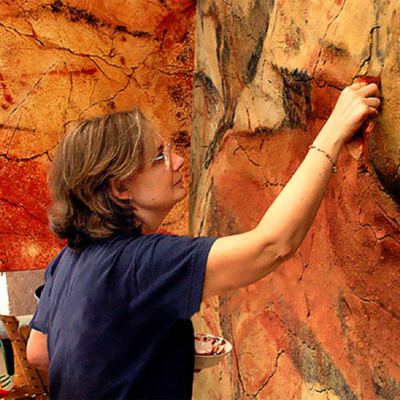
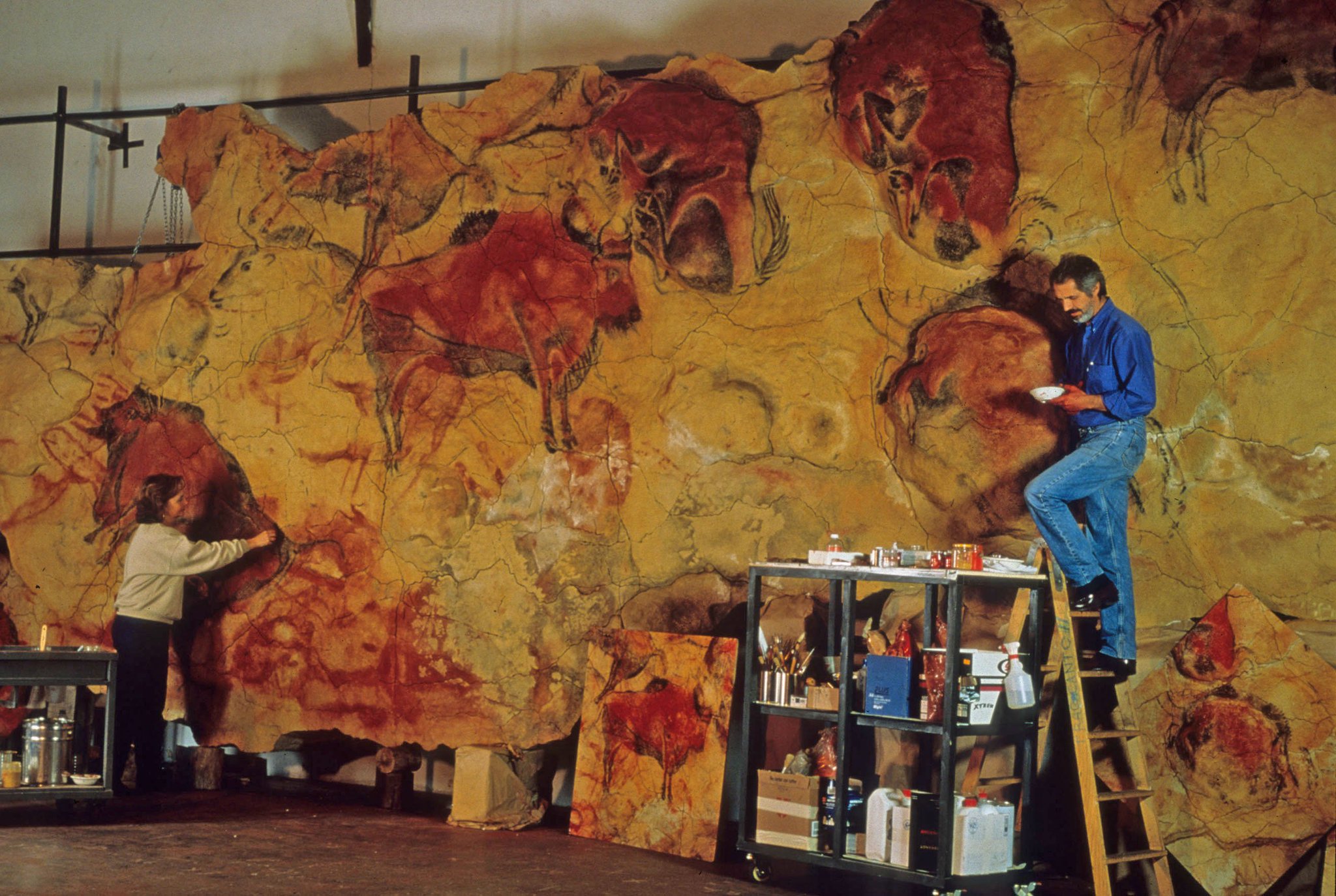
+1 The decision to show a woman in the exhibition poster was also inspired by and meant to celebrate Spanish painter, cave art expert and art professor Matilde Múzquiz, the first person to study the cave paintings of Altamira from an artistic point of view during her PhD in 1988. She was the coauthor, alongside photographer professor husband Pedro Saura, of a large number of replicas of cave paintings for various national and international organizations.

 -1 While the cover of this book and exhibition was refreshing, there is still the fact that male generics, such as 'mankind'/'man/men' instead of 'humankind'/'human(s)', are used throughout many of the essays in the book, emphasizing the male-dominated outlook and lack of inclusivity in the language used in the archaeology world (among many other places and contexts). Other essays do use 'human(kind)' consistently, though. Also, out of the 24 essays in this book (which was published in 2012), only two of them were written by women, also calling out the lack of parity we can still observe in many sectors of the academic world.
 
One of the last times I visited Madrid's Archaeology Museum I did notice more representation in the Prehistory and Paleolithic section, with female depictions as well as male. Which is quite refreshing, as most people still use 'Man' as a masculine generic to refer to the whole Homo Sapiens species :S


Essays discussing FEMALE REPRESENTATIONS in Paleolithic art

 +1 Out of the two (out of 24!) essays written by women in this book, one of them was about female representations in Paleolithic art, exploring the Pre- and Post-Glacial periods and talking about artistic styles in quite an informative and thorough way. There are also male writers who mentioned or discussed female representations in their essays, albeit in less depth, given as it was not the main topic of the essay.
-1 However, one of these male authors were blatantly sexist and fatphobic in the way he tackled the issue of the Paleolithic Venus, describing them (in a very offensive and unsolicited way) as 'not particularly attractive depictions' (yes, it's massively relevant to know what the male academic of the day rates historical female depictions, sigh). He then refers to the women of the time as 'females' (red flag for dehumanizing sexism), and quips that the Venus figures are 'not reliable' because they 'obviously do not describe the females of the time in a realistic way', kinda assuming (apart from being unprofessional and sexist af) that real women with the body types usually associated with Paleolithic Venus do not exist in real life, when obviously they do :S

And furthermore, one thing which I really like about the Paleolithic Venus figures is that they include a refreshing diversity of body types and shapes, from thin to fat (all terms obviously used in a neutral way because there's nothing wrong with being fat), and, artistic stylistic choices and fertility symbolism aside, all of them can actually describe how 'real women' look like, so yeah.

Also, let us remember that women, be they real or artistic representations, do not need male validation for how attractive they are perceive to be to deserve basic respect. Apart from this, personally it blows my mind that an archeologist would not look with at least professional awe at these stunning depictions, but no, dude had to showcase his Prehistoric (lol) sexism, sigh. Thankfully, the female author of the essay focused on this topic in her essay didn't find the entitled need to evaluate their appearance and be sexist or fatphobic about it, so thank Someone about that.


"But Paleolithic Venus are always exaggerated and never portray real women in a realistic way", OK my dude, OK (this is, incidentally, a photograph from the actual exhibition).

+-1  Regarding the essay by Margherita Mussi focusing on the Venus figures and other female representations in Paleolithic art, like I said, I generally liked the information discussed in her work, but I actually don't quite agree with some of her interpretations about the association between fertility symbolism and these Paleolithic female depictions.

Enter some discussion about it - 

1) The interpretation of Venus figures as fertility symbolism

Venus of Laussel, an original piece from the exhibition
I completely agree with the author's early statement in the essay that, when it comes to subjects as far back in time as Paleolithic society and art, we can't really know for certain which interpretations would be the correct ones and thus should never state these interpretations as facts. When it comes to the female representations from the Paleolithic (and especially the Venus figurines), there is more than one interpretation: From fertility, abundance and health symbols associated with religious cults and/or sympathetic magic (potentially depicting Mother/Creator goddesses),  to self-portraits by female artists, to beauty ideals, to the more depressing and rather less inviting take from a feminist standpoint of seeing at least some of them as male-gazey sexualized images serving as erotica (or rather, p*rnography :/). However, the author seems to contradict herself when claiming, later on in the essay, that the Venus figures 'had nothing to do with potential fertility cults or beauty canons'. She is of course entitled to have her own interpretation on the matter, but, following her initial assertion, it's rather contradictory that she should, as it would seem, claim it as a fact :S

Personally, I disagree with her interpretation and prefer the take (which also appears mentioned in other essays in this book and is one of the most discussed) that it's highly probable that Paleolithic female representations would have had a close link with beliefs/cults, symbolism and sympathetic magic associated with the idea of fertility, health and life. I tend to think this interpretation is pretty logical (at the same time that my feminist mindset also bears in mind the negative as well as the more feminist-oriented aspects these cults can entail - which I'll discuss briefly below in a bit). 

The counter-argument of the author is along the lines that it wouldn't make any sense for Paleolithic nomadic peoples to be interested in fertility cults because if a higher birth rate and emphasis on fertility were seen as important, women would be giving birth roughly every two years and would have to carry more and more weight every time in their nomadic travels, which would not be viable. Personally...I actually think it makes perfect sense that -

1) Women would have been carrying more weight than they should (both physical and in the form of childcare) because we've been seeing that kind of unequal gender roles for centuries, with women travelling and working and doing housechores with their babies on tow, so unfortunately I could also see it happening back then. Or maybe everyone in the group, including men, did 'help out' more with all the additional weight caused by new babies, and childcare could have been seen as a more collective task (it's generally believed that the pater familias family system wasn't really up and going till the Neolithic, after all). We're talking about small groups of people where daily life was often literally a question of living or dying, so tasks might have been less gendered and more equally shared given the needs of the moment, perhaps (we actually don't really know the level of  gendered roles in these times, so that's also up for various interpretations, which range from completely Patriarchal societies à la The Flintstones, to a potentially too idealized equal society with hardly any gender roles, or more matriarchal-veering societies which mainly worshipped goddesses).
This depiction of a Prehistoric family is idealized and anachronistic at least regarding things such as the 'just went to the hairdresser's' vibe with the hair (xD), and the monogamous family as a normative societal system doesn't seem to have taken hold till the Neolithic. But I still find it pretty refreshing to see a Prehistoric woman in a reasonably equal footing with the man joining the defense with her axe, so here it is xD
But  my main counter-argument is that 2) In such small nomadic societies with a very low life expectancy that would probably encounter hazards and difficulties daily (from extreme weather to wild animals, poorly treated illness, to the continuous need to find and make food, clothing and shelter), I think it would not be far-fetched to assume that fertility would have been seen as very important and something celebrated and venerated as the means to repopulate the groups and keep the species alive. Also, apart from the (disputed) existing hypothesis about the understanding of pregnancy as something that wasn't directly linked with sexual intercourse in the Upper Paleolithic (a hypothesis quoted by Kate Millett in Sexual Politics, or Jean Markale in La Femme Celte, for example), contraception was most probably not going on, so women - those who could get pregnant and/or who didn't die in childbirth :S - would probably be burdened with continuous pregnancies anyway, veneration of fertility or not, so they would be probably be carrying a lot of weight in any case :S.

 Also, I don't know, it really doesn't make any sense to me that for thousands of years the Paleolithic homo sapiens folks would have been drawing, painting and carving many female representations which, interpretations aside, clearly emphasize fertility symbolism if they weren't  for some reason actually interested in that until the Neolithic times :S.


-Some of the screenshots containing part of the essay and my notes on this subject, in case you're interested in reading it (as usual, open in new tab for larger size)

2) Goddess feminist empowerment vs problematic patriarchal aspects about fertility cults

And I'm going to finish this post with a brief reflection on the empowering and problematic aspects I personally see when it comes to fertility cults, closely linked with both Goddess Feminism and reproductive exploitation.

       VS


The positive aspects: Firstly, when it comes to the Paleolithic Venus figurines and the representation promoted by Goddess Feminism in general, I do like how there's a positive diverse portrayal of female body types, something which can be linked with the modern body positivity movement and fight constraining Patriarchal beauty canons
 
Then there's the important fact that these historical female representations often linked with goddesses and the 'Divine/Sacred Feminine' have also served to help visibilize the female body and sexuality, often invisibilized and severely stigmatized since centuries past by Patriarchal societies, especially by the cultural influence of Abrahamic religions (for clarification, I note that, while I'm mainly referring here to the gender binary, there are also depictions which are non-binary/dual/androgynous/etc in the area of goddesses, mythology and its associated cults and movements).   Goddess Feminism, which draws its influence and inspiration on these historical female depictions and pagan cults, and emerged mainly in America, Western Europe, Australia and New Zealand as part as the Second Feminist Wave in the 1970s, has also helped promote female empowerment and representation in more than one respect. However, it's also worth nothing that the movement can also have problematic aspects, such as more essencialist and/or traditional gender role views, or the overt idealization and promotion of fertility mindsets which are way too linked with traditionally patriarchal reproductive exploitation.
 
Finally,  I also like the fact that these movements often focus on women owning their naked bodies and sexuality in a way that's not instantly catering to the male gaze or desire, and I actually find the Paleolithic Venus refreshing, for example, because I can often see it as diverse female nudity that doesn't seem to be there mainly for the male gaze (of course, this could be massively idealized if we take the p*rn interpretation into account :S, but at least these female depictions have served to promote all that, so there's still that disregardless of the original intention of the figurines).

The problematic aspects: On the other hand, I can also criticize quite a lot of things about fertility cults, which can be closely linked with reproductive exploitation, one of the main roots of patriarchal oppression, and also present in apparently 'matriarchal' societies that worship goddesses, as we can see in The Mists of Avalon, for example.
The Mists of Avalon includes both empowering positive aspects of a Goddess-worshipping matriarchal society which grants women more independence and rights, and more problematic aspects in the form of reproductive and sexual exploitation in the name of religion.  
 
Female depictions emphasizing fertility symbolism can also be seen as dehumanizing and sexist by seeming to reduce (cis) women to their reproductive ability and sexual characteristics. (Note: cis women are the main demographic in this matter, but of course trans men, intersex people and non-binary afab people would also be targeted - and most probably also misgendered :S - by oppressive fertility mindsets. And it's also worth mentioning that an incorrect treatment of Goddess and neopagan feminism can also become essentialist and transphobic against both trans men and women as well). The fact that we know that male graves are way more common in the Paleolithic findinds than female ones, while female depictions (often emphasizing fertility) massively outnumber male artistic representations is another thing that could suggest that Goddess feminist movements could have idealized these female representations as an era of greater female independence and empowerment, and maybe the reality was that the significance behind the numerous Paleolithic female representations could be thus severely limited to their perceived societal use as reproductive vessels for the perpetuation of the species :S. This idea can also be seen in modern feminist shows such as The Handmaid's Tale, which focuses on Patriarchal oppression and revolves around the sexual and reproductive exploitation of women in a misogynistic theocracy, and which has made use of fertility goddess symbolism as well as Christian material in order to portray the reproductive exploitation of Gilead
 
 It is maybe a bit unclear whether the original idea was to show how former more feminist-coded Goddess imagery, especially in the 1970s with its association to feminist characters such as June's mother Holly, was made more regressive and oppressive by Gilead. The problematic points of neopagan fertility mindsets still remain, though, and I think it is fitting to show Gilead also appropriating that imagery alongside Christian patriarchy, because firm believers in the utter female empowerment of Goddess feminism often fail to be critical of the fact that neopagan and Goddess mindsets, while empowering and refreshing in some aspects and especially against more blatantly patriarchal monotheisms, are also deeply problematic and still misogynistic and non-inclusive in others, and have also oppressed women historically for reproductive exploitation purposes, as well as sometimes also reinforcing gender roles and the gender binary. So I personally get why Margaret Atwood (in The Testaments, mostly) and the Handmaid's Tale series creators would also use Goddess-y religious imagery as a way of portraying reproductive exploitation.

In spite of these more considerably problematic aspects, I think that one of the main reasons why the feminist imagination has revolved so often around Mother Goddesses and these historical female representations so linked with fertility is that it can be seen a very refreshing change opposed to, for example, the total stigmatization and invisibility of the feminine in the patriarchal Abrahamic world and other patriarchal cultures and religions. While the idea of Goddess worship and the Divine Feminine can be idealized in more than one case, ranging from the more naïve to the more problematic (exclusionary or authoritarian), these depictions, disregardless of their original intention,  have certainly helped and can still keep helping to promote female empowerment and representation. Still, we must remain critical of the flaws and problematic aspects as well.

-Spanish version in the IG stories screenshots (as usual, open in new tab for larger size)

Hope you enjoyed this essay, see you hopefully soon-ish with more historical and/or feminist material(or preferably both xD)!