Fig. 1 - All the new specimens from the fair: From left to right, azurite+malachite and aragonite (top), cactus amethyst, vanadinite, chrome diopside, fluorite and cinnabar (bottom).
Fourth post in my new mineralogyseries, talking about my mineral collection ✨💎! This time it's not another installment about the specimens from the National Geographic RBA minerals collection that I've been getting since 2022 (more of that specific series to come after this haul!), but rather about the new (and gorgeous) specimens that I got at a local fair this past May, from amineral stall (@/cabolitos on Instagram)- Featuring (see Fig. 1) azurite+malachite, aragonite, vanadinite, fluorite, cactus amethyst/'ametrine', chrome diopside,and cinnabar (mercury sulfide). These are easily among the most stunning specimens in my collection, all of them are so beautiful 😍, and lately I'd been especially looking for a larger azurite specimen and a vanadinite (I got another one at another September fair since), so yay 😁👌!
Here's a video with all of the minerals from this haul (also on TikTok, and a slideshow post here as well). See below for the individual videos!
And before the haul, here are some pictures of the mineral stall from the fair, and it was mineralogy heaven, so many beautiful specimens ✨💎! I was also pleasantly surprised by this stall because the main section of it was revolving around mineralogy and mineral collecting per se, with most minerals organized in your typical cardboard and methacrylate boxes indicating the name and country of origin of each specimen. Typically, stalls at local fairs which sell gems and minerals tend to be mainly focused on the New Age/'crystal healing'/esoteric/spiritual aspects (see this post to see why 'crystal healing' is such a huge pet peeve of mine 😅), so yeah, big breath of fresh air, honestly! And while I also do like tumbled stones and polished minerals and gems, this stall also offered a lot more rough/unpolished specimens than is also typical among fair stalls in my area, so I really liked that as well 😃.
Fig. 2 - This mineral stall was mineralogy heaven ✨💎!
Fig. 3 - So many minerals ✨💎!
Fig. 4 - No fair outing is an optimum fair outing without some chips xD!
A hefty picture spam is incoming 🤩💎 and will be the main highlight of this post, but I'll also be expanding on some of these minerals, namely the cactus amethystvariety,and cinnabar (and mercury), which won't feature in the National Geographic/RBA collection posts. For the rest, malachite, aragonite, vanadinite and (chrome) diopside will feature in future installments of the RBA series, and I have already talked about the remaining ones in the following posts:
✨Post 1: Amethyst (with general mentions to ametrine) and fluorite.
✨Post 3: Azurite (with general mention to malachite).
So, let's being with the pic spam 😃✨:
Fig. 5 - From left to right: Azurite+malachite and aragonite (top), cactus amethyst and vanadinite (bottom).
Fig. 6 - From left to right: Aragonite (top), chrome diopside, cinnabar, fluorite (bottom).
Fig. 7 - These were the minerals that I got on my first outing, then the next day I also got the aragonite and vanadinite xD. From top to bottom, left to right: Azurite+malachite, cactus amethyst, cinnabar, fluorite and chrome diopside.
1) Azurite & malachite:
This large azurite and malachite specimen over a goethite matrix plate is absolutely gorgeous, and easily one of my top 5
fave specimens in my collection 😍💎. The front is nearly completely covered with patches of deep blue azurite, accompanied by some bright green malachite patinas at the right, while the
back and sides feature small crystals of both azurite and malachite
strewned upon the goethite plate. Also, see below for a couple of videos showcasing the rich colour and glittering crystals of my large azurite specimen ✨:
✨Read more about azurite inthis post from my RBA mineral collection series.
Fig. 8 - Look at this beauty 😍! Azurite+malachite on a goethite matrix plate, front view.
Fig. 9 - Azurite+malachite on a goethite matrix plate, side and back view.
Fig. 10 - Azurite+malachite, front, II.
Fig. 11 - Azurite+malachite, size comparison with hand.
Fig. 14 - Azurite+malachite (left), alongside amethyst and celestine cluster.
Videos✨ (also on TikTok here and here, and slideshow post here as well):
2) Aragonite:
This large aragonite cluster, originating from Tichka (Morocco), shows a beautiful display of red, reddish-brown and white pseudo-hexagonal prismatic crystals of varying sizes, grouped around a central axis - These kind of specimens are typically called 'pinecone aragonite' or 'aragonite star clusters'. Also see a couple of videosbelow showing the different colour hues of this lovely cluster and the shape and vitreous luster of its crystals✨.
✨Aragonite will feature in the upcoming post 4 of the RBA mineral collection series on this blog.
Fig. 15 - Aragonite star cluster from the fair (front view), with other aragonite specimens from my collection in the background.
Fig. 16 - Aragonite star cluster (side).
Fig. 17 - Aragonite star cluster (back).
Fig. 18 - Look at how pretty the crystals are in this specimen! Aragonite star cluster in direct sunlight (front view, size comparison with hand).
Fig. 19 - Aragonite star cluster in direct sunlight (back, size comparison with hand).
Fig. 20 - Aragonite star cluster (front view, comparison with hand).
Fig. 21 - Aragonite star cluster (side).
Fig. 22 - Aragonite star cluster (front view, comparison with hand).
Video✨ (also on TikTok here, and slideshow post also here):
3) Cactus amethyst:
Alongside the gorgeous azurite+malachite and vanadinite specimens in this haul (all of the minerals in this haul are gorgeous, really, but I was most excited about finally finding some nice specimens of these two, as I said above), I was particularly thrilled to also find some cactus amethystsin the mineral stall - and this is quite a beautiful specimen, showcasing both the purple hues of amethyst in the terminations of the main (pyramidal prismatic) crystalsand in all of the smaller crystals,and the intense orange-yellow hues inside the main crystals, caused by iron oxide inclusions (but not citrine, see below)😍💎. As we will see below when discussing ametrine, we could also refer to this cactus amethyst specimen (as shown in Figs. 23-27) as a 'cactus ametrine'(although bearing in mind that 'ametrine' is the trade name, and the most recent studies seem to show that the yellow zones of ametrine are caused by iron oxide inclusions, rather than being citrine quartz - see below).
Scroll down the (lovely) picture spam for a video showing the showy colours and shine of the multiple quartz crystals in this piece, as well as for some general information and trivia about both cactus quartz and ametrine ✨:
Fig. 23 - A stunner 😍! Cactus amethyst with yellow iron oxide inclusions, front view and size comparison with hand.
Fig. 24 - Cactus amethyst, with azurite+malachite in the background.
Fig. 25 - Cactus amethyst, with azurite+malachite in the background.
Fig. 26 - Cactus amethyst, front view. The iron-stained orange-yellow zones in the middle of the prisms contrast in a beautiful way with the pale violet hues of the amethyst in the crystal terminations and in the smaller crystals all around the main ones.
Fig. 27 - Cactus amethyst, with azurite+malachite in the background. The colours are particularly intense here.
Video✨ (also on TikTok here, and slideshow post also here):
✨Read more about amethyst (with a brief mention to ametrine) inPost 1 of my RBA mineral collection series. Citrine(both natural and heated) will feature in a future post of the RBA collection as well.
Thecactus quartzvariety, also known as 'pineapple quartz' and 'spirit quartz', is so rare as to be practically only to be found in one place: the Magaliesberg Mountains close to Pretoria (South Africa). It usually occurs as large pyramidal-shaped and perfectly formed quartz crystals, containing multiple twinned quartz crystals with faceted terminations on each hexagonal side of the main prismatic crystal (see Figs. 23-27).The disposition of these smaller crystals is what creates the prickly "cactus" appearance of this variety. Some specimens of cactus quartz are composed only of amethyst, while others can range from clear to smoky and yellow hues caused by iron residue inside the crystals.
Various sources have generally defined (and still define, see Fig. 28) 'ametrine' as the resulting bicolour purple+yellow quartz variety which includes both amethyst and citrine zones in the same crystal. Thus, the name originated from the combination of 'amethyst' and 'citrine'. Also called trystine and 'bicolour amethyst', this naturally occurring variety of quartz makes for quite a rare gemstone that is mainly (but not exclusively) produced in commercial quantities in the Anahi mine in Bolivia (thus its trade name bolivianite).
Earlier studies explained the presence of both amethyst and citrine in an ametrine specimen due to differing oxidation states of iron impurities within the crystal, with purple amethyst zones thought to be produced by Fe3+ that is oxidized to Fe4+ as a cause of natural radiation emitted
by the decay of potassium-40 in nearby rocks; and the yellow citrine segments being produced by oxidized Fe3+ iron. Moreover, these different oxidation states occur due to the presence of a temperature gradient across the crystal during its formation process.
However, some studies have
actually concluded that amethyst and citrine cannot form in the same environments,
and thus 'ametrine' specimens would be instead composed of amethyst with inclusions of iron compounds which create yellow and orange zones reminiscent of citrine(in contrast, the yellow tones in citrine quartz specimens seem to not be simply caused by trace elements in the crystal, and are also at least in part aluminum-based rather than iron-based). Thus, the purple zones in ametrine specimens are indeed made of amethyst, but the yellow segments would be more accurately referred to as 'ferruginous quartz' instead of 'citrine'. Additionally, upon heating ametrine the amethyst zones pale, while the yellow-orange areas maintain their colour (in contrast to citrine quartz, which also pales when heated). Despite this, the trade name to refer to this variety has typically remained 'ametrine'.
In view of this, we can refer to this cactus quartz specimen (Figs. 23-27) as either a cactus 'ametrine' (as in combining amethyst with ferruginous quartz zones), or simply as a cactus amethyst which also happens to include some iron-stained orange-yellow zones, in so many words. In any case, the hues in these cactus quartz specimens are completely natural and have not been either dyed or heat-treated, in contrast to the common practice of heat-treating amethyst to obtain affordable 'citrine' specimens (I actually like the intense tones and zoning of some treated citrines, though, I only wish there was way more transparency in the mineral market about it 😅). Moreover, unlike
the typically lighter and more homogeneous yellow tones of many natural citrines, cactus 'ametrines' such as this one (which contain iron-stained zones rather than citrine, as we have seen) can feature very intense orange-yellow hues in the middle of the main crystals, due to the sides reflecting the iron-stained hues from underneath.
A well-formed ametrine crystal sawn perpendicular to the c-axis (optic axis) can also form a striking geometric pattern radiating outwards from the axis like the pieces of a pie, with straight lines separating the zones of amethyst and ferruginous yellow quartz:
Fig. 29 - Geometric pattern in an ametrine specimen from Anahi mine (Bolivia) (Source).
✨Some interesting historical and STEM trivia about ametrine:
According to legend, the indigenous Ayoreos tribeof Eastern Bolivia (currently living in an area spanning both Bolivia and Paraguay) knew about the existence of bicolour quartz crystals with zonal colouring of purple and yellow (aka ametrine) over 500 years ago, and it was introduced in Europe in 1600s when a Spanish colonizer ("conquistador") (sighs in Spaniard not happy about the country's colonialist past) gifted the Spanish Queen some ametrine after acquiring a mine in Bolivia as dowry for marrying a princess from the Ayoreos people (doubly sighs in sexism and colonialism). Legend or not, this is not dissimilar to the way that many things (food, cultural, technology, fashion, etc) from America, Africa, Asia and Oceania were introduced to Europe, via colonialism and imperialism (and, in this case, also patriarchy, yay) 😬. But the earliest attested mention of ametrine in Europe was probably in a 1925 issue of American Mineralogist, with further reports beginning in earnest in the 1960s and ametrine becoming more available in the 1970s.
Synthetic ametrine: Heat and irradiation can be used to transform natural amethyst into a bicolour material similar to ametrine, as determined in laboratory experiments as early as 1981, but this process is very costly and has seemingly not produced appreciable quantities of synthetic 'ametrine'. With many similarities (but also differences) to their natural counterparts in Bolivia, gem-quality synthetic ametrine has been produced in Russia since 1994, via hydrothermal synthesis from alkaline solutions, followed by irradiation of the created crystals.
4) Vanadinite:
This stunning specimen of vanadinite, originating from Mibladen (Morocco), definitely comes in second among my favourites, after the azurite+malachite piece (with the aragonite and cactus ametrine closely viyng for third position). It displays a cluster of gorgeous bright orange-red crystals on a matrix plate 😍💎. The vanadinite crystals in this specimen come in varying sizes, with the largest of them clearly displaying their hexagonal (prismatic) shape. I especially love one of the largest hexagonal-shaped crystals sticking out at the side! Also see the video below showcasing the rich colour and the characteristic adamantine luster of these vanadinite crystals ✨.
✨Vanadinite will feature in an upcoming post of the RBA mineral collection series on this blog.
Fig. 30 - Rich colours and sparkles ahoy 😍! Vanadinite cluster with bright orange-red crystals, front view. Another vanadinite specimen in my collection can be seen in the background, featuring darker-coloured cyrstals.
Fig. 31 - Vanadinite cluster with bright orange-red hexagonal prismatic crystals, side views. Note the largest hexagonal crystal sticking out at the side!
Fig. 32 - Vanadinite cluster, more details.
Fig. 33 - Vanadinite cluster, from above, with another vanadinite specimen in the background.
Video✨ (also on TikTok here, and slideshow post also here):
5) Chrome diopside:
This chrome diopside specimen, a lovely rich green prismatic crystal, originates from Nuristan (Afghanistan), and includes some white quartz inclusions, especially on one side. See a videobelow featuring the vibrant green of this diopside in direct sunlight!
✨(Chrome) diopside will feature in an upcoming post of the RBA mineral collection series on this blog.
Fig. 34 - This chrome diopside prismatic crystal has a lovely rich green colour, reminiscent of other bright green gems like peridotite.
Fig. 35 - The chromium in this diopside crystal is what gives it its rich green colour.
✨Video (also on TikTok here, and slideshow post also here):
6) Fluorite:
I also got this small tumbled fluorite as a gift, and it's a lovely one, displaying a very defined banding pattern with various hues of green and purple.
✨Read more about fluorite inthis post from my RBA mineral collection series on this blog.
Fig. 36 - This tumbled fluorite showcases a very defined banding pattern in various shades of green and purple.
Fig. 37 - Tumbled fluorite with a very defined banding pattern, size comparison with hand.
✨Video (also on TikTok here, and slideshow post also here):
7) Cinnabar (and mercury):
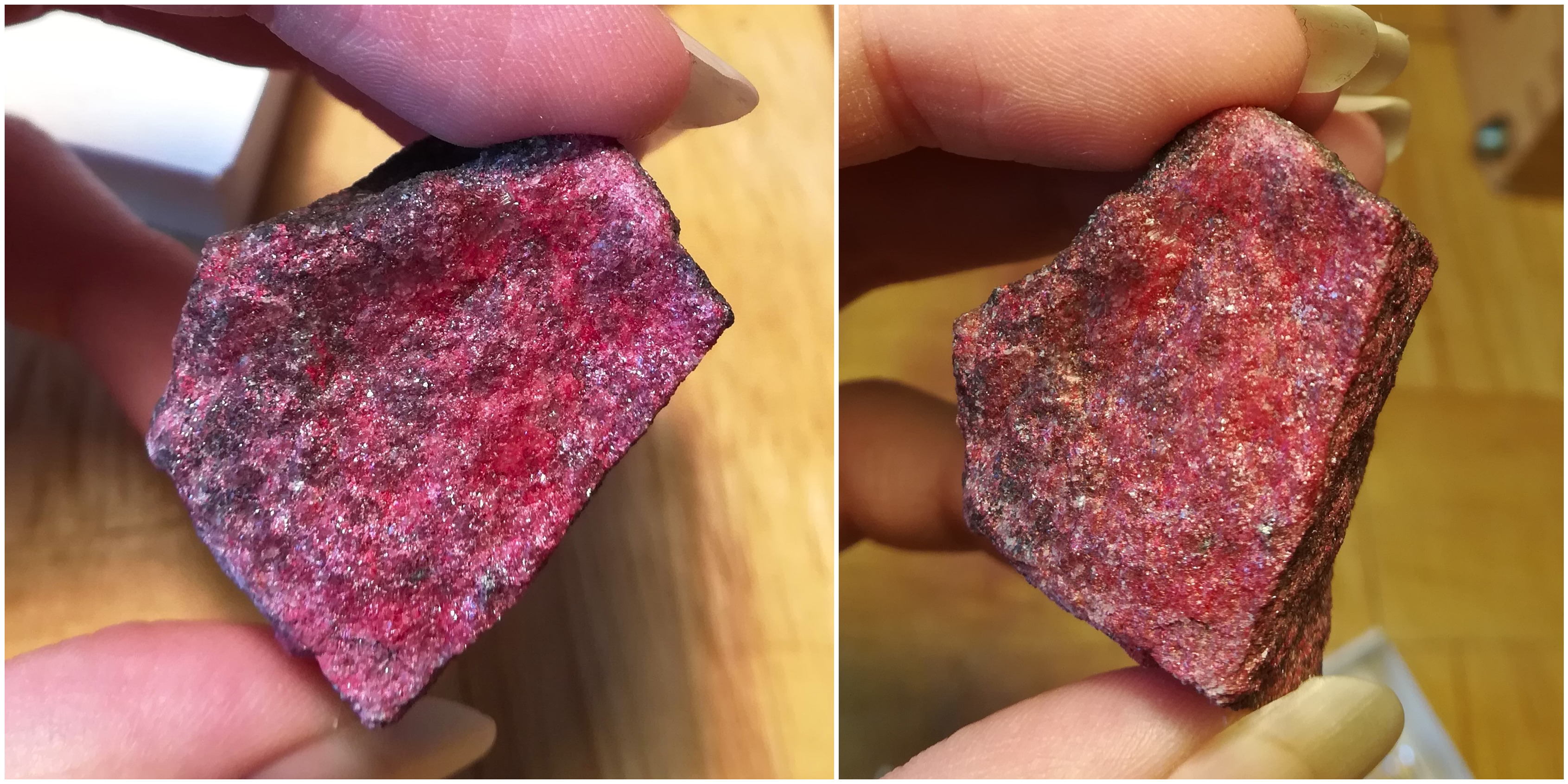
And finally, I also got a small specimen of cinnabar with mercury (Figs. 40-43), from Almadén(Ciudad Real, Spain), featuring its characteristic rich deep red hue alongside some silvery grey-blackparts, as well as a very pretty shimmer in the light due to the tiny native mercury drops present in the specimen. In my existing collection, I already had some mercury in a bottle (see Figs. 40 and 44), also from Almadén, which I got quite a few years ago (I don't think they sell native mercury as often now for safety reasons).
Important note: Cinnabar and mercury are toxic minerals 😅. Collecting cinnabar specimens should be reasonably safe if handled correctly, but don't keep liquid mercury out of its bottle or container (it's dangerous to touch and especially to inhale). In contrast to native mercury, cinnabar is insoluble and more stable than native mercury, but it's a very good idea to wear gloves when handling cinnabar, and/or to wash one's hands after touching a cinnabar specimen (especially the specimens which include native mercury in them, typically those with a massive habit). Even though in the pictures I appear holding cinnabar bare-handed, it was for a very short period of time, and I washed my hands immediately afterwards! In fact, it's standard advice among the mineralogy collecting community to wash one's hands after handling *any* mineral, just in case (as well as keeping the minerals away from children and pets, not licking or ingesting them, and not inhaling any mineral powder). Finally, although some people display their cinnabar specimens more in the open in a display case or specimen cabinet with reasonable safety, I personally like to keep mine inside a closed box alongside other specimens, and only take it out for short periods of time when needed.
Scroll down this picture spam for a couple of videos showing both the red hue and glimmer of this cinnabar specimen, and how liquid mercury moves. And then we'll finish this post with some general information and trivia about cinnabar and mercury ✨:
Fig. 40 - Cinnabar in massive habit with native mercury (left), alongside native mercury (right).
Fig. 41 - Cinnabar with native mercury (front).
Fig. 42 - Cinnabar with native mercury (front and side).
Fig. 43 - Cinnabar with native mercury (back and side).
Fig. 44 - Native mercury in bottle.
✨Infographic video (also on TikTok here, and slideshow post also here):
- Cinnabar(also calledcinnabarite) is a toxic mineral with a chemical composition of HgS (mercury(II) sulfide), the most important and common ore of elemental mercury (Hg). A hydrothermal mineral associated with recent volcanic activity, as well as hot springs and fumaroles, cinnabar typically precipitates at shallow depths as coatings on rock surfaces and as vein fillings from ascending hot vapors and waters moving through fractured rocks.
Cinnabar is mostly associated with native mercury, as well as with other sulfide minerals, such as pyrite, realgar, marcasite and stibnite, and is typically found alongside gangue minerals (materials surrounding a deposit ore) which include quartz, barite, dolomite and calcite. The most important cinnabar deposit worldwide for centuries has been Almadén, in Ciudad Real (Spain), exploited since Roman times, from where both the specimens above originate.
Cinnabar typically ranges from bright scarlet to brick red in colour, and is generally found in a massive or granular habit, sometimes with small droplets of liquid mercury also present on or near the specimen (as is the case in my specimen). Sometimes, a silver colouration can also be seen on cinnabar, a product of colloidal mercury being formed on the crystal surface after photo-oxidation. Cinnabar can also occasionally occur as well-formed prismatic crystals with an adamantine luster,ressembling quartz in symmetry and exhibiting the phenomenon of birefringence, with the second highest refractive index of any mineral.
- Mercury(also known as quicksilver, with symbol Hg) is a heavy and silvery-white chemical element, the only metal which remains liquid at standard temperature and pressure. Extremely rare in Earth's crust as a native metal (although large liquid masses have been found in rock cavities), mercury typically occurs in volcanic regions and hot spring deposits worldwide mostly as cinnabar, and can be also associated with other ores, such as sphalerite and corderoite.In spite of being liquid, and thus not satisfying the normal criteria to be classified as a mineral (it only forms rhombohedral crystals at -40 degrees celsius), mercury is officially classed as a mineral species because of its distinctive chemical and physical properties, as well as for historical reasons.
✨Some interesting historical and STEM trivia about cinnabar and mercury:
The etymology of cinnabar: The origin of the name "cinnabar" comes from Ancient Greek κιννάβαρι(kinnàbari), cited by Theophrastus
(c. 371 – c. 287 BC) in his treatise Περὶ λίθων (On Stones). The origin of this word is oriental in origin, associated with Persian zinjirfrah and Arabic zinjafr, "Dragon's blood".
The etymology of mercury: The chemical symbol "Hg" is an abbreviation of hydrargyrum, a romanized form of the ancient Greek name for mercury, ὑδράργυρος (hydrargyros) "water-silver",from hydro "water" and argyros "silver" (so called, similarly to 'quicksilver' "living-silver", due to the element's liquid, shiny aspect). On the other hand, mercury is the only metal for which its alchemical planetary name survives as one of its current common names. In Medieval alchemy, the then seven known planets gave their name to the seven known metals (quicksilver, gold, silver, copper, iron, lead, tin). Quicksilver was associated with the fastest planet, Mercury, named after the Roman name for Hermes, the wing-sandaled messenger of the gods in Ancient Greece.
Fig. 46 - Apparatus for the distillation of mercury from cinnabar, Alchimia, anonymous, 1570.
Cinnabar as a mercury ore: Cinnabar has been mined for thousands of years, as far as the Neolithic Age, to obtain mercury. Liquid mercury was produced by crushing cinnabar and heating it in rotary furnaces (see Fig. 46 for an example in a 16th Century book). During the process, mercury separated from sulphur, escaping as a vapour that could be collected and condensed into liquid mercury.
Decorative uses of cinnabar: Due to its bright red colour, many cultures have used cinnabar for decorative purposes for thousands of years, tracing back to Paleolithic cave paintings in Spain and France from 30,000 years ago. It is also one of the few minerals that have been in use by ancient people worldwide,
from the European Mediterranean to
the Middle East, Eastern Asia and the Mayan and Incan cultures in South
America. Cinnabar was ground into a fine powder and used as a pigment for paints and cosmetics (cinnabar being the historic source of red pigments such as "vermillion" and "Chinese red"), as well as carved into ornaments and jewellery. Chinese lacquerware using cinnabar is especially famous (see Fig. 47 below for an example), a technique dating back to the Song dynasty (960–1279 AD). Due to the toxicity of cinnabar, however, its use in paints, decoration and cosmetics has been discontinued in present times, substituted by safer synthetic alternatives.
Fig. 47 - Chinese cinnabar lacquerware: A Yuan oval tray with people in a landscape. Source.
Toxicity: Cinnabar is a highly toxic material due to its mercury content, and mercurialism due to overexposure to mercury (which can be both absorbed through the skin and inhaled as vapours) was a disease recognized historically as early as ancient Rome, where cinnabar was already being mined both for pigment and decorative purposes, and for its mercury content. The toxic properties of mercury were also known in other parts of the world, such as ancient South America, where cinnabar was also routinely used for similar purposes. Mining and processing cinnabar was (and is) very dangerous, and many of the workers in the (in)famous mine of Almadén (Spain) were enslaved people and convicts, as working there was regarded as pretty much death sentence, with a considerably shortened life expectancy for the miners, constantly exposed to toxic mercury fumes. Nowadays, there fortunately tend to be stricter protocols when it comes to safely handling mercury and its compounds in the cases when this element continues to be in use (see below), with specific cleaning procedures to avoid exposure in the event of potential mercury spills. Contamination of mercury in the environment (especially in the sea), however, continues to be a pressing problem.
Mercury in history: Similarly to cinnabar, native mercury has been in use historically for thousands of years worldwide, having been found as far back as 1500 BC in both Egyptian tombs and Mesoamerican pyramids. Despite its high toxicity, it has been used repeteadly for cosmetics and supposed medicinal purposes in various cultures, from ancient Egypt, to ancient Greece and Rome, China and India. Throughout the European Middle Ages and Renaissance period, the use of mercury was still (quite wrongly) thought to maintain good health and promote longevity (on the contrary, exposure to mercury leads to severe adverse health effects 😬). Mercury was also routinely used in the mining industry to create amalgams, alloys of mercury with other metals, and alchemists additionally believed that the different metals could be obtained by varying the quantities of sulphur in mercury, with the ultimate goal of achieving the transmutation of several metals into gold.
Uses of mercury: Despite the many applications of mercury, its high toxicity has resulted in its use being reduced or discontinued whenever possible due to health and safety regulations, and to replace it with less toxic and nontoxic substitutes. Mercury was formerly widely utilized in the manufacture of industrial chemicals and electrical and electronic applications, and has been famously used since the 18th century as a part of temperature- and pressure-measuring instruments such as thermometers and barometers. The use of these instruments declined in the early the 21st century and has been since banned in several countries and medical
institutions. Mercury does still remain in use in several scientific research applications, however (for an Astrophysics example, see liquid mirror telescopes below), and gaseous mercury is still utilized in fluorescent lighting. Many more uses of mercury, past and present (many of them dangerous 😅), are listed here, from ancient divination practices, to mercury-filled pools as decoration, skincare products (yikes), gold prospecting and silver mining, as coolant for nuclear reactors, or as propellant
for space engines.
Fig. 48 - The Liquid Mirror
Telescope at the
NASA Orbital Debris Observatory in Cloudcroft, New Mexico, operated from 1996 to
2000. Source.
🌟🪐Astrophysics fact! Liquid mirror telescopes: For some reflectingtransit telescopes (mounted on a horizontal axis),liquid mirrors made out of mercury have been used as the primary mirror since the 1990s (see Fig. 48). These mirrors assume a concave paraboloidal shape by rotating the liquid and its container at a constant speed aroung a vertical axis. The main advantage of such a rotating liquid metal mirror is that they are vastly more affordable than conventional solid glass mirror telescopes, which typically account for at least 95% of the cost of the entire telescope. As for disadvantages, a liquid mirror cannot be tilted and thus always points straight up, which limits their use to zenith telescopes and astronomical fields of research which would remain unaffected by the fact that the mirror's view changes as the Earth rotates and cannot track physical objects (these research fields include long-term sky surveys, supernova searches and some cosmology studies). Another disadvantage is of course once again presented by the toxicity of mercury vapours (with the alternative less toxic metal gallium being considerably more expensive), resulting in the need to house the mirror and the human operators in separate, well-ventilated rooms, as well as placing the telescope in more isolated locations to reduce hazards to the area population.
And that's it for this haul! Stay tuned for more mineral content with a next installment of the RBA collection series (or perhaps, another haul) 😁!
Fig.1 - Red jasper, Iceland spar and obsidian (top row); desert rose (this one is for the next post xD) and azurite (bottom row)
Third post in my new mineralogyseries incoming, talking about my mineral collection ✨💎! I
have been a great fan of collecting minerals and gemstones since I was little, and
through the years I've collected quite a few, both from various shops and from
field trips. What really gave me the final nudge to rediscover mineralogy as an active hobby was finding out that the local kiosk was selling a mineral collection, the National Geographic RBA minerals collection (in Spanish), and it included a lot of minerals and gems I didn't have. So in April 2022 I started collecting most of the weekly numbers, and here I am, full on back to mineralogy as a hobby and expanding my existing collection 😃.
Fig. 2 - My mineral collection as of May 2022, featuring the fuchsite, rhodonite, quartz geode, galena (see the second post in this series) and red jasper from the RBA collection ✨💎
Fig. 3 - My mineral collection as of June 2022, featuring the fuchsite, rhodonite, quartz geode, galena (see the second post in this series), red jasper, Iceland spar and obsidian from the RBA collection ✨💎
In this third post we're gonna keep following the order of the RBA collection, and talk about four minerals, up to the first 16 minerals in the collection: red jasper, Iceland spar, obsidian, azurite and copper sulfate/chalcanthite 😃💎. As I explained in more detail in post 1, in this series I will show the specimens
from the RBA collection alongside the ones in my existing collection
before collecting the kiosc numbers, and also any pieces from new hauls.
13) Red Jasper:
Fig. 4.1 - All of my red jasper specimens in my collection:
Most of them are tumbled stones - RBA collection (above, right), and two
others from my former existing collection (front, and left, above); alongside a red jasper in its natural rough form (in the middle).
Fig. 4.2 - All of my red jasper specimens in my collection: Most of them are tumbled stones - RBA collection (above, left), and two others from my former existing collection (above, right, and below, right); alongside a red jasper in its natural rough form.
Fig. 5 - The red jasper tumbled stone from the RBA collection
Fig. 6 - Red jasper specimen in its rough form. Its conchoidal fracture, with smooth and curved edges, can be easily appreciated here.
In my existing collection, I had three specimens of red jasper (Fig. 4), two tumbled stones and a rough red jasper specimen. The boxed ones (both specimens originating from Brazil) are part of a couple of collections from the science shop of the former CosmoCaixa museum. The RBA collection specimen (also from Brazil) is another tumbled stone, the largest out the three.
Jasper is a variety ofchalcedony, so let's introduce that mineral first, and then focus on (red) jasper per se:
Chalcedonyis a microcrystalline compact form of silica composed of very fine intergrowths of quartz(SiO2, also see post 1) alongside small amounts (between 1% and 20%) of the silica mineral moganite. Chalcedony appears in numerous varieties,which are mainly classified asagatesand jaspers (see below), with various lusters (from waxy, to vitreous and silky), and displaying a wide range of colours. Microcrystalline quartz in its pure form is semitransparent, and the different colours and levels of diaphaneity (from translucent to opaque) tend to appear due to the addition of varying amounts of impurities.
The most common hues displayed by chalcedony are white,grey, brown (see all the banded agates in post 2), and greyish-blue (for ex., the lace-blue agate in post 1), but we can also find chalcedony specimens in reds and oranges (as in the case of red jasper, carnelian or red onyx, deriving their colour from iron oxides), greens (for ex., chrysoprase and green jasper, deriving their hues from nickel impurities), and black (as in the case of black onyx, which is rare in nature and usually dyed). Many chalcedony specimens (for example, numerous banded agates), are artificially dyed or heated to achieve enhanced and/or brighter colours that are not to be found naturally (see the dyed blue agates in post 1 vs the naturally coloured agates in post 2).
✨Some interesting historical trivia about chalcedony:
The word "chalcedony" comes from theLatin chalcedonius, probably derived from the Turkish town of Khalkedon (Chalcedon) in the Asia Minor of Ancient Times. Pliny the Elder mentioned the name in his Naturalis Historia to name a translucent variety of jasper.
Uses: Chalcedony being a very hard and durable material, breaking with a conchoidal fracture with smooth, curved and sharp surfaces, it has been used for thousands of years to manufacture tools and weapons (in these contexts, usually under the name of 'flint').With its colourful varieties and its luster and ability to be brightly polished and tumbled, chalcedony has also been historically used for jewellery and ornaments, and in the Bronze Age this mineral was already in ample use in the Mediterranean and Central Asian regions (featuring seals, beads, rings and cameos).
Both jasperand agateare varieties of chalcedony, and the main difference between them is their diaphaneity: Jasper is opaque while agate is translucent to semi-transparent (typically with banded patterns). In the first post of this series, agatewas
described as forming in the cavities of igneous and metamorphic rocks
as deposits of hot silica. Jasper, on the other hand, often forms in
soft sediments when silica precipitates, cementing them into a solid
mass. Jaspers can also form from silica precipitation when volcanic ash is cemented into a solid material, and sometimes this process is so violent that the sediments and ash dissolve and then recrystallize into microcrystalline quartz. These fine materials (sediments and/or volcanic particles) are what give jasper its opacity and its varying colours.
'Flint', 'chert' and 'jasper' are names used to describe opaque varieties of chalcedony, with the usage of 'flint' being favoured by historians and archaeologists (especially when referring to human-made artifacts and weapons with this material), 'chert' by geologists (when referring to this material as a sedimentary rock unit forming in extensive bedded deposits), and 'jasper' being a more gemological term: Jasper would thus be described as opaque microcrystalline quartz (chalcedony)in attractive colours that can be carved, cut, tumbled and polished as a gem, usually in the shape of tumbled stones, cabochons and spheres.
Jasper generally appears with red, yellow, brown, green and (rarely) blue colours, due to the presence of different impurities in the silica (the higher level of impurity inclusions from different non-chalcedony materials being the reason why this variety of chalcedony is opaque). The rich and homogeneous red hues of red jasper, the main variety of jasper that concerns us here, are a result of iron oxide inclusions.
✨Some interesting STEM trivia about red jasper:
The word "jasper" means "spotted or speckled stone" and derives from the Old French jaspre (a variant of Anglo-Norman jaspe), and Latin iaspidem (nom. iaspis), from Ancient Greek ἴασπις(iaspis). This Greek work, in turn, comes from a Semitic language - For comparison, we have Hebrewישפה(yashpeh) or Akkadian yashupu. The Persian word for the mineral jasper is also yashp(یَشم).
Uses: With its name being traced back in Persian, Assyrian, Hebrew, Arabic, Greek and Latin, since Ancient times jasper has been polished and used as a gem to make jewellery and ornaments (from seals, to cameos, beads, rings or vases). For example, jasper seals dating back to c. 1800 BC in Minoan Crete have been found in Knossos, and in Ancient Egypt amulets made out of red jasper were common, as this gem was revered as a sacred stone linked to the goddess Isis and associated with fertility and protection (see the first post for some context on the modern 'crystal healing' as a pseudotherapy and pseudoscience). Many mentions of jasper in antiquity actually refer to the green variant rather than the red, compared to emerald and other green stones (it might have also been akin to the green chalcedony variety now named chrysoprase).
Fig. 9 - Red jasper infographic from the RBA collection (in Spanish)
14) Iceland spar:
Fig. 10 - The Iceland spar specimen from the RBA collection
This was my first Iceland spar my existing collection (Fig. 10), and I was really excited to get this one because of the birefringence property of this clear calcite crystal 😃 (see below). This is arhombohedralspecimen from Mexico, displaying perfect cleavage, and also easily scratched, with a white streak that minimizes its birefringence properties, so handled with care it must!
Iceland spar (also known as Iceland crystal and optical calcite), is a transparent variety of calcite (crystallized calcium carbonate, CaCO3), an abundant rock-forming mineral found worldwide in igneous, metamorphic and sedimentary rocks alike. Iceland spar is so named for having originally been brought from Iceland, and is remarkable for its birefringence, an optical property where the refractive index of the crystal changes depending on the polarization and the direction of propagation of the incident light.
Birefringence is responsible for the phenomenon of double refraction, by which an incident ray of light is divided into two rays of perpendicular polarization that are directed at slightly different angles - Causing objects to appear doubled when seen through the birefringent crystal.
Fig, 12 - Example of birefringence (Source). Here, the optic axis along the surface is perpendicular to plane of incidence. Incoming light in the s
polarization (perpendicular to plane of incidence, thus "parallel
polarization" to optic axis) sees a greater refractive index than light
in the p polarization ("perpendicular polarization" to optic axis)
As a result of these properties, Iceland spar has been widely used historically to study double refraction and to demonstrate the polarization of light, withDanish scientist Rasmus Bartholin first describing double refraction in 1669 with the aid of calcite. In the 1820s, Augustin-Jean Fresnel described this phenomenon in terms of polarization, studying the nature of light as a wave, as perChristiaan Huygens's wave theory of light (1690). Some other scientists who studied the birefringent properties of Iceland spar include William Nicol, who invented the first polarizing prism in 1828 (the Nicol prism) by making use of this clear calcite variety; and Sir George Stokes, who studied the double refraction of Iceland spar in 1862.
The short video below shows the birefringent properties of my Iceland spar specimen. When placing the mineral over the page, the words appear twice, and if we rotate the rhombohedral specimen around itself, we will see that one of the texts doesn't move, while the duplicated one rotates in a circle around the former:
✨Some interesting historical and STEM trivia about Iceland spar:
One alternate name of Iceland spar is 'Iceland crystal', and in Icelandic it's named silfurberg"silver-rock".
The Viking sunstone?: Iceland spar could be a probable candidate for the Old Norse sólarsteinn "sunstone" mineral mentioned in 13th-14th Medieval Icelandic texts such asRauðúlfs þáttr, where this sunstone is described as being used to locate the Sun in an overcast or snowy sky, by holding up up and observing where the stone emitted, reflected or transmitted light:
Fig. 15 - Use of sunstones for navigation
"Veður var þykkt og drífanda sem Sigurður hafði sagt. Þá lét konungur
kalla til sín Sigurð og Dag. Síðan lét konungur sjá út og sá hvergi
himin skýlausan. Þá bað hann Sigurð segja hvar sól mundi þá komin. Hann
kvað glöggt á. Þá lét konungur taka sólarstein og hélt upp og sá hann
hvar geislaði úr steininum og markaði svo beint til sem Sigurður hafði
sagt."
"The weather was thick and snowy as Sigurður had predicted. Then the king
summoned Sigurður and Dagur (Rauðúlfur's sons) to him. The king made
people look out and they could nowhere see a clear sky. Then he asked
Sigurður to tell where the sun was at that time. He gave a clear
assertion. Then the king made them fetch the solar stone and held it up
and saw where light radiated from the stone and thus directly verified
Sigurður's prediction" (translation byThorsteinn Vilhjalmsson, Source).
Viking seafarers could have been making use of the light-polarizing properties of Icelandspar for navigational purposes in this way. The polarization of sunlight in the Arctic latitudes can be indeed detected with a mineral such as Iceland spar(or other minerals with similar light-polarizing properties, such as iolite,called 'Vikings' compass'), and the azimuth of the Sun can be consequently identified with the naked eyeto within a few degrees in cloudy skies and when the Sun is just below the horizon.
Fig. 16 - In the series Vikings (2013-2020), Ragnar Lothbrok uses what looks like a large specimen of Iceland spar as a sunstone to help with navigation in his seafaring (and plunder).
As these videos below illustrate, one possible way that Scandinavian seafarers could have used the sunstone as a navigational tool consists in placing a dot on top of the crystal with pine tar or charcoal, and then pointing the stone at the brightest part of the horizon. Looking up from the bottom of the crystal, the navigator would see two dots appearing, refracted through the stone due to birefringence. The direction of the Sun could be found by moving the crystal along the horizon until these two points had the same brightness. In this position, the front the crystal would be pointing towards the Sun:
In addition to Viking seafarers, a sunstone was additionally found in a 16th century Elizabethan shipwreck, which may point to the continued use of such stones as navigational devices even when the magnetic compass was already well in use. And beyond their use in nautical navegation, sunstones are also mentioned in 14th-15th century Ireland and Germany as part of churches and monasteries, which were probably using these polarizing crystals in conjuction with known landmarks as a sundial to keep track of time, particularly at high latitudes with limited hours of sunlight and extended periods of twilight, as well as in mountain areas and in frequent overcast weather conditions.
Fig. 17 - Iceland spar infographic from the RBA collection (in Spanish)
15) Obsidian:
Fig. 18.1 -Obsidian specimens in my collection, including raw and tumbled pieces of snowflake obsidian, mahogany obsidian and regular black obsidian.
Fig. 18.2 -The snowflake obsidian specimens in my collection: All of them tumbled stones, except for the specimen from the RBA collection (above, left), which is in its rough unpolished form.
Fig. 19.1 -Rough snowflake obsidian specimen from the RBA collection. Its conchoidal fracture, with smooth and curved edges, can be easily appreciated here.
Fig. 19.2 -Snowflake obsidian tumbled stones.
Fig. 20 -Rough black obsidian from a set including various Chilean minerals.
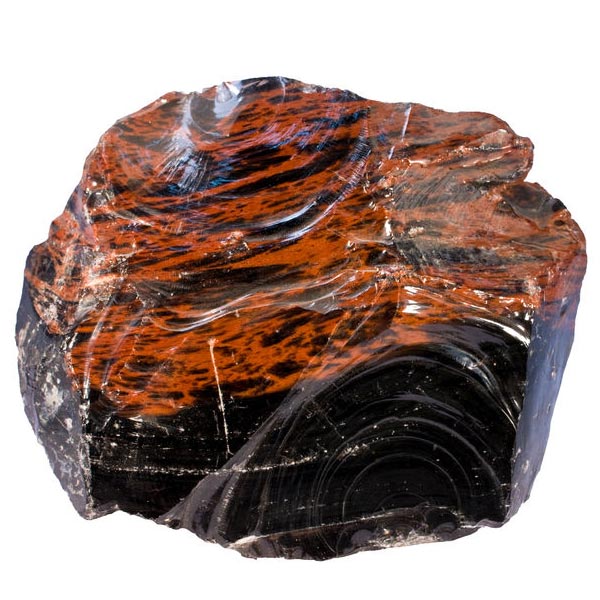
Fig. 21.1 - Raw black obsidian pieces from the RBA collection. Left is a 'mahogany obsidian', only with only part of the piece tinted reddish-brown by iron impurities.
Fig. 21.2 - Raw black obsidian from the RBA collection.
Fig. 21.3 - Raw black obsidian pieces from the RBA collection. Left is a
'mahogany obsidian', only with only a tiny part of the piece tinted
reddish-brown by iron impurities.
Most of the obsidian specimens I had in my existing collection are tumbled, featuring four tumbled stones of snowflake obsidian(Figs. 18.1-2 and 19.2) of varying sizes and differing abundance of their characteristic cristobalite spherulite inclusions (see below). I also had some small pure black obsidian in the rough, from a Chilean mineral set (Fig. 20). As for the new pieces, the RBA collection includes not only one, but three obsidian specimens: The first one is a rough obsidian of the snowflake variety from USA (Figs. 18.1-2 and 19.1), followed, near the end of the collection, by two rough black obsidian pieces from México (in Figs. 18.1 and 21.1-3). Both of them showcase thecharacteristic conchoidal fracture of this volcanic glass variety, with visually striking smooth (and very shiny) curved surfaces, as well as the typical concentric undulations ressembling lines of growth in a shell (see, for ex., Fig. 21.2).
One of these was sold as a 'mahogany obsidian' (Figs. 18.1, 21.1 and 21.3), a variety which includes varying degrees of mahogany tones due to iron inclusions (see below). However, this one falls under the "subpar (and kinda dodgy)" category in this collection, given that the piece I got can hardly be called a 'mahogany obsidian', sporting only a minimal amount of reddish-brown tones. It is much more a regular black obsidian than a mahogany one. To the surprise of no one, the cover of the associated booklet also showcased a specimen of mahogany obsidian resplendent in its abundant bright reddish-brown tones, lol 🙃. So, the end result in this case was to make collectors buy two near identical specimens of regular black obsidian in its raw form. Ah well.
Obsidian is a naturally occurring volcanic glass with a smooth texture and a glassy shine which is amorphous, hard and brittle, with a characteristic conchoidal fracture. Found worldwide in areas of volcanic activity, it is formed when silica-rich lava flows with high viscosity cool so rapidly that atoms are unable to form a crystalline structure, instantly solidifying as anamorphous glass. Sometimes also known as a 'mineraloid', obsidian is thus an igneous rock and not a true mineral, both because of its lack of crystalline structure and its very variable composition (although typically similar to that of the silica-rich igneous rock rhyolite). Most commonly an extrusive rock (solidifying above the surface of the Earth), obsidian is produced from felsic lava, rich in elements such as silica, oxygen, aluminium, pottasium and sodium.
The most common colour for pure obsidian is deep black, sometimes also showcasing brown, reddish or green tones, and very rarely blue, yellow and orange hues. All of these colours are caused by trace elements and inclusions, with iron (via the presence of hematite, for example) and other transition elements giving it the characteristic dark brown to black hues. For example, the 'mahogany obsidian' variety features reddish-brown, mahogany tones due to iron (hematite) inclusions (see Figs. 21.1, 21.3 and 23.1-2).
Fig. 23.1 A Mahogany obsidian.
Fig. 23.2 - One of the tumbled snowflake obsidians also sports small mahogany-toned patches due to iron inclusions.
With the passage of time, obsidian, a chemically unstable glass, begins to crystallize at a non-uniform rate. The crystallization process forms radial clusters of white and grey cristobalitespherulites within the volcanic glass (cristobalite has the same chemical formula as quartz, SiO2, but a distinct crystal structure), producing a snowflake pattern and creating specimens which are fittingly known as 'snowflake obsidian' (see Figs. 18.1-2 and 19.1-2). More rarely, some obsidian specimens can showcase a golden, silver or rainbow iridescent sheen caused by the light being reflected off gas bubbles resulting from the lava flow or minute inclusions of mineral crystals. These varieties are known as 'golden/gold sheen obsidian' (with a golden sheen), 'silver/silver sheen obsidian' (with a silver sheen), and 'fire/rainbow obsidian' (with colourful, iridescent rainbow patterns) (see Fig. 23.3).
✨Some interesting historical and STEM trivia about obsidian:
In in his Natural History, Roman writer Pliny the Elder included mentions of a volcanic glass discovered in Ethiopia by a Roman explorer called Obsidius, thus the name 'obsidian' (lapis obsidianus, "stone of Obsidius")
Obsidian in history: Because its breaks with a characteristic conchoidal fracture, creating curved and sharp edges, obsidian has been used by numerous cultures since the Stone Age (c. 700,000 BC) to manufacture cutting tools, from knives, to spear points and arrowheads. Early mirrors were also made out of polished obsidian in Ancient times, because of its high luster and reflective properties, and it has been consistently carved into jewellery and many artifacts and decorative objects (figurines, sculptures, masks,...). Obsidian was considered a highly valued commodity in Ancient times, with many artifacts and tools travelling far and wide thanks to widespread trading:
Obsidian objects had become common by the Upper Paleolithic and have been found in many Neolithic cultures in Central Europe, and in Turkey dating to the 5th millennium BC. Ancient Egyptians imported obsidian from the eastern Mediterranean regions. Minoan Crete, as well as the areas of modern Hungary and Slovakia, were some of the main sources in Europe. The Japanese areas of volcanic activity were another focal point of obsidian tool making. In America, the Aztec culture used obsidian in a very sophisticated way, and Native North American peoples traded it in a widespread way. Obsidian was also widely used throughout Oceania since at least 1000 BC, with Pacific cultures engaging in long distance trading, and many tools showing complex production techniques that would indicate the association of the use of this volcanic glass with high status.
Modern uses: Thin blades of obsidian have been used to create precision scalpels in the field of modern surgery. While obsidian blades can be thinner and sharper than any steel blade, their major disadvantage is their brittleness, thus limiting their use to specialized uses where this would not be a concern. One of the main industrial uses of obsidian is to manufacture glass wool, used in building construction for thermal and accoustic insulation. Several variations of obsidian, such as snowflake obsidian, are also considered as a semiprecious stone, and used for ornamental purposes, cut into beads, cabochons and tumbled stones.
Apache tears: This is the name that has been given to rounded pebbles of black obsidian, or 'obsidianites'. Mainly found in Arizona and Nevada, the name calls back to a legend of the Native American Apache tribe, recounting a battle between 75 Apaches and the US Cavalry in the 1870s in a mountain in what is now Arizona. Rather than face defeat, the outnumbered Apache warriors preferred to jump their
horses off the mountain. Upon hearing the news (and probably awaiting slavery or death themselves), the
wives and families of the fallen warriors wept, their tears turning into dark pebbles upon hitting the ground 😕.
Fig. 24 - Obsidian infographic from the RBA collection (in Spanish)
16) Azurite:
Fig. 25 -Large azurite and malachite specimen over a goethite matrix plate, from a local fair. It is absolutely gorgeous, and easily one of my top 5 fave specimens in my collection 😍
Fig. 26 -Two azurite specimens from the RBA collection.
Fig. 27 -The first azurite specimen I got from the RBA collection, featuring small azurite crystals (as well as some green malachite crystals) over a goethite matrix.
Fig. 28 -The second azurite specimen I got from the RBA collection, with larger patches of azurite over what looks like a goethite rock piece.
Fig. 29 -Another shot of the large specimen from the local fair. Its front is nearly completely covered by the azurite and malachite crystals.
Fig. 30 -Another shot of the large azurite and malachite specimen from the local fair.
Fig. 31 -The back of the large specimen. Contrasting with the front, the back and sides feature small crystals of both azurite and malachite dispersed on the goethite matrix plate. It's very much like the small RBA specimen in Fig. 27, but considerably larger.
Azurite is one of my favourite minerals, mostly because of its deep blue colour 💙. I didn't have any azurite specimens in my former collection, and all of a sudden I got three of them this year, so yay 😃 xD. Two of them are from the RBA collection(Figs. 26-28, both of them from Morocco), and then I found the most gorgeous large azurite and malachite specimen at a local fair this past Spring (Figs. 25 and 29-31). I was a bit disillusioned with the first specimen from the National Geographic collection (Fig. 27). Its small azurite and malachite crystals, embedded in what looks like a matrix plate of goethite, an iron oxyde-hydroxide mineral typically associated with azurite (also seegossan rock), are undeniably beautiful, but I was expecting a bit more of a presence of azurite, so to speak 😅, and so I got the same number from the collection when it started selling in kioscs again from the top (I've since done this with a couple of others because I wasn't satisfied with the specimen I already had and wanted one more....perfectionist, me? Hoarder-collector, me? Nope 😅 xD). The second specimen I got from the same collection (the renewed round of it, that is) showcased azurite patches that were a little larger (Fig. 28), something which I was initially going for.
I still wanted to find a larger azurite(+malachite) specimen sometime, and then I visited a local Spring fair which had a minerals stall and voilà, I fell in love with a large (and surprisingly affordable!) specimen, featuring extensive patches of mainly azurite but also malachite (love the combination!) on a large matrix plate of goethite. It's like the amped up (and utterly gorgeous) edition of both RBA specimens, featuring both the more homogeneous patches of azurite and malachite patinas on the front (Figs. 25 and 29-30), and the small crystals strewn upon the rock in the sides and back (Fig. 31). I found this specimen quite by chance, and it has easily become one of my top faves in my whole collection 😍💎.
Azuriteis a soft copper carbonate hydroxide mineral (Cu3(CO3)2(OH)2) formed as a secondary mineral by the weathering of copper ore deposits by carbon-dioxide-laden waters, often occurring in fractures and cavities of subsurface rock. Azurite showcases a characteristic deep blue to violet blue colour, traditionally called azure (hence the name), and forms either tabular or prismatic glittering crystals with a vitreous luster in a wide variety of crystal habits, from rossette-shaped crystalline aggregates to massive (shapeless, no distinctive external crystal shape), nodular, stalactitic or botryoidal (globular) forms.
Azurite is one of the two common basic copper (II) carbonate variations, the other being malachite, with bright green hues. The copper (II) content in these two minerals is reponsible for their bright blue and green hues, and also for their high specific gravity of 3.7-3.9, exceptionally high for a non-metallic mineral. Being more unstable in open air conditions, azurite is often pseudomorphically replaced by malachite over time, one mineral replacing another in a substitution process where the appearance and dimensions remain constant. Both azurite and malachite are thus are often found together in the same geological settings and the same specimens (as we can see in the large specimen of Fig. 25), although azurite is markedly less abundant than malachite. Both variations are also associated with native copper, cuprite (a copper oxide) and various iron oxide minerals.
Fig. 33 - Azurite infographic from the RBA collection (in Spanish)
Also, here are a couple of videos showcasing the rich colour and glittering crystals of my large azurite specimen ✨ (also on TikTok here and here):
✨Some interesting historical and STEM trivia about azurite:
"Azure" comes from Old French asur/azur, from Medieval Latin azzurum/azolum, via the Persian lazhuward,
“blue" and the Arabic lāzaward"heaven, sky". This is the same etymology that appears in the also blue mineral lapis lazuli. Azurite has been known since Ancient times, mentioned by Pliny the Elder's Natural History under the Greek name κυανός (kuanos)"deep blue" (root of 'cyan'), and the Latin caeruleus "dark blue"(root of 'cerulean'). During the 19th Century, azurite was also known aschessylite after the French locality of Chessy-les-Mines, where azurite was mined.
Uses: Even though it is not an abundant mineral, the
bright blue tones of azurite have attracted attention for thousands of
years, and it has been used since Ancient times for various uses, especially as a pigment (see below) and as a gemstone, cut into beads, cabochons, carvings and various types of jewellery and ornaments (even though it's brittleness and low hardness, as well as its oxidation into malachite with time, limits its use an an ornamental stone). Cultures such as the Ancient Egyptians also used it as an ore of copper, although nowadays the presence of azurite is mainly used in prospecting only as a surface indicator of the presence of copper sulfide ores. Another modern use of azurite is its interest for mineralogy collectors, due to its intense azure colour.
Azurite as a pigment: As early as the Ancient Mesopotamian and Egyptian cultures, azurite was already being ground to use as a blue pigment, as well as fused with glass. While Romans don't appear to have used it significantly, it was also used in Ancient Greece. A common mineral in Europe, it was during the Middle Ages and the Renaissance that the use of azurite for art became commonplace, becoming the main blue pigment used by Medieval artists and vastly surpasing the use of lapis lazuli, which had to be imported from Afghanistan. Because azurite weathers into malachite with time and exposure to light and the atmosphere, older paintings using azurite can show deterioration of the blue tones, with greenish tints appearing due to malachite. And, while its use was commonplace for centuries, making pigment from azurite was also quite costly, as it was difficult to mine, transport and produce. In the 18th Century, its use started to be replaced by human-made synthetic blue pigments such as "Prussian blue" and "blue verditer", more uniform and permanent in use and less costly to produce.
Fig. 34 - Medieval women painting women, using azurite among other pigments (note the man grinding azurite in the illumination on the right). Manuscript illuminations from Boccacio's De Claris Mulieribus.
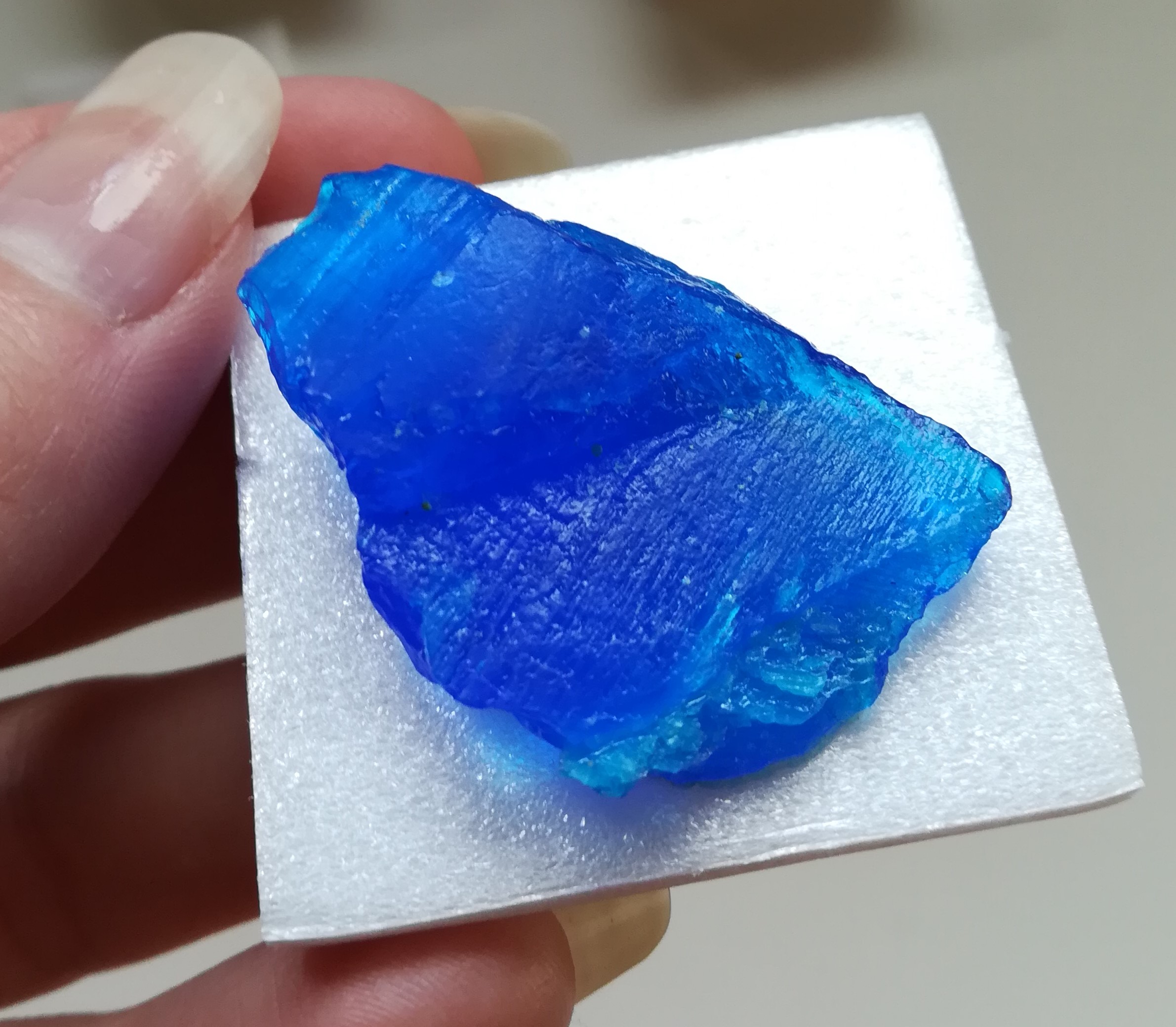
Fig. 35 - A crystallized synthetic specimen of pentahydrate copper(II) sulphate (left), and a chalcanthite specimen (naturally ocurring copper sulphate) (right), both from my existing collection.
Fig. 36 - A synthetic specimen of chalcanthite, showcasing beautiful prismatic crystals
Fig. 37 - A chalcanthite specimen with a tabular crystal habit
Fig. 38 - a chalcanthite specimen
Fig. 39 - A synthetic specimen of chalcanthite
Another blue copper mineral that I wanted to talk about in this post is chalcanthite (pentahydrate of copper sulphate). It does not feature in the RBA collection, but I have two lovely specimens that I got years ago in a memorabilia shop in Segovia (Castilla y León, Spain) (Figs. 35-39), so I'm including them in this post as well. One of them is a naturally ocurring chancanthite from Riotinto (Huelva, Spain) (Figs. 37-38), while the other one (Figs. 36 and 39) is a synthetic specimen of (pentahydrate) copper sulphate. These are also among my fave specimens in my collection, because of their striking electric blue shades, and also because of the beautiful crystallization pattern of the synthesized specimen (Figs. 36 and 39).
Copper(II) sulphate (CuSO4) is an inorganic compound which forms hydrates with the chemical formula CuSO4·nH2O(where n can range from 1 to 7). The most common is the pentahydrate (n=5) of copper sulphate (CuSO4·5H2O), a bright blue water-soluble crystal, occurring in nature as the chalcanthitemineral, and also as rarer minerals such as chalcocyanite. It can also be produced industrially by treating copper metal or copper oxides with hot sulfuric acid. Other names for this pentahydrate include blue vitriol, vitriol of copper, bluestone and Roman vitriol.
Chalcanthiteis found in late-stage oxidation areas of copper deposits. Due to the rapid solubility of this mineral, it is typically in arid regions and dry caves, commonly forming both botryoidal (globular) and stalactitic growths on walls and ceilings. The most notable feature of this mineral is its striking electric blue colour, and it dissolves in water, turning the solution blue.
Natural chalcanthite crystals, typically tabular (shaped like a book) or prismatic, are very rare in nature, and most well-formed crystals are actually grown synthetically(as seen in the specimen of Figs. 36 and 39), dissolving readily-made copper sulphate and letting the water evaporate, leaving a beautifully crystallized mass of chalcanthite as the result. Large synthetic specimens of crystallized chalcanthite are sometimes unethically sold as being natural.
Here's a short video, with a rather yellowish background, but the electric blues, and the way that the light shines off the crystals of especially the synthetic specimen, still show:
✨Some interesting historical and STEM trivia about chalcanthite:
The name "chalcanthite" means "copper flower", describing the curved and flowering formations of this mineral, originating from the Ancient Greek χάλκανθον (khálkanthon), from χαλκός (khalkós) "copper", and ἄνθος (ánthos) "flower, bloom".
Copper(II) sulphate is a poisonous substance which can induce dangerous copper poisoning when consumed (so don't taste-test any copper sulphate solutions at home :S!).
Uses: Chalcanthite can be used as an ore of copper in arid regions where it is found in suficiently large quantities. Its rich blue hues and beautiful crystals (be they naturally ocurring or synthesized) also make this a mineral that is highly sought out by mineralogy collectors, with the specimens needing to be adequately stored in order to protect them from humidity and preserve their crystalline structure. however, due to their rapid sollubility (I store both of my specimens in a closed wooden box). Copper(II) sulphate in general also has various uses, mainly in industry and art: Among others, it has been used as a fungicide, insecticide and herbicide; as a mordant in vegetable dyeing (dissolved copper sulphate also dyes materials in blue tones and highlights the green tints of some dyes); as a colouring ingredient in glasses and potteries; and as an additive for both book-binding glues, and to make concrete more resistant to water.
-Finally, here are some infographics from the collection (in Spanish) about red jasper, Iceland spar, obsidian and azurite (click on the pics or open in new tab for larger pics!):
That's it for today! On the next minerals post we'll talk about: desert rose, aragonite, emerald, and jadeite😃💎
💎Former posts in this series💎:
Post 1: Various types of quartz (rose quartz, Tiger's Eye, amethyst, ametrine and blue agate), as well as gold, fluorite, and celestine. Also check out this same first post for a lengthy rant about what I think about the pseudoscientific branches having to do with rocks, minerals and gems, such as 'crystal healing' (spoiler alert, I'm not a fan).
Post 2: Fuchsite,rhodonite, quartz and agate geodes, pyrite and galena.


.png)




.png)

_with_Pavilion_on_a_Garden_Terrace_LACMA_M.81.125.1.jpg)


.png)
.png)


.png)

_birefringence.jpg)


.png)


.png)



.png)


