Showing posts with label Magical women. Show all posts

Thursday, 25 August 2022

Tolkien essays - Rompiendo roles de género: Galadriel

Morfydd Clark (left) and Cate Blanchett (right) portray Galadriel in Amazon Prime's The Lord of the Rings: The Rings of Power series, and Peter Jackson's LOTR and The Hobbit movies, respectively.

(English version, Spanish on the next paragraph) In this post from March 2022, I talked about my participation in a Twitch live for 8M (International Women's Day), in which the Onóressë feminist group of the Spanish Tolkien Society (STE) to discuss women from Tolkien's life and works. I chose to delve into gender roles in Elven society, and especifically talk about my favourite Tolkien woman, Galadriel, and all the gender roles she subverts both in her characterization and plot✨📚💪💜. The post I published back in March includes the YouTube video with the complete Twitch live, as well as the PDF of my talk (which also appears on the video as I'm discussing it). Note that both the video and the talk are in Spanish only! 

En este post de marzo de 2022, estuve hablando sobre mi participación en un directo de Twitch el pasado 8M (Día internacional de la mujer). En este directo organizado por el grupo feminista Onóressë de la Sociedad Tolkien Española (STE) estuvimos dando breves charlas sobre varias mujeres de la vida y obra de Tolkien. Yo decidí hablar sobre roles de género en la sociedad élfica, y específicamente sobre mi personaje femenino favorito de las obras de Tolkien, Galadriel, y todos los roles de género que subvierte en su caracterización y trama ✨📚💪💜. En el post que publiqué en marzo  incluí el vídeo de YouTube con el directo de Twitch completo, además de mi charla en formato PDF (esta presentación también aparece en el directo durante la charla). Podéis también ver el directo aquí abajo (mi charla empieza a partir de 21:50, y estoy respondiendo preguntas a partir de 54:2):

You can also watch the YouTube video here below (My talk begins at 21:50, and I'm answering some questions at 54:2):

Participating with Elanor and Silmariën during the Twitch live back in 8M 2022

(English version, Spanish below) So, after working on the presentation for this live, I decided to use all this geeky feminist inertia to write an article based on my presentation and send it to be published in the Summer 2022 edition of the Estel (no. 97), the biannual magazine of the STE. In this essay, I summarized the main aspects from my presentation, starting with an introduction about gender roles in Elven society, and then delving into all the ways Galadriel defies societally established gender norms, from her erudite aspect to her desire for adventure and exploration, her athletic feats and warrior aspect, her role as a stateswoman, leader and strategist, and her protective and offensive magical abilities harnessing her ring of power Nenya. This essay is, for the moment being, in Spanish only, but I am planning on translating it into English as well sometime in the future 🙂

My essay about Galadriel was also published near the upcoming start of The Lord of the Rings: The Rings of Power, the new Amazon Prime series that will delve into many of the subversive traits described in Galadriel's character and plot in Tolkien's works, and I'm personally looking forward to finally fully seeing aspects of Galadriel we haven't still seen in other Tolkien adaptations 😃💪. While Cate Blanchett's amazing performance as Galadriel showcases her role as the wise, ethereal and magical leader of Lothlórien near the end of the Third Age, judging by the teasers, trailers and promotional material, Morfydd Clark's also amazingly cast Galadriel will be exploring the Second Age and highlighting other traits more often seen in Tolkien's works in the younger Galadriel of the First and Second Ages: her athletic, warlike and strategic aspects, her adventuring wanderlust, and her competence as a budding stateswoman, most probably showcasing her evolution throughout the seasons towards becoming the leader of Lothlórien and the magical wielder of Nenya, one of the three Elven rings of power. Stay tuned for more Rings of Power posts and discussions in this blog, coming soon!

Después de trabajar en la presentación para este directo, decidí usar toda esta inercia de feminismo tolkieniano para escribir un artículo basado en mi charla y enviarlo para que pudiera ser publicado en el siguiente número de la Estel (número 97, edición de verano de 2022), la revista bianual de la STE. En el artículo resultante resumí los aspectos principales de mi presentación, comenzando con una introducción sobre los roles de género en la sociedad élfica descrita por Tolkien, y después profundizando en todas las formas en que Galadriel desafía y subvierte las normas de género establecidas en dicha sociedad, desde su aspecto erudito a su deseo de aventura y exploración, sus proezas y aptitudes atléticas, su aspecto guerrero, su rol como estadista, líder y estratega, y su aspecto mágico, tanto ofensivo como protector, mediante el uso de su anillo de poder Nenya. 

Este artículo sobre Galadriel también ha salido publicado en la revista a poco tiempo del estreno de la nueva serie de Amazon Prime, El Señor de los Anillos: Los Anillos de Poder. Esta serie profundizará en varios de los muchos aspectos subversivos de la personalidad y trama de Galadriel tal y como se la describe en las obras de Tolkien, y tengo muchas ganas de poder ver al fin aspectos de Galadriel que otras adaptaciones de Tolkien no han mostrado aún 😃💪. Cate Blanchett ofrece una actuación maravillosa como Galadriel en su rol como la líder sabia y etérea de Lothlórien al final de la Tercera Edad, con especial énfasis en su faceta de habilidades mágicas con Nenya, de forma acorde con la Galadriel descrita en la época de SdlA. Por otro lado, juzgando por los avances, tráilers y todo el material promocional publicado hasta la fecha, con la Galadriel de Morfydd Clark - una elección de actriz que me parece también genial - se explorará la Segunda Edad y se pondrá más énfasis en otros aspectos del personaje que Tolkien suele describir para la Galadriel más joven de la Primera y Segunda Edad: sus facetas atléticas, marciales y estratégicas, sus ansias de aventura, y su aptitud creciente de estadista y líder, probablemente con el objetivo de también mostrar su evolución durante las temporadas hasta convertirse en la gobernante de los elfos de Lothlórien y en la portadora del anillo mágico de poder Nenya. Si os interesa la serie de Los Anillos de Poder, ¡estad atentos a este blog, porque se vienen nuevos posts donde hablaré de temas relacionados con la nueva serie! 

 But before that, and coming back to the essay, Estel 97 came out in PDF online form a while ago. You can read the essay on pages 2-9 here below ⬇️, and I would also like to give a shoutout to Pilar Erika 'Tarmariel Luinilmë''s great article about alliterative verse in The Lord of the Rings, which you can read on pages 32-37 of this same magazine, and also on her blog here

Pero antes de todo eso, y volviendo al artículo, el número 97 de la revista Estel salió publicado en formato PDF hace un par de meses. Podeís leer el artículo en el PDF adjunto en las páginas 2-9⬇️, Y en esta revista también podéis encontrar el excelente artículo de Pilar Erika 'Tarmariel Luinilmë''s sobre el verso aliterativo en El Señor de los Anillos, artículo que podéis leer en las páginas 32-37 de la revista, y también en su blog

Read both articles in the magazine here:


As well as reading it on the PDF, I'm always including my essay here below in this post, in its entirey and with additional images. Hope you enjoy it 😊!  

 
Además de poder leer el artículo en el archivo PDF de la revista que acabo de adjuntar, a continuación muestro también el artículo completo, con imágenes adicionales. ¡Espero que lo disfrutéis 😊!


This essay is for the moment in Spanish only, similarly to most of my essays and presentations for the magazine and the events of the Spanish Tolkien Society, but ideally I'd like to translate them all into English as well sometime, hopefully soonish. In the meantime, if you can't read Spanish and would like to know what it's about and what I think about Galadriel and all the ways she defies societal roles and expectations, I recommend that you use Google translate to offer a hopefully adequate English version of it 😅 Thanks again for reading!

Rompiendo roles de género: Galadriel

El pasado 8 de marzo, el grupo Onóressë organizó un directo de Twitch1 con un de par de charlas enfocadas en varias mujeres de la vida y obra de Tolkien. Junto con Leonor ‘Elanor’ y Ángela ‘Silmarien’, tuve la oportunidad de hablar de Galadriel, uno de mis personajes femeninos favoritos de la obra de Tolkien, y también uno de los más excepcionales dentro del universo de Arda. Basándome en esta charla2, presento este artículo describiendo de forma general cómo Tolkien imaginó la sociedad élfica respecto a roles de género, para pasar a centrarme en Galadriel y todos los roles que subvierte dentro de su sociedad, tanto en su caracterización como en su arco argumental.

1.       Roles de género en la sociedad élfica

Galadriel toca el arpa en Lórien (©Kikuno I. Craft)

No hay temas entre los Eldar que sólo un nér pueda pensar o hacer, u otros que sólo conciernan a una nís. se encuentran una serie de diferencias entre las inclinaciones naturales de los néri y nissi, y otras que han sido establecidas por la costumbre (…). Pero a todas [las] cosas (…) se podían dedicar en diferentes momentos cualquiera de entre los Noldor, ya fueran neri o nissi.   (El Anillo de Morgoth, “Leyes y costumbres de los Eldar”)

 En la sociedad élfica descrita por Tolkien imperan una serie de roles de género para los elfos (nér, pl. neri) y elfas (nís, pl. nissi). Estos roles de género están establecidos por la tradición y reforzados por la costumbre, y en parte también se justifican por medio de un ideario basado en el determinismo biológico, donde son supuestas ‘inclinaciones naturales’ las que diferencian algunos de los roles llevados a cabo por los neri y nissi

  Así, los elfos varones suelen dedicarse a la lucha y la caza; la forja, orfebrería y artesanía; el estudio de lenguas y la erudición; la composición musical y escrita; y también la cocina (excepto el pan). En contrapartida, las elfas tienden a dedicarse a la curación y los cuidados; la jardinería; la costura, tejido y bordado; el canto, baile y el tocar instrumentos; la fabricación del pan y las lembas (una actividad ceremonial exclusivamente femenina); y en las áreas del conocimiento suelen limitarse a estudiar y transmitir la historia de los Eldar y sus genealogías3.  Tolkien también enfatiza que las nissi como norma general mostraban una ‘inclinación natural’ a la maternidad, justificando así que tuvieran menos interés en facetas asociadas con el saber o los trabajos manuales3,4, más reservadas a los neri, descritos además como ‘naturalmente’ más aventureros y fuertes de espíritu5.

A pesar de estos roles establecidos y de este ideario más basado en un determinismo biológico (ideario que podemos también apreciar claramente en algunas de sus cartas, especialmente en la número 43), Tolkien también comenta cómo cualquier nér o nís tiene la capacidad tanto física como mental para llevar a cabo cualquier actividad o rol, alejándose de la norma establecida3. Podemos así ver elfas que siguen caminos no tradicionales, entre los que se pueden listar: atletas, guerreras y cazadoras; aventureras y exploradoras; artesanas, herreras y pintoras; escritoras, poetas y eruditas; líderes, gobernantes y estadistas; magas y hechiceras (con aspectos tanto más tradicionales como menos normativos); y/o elfas que prefirieran mantenerse solteras o no tener hijos. 

Galadriel subvirtiendo todos los roles (©Los Anillos de Poder)  

Sin embargo, no podemos olvidar el poder que tienen los roles de género en una sociedad de base patriarcal a la hora de influir en las decisiones, inclinaciones y aspiraciones de cada persona. Es por esto que, desafortunadamente, también vemos que las elfas y elfos que eligen roles no tradicionales dentro de su sociedad parecerían hacerlo de forma más excepcional. Y dentro de esta minoría no hay ninguna elfa que destaque más que Galadriel.


2.       Galadriel y sus roles

Galadriel es la elfa más fuerte y empoderada de la Primera Edad, y la única elfa de nombre conocido e importancia notable en la trama que sigue apareciendo en los relatos de la Segunda y Tercera Edad. 

Galadriel en ©El Hobbit

Galadriel cumple un papel normativo de esposa-madre, al estar casada con Celeborn (de esta relación hablaremos más adelante), con el que tuvo a su hija Celebrían. Descrita como la más hermosa de los Noldor, se resalta también su belleza, y especialmente sus cabellos dorados. Galadriel realiza una serie de actividades vistas como ‘tradicionalmente femeninas’ en la sociedad élfica, mencionadas sobre todo en El Señor de los Anillos: Es ella, junto con sus doncellas, la que teje las capas que regala a la Comunidad del Anillo en Lothlórien, toca el arpa y canta, y también preserva la receta y la tradición de la fabricación de las lembas en Lórien6. Sus capacidades mágicas también presentan un importante aspecto de protección y curación en SdlA.

Pero Galadriel es también una elfa excepcional en su sociedad, descrita continuadamente como sabia, fuerte y valiente además de hermosa, y presenta un gran número de inclinaciones y habilidades que subvierten todos los roles de género tradicionalmente impuestos entre los Eldar: Actividades atléticas, lucha, ansias de aventura y liderazgo, dotes estadistas, erudición, interés por la artesanía,…De todos estos roles pasaré a hablar a continuación. 

Aunque antes de ello sí quiero remarcar que mi intención no es restar validez o importancia a las actividades consideradas como ‘tradicionalmente femeninas’ tanto en la sociedad élfica como en la vida real. El problema radica más bien en que exista una obligación social de que una persona tenga que dedicarse a una cosa u otra sólo por su género, y que sólo una minoría sea capaz de llevar a cabo actividades vistas como no normativas, en lugar de poder elegir libremente el poder dedicarse tanto al atletismo como al bordado, por ejemplo.

2.1 Erudita, maestra del saber y artesana

(©Los Anillos de Poder, detalle)
“[Galadriel] conocía bien la historia de su lengua y todos los asuntos de los maestros del saber” (Los Pueblos de la Tierra Media)

Descrita como la más grande entre los Noldor, Galadriel se convirtió en una gran erudita en lingüística y muchas ramas del saber durante su juventud en Valinor, y también destaca su capacidad excepcional para percibir los pensamientos y comprender las mentes de las personas. Sólo Fëanor la igualaba en poder, aunque ella lo superaba en sabiduría, y llegó a ser la elfa más sabia y poderosa en la Tierra Media a partir de la Segunda Edad7. Su feudo con Fëanor fue constante, lo que la llevó desde a enfrentarse a él durante la Rebelión de los Noldor, a negarle tres veces un mechón de su cabello (al que Fëanor se creía con derecho), o a adoptar usos fonéticos en quenya que él odiaba8.

Como Noldo, Galadriel también comparte con los enanos su interés por la artesanía y los trabajos manuales. Dado que fue alumna de Aulë (y de Yavanna) en Valinor7, es probable que tuviera experiencia en la forja, la orfebrería u otro tipo de artesanía.

2.2 Fortaleza física de Galadriel. Atleta

“[Galadriel] llegó a ser alta por encima incluso de las mujeres de los Noldor; era fuerte de cuerpo, mente y voluntad, a la altura tanto de los eruditos como de los atletas de los Eldar en los días de su juventud.” (Cuentos inconclusos, “Historia de Galadriel y Celeborn”)

'Maiden Crowned with Light' (©Jenny Dolfen)
Aunque las elfas son de media muy altas9, Galadriel tiene una estatura excepcional de 1.95 metros7, y es descrita como fuerte y vigorosa, con “disposición de amazona”10, y destacando durante su juventud en Valinor en ejercicios y proezas atléticas. De nombre paterno Artanis (“Mujer noble”), el nombre materno11 de Galadriel es Nerwen (“Mujer-hombre”), haciendo alusión a su altura, fortaleza física y valentía7,12. Por otro lado, el nombre que adoptó en la Tierra Media, ‘Galadriel’ (“Mujer coronada por una guirnalda resplandenciente”), le fue dado por Celeborn y parece hacer referencia a la forma en que se recogía el cabello en forma de corona cuando tomaba parte en competiciones atléticas10,12 .

Respecto al nombre de ‘Nerwen’, y en relación con los roles descritos anteriormente, me resulta bastante problemático que se equipare la fuerza, inteligencia o la valentía de una mujer a características ‘de naturaleza varonil’, ya que la inteligencia y coraje no entienden de género, y existen mujeres altas y fuertes sin que tengan que ser comparadas por ello con hombres. Esto es algo que también podemos observar en otros nombres de mujeres atléticas, eruditas, guerreras o artesanas, como ‘Nerdanel’, ‘Nessa’ o ‘Emeldir’.

Mi dibujo de una joven Artanis Nerwen en Valinor
2.3 Líder y aventurera

"Galadriel, la única mujer de los Noldor que se mantuvo erguida y valerosa entre los príncipes contendientes, estaba ansiosa por partir. (…) anhelaba ver las amplias tierras sin custodia y gobernar allí un reino a su propia voluntad.” (El Silmarillion)

Galadriel muestra un fuerte aspecto aventurero y ansias de liderazgo, vagando lejos en Valinor12 y soñando con explorar las tierras lejanas de la Tierra Media y allí gobernar reinos de manera independiente. Mientras que su padre Finarfin es de temperamento más calmo, Galadriel parece heredar sus deseo por la aventura y la exploración más de su madre Telerin, Eärwen8.

Atraída más por la oportunidad de explorar la Tierra Media que por un fuerte posicionamiento en el asunto de los Silmarils, Galadriel es descrita como la única mujer en asistir al juramento de Fëanor (momentos como este refuerzan su carácter excepcional dentro de los roles de género en su sociedad), y se convierte en una de los principales líderes de la Rebelión de los Noldor. Lidera junto a su hermano Finrod la casa de Finarfin, y pone a prueba su fortaleza y valentía atravesando los hielos del Helcaraxë hasta llegar a la Tierra Media. 

Galadriel lidera una misión en el Norte (©Los Anillos de Poder)
2.4 Estadista y gobernante

[Sauron] percibió de inmediato que Galadriel sería su principal adversaria y obstáculo. (...) En Lórinand Galadriel tomó el liderazgo y organizó la defensa contra Sauron.“  (Cuentos inconclusos, “Historia de Galadriel y Celeborn”)

Además de su espíritu aventurero, Galadriel muestra continuamente sus habilidades de estadista y sus capacidades de liderazgo. Durante la Segunda Edad, Galadriel y Celeborn establecen el reino de Eregion7, y, gracias a su amistad y alianza con los enanos de Moria, Galadriel se establece en Lothlórien7 y se termina convirtiendo, junto con Celeborn, en la gobernante, protectora y ‘reina’ de los elfos silvanos de Lórien7, 13, 14
Galadriel mostrará sus aptitudes de  liderazgo en ©Los Anillos de Poder

Galadriel se muestra como una líder y estadista brillante, pero, como pienso que es importante dar un análisis matizado de cualquier persona, ficticia o real, también pienso que se la puede criticar desde un matiz colonialista, ya que se trata de una Alta Elfa de los Noldor con deseos de gobernar en la Tierra Media a elfos Sindar y Silvanos, que no sólo son los pueblos indígenas de esas tierras, sino que también se encuentran por debajo de los Eldar de Valinor en el sistema de jerarquía élfica15.

Galadriel y el Concilio Blanco (©El Hobbit)

Durante la Segunda Edad Sauron pasa a considerar a Galadriel como su principal adversaria, la más poderosa de los elfos en la Tierra Media en ese momento, y ella se dedica durante la Segunda y Tercera edad a enfrentarse a él de todas las formas posibles7, 13. Es Galadriel la que inicia el Concilio Blanco para oponerse a Sauron, y establece una relación estrecha de amistad con Gandalf de los Istari13, 14.  Y aunque una discusión de este tema daría para un artículo entero, quiero destacar también la gran fuerza moral y sabiduría que termina mostrando Galadriel, portadora de otro Anillo de Poder, al terminar rechazando el poder corrupto del Anillo Único13.

2.5 Galadriel guerrera

“Incluso tras el asalto inclemente contra los Teleri y el robo de sus naves, aunque luchó con fiereza contra Feänor en defensa del pueblo de su madre, no se echó atrás. (...) ” (Cuentos inconclusos, “Historia de Galadriel y Celeborn”)

Galadriel guerrera en ©Los Anillos de Poder

Según “Leyes y costumbres de los Eldar”, hay muchas menos diferencias en fuerza y velocidad entre los neri y nissi que entre los humanos, y las elfas luchan valientemente en “situaciones graves o defensas desesperadas”, si bien hemos visto que por imposición social estos roles son generalmente llevados a cabo por los neri.

Además de sus proezas atléticas, Galadriel también parece haberse entrenado en la lucha, ya que toma armas en más de una ocasión. Tolkien la describe como “la más valiente de la casa de Finwë”16 y como “el prototipo de la guerrera”17 por su fuerza y estatura. Galadriel toma armas y lucha heroicamente y con furia contra los fëanorianos para defender al pueblo Telerin de su madre en Alqualondë7. Más tarde, como parte de su lucha contra Sauron, es de esperar que participara en el asalto de Dol Guldur junto al resto del Concilio Blanco, y también se une a los ejércitos de Lórien tras la Guerra del Anillo para echar abajo Dol Guldur18.

Galadriel guerrera en Dol Guldur (©Angus McBride)

 La nueva serie de Los Anillos de Poder ha mostrado en su adelanto a una Galadriel guerrera en la Segunda Edad, la “comandante de los ejércitos del Norte” en su lucha contra Sauron19. Y, aunque los derechos acotados con los que cuenta la serie y el hecho de que se trata de una adaptación signifiquen que la trama se pueda alejar de los escritos de este período, este aspecto guerrero resulta ser completamente acorde con el lore de Tolkien, a pesar de las críticas que ha recibido ya el personaje de Morfydd Clark de parte de algunos que ven su armadura como una invención incoherente con el personaje20 – Un juicio que a menudo parecería ser casi más causa de un sexismo interiorizado (o externalizado) que de la ignorancia del transfondo más escondido de Galadriel y sus dotes atléticas y marciales.

2.6   Galadriel y magia

"Tomaron Dol Guldur, y Galadriel echó abajo sus muros y dejó sus fosos al descubierto, y todo el bosque fue limpiado.“ (SdlA, apéndice B)

Durante su estancia en Doriath en la Primera Edad, Galadriel estableció una larga amistad con Melian, de la que aprendió muchos conocimientos14 y probablemente habilidades mágicas, dado que tanto Melian como su hija Lúthien son las hechiceras más poderosas de Beleriand. Vemos también paralelismos claros entre Melian y Galadriel y su protección mágica de los reinos de Doriath y Lórien, respectivamente.

Galadriel con Nenya (©El Hobbit)
Las habilidades mágicas de Galadriel parecen tomar protagonismo frente a sus características atléticas y marciales cuando se convierte en la portadora de Nenya, uno de los Anillos de Poder élficos, que usa constantemente con el fin de preservar la tierra de Lórien a imagen de Valinor y para proteger el reino contra Sauron. 

Los humanos y otras razas suelen asociar a los elfos con la magia, calificando de ‘magia’ no sólo al poder de artefactos innegablemente mágicos en este universo, como los Anillos de Poder, sino también a una serie de habilidades y objetos que los elfos consideran como sus capacidades inherentes, o algo más cercano a la ciencia y la tecnología que a la magia13. Pero dentro de esta percepción, podemos también listar las habilidades de Galadriel de comunicarse telepáticamente13, 21 y su don de la premonición (usual entre las elfas).

En SdlA, uno de los roles claves de Galadriel es el de proporcionar ayuda ‘mágica’ a los miembros de la Comunidad del Anillo, desde sus regalos de las capas de Lórien y el Vial con la luz de Eärendil a la ayuda prestada a Gandalf el Blanco o su consejo con ayuda de las visiones de su Espejo. Así, en la Tercera Edad a Galadriel se la tiende a asociar más a un rol de consejera y protectora, un papel más ‘tradicionalmente femenino’ según la sociedad élfica, pero también la postura elegida por todos los señores elfos dentro de sus reinos en esta etapa22.

Galadriel en Dol Guldur (©Rebekah Tischr, Weta Workshop)

Por otro lado, Galadriel es descrita no sólo usando su magia de forma protectiva y curativa, sino también de manera ofensiva cuando la ocasión lo requiere. El poder de Nenya blandido por Galadriel es tan poderoso que hace retroceder a las fuerzas de Sauron tres veces durante los ataques a Lórien de la Guerra del Anillo21, y en las películas de El Hobbit: La Batalla de los Cinco Ejércitos, durante el asalto a Dol Guldur Galadriel usa el poder de Nenya y sus habilidades mágicas de forma ofensiva para rescatar a Gandalf (donde también hace gala de su fuerza física llevándolo en brazos) y expulsar a Sauron en un duelo mágico de voluntades23. Destruido el Anillo Único, Galadriel parte a Dol Guldur con Celeborn y la hueste de Lórien, y con Nenya purifica el lugar y echa abajo toda la fortaleza21, recordando a cómo Lúthien tiró abajo la fortaleza de Sauron en El Silmarillion con su canto mágico.

3.       Galadriel y Celeborn

La relación de Galadriel con su esposo Celeborn es quizá la más igualitaria de la obra de Tolkien. Me resulta excepcional el hecho de que la relación romántica de Galadriel nunca es el punto principal de su trama, y sobre todo que no pierde ni un ápice de iniciativa ni sacrifica ninguna de sus aspiraciones ‘no tradicionales’ al casarse – Frente a esto, podemos observar a menudo un patrón donde otros personajes femeninos de Arda con rasgos poderosos terminan teniendo que adoptar un rol más ‘tradicionalmente femenino’ y más pasivo a la hora de casarse.

Galadriel y Celeborn (©evankart)

Galadriel y Celeborn fundan Eregion en conjunto y terminan gobernando en Lórien lado a lado7, con Galadriel como la principal protectora como portadora de Nenya. También los podemos ver batallando juntos, en Alqualondë (en una versión más temprana del legendarium)7, y en Dol Guldur tras la Guerra del Anillo.

Galadriel y Celeborn disfrutan de una de las dinámicas más sanas de Arda, si no la que más. Además de no tener que renunciar a sus aspiraciones y de gobernar lado a lado, no necesitan estar juntos todo el tiempo para ser una pareja fuertemente estable, y mantienen su independencia pasando temporadas en lugares diferentes sin necesidad de sacrificios innecesarios. Así, Galadriel pasa un tiempo estableciendo lazos de amistad con los enanos de Moria sin Celeborn7, y Celeborn decide demorarse una temporada en Lórien cuando Galadriel parte a Valinor24.

Celeborn claramente admira y respeta a Galadriel por sus muchas habilidades y poder (como Galadriel merece), y siempre me ha gustado el detalle de que le dedica un nombre que hace referencia de manera indirecta a sus capacidades atléticas y su fortaleza física. Tengo que admitir que me resulta increíblemente frustrante el que buena parte del fandom se dirija a Celeborn de forma despectiva como alguien ‘débil’, concluyendo que Galadriel ‘domina a su marido’ por el aparentemente audaz hecho de tener poder e iniciativas propias. Lo veo como un claro reflejo de cómo la sociedad sigue normalizado en demasiados casos las relaciones desiguales con roles de género como el estándar que emular.

4.       ¿Qué diferencia a Galadriel de otras mujeres de Arda?

Cate Blanchett (izqu.) y Morfydd Clark (der.) como Galadriel en las películas de SdlA de Peter Jackson, y en la serie de Amazon Prime El Señor de los Anillos: Los Anillos de Poder, respectivamente.

Para terminar, quisiera comentar que lo que en mi opinión hace a Galadriel excepcional en su caracterización y arco argumental no es solamente el gran número de roles de género que combina y subvierte sin importar su género, haciendo de ella un gran modelo feminista a seguir, ni tampoco su relación de pareja marcadamente igualitaria dentro de su sociedad. Es también el hecho de que prácticamente no se encuentra ningún impedimento social o personal a la hora de realizar y cumplir todas sus aspiraciones e inclinaciones no normativas, que cuentan con un enfoque positivo y admirativo en todo momento. Conseguir todo esto a la vez es algo muy refrescante que también podemos ver en el caso de alguna otra mujer en Arda (Haleth, por ejemplo), pero desafortunadamente también resulta bastante poco usual.

Porque si bien en la obra de Tolkien encontramos un número nada despreciable de mujeres con iniciativa, poder, inteligencia y valentía, para un número bastante grande de ellas (desde Lúthien a Aredhel, Erendis o Éowyn) sus inclinaciones no normativas y carácter empoderado tienen que enfrentarse a muchos más obstáculos – ya sea de su sociedad patriarcal en general, o de parte de sus padres, maridos, o acosadores varios –, lo que puede resultar realista, pero es también más descorazonador, y de ahí que el ejemplo de Galadriel me parezca tan excepcional. También resiento fuertemente cómo varias de estas mujeres terminan necesariamente claudicando a un rol más tradicional como parte de su arco y sus tramas románticas. A veces incluso se las demoniza por su ideario más vocalmente feminista (Erendis, Tar-Ancálime), o se las castiga en su trama por sus deseos de independencia y aspiraciones no normativas (Aredhel). Y, aunque también vemos a mujeres en relaciones relativamente sanas, como Morwen, Idril o Emeldir, incluso llevando a cabos roles no normativos, sus aspiraciones y arco propio siempre suelen estar supeditados en la historia a las tramas de sus maridos, cosa que tampoco ocurre con Galadriel, que es siempre la protagonista indudable de su historia.

Notas y referencias:

1: Disponible en diferido en Youtube: https://youtu.be/wqU5Sho4KUE

2: La charla original está publicada en mi blog junto a otros trabajos relacionados con la STE: http://aeternalswirlingfight.blogspot.com/search/label/STE

3. El Anillo de Morgoth: “Leyes y costumbres de los Eldar”.

4. La Naturaleza de la Tierra Media, parte 1, caps. V, XII y XVIII.

5. La Guerra de las Joyas: “Los Quendi y los Eldar” y La Naturaleza de la Tierra Media, parte 1, capítulo VIII.

6: Los Pueblos de la Tierra Media, capítulo XV: "De las lembas".

7: Cuentos inconclusos: "Historia de Galadriel y Celeborn".

8: Los Pueblos de la Tierra Media, capítulo XI: "La marca de Fëanor".

9: En La Naturaleza de la Tierra Media se dice que las elfas raramente miden menos que 1.8 metros.

10: Las Cartas de JRR Tolkien, carta 348.

11: Dadas las dotes de premonición de las elfas, los nombres maternos (amilessi) suelen hacer referencia a las aptitudes y/o temperamento de sus hijas e hijos, o a algún aspecto relevante de su vida.

12: La Naturaleza de la Tierra Media, parte 3, cap. XVI.

13: SdlA, La Comunidad del Anillo.

14: El Silmarillion.

15: Obviamente, esto es algo criticable para todos los Señores de los Eldar con un sistema similar en Beleriand y la Tierra Media, la grandísima mayoría varones.

16: El Anillo de Morgoth.

17: La Formación de la Tierra Media, descripción de Galadriel en relación a Idril.

18: SdlA, Apéndice B.

19: Véase por ejemplo: https://wegotthiscovered.com/movies/lotr-the-rings-of-power-showrunner-explains-warrior-galadriel-in-amazon-series/. En Cuentos inconclusos también se describe a Galadriel como teniendo el “ojo de una comandante”.

20: Y, aunque Galadriel guerrera resulta ser canon dentro de la obra, en mi opinión tampoco es necesario que una adaptación siga la obra original al pie de la letra, mientras mantenga el espíritu del universo. Por ejemplo, considero muy positivo actualizar potenciales sesgos de género, raza u orientación sexual en adaptaciones de la obra de cualquier autor/a, y apoyo al completo la decisión de mostrar una mayor diversidad de género y etnicidad entre elfos y enanos.

21: SdlA, El Retorno del Rey

22: Cuentos inconclusos: "Los Istari".

23: El Hobbit: La Batalla de los Cinco Ejércitos. Crónicas V y VI

24: Sauron Defeated: Part 1, cap. XI: "The Epilogue".

Bibliografía:

CARPENTER, H. & TOLKIEN, Christopher (editores). The Letters of J.R.R. Tolkien, HarperCollinsPublishers, 1995.

FALCONER, Daniel. El Hobbit: La Batalla de los Cinco Ejércitos. Crónicas V: Arte y diseño, Minotauro, 2014. 

           El Hobbit: La Batalla de los Cinco Ejércitos. Crónicas VI: El arte de la guerra, Minotauro, 2015.

HAMMOND, Wayne G., SCULL, Christina. The Lord of the Rings. A Reader’s Companion, HarperCollinsPublishers, 2005.

TOLKIEN, J.R.R. The Lord of the Rings: The Fellowship of the Ring, HarperCollinsPublishers, 1991.

         The Lord of the Rings: The Two Towers, HarperCollinsPublishers, 1991.

          The Lord of the Rings: The Return of the King, HarperCollinsPublishers, 1991.

TOLKIEN, J.R.R. & TOLKIEN, Christopher. Unfinished Tales of Númenor and Middle-earth, HarperCollinsPublishers, 1998.

         The Silmarillion, HarperCollinsPublishers, 2000.

         The History of Middle-earth: The Shaping of Middle-earth, HarperCollinsPublishers, 2002.

         The History of Middle-earth: Sauron Defeated, HarperCollinsPublishers, 2002.

         The History of Middle-earth: Morgoth’s Ring, HarperCollinsPublishers, 2002.

         The History of Middle-earth: War of the Jewels, HarperCollinsPublishers, 2002.

          The History of Middle-earth: The People’s of Middle-earth, HarperCollinsPublishers, 2002.

TOLKIEN, J.R.R., HOSTETTER, Carl F., The Nature of Middle-earth, HarperCollinsPublishers, 2021.

LOTR Wiki (https://lotr.fandom.com/wiki/Main_Page)

Tolkien Gateway (http://tolkiengateway.net/wiki/Main_Page).

https://www.vanityfair.com/hollywood/2022/02/amazon-the-rings-of-power-series-first-look


-On the use of my essays, studies and translations: Please, do not use this work without my permission without any credit. If you're interested and want to share it or expand on this idea, you're of course allowed to reference it if you credit me and link to this post. It would also be nice if you contacted me beforehand. DO NOT publish as if it were your own work, always quote and link.

Friday, 22 July 2022

Goodreads feminist reviews - Tolkien illustrated books: Beren and Lúthien


Cover of Beren and Lúthien, by Alan Lee.

A new Tolkien post for today ✨! These were originally separate reviews on Goodreads, but I decided to make a couple of individual longer posts to talk about some of the illustrated Tolkien books published in the last few years: In this post I'll be talking about Beren and Lúthien (which should be frankly rather titled Lúthien and Beren, but ah well), and in the next post I'll be commenting on The Fall of Gondolin from the 'Tales of Middle-earth' series, and the newly illustrated edition of Unfinished Tales from 2020, which I got as a gift after finally defending my Astrophysics PhD thesis. 

As a Tolkien collector, I wanted to have all three of these books mainly because of the new illustrations by Alan Lee (alongside John Howe and Ted Nasmith for the latest edition of Unfinished Tales), but in these reviews I'm also going to gauge the pros and cons of these books regarding their material, organization, format and commentary, and how worth it they are, in my opinion, either as reading material for a Tolkienite in general, as source material for a Tolkienite scholar, or as an additional book for a Tolkien book collector. Random feminist ramblings will also feature, of course, and there will be an specific focus on these reviews regarding the representation and portrayal of female characters, as usual.

  • 1) Beren and Lúthien

Book: Beren and Lúthien (2017), by J.R.R. Tolkien, edited by Christopher Tolkien and illustrated by Alan Lee The second of the 'Tales of Middle-earth' series edited by Christopher Tolkien (volumes I-III) and Brian Sibley (volume IV, pending publication).


3/5. Goodreads review also here

- Is buying this book worth it? My opinion on content and format:

To be honest, when I thumbed through this book I felt like it was kind of a rip-off, and, as much as I like Lúthien (not Beren that much, really, or the romance, but more on that below xD), I personally don't quite get the aim of this book, apart from the fact that it contains a series of new illustrations by Alan Lee, and thus it's another book that Tolkien fans can add to their collection (and that the Tolkien State can easily profit from with minimal work, I guess. There I said it 🙃 xD). 

The thing that differentiates this second volume of the 'Tales of Middle-earth' series from its predecessor, The Children of Húrin, similarly edited by Christopher Tolkien and illustrated by Alan Lee, is that the rendition of Children of Húrin was a new and expanded one, containing a sizeable amount of new material and commentaries, as well as gorgeous illustrations by Lee. But in Beren and Lúthien (which I was initially pretty hyped about when I heard about its publication because my namesake Lúthien is one of my favourite Tolkien women), all texts found in the book were already published in former books, such as The Book of Lost Tales II, The Lays of Beleriand and other books in the History of Middle-earth series, with minimal or no changes, just a new organization. 

However, even so, the idea of a book containing a compendium of all versions of the tale of Lúthien and Beren, alongside updated and expanded commentary, and brand-new illustrations by Alan Lee, does sound pretty amazing and very much worthwhile for Tolkien scholars and fans alike, right? For me, such a book sounds very enticing because it would mean I would have pretty much all material regarding the evolution of the story of Lúthien in one book, something helpful to use as source for my Tolkien women-related personal projects, for example. But the main problem with this book for me is that an organized compendium it is not.

 The material included in this book is instead often heavily abridged, featuring selections and excerpts from different versions of the tale of Lúthien, but neither in their entirety (one version was presented in their entirety, and most were not, which seemed odd), nor quite in chronological order of publication, nor in o rather in order regarding the events of the story per se (confusing in the chosen inconsistency). 

While the early version of The Book of Lost Tales II is presented in full, whihle no other version is, which seemed odd and strangely inconsistent. the Lay of Leithian from Lays of Beleriand appears only as excerpts and sections that often focus more on tangencial characters and storylines, like Gorlim or the mention of Fingolfin's death, rather than on Lúthien and Beren's story and quest per se, although the selection did include at least part of the sections featuring Lúthien's confrontations with Sauron and Morgoth. The final version from Quenta Silmarillion is mentioned in commentary, but no selections of text appear, and then there are some short excerpts from various books of the History of Middle-earth. The overall format was quite confusing to me, both in the decision to show some versions complete and others simply as excerpts (excerpts which also appear in different sections of the book, interwoven with other versions), as also in the way that the book seems to not quite decide whether it wants to tackle the different versions in chronological order, or rather offer selections from different versions following the events of the tale. And it ended up doing neither in a consistent way.

Furthermore, I felt like the commentary in this book didn't add a lot of new information either, and I didn't find it very engaging or informative, as I was expecting something more in-depth about the tale, the characters and/or the evolution of the different existing versions, Children of Húrin style. That alone would have made this book rather more worth it, but to me it fell very short both regarding content, format, organization, and the quality of the commentary. When I bought the book, I already knew this was no Children of Húrin and so wasn't expecting to find a lot of new material, but I did expect a better format and more engaging commentary, and the book did not deliver those for me. So frankly, I don't think it's fair to ask for (the original price of) 20 pounds for a not that well-organized, abridged, selected remix of existing material 😕. 

Alan Lee's watercolour painting of Lúthien dancing in the forest of Neldoreth, from LOTR: The Fellowship of the Ring.

- How is Lúthien portrayed in this book? Text selections and illustrations

Still, I didn't want to give this book less than 3 stars on Goodreads because it has Lúthien in it. However, the way the texts are selected, there isn't as much emphasis as there should be about Lúthien's power and overall badassery, in my opinion. Both the text and the illustrations (more on that below) tend to focus instead on the more traditional aspects of her character, societally: Her beauty, her romantic plot, her dancing skills and her singing (but not so much her singing Songs of Power that topple down the fortresses of Dark Lords! 😐). Then again, that's what I'm always thinking practically every time I encounter something Lúthien-related. Most emphasis is often on the romance and her beauty and dancing, not on her power, magic and epic confrontations against Sauron, Carcharoth and Morgoth, which for me are the absolute highlight of Lúthien's character ✨✊. 

ILLUSTRATIONS

Alan Lee's illustrations were easily my favourite part from this book - and the main reason why I got it, apart from the inclusion of Lúthien -, although I also ended up a bit disappointed about the selection of illustrations for this book as well, as I had overrated the hype of the excellent combo that Alan Lee+Lúthien would make, especially considering that I adore his watercolour painting of Lúthien from The Fellowship of the Ring (see above). 

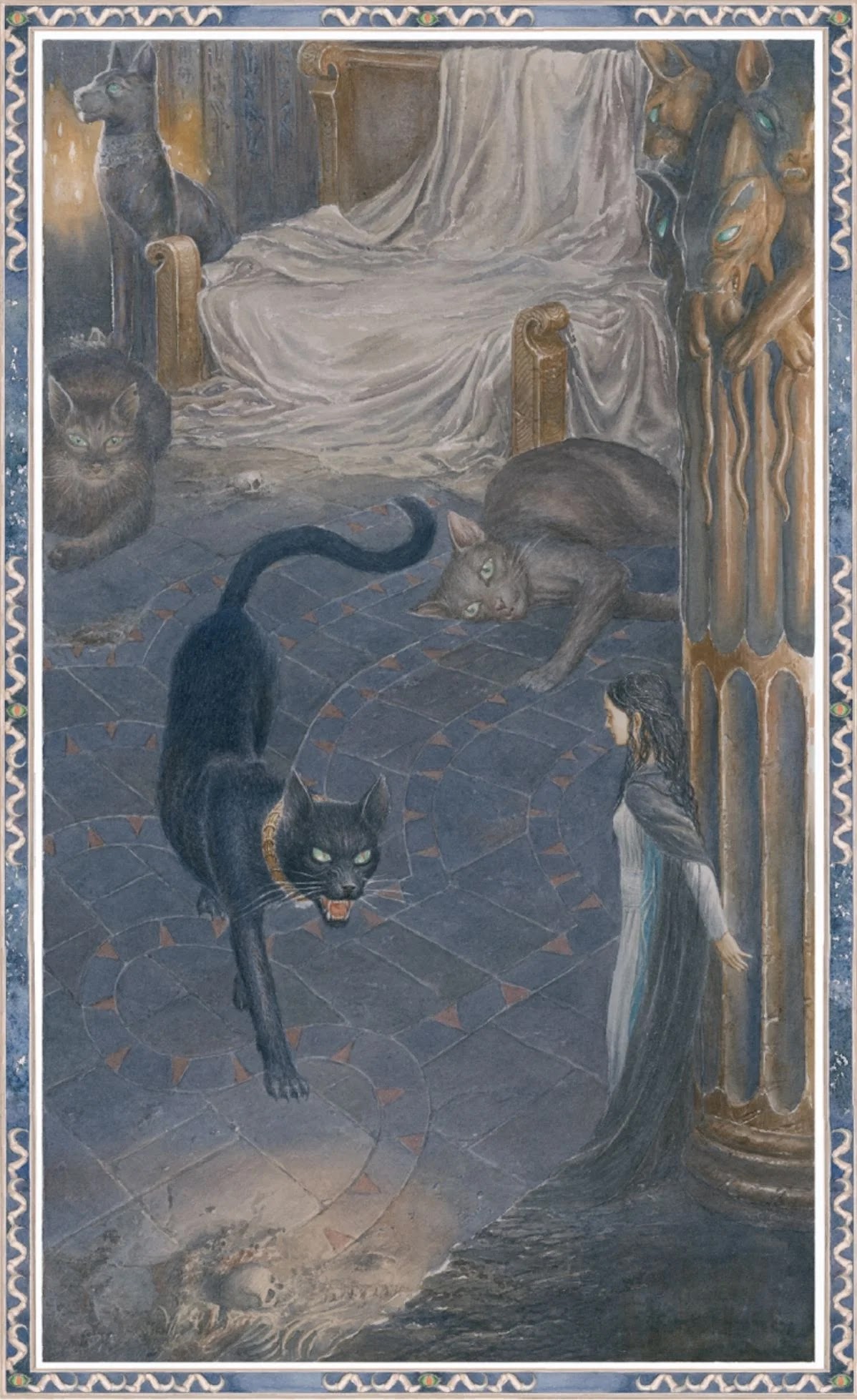
Firstly, quite a lot of the selection of illustrations for this book - including at least four colour plates - choose to depict male Elves, wolves, ravens and the like (not even Beren) instead of Lúthien. Lúthien does appear in six colour-plates and three graphite drawings. But, somehow bafflingly, in three of these six colour-plates, she is drawn small and hard to distinguish, with the main focus given to the scenery around her or to other characters. And in six out of the nine depictions of her, she is shown in the traditional mode mentioned above: Dancing - both in a graphite sketch (Fig. 1, below), and in a colour plate (Fig. 2) which focuses more on the forest of Neldoreth than in Lúthien herself, shown quite difficult to distinguish -; cowering in Tevildo's palace (Fig. 3) (and yes, she shows continuous agency in getting in there in the first place, but she was portrayed in a less badass manner in that particular version with Tevildo compared to the final one with Sauron); thrown to the ground in the very background (again, very hard to distinguish) after the attack of Celegorm and Curufin (Fig. 4); looking after wounded Beren (Fig. 5); and on the main illustration from the cover (Figs. 6a and 6b), where Lúthien does take center stage, but is also shown sitting sidesaddle on Huan (I've personally always imagined practical, intelligent Lúthien to ride Huan astride instead of sidesaddle, similarly to Ted Nasmith's illustrations), and holding hands with Beren, focusing on her role as romantic interest

Fig. 1: Graphite drawing - Lúthien dancing in Neldoreth with Daeron playing the pipes. Beren being creepy eavesdropping somewhere. Is stalking and invading women's personal spaces unsolicited romantic? Hardly.
Fig. 2: Watercolour plate - Lúthien dancing among the hemlocks in the forest of Neldoreth. Lúthien is painted small and hard to distinguish (I think that if she were dressed in her frequent azure and flax blues she would be easier to spot), alongside Daeron at the harp. The main focus is on the forest glade itself.

Fig. 3: Watercolour plate - Lúthien, discovered in spite of her shadowy cloak, cowers from Tevildo, Prince of Cats, the predecessor of Sauron.

Fig. 4: Celegorm and Curufin, creeps extraordinaire, shoot Beren after trying to kidnap Lúthien. Lúthien is with Beren and Huan in the background, hardly visible, the focus being on Celegorm and Curufin riding away after their attack.
Fig. 5: Graphite sketch - Lúthien uses her healing skills and magic to cure Beren

Fig. 6a: Cover of Beren and Lúthien (earlier version than the final painting shown in the actual cover), with Lúthien riding Huan sidesaddle and holding hands with Beren.

While there's obviously nothing inherently wrong in being beautiful, enjoying dancing, possessing healing abilities or engaging in a romantic relationship (although I tend to draw the line at problematic relationships 🙃), it's often telling how it's the more traditionally feminine attributes and characteristics of Lúthien the ones which are depicted and highlighted the most often both in the text selections and in art. This is particularly baffling to me in Lúthien's case because she literally has goddess-level magic powers (she and her mother Melian - an actual Maia, technically a goddess - are the most powerful enchantressses and magic-users in Beleriand, and the fact that Lúthien bests both Sauron and Morgoth means that yes, she's more powerful than both of them as well). Lúthien also often puts to use her 'traditionally feminine' skillset to create magic that is incredibly powerful both in the offensive and defensive areas, and is characterized in a subversive way as someone who wears flowing dresses and likes dancing and singing, *and* (not 'but') she is also incredibly courageous, capable, powerful, and continuously shows agency and an active, determined will wherever she goes (until she is eventually shoehorned in her own story into a traditionally romantic story with all its tropes, even with all her badassery, but ah well, that's my pet peeve xD).  

And so, in light of the fact that Lúthien is also often characterized in an incredibly badass and subversive manner in the Lay of Leithian, one thing that will forever mystify me about Tolkien artists - both professional and hobbyists - when it comes to depicting Lúthien Tinúviel is why they hardly ever fully exploit ✨✊the gold mine of awesome✨✊ that is portraying Lúthien going through all the badass af actions she can add to her personal CV: From bringing down the whole fortress of Sauron with a Song of Power (#BossLady, she created the hashtag alongside Galadriel), to escaping single-handedly from her imprisonment in Doriath with just her hair, to smiting down Carcharoth, to using her shapeshifting magic to create disguises to enter Angband, to performing her sadly rarely depicted magically-charged, literally 'winged dance' around Morgoth, the Balrogs and all the Orcs in Angband while singing more Songs of Power and kicking another Dark Lord's ass (in contrast to the more frequently portrayed male-gazey 'seductive dance' she initially entinces Morgoth with as her cover), reimagining Lúthien as a warrior as well as a powerful enchantress, there are so many options here.      And yet, for each artwork that depicts one of these scenes, there's a handful with Lúthien being beautiful, being a romantic love interest, being sad, dancing and singing in a non-offensive manner, looking after Beren, being sad again. I personally think it's a shame and a waste.

My cosplay of Lúthien, badass magical edition. Source

Going back to the illustrations of this book, Alan Lee does choose three of these scenarios for his selection, in two colour plates and one graphite drawing, and does depict Lúthien in her more active, badass roles. But I still found these examples to be fewer than I expected, and sometimes also executed in a way that didn't quite focus primarily on Lúthien or do her full justice, in my opinion. In one colour plate (Fig. 7) she's shown suspended in the air against Morgoth, showing the surprisingly rarely depicted scene of Lúthien rising 'wingéd' in front of the Dark Lord of Angband while singing her Song of Power. Lúthien does radiate power and agency in this illustration, my favourite from the whole book. In another graphite sketch, Lúthien is shown transformed into the female bat Thuringwethil, servant of Sauron, flying alongside transformed Beren towards Angband (Fig. 8). But in another plate (Fig. 9), Lee chooses to show the fortress of Sauron from a full panoramic view with Lúthien standing on the bridge as a mere blob, focusing more on Sauron's fortress instead of depicting the also massively underused-in-artwork epic moment where Lúthien takes down Sauron's fortress with her singing magic. While I also get the effect of showing Lúthien as a barely discernible speck in the midst of this huge dark fortress she is going to destroy just by singing, don't tell me that's not a freaking epic scene to fully paint, with Lúthien front and center and zoomed-in, because it is. My favourite Lúthien cosplay pictures are a tribute to that xD (see above).

Fig. 7: Watercolour plate - Lúthien is shown center-stage in this painting rising with a powerful, defiant pose in her 'wingéd dance' and singing her Song of Power against Morgoth. Various creatures are shown asleeep inside Angband, and Beren is huddled in the forefront alongside asleep Balrogs, Orcs and the like.
Fig. 8: Graphite drawing - Lúthien flies towards Angband transformed into Thuringwethil, bat servant of Sauron, with Beren disguised as a werewolf below her.
Fig. 9: Watercolour plate - Lúthien approaches Tol-in-Gaurhoth, the fortress of Sauron, determined to free Beren even if that means crushing the whole fortress down to its foundations (queen xD). The focus of the painting is the fortress rather than Lúthien, however.

CONTENT
 
Now we've talked about Lee's illustrations depicting Lúthien, how is Lúthien portrayed in the text selections and commentary in this book?  Well, as I said before, for some reason the selections do tend to omit the more badass, powerful and subversive aspects of Lúthien's characterization and her ample participation in the Quest of the Silmaril, especially in the final versions where she is the most active and overtly badass (so many people tend to put Beren centerfront when it was actually Lúthien with Huan who did like 90+% of the work, and that's being generous). The commentary did not add any particularly new or interesting info about her either, that I recall. 
 
Bonus rant incoming about how the relationship between Beren and Lúthien is so romanticized near everywhere and hardly anyone seems to feel like there are actually problematic points going on there. Because I adore Lúthien, but I don't much care for Beren, and I actually overtly dislike more than one point about the romantic relationship as portrayed in all the versions of the tale 😬. This is not an specific issue of this book, but rather of the different versions of the tale of Lúthien and Beren on their own. However, I feel that the way the excerpts from the different versions were selected for this book does highlight some of these issues, alongside the oftentimes found shoehorning of Lúthien into her more 'traditionally feminine' characterization and roles that I described above.

Some examples of why I don't really like this romance (I was initially supposed to review *three* books here lol, but then a feminist analysis appeared xD):

All extraordinary women deserve to be admired and respected the way Galadriel is, to be honest. Become even 1% less extraordinary just because of a relationship? She says nope can do.

-It's the epytome of the trope of the extraordinary woman whose considerable powers and skills (be they magical, warlike, intellectual, or a combination of all these) are at the service of the more objectively mediocre man. A man who 99% of the time also ends up - or even begins by - being in a romantic relationship with her simply because he's worth it (being a man), and also because the extraordinary woman often and very bafflingly (well, men often write them, so that's why) doesn't have standards, doesn't recognize red flags and accepts the first dude that falls for her no matter what 🙃 (if we ignore the Friendzoned Nice Guy act of Daeron, that is :S xD). I'm sorry, but that's the tea. I love Lúthien's epicness and power, but she basically does all Beren's work, with the added aggravating fact that said more mediocre man is often talked about as the actual main character and hero, both in the tales, in the commentary, by Tolkien in his letters, by part of the fandom

And your treatment in Multiverse of Madness wasn't fair either, Wanda.

Related to this, in one of the quotes selected for this book, in one of his letters Tolkien actually refers to Lúthien, with all her power, 'a mere maiden even if an elf of royalty', and centers his conversation on how heroic Beren is: "Beren is the outlawed mortal who succeeds (with the help of Lúthien, a mere maiden even if an elf of royalty) where all the armies and warriors have failed: he penetrates the stronghold of the Enemy and wrests one of the Silmarilli from the Iron Crown. Thus he wins the hand of Lúthien". Um, wtf. Lúthien's literally a powerful half-goddess with way more offensive capabilities, experience and wisdom than Beren ever had, but she's also called a 'mere maiden' who 'helped' Beren the Hero out because of her gender, while the mortal, power-free male is hailed as the brave hero, and nothing 'mere' about it, apparently, in spite of doing like 5% of the work during the Quest, and that's being generous (Lúthien allowed them to be able to enter Angband!). And let's also remember that in the fandom Lúthien's also often branded as a 'Mary Sue' because of the sheer power she wields and her many capabilities - because the Valar forbid a powerful woman (whose power and skills make total sense in terms of her nature and characterization) exist among an ocean of societally-accepted powerful men, am I right?

River relates and yes, I am right.

-The romance and the dynamic between Beren and Lúthien (or rather, of Beren with Lúthien) is just problematic when you delve minimally into it, quite frankly. They look like a power couple, but are they really? Prior to even meeting and during their very first meeting, Beren shows more than one sign of male entitlement and the consistent red flag behaviour of a creep and a stalker, spying and following her around while she thinks she's dancing and singing alone in her forest (the audacity of women being alone and tempting men with their looks and songs, am I right), and then, in all versions of the tale, basically sexually assaulting her when he calls to her, pursues her, grabs her and kisses her without a by your leave. Why Lúthien would find that attractive is beyond me (well, a man did write her, and, even taking into account her subversive active personality and amazing skill, that shows).  

If powerful demigoddesses aren't safe dancing alone at night in a realm magically protected by another goddess, who is??

One quote from an early version from The Book of Lost Tales II describes the interaction thusly: "Thus suddenly did he lay his hand upon her slender arm beneath the leaves, and with a cry she started away from him and flitted as fast as she could in the wan light (...). The tender touch of her arm made Beren yet more eager than before to find her, and he followed swiftly and yet not swiftly enough, for in the end she escaped him, and reached the dwellings of her father in fear; nor did she dance alone in the woods for many a day after." I think all women can relate to this feeling. And yet the interaction is painted as high romance, the ultimate heroic fantasy romance. In the very same page of this version, Tinúviel keeps getting stalked by Beren for months, and yet she grows fond and unafraid of him because of his 'sad, yearning face' and, without even knowing who he is or what his intentions are (I mean, those are clear anyway, he's obsessed with her :S) ends up feeling flattered that he likes to observe her dancing. That is so not relatable. Male writing in action.

*channelling Thranduil's I'm done with everything 24/7 attitude* Sure thing, serial stalking and non-con grabbing and kissing is romantic af. Why Tolkien, why.

After this non-consensual grabbing and kissing as a means of romantic meeting (not), Lúthien is then supposed to fall in love with him completely at first sight (because that's the natural reaction when a male stranger who's obsessed with your beauty and little else stalks you for months and then grabs you and kisses you when you were just minding your business), then she's putting all her power at the service of a quest devised by men who presume to treat her as a possession which passes from one man (Thingol the father of the millenium) to another (entitled lover-husband wannabe Beren) as recompense in exchange for a pretty jewel, and ultimately expected to sacrifice her everything, losing her actual lifestyle and immortality for this man who met her by forcibly kissing her. Romantic? Not to me.

And that's the tea

And then the woman who's being treated as a thing by near everyone in this tale does the majority of the work to succeed in this quest, involving a lot of misogynistic-flavoured obstacles and a lot of hard work, including but not limited to (brace yourselves):  

  • Having to break free of her father's imprisonment (because men still think they own women no matter how powerful they are, and Thingol sucks as a father)
  • Being kidnapped and forcibly detained by rapey Feänorians (a dog is literally her only ally. Celegorm was so set on raping Lúthien that Huan had to literally stand guard at her door 24/7 till they escaped, and bare his teeth and snarl at his former master so that he would leave her alone. Yay :|)
  • Having to destroy Sauron's fortress to rescue her lover while Sauron is beeing leery about what he would do with her (didn't know what was coming for him, did Mairon)
  • Curing said injured lover from another attack from the Feänorians who intended to kidnap her again (side note, they suck big time, but so do many men in The Silmarillion welp)
  • Transforming herself and Beren into servants of Sauron (10 points to cosplay magic xD)
  • Taking down a huge wolf guarding the gate of Angband (Lúthien literally multitasking with the badass shit and taking down dark creature after dark creature, and Beren literally wanted to abandon her and go alone lol)
  • Feigning to have come all the way to Angband to seduce the leery creep Morgoth into complacency (totally empowering for women, huh! And the entitled idiot believes her)
  • And then throwing all her singing and epic flying dancing magic at him and literally putting him and every creature in Angband to freaking sleep, Balrogs and all (after which Beren cuts the Silmaril from the crown because he wants to be helpful and get brownie points or something, but then again, he also causes the whole of Angband to wake again because he's kinda dumb with his plans, so maybe not)
  • Then curing Beren again when his hand is bitten by Carcharoth because he woke up the whole of Angband again (seriously, Lúthien should have cut the Silmaril from the crown while she was at it)
Then, finally, the pretty crystal is in the hands of the father and Beren - yes, Beren, as we saw before - gets hailed as a courageous hero while Lúthien's literally standing by hyping him up (male writing), and Lúthien gets successfully exchanged aka married to him. Tell me how any of this is fair and how Lúthien's OK with it, because I don't get it. 
 
"Beren is the hero of the Quest of the Silmaril" Dude, Lúthien is literally *right there*. She literally does *everything* and doesn't at least get hyped and praised, as she should? I'm suing.

Lúthien then of course also gives away her immortality in exhange of a mortal life with Beren because Elven women do that as an instinctual feminine thing when they're in love, we're told, but male Elves are rather more reticent about it (ahem, Aegnor). And she ends up living a very traditionally-structured life isolated from her mother (do I care about Thingol? Nope), friends and family, as a wife and a mother and a beautiful woman who dances and sings for Beren but never again shows the amazing feats of power featured in the Quest, with a short life and a very beautiful Silmaril to briefly wear until it shortens her already brief new mortal life. Yay!

While there's nothing wrong per se with actually choosing to marry, be a mother or partake in traditional activities that one may actually enjoy, having such an incredibly powerful woman simply end up like that because that's the societally accepted happy ending? Anticlimactic is the word (and Galadriel didn't have to tone down shit when she got married, btw, so it's doable). And all this time? Beren of course deserves such an extraordinary woman as Lúthien, so much so that she as a result should certainly work so much and sacrifice so much for him because he's so worth it.  Because everything is of little value in exchange for the promise of the traditional married heternormative life every woman longs for from the beginning (this is literally what Tolkien says in the infamous letter 42 - Tolkien's work is great and all, but if you also want a taste of stagnating conservative values about gender roles and relationships, that's the letter you want to peruse :S!). 

Totally a 100% great deal for every woman!

 When it comes to this tale, I would honestly, really love to see a power couple with two people who work together and take down the bad guys and go through obstacles as a tandem, and genuinely appreciate and love each other. But in this case, that's not what I see, unfortunately. While I love Lúthien being a badass who ends up doing nearly all the heavy lifting, the balance dynamic still comes off quite unequal instead of just subversive and indicative of a more egalitarian dynamic, and this is because the motivations for the Quest are masculine codes of 'honour' and female ownership, and she multitasks through it all at the service of said men, who just seem to see her as a pretty object. 

And the famed romance is still based on 'she's beautiful and he wanted a piece of that, and she fell in love at first sight in response because a man wrote her', and that isn't deep enough ot believable enough for me, I have to say. Because we also need to highlight the fact that Beren's main motivation to want to marry Lúthien is that she's incredibly beautiful, dances really well, and well, that's all there needs to be! He does call refer to her as brave sometimes, if I remember correctly (although Huan is the one who's mainly hyping her up), but in a truly equal dynamic firstly he would not have outright stalked and assaulted her, right? 🙃 

Secondly they would preferably have things in common that would help build a significant relationship, but their dynamic post-stalking and pre-quest involves Lúthien dancing for him (mainly) and sporadically with him, and them 'being in love' in a generic way. Which I guess could work in a kinda bland way (except for the fact that Lúthien's dancing wasn't originally intended to entertain or titillate a man - although Nice Guy Daeron might have thought otherwise as well :S), but there are other red flags, as we have discussed. And thirdly, if he really liked her as a person, he would very probably want to hype her up and talk to her and about her regarding how badass, witty and powerful she is, and...he doesn't really do that, and if he did it was so sporadical I have forgotten about it (Lúthien's dog friend Huan does hype her up, a lot more. Heh). Because she's beautiful, and that's the main reason why this romance exists for him, it seems ("I desire thy daughter Tinúviel, for she is the fairest and most sweet of all maidens I have seen or dreamed of", he says in Book of Lost Tales II, for example).

This gif is a must, come on xD

In conclusion, I love the character of Lúthien in itself, how utterly powerful and capable she is, but I resent and hate the way her character is made to revolve around entitled problematic men, and how all the men in the tale are constantly throwing obstacles in her path. No to Thingol, the controlling father. No to Daeron, the 'friendzoned' Nice Guy who doesn't get any in spite of offering free music for her dancing (the audacity. Pay me back for my free karaokes!). No to Beren, the stalker entitled guy who thinks he deserves the extraordinary woman just because she's beautiful and he called to her, who insists on the stupid quest when he could have opted out and stayed with Lúthien on their own terms, and who then made dumb decisions in the midst of Lúthien's unlauded multitasking (let's leave Lúthien asleep because I can totally handle Angband after the Sauron fiasco she rescued me from! Then let's sing so loud the creatures of Morgoth might hear me, and Lúthien too! Then let's prick Morgoth's foot after Lúthien's hard work while trying to pry off a second Silmaril you didn't even need!). No to Celegorm and Curufin, the rapey entitled brats. Yes to Huan, the only ally Lúthien seems to have, a freaking giant hound. Yes to Melian, who does support her daughter, but who, in spite of being an actual goddess, seems to need to answer to the commands of her Elven husband (hello, Patriarchy). And of course, no to Sauron and Morgoth, who get their asses kicked by Lúthien's badassery but not before they can tell the readers and Lúthien about their creepy lustful and rapey intentions towards her. But hey, at least the narration is honest about it and Lúthien is adequately creeped out and responds by taking them down. Beren basically stalks the shit out of her for months and assaults her by taking her in his arms and kissing her without her freaking consent, and it's all apparently 'so romantic'? So much that as a response she sacrifices her everything for him, including her freaking immortality? For a dude apparently only interested in how beautiful she is?? Yep, after so many years I'm still so not getting it, but now I'm kinda repeating myself xDD. 

I could definitely go on about how the fact that JRR Tolkien considered his wife Edith to be the inspiration for Lúthien and called himself Beren in association, and how we can definitely see a projection of some points of their dynamic (not all of them unproblematic) and his idea of an ideal F/M romantic relationship by comparing his real life relationship with his story of Lúthien and Beren as a romantic duo. But that is a whole different (but related) can of worms to analyse, and I do have at least a post about Edith planned, so that's enough controversial Tolkien women opinions for today, folks 😅 😂 xD!

Lúthien out xD