Showing posts with label social criticism. Show all posts

Tuesday, 17 September 2024

Goodreads reviews - Doctor Who: Only Human (New Series Adventures, #4)

Book: Doctor Who: Only Human, by Gareth Roberts.

2.5/5 Goodreads review also here.  

 This is the fourth book in the Doctor Who New Series Adventures series, featuring the Ninth Doctor and Rose Tyler. A lengthy review (as usual xD) below, including spoilers:

   My main qualm with this book is its author, Gareth Roberts, whose icky and problematic ideology (he has an unsavoury penchant for sexism and transphobia 😑) tends to end up reflected to a greater or lesser extent in his work (as is the usual thing with the majority of authors). So that was a qualm about rereading this book, which I did because of my recent project of (re)reading and reviewing all six Nine&Rose New Series Adventures novels (perfectionism ahoy xD). And yeah, in this book we can definitely see some sexist choices and stereotypes which I didn't love (as I will detail below).

   As to the more positive, the story and narration wasn't the most engaging of the six novels, in my personal opinion, but it was reasonably well written and the plot did hold my interest overall. The book tackles both history and science fiction, with a human colony from the far future who built a faulty ‘time engine’ and got stuck during the time of the Neanderthals and Homo sapiens. The plot explores interesting themes such as genetic engineering and the ethics of science, as well as the strife between Neanderthals and Homo sapiens, with the latter here portrayed as more violent, territorial and with genocidal intent against all 'lesser' human species, whom they other and regard and 'Them'.  Time travel shenanigans aside, the themes of competitive replacement and the dangers of dehumanization, seen through a fully Whovian ethics lens, are the central points of the story, and in that sense I did enjoy the book, even though it has its flaws, and some of them are pretty jarring.

Replacement of Neanderthals (yellow) by early modern humans (blue). Source.

➡️A quick aside on the Neanderthal extinction: There are many hypotheses for the extinction of the Neanderthals, among which we can name inbreeding and a small population size, violent conflict with Homo sapiens and competitive replacement - which is the hypothesis that is most explored in this book -, a change of climate, disease, natural catastrophes, and/or interbreeding and ultimate assimilation with early modern humans. Most likely, it was a combination of several of these factors which caused the extinction of the already low Neanderthal population.  In spite of the speculative nature of the dynamics of Neanderthals and early modern humans depicted in this book (violent replacement by Homo sapiens was first proposed in 1912-20 by Marcellin Boule, but other hypotheses as to the demise of the Neanderthals have since appeared), in my reading experience it's not often that Neanderthals are given the spotlight in this way, with the Homo sapiens as the more antagonistic people, so I found that to be a compelling part of the plot

  As to the main characters, Nine and Rose were well characterized overall, and while Jack Harkness did reflect some of the author's sexist ideas at times, his trademark (and creepy) approach to 'harassing everyone on first meeting them is such a good rep of pan(omni)sexuality' 😬 was toned down in this book with respect to the series and other media, which I appreciated. Other characters were more or less compelling regarding their characterization, with Neanderthal Das turning up to be an unexpected favourite with rather wholesome and endearing traits (I did enjoy the portrayal of the Neanderthal people in general), while I found others to be markedly more problematic in their characterization - Especially 'boss lady' Chantal Osterberg ticking off all of the stereotypical traits of the mad and amoral scientist who is also kind of a drop-dead beautiful femme fatale 🙄, and whose characterization I found to be not only rather lazy and two-dimensional, but also leaning on the more overtly sexist side.

More details below, so here be spoilers!

Female representation:

  Rose Tyler is one again the main female protagonist with her role as Nine's companion (see more about her below), with Chantal Osterberg, the leading scientist of the research colony of humans from the future (also see below), being the leading secondary character. Some other women in the colony appear in the story as well with more minimal roles, with scientist Lene having the most importance (even though her plot is pretty much reduced to being a wife and having to process her terminal illness 😕), and others just appearing very briefly (like the unfortunate Tina with her redshirt role). In late 20th century, a nurse called Weronika makes a brief appearance as a wannabe companion figure (not much more to her), Jackie Tyler in her youth also has a cameo (not in an excellent light), and Neanderthal Das finds her mate in Anna Marie, a 20th century woman who is described as fitting the Neanderthal beauty canon to a T, but who Harkness 'charmingly' describes as ugly, hairy, short and fat (nothing wrong at all with not conforming to limited societal beauty canons, I'm referring to the sexist way Roberts describes her through Harkness 😑). 

A Neanderthal woman (artist's impression, source).

  Finally, there's the women from the Neanderthal tribe (featuring Ka, who is in a relationship with one of the future human colonists, and Sakka) and the Homo sapiens tribes, featuring the matriarch-like figure of the wise-woman Nan (thus named because she has a grandson xD). Wise-women are mentioned to exist in both types of tribes, and Nan seems to be the leading voice of the tribe.  But in spite of this, and her statement that "Wise man! Man! Men in charge, we all know how that ends up!" (that's not what's always exactly portrayed in the book, either, with Rose also being forced to marry some man she doesn't know, see below, and Chantal being demonized in the book as the evil boss lady that wrecks stuff, but OK), well, in spite of that she ends up paired with a creepy middle-aged dude from the future (who harasses Rose continually, see below), and suddenly Nan seems to need a man in her life so much that she defers to him automatically, so it looks like she won't be the leading voice of the tribe for much longer. Sigh. But I guess that Roberts needed to have his performative phrase to assure us that he's not sexist at all 🤦!

➡️A quick aside on Prehistoric gender roles

  The societal structure of both Homo sapiens and Neanderthals would probably still be far from a feminist utopia with a harmonious and egalitarian goddess religion (paternity was probably ignored for a while and Prehistoric fertility goddess art is beautiful and fascinating and I love it, but fertility cults tend to also be more sinister than the 20th century New Age feminism portrayed them as, as I covered on these two posts: 1, 2). But even so, the hunter-gatherer tribes of the Paleolithic and Neolithic (mostly up to the Upper Paleolithic) also did not seem to uphold a gendered division of labour that was as rigid as it has been assumed for a long time, and mainly by male academics, who also consistently fail to identify all the cave paintings depicting huntresses as women (among other things) because of course "all men hunt and all women gather", thus quoth the 1960s academics, and that's it, survival of the tribe be damned 🙃 (more on archaeological sexist biases on my blog here and here). Yes, women did indeed hunt in early human societies 🏹 (and paint, and probably invent technology, and do stuff in general, because they have brains too, what a notion). I love this topic, so I will be making a separate post about it at some time, but here are some more interesting articles on Prehistoric huntresses: 1, 2, 3, 4. These include some pretty recent studies with fascinating updated information on women's active participation in hunting during Prehistoric times, and how we should be reenvisioning how gender roles and the division of labour could actually have been in Prehistoric societies

Artist's rendition of a Prehistoric huntress (Photo: Matthew Verdolivo, Source).

  However, the patriarchal bias remains in academic studies, with this (older) 2006 article stating that Neanderthal tribes had a less rigid gendered division of labour compared to Homo sapiens, with both men and women routinely participating in the hunting of big game (however, we do know with pretty good certainty that Homo sapiens women routinely hunted both big and small game, too), but then concluding that this 'relative lack of labour division' could have been a factor for the Neanderthal extinction (!), claiming that it resulted in 'a less efficient extraction of resources'. To me, and to other academic studies as well (many of them quite recent, like I said), it is rather more logical than better survival be instead achieved when the female part of the (small) population in each group, who is also fully capable of hunting - and even allegedly even having certain advantages for it, such as higher levels of estrogen providing Prehistoric huntresses with more stamina for longer runs - not be relegated to just gathering berries. But hey, academics, you do you 🤷‍♀️.

A depiction of a Paleolithic huntress. Source.

🌹 More on Rose:

+1 Rose is characterized fairly well, and, as per usual, shows the positive traits of agency, resourcefulness, curiosity, assertiveness, open-mindeness and intelligence she usually displays in the TV series, and also in this New Series Adventures book series.

-1 However, she also gets the short end of the stick, often in a very gendered way, in this plot. For one, Rose is continually sexually harassed by icky (but adorkably excentric!) lecherous colonist Quilley. This includes him ogling her constantly (there is a sentence that quite literally reads "he looked her fur-bikinied body up and down and made an indescribable lustful noise" ewwwww 😫), and also grabbing her at some point. Roberts already showing us he thinks sexism and harassment are funny, or something. Rose keeps being assertive and vocalizing how uncomfortable and angry he keeps making her, warning him to keep his hands off her, not to ogle her and to step out of her personal space (and then the sentence of "she was used to dealing with older men" while thinking about her discomfort as something that she has completely normalized is also just 😫). But this 'gag' drags on whenever this dude appears in the book, which is fucking exhausting and infuriating, and the Doctor generally doesn't seem to take this seriously, either, when he's present, which is also, well, promoting that Quilley's behaviour is more excentric than just plain wrong. Even when the Doctor deigns to comment negatively on his behaviour, it's centered more on 'relearn basic manners' (which OK, that too), rather than 'hello, can you please not harass my companion and women in general, thank you'.

Me reading Quilley's relentless creepy af characterization

  But this isn't the end for Rose having a (not) great time in this adventure. She then ends up in the Homo sapiens colony forcefully clad in a painfully stereotypical and anachronistic (and uncomfortable) fur bikini and having to marry the grandson of the tribe's wise-woman. A companion stuck in a sexualized outfit and an arranged marriage conundrum, what an incredibly forward and interesting thing for Roberts to write 🙃! The only way I would have found this interesting in some way would have involved a clear social criticism lens of women's societal roles and arranged marriages and so on, but that is clearly so not the intention here, it's done mostly for hilarious shenanigans once more. Rose does use her wits and agency to try to get out of this pickle, but she also ends up having to actually marry the guy because plot reasons, and said guy is so fit Rose does actually feel attracted to him and at the end is not that against him kissing her, so everything is all right, I guess 🙃! The Doctor also seems to think so, (jealously 😑) rolling his eyes at the 'terrible ordeal' Rose must be going through, and then relishing having a go at Rose's 'husband' during their escape (the Doctor a good ally is not in this book). While he is not the most toxic male character in the book as that is reserved for Quilley (low bar, though), said husband (name of Tillun) also not the brightest tool in the box and upholds more than one systemic patriarchal idea about gender roles and what a wife should be, too.

Rose is so NOT having a great time in this book
 
  So that's it for Rose having to go through shit, right? Wrong! She then loses her head - quite literally - thanks to the technological advances and the amoral inclinations of unhinged scientist Chantal, but what's more, this sizeable trauma is not addressed at all at the end of the book. To Rose's credit, who seems like she has to make use of extreme levels of agency, wits and a level-headed mind to go through Roberts' questionable plot choices in the story 😬, she still finds the way to be proactive by shallowing said trauma and kicking the baddie's ass and criticizing her twisted amoral discourse...with her head literally under her arm. Lol, I guess. The Doctor was also subjected to invasive probing by Chantal in this book (who is gorier and more disturbing than one might initially think), but it's still the female character who gets the short stick of the (heavily gendered) traumafest in this story, which is not fun. 

  And, important note, even if a female character manages to brave through all of the gendered clusterfuck of violence and oppression (that her author wishes her to go through) by displaying all her positive traits, it still says a lot about said author that she's subjected to all of it in the first place, and through a humorous lens more times than not, which is even worse, because the way in which patriarchal violence and oppression is approached in a story makes all the difference in the world (for example, Handmaid's Tale has a very clear aim of denouncing said violence and oppression, and so it is read and viewed very differently). So, male authors, and I'm not even saying 'please': Stop👏 writing👏 unnecessary👏 and👏 unwarranted👏 traumafests👏 for👏 your👏 female👏 characters👏 already!

🌹 More on the female villain 👩‍🔬: 

-1 While Missy is in my view an excellent example of how an amoral and ruthless female antagonist can totally work, the character of Chantal Osterberg is not doing it for me at all. She is much more two-dimensional than Missy and, like I mentioned before, seems to be constructed out of fairly stereotypical traits that are seen through a more sexist view (this is even lampshaded in the book, through the sentence "It was hard to threaten somebody who didn't posses a full personality" Lol 😅). Chantal is a brilliant scientist and the leading researcher and boss of her colony. She is also amoral, ruthless, unhinged and femme fatale-sexy, and that combo with Roberts' way of writing her ticked me off. Missy seem to conform to but at the same time fully subverts all of these gendered stereotypes for a female villain, and that is what makes her so complex and compelling, in my opinion, but I feel that Chantal is just another example of the stereotypical female villain written by a questionable male author.

Missy just does it right
 
+-1 Chantal's plan of using the energy of the time engine to breed a new species - Hy-Bractors - that would be superior to humans and replace them (she totally intends for the colony to be slaughtered by her creations, except for her), and then rationalizing her actions with elevated philosophical dialogue on how this is supposedly good for evolution and the future and sustainability of the Earth, is on par with the standard 'mad scientist' discourse, I guess, but also a bit meh and confusing overall. I also still don't quite get how the bloodthirsty, animalistic, barely intelligent Hy-Bractors, who are engineered to be brutally efficient in their "dispatch of inferior human competitors", are supposedly an upgrade on the "naturally violent, competitive, hunting brain" of the humans? The explanation didn't quite make sense to me, but anyway xD In any case, their scenes were much gorier than I usually like to go for, too, so that part of the story didn't thrill me. 

 Other problematic issues, from a feminist and queer pov:

 +-1 Jack Harkness: John Barrowman problematic real life personhood aside, I'm not the biggest fan of Captain Jack as a character, although I'm at least relieved this book toned down his boisterous persona a bit, especially regarding RTD's questionable choice of portraying a pan/omnisexual character as flirting with (which is often more like harassing) everyone who he passes on his way 😬. He does get the chance to brag about his tight trousers, throw a couple of innuendos around (not so many, small mercies), and provide the Doctor and Rose with a naked diversion (sigh xD).

-1 One thing that really bugged me about Jack in this book is his treatment of Das's girlfriend/fianceé Anna Marie. It's fascinating how Jack is canonically supposed to literally want to jump everything sentient that moves (that is a queerphobic stereotype in itself, too, because pan/omnisexuality does *not* mean wanting to literally sleep with everyone on the face of the Earth), but yet he takes his time to wonder and get scandalized about how anyone can be attracted to Neanderthal Das, who has a 'feminine' high-pitched voice and is short and stocky without a waist, and how any man can be attracted to Anna Marie, who is, in his words, plain and fat and has facial hair and "a face only a mother or a Neanderthal could love" 😐. Aren't you supposed to be canonically attracted to everyone, dude?? I guess that means only canonically attractive people, or? 🙄 Jack Harkness definitely serves as a conduct for Roberts misogyny here. Also, Jack mainly mentions attraction to women in this book (except for a couple of mentions about the Doctor), which is an additional point of weirdness considering that the book was written by a gay author.

Definitely choose Bill Potts for Whovian queer rep done *right*

-1 Another eyebrow-raising thing is that the book is supposedly revolving around the racially-motivated strife between Neanderthals and Homo sapiens, with the story sympathizing with the Neanderthals, portrayed, perhaps in a more idealized way than what have been in real life (I tend to believe that utopia is hard to come by anywhere), as the more pacifist, friendly and harmonious society of the two, while the Homo sapiens tribes are depicted as way more violent and territorial, accepting only new people if they are human and married to someone in their tribe. And yet, Roberts also makes use of 'man/woman' descriptors only for Homo sapiens tribe members, and constantly uses 'male/female' to describe the Neanderthals - a distinction which markedly dehumanizes them and makes them more comparable to animals than actual humans 😬.

Neanderthal women. Source.

 ✨Ethical issues

 +-1 "'And what about them? They die, and it's history, and no one cares. Just a little bit of genocide along the way to building a mighty space empire? And that's just "the way it is here"?'" The book, via the voices of Rose and the Doctor, generally tackles moral dilemmas with the usual Whovian ethical messages, such as its anti-war stance and the belief that the ends don't justify the means. A central ethical theme is the persecution of the Neanderthals by the Homo sapiens for deeming them 'inferior', and the Doctor and Rose share a few important conversations about genocide and the problematic nature of humans in this respect. The Hy-Bractor 'monster' antagonists are annihilated in their majority in the end, though, which might have been the only way in the story to avoid the slaughter of both the Homo sapiens and Neanderthals, but it's still tackled by the Doctor with more nonchalance that should be expected.

+1 Another interesting topic discussed in the story is the exploration of the human colony, where people are not only genetically engineered to live longer and be canonically beautiful, but also supress their emotions with a constant use of chemicals to avoid any 'wrong-feeling', stripping them not only of empathy and meaningful inter-dynamics, but also of the capacity for agency and individual judgment, as they blindly conform to anything their boss and leader demands.

An Homo sapiens woman (artist's impression, source).

+1 Finally, Neanderthal Das initially faces persecution for being different among modern humans, which is linked to their original persecution and ultimate demise as a cause of the Homo sapiens, according to the book. Das, however, manages to get a happy ending where he not only doesn't miss his original home, but relishes in modern technology and society and thinks that nothing is better than a life where you can buy junk food and watch TV in your sofa after work instead of a life dedicated to hunting to survive 😂. This character is an interesting take, as it strongtly defies the common stereotype of Neanderthals as savage and stupid compared to the way more intelligent Homo sapiens (this is also contested by research on their culture), with Das very quickly acclimating to modern human life with hardly any problems. Fortunately, this character also does not display a stereotypical 'Neanderthal sexist attitude' for humorous kicks (which is a relief, because we do have sexism for humorous kicks in this book otherwise). For example, he manages to understand the concept of consent and healthy relationships much better than Jack Harkness from the 51st Century, for one, which is ironic to say the least.

If you want to read more reviews of the Doctor Who New Series Adventures:

 -The Clockwise Man (New Series Adventures, #1)

-The Monsters Inside (New Series Adventures, #2) 

 -Winner Takes All (New Series Adventures, #3) 

Monday, 12 August 2024

Goodreads reviews - Doctor Who: Winner Takes All (New Series Adventures, #3)

Book: Doctor Who: Winner Takes All, by Jacqueline Rayner.

3.5/5 Goodreads review also here.  

 This is the third book in the Doctor Who New Series Adventures series, featuring the Ninth Doctor and Rose Tyler. Some thoughts below, including spoilers:

This book has, in my opinion, an engaging plot, pretty good characterization, a proactive Rose, and features some interesting ethical themes, such as criticizing the violence of video games, anti-war mindsets as per usual, denouncing the behaviour of bullies, and tackling the ethical issue of controlling a person. The story also features a handful of problematic elements I didn't like, though, so full discussion of those will follow as well. Spoilers below!

Female representation:

  Rose Tyler is the main female protagonist as Nine's companion, and her mother Jackie Tyler makes a limited appearance as a secondary character (would have liked to see more of her, although the dynamic between her and Rose was lovely). Most female characters in this book, though, are extras, neighbours from the Powell Estate plus some random humans abducted for the game, plus a female Quevvil alien. All of these characters hardly talk or only have a very minimal part in the plot. The one who appears a bit more is incel-teenage Robert's mother Daisy, whom Rose befriends at very nearly the end of the book. Apart from Rose, most of the action and dialogue in this book goes to male characters, from the Doctor to Mickey Smith and his male friends, Robert, local bully Darren Pye, and male Quevvil characters.

+1 Rose is proactive and shows a lot of agency, wits and resourcefulness. She confronts a bully head on, rescues Mickey and the Doctor in a very resourceful way, engages actively in the adventure at hand (which involves saving human beings from aliens who are making them play as part of a video games against their enemies), and, even though she apparently seems to think that in the Doctor's mind she always plays the role of the one who 'needs to be rescued'  ('He gets to be the superhero. I get to be rescued'), the truth is that she always tries to find a solution on her own, instead of waiting to be rescued, and is a very proactive companion overall.

I quite enjoy how proactive and assertive Rose always is, both in the series and the extended universe.

+-1 In the last third of the book Rose becomes a playable character inside the video game they're trying to put a stop to and all her movements and actions are being controlled by the Doctor, who's very much not happy about it, but it's also worth mentioning that it's the main female character, who has been very proactive so far, who ends up in this more passive position involving a dodgy non-consent issue. At least the plot does explore at length how this loss of control and the feeling of someone else controlling her every move (even if it's her best friend) affects Rose, who describes the feeling as terrifying, uncomfortable and vexing. Even when the videogame effectively transforms her into 'Super Rose', with superhuman strength, speed, agility and stamina, something that she wishes she could be in real life, she still feels massively uncomfortable about the situation as she is unable to make any single choice or movement of her own. For his part, the Doctor continuously rages at the fact that he is forced to control Rose in this way and is very upset about the fact that the Quevvils are making him dehumanize Rose (and the other humans), and the issue of the indignity of treating human beings as puppets and toys is frequently brought up in the book, which I appreciated.

+1 Jackie Tyler also shows her usual upfront side and confronts neighbourhood bully Darren Pye when he has a go at Rose.

We stan badass Jackie Tyler

 +1 Female bonding and Bechdel: We see several instances of bonding between female characters throughout the book, featuring several women from Rose's neighbourhood, and also the scenes between Rose and Daisy, teenage Robert's mother. I particularly enjoyed the mother/daughter relationship between Rose and Jackie, here portrayed as healthier and more mature than is shown in other books and episodes, and they worry and care about each other in a very lovely way. 


Some problematic issues, from a feminist pov:

-1 True to his characterization in the series, Mickey Smith is portrayed with so much male entitlement going on his character is very jarring, even if he also has some better scenes in this book. He neglects the housework in his flat 100%, never seeming to clean anything and, in a grating scene, also expecting his (ex)girlfriend Rose to bring him the groceries his kitchen has been lacking for a good while ('[There won't be any biscuits] since I stopped doing the shopping for you'). In this grating scene, the Doctor goes all 'yay bros' with Mickey and sits down for a videogame session, casually and 'jokingly' telling Rose to 'Go and get us some milk and biscuits, will you Rose?'. Ugh. Just ugh.

Male entitlement and gender roles are so funny, aren't they.

 -1 Although Rose is labelled as Mickey's 'ex-girlfriend' in one instance, Rose also feels like they haven't properly split up, and, similarly to what happens in the series, the ambiguous triangle between Rose, the Doctor and Mickey frustrates me to no end and doesn't promote anything that's remotely healthy when it comes to relationship dynamics. Mickey is overtly jealous of the Doctor all the time, the Doctor bashes Mickey and has a go at his capabilities at any time he can (even though, to be fair to a character I don't particularly like - with Noel Clarke's real life beahviour also being an important factor why -, Mickey does play an important part in the story when it comes to saving the day with his computer and videogame skills). All in all, the Nine/Rose/Mickey scenario it's a very cringe-worthy situation that I don't particularly enjoy (more about that in my review of New Who's 'Rose').

Can we stop doing the triangle cliché, especially when it just promotes people being really ambiguous about their relationship status and not communicating? Crowley would never to the first one. He and Aziraphale are also not so great at communicating, though, in their own wholesome-r way, but they are also rather more justified because trauma baggage (sobs xD).

-1 There are a couple of mentions of domestic violence and feminicides which I feel are treated a bit more 'humorously' than they should: Mickey's (male) friends also think that he has more value among his peers for having dated the 'most beautiful girl of the neighbourhood', and what is worse, he is also seen as more virile and badass for potentially having murdered her (and maybe other blonde women), as was suspected of him during the disappearance in the TARDIS in S1 of New Who. What the actual f. Later on, we also briefly encounter a man who has wilfully sent his wife/girlfriend to die because he couldn't stand her, but lately comes to mildly regret it (poor him, I guess). If one is not going to full on denounce gender violence, I think that it is better not to mention it in the first place, and even more so seeing as this book was written by Jacqueline Rayner, the only female writer out of the six Nine&Rose novels, and one of the very few female writers in the Doctor Who book series :S.

+-1 Several male characters, especially Mickey and Robert (we'll talk about this incel below) are afraid to show fear and pain, and turn to bragging and creating Gary Stu stories where they're the hero to hide their insecurities. The book does add conscious criticism to these issues, though, with Rose innerly eye-rolling at how Mickey feels embarrassed for expressing vulnerability, and the Doctor at one point claiming that it's OK [for men, and everyone] to cry and be afraid ('It's OK to cry. I cry all the time').

-1 The whole depiction of teenage Robert's character is that of the ultimate incel and he got on my nerves constantly. He feels oppressed because all the pretty girls don't fawn at his feet in adoration, and wallows in self-pity at his lack of social skills to be suave and charming. He ends up being super creepy about Rose and at some point in his incel daydreams he actually wishes he could control and own her (similarly to other girls in his fantasies), something which, especially considering Rose's arc in the last third of the story, is not great. He dislikes his mother with a teenage passion because he feels that she coddles and embarrasses him and spoils his chances to be charming with the girls. All of these traits are combined in his daydream fantasies, Gary Stu fanfics where he's the hero and the Chosen One (ripping off Star Wars, Harry Potter and more) and goes on adventures without his mother, and gets all the girls, of course. There's nothing wrong about fanfics and daydreaming and self-inserts, but Robert fits the incel archetype to a T, and his entitlement and toxic masculinity shows in all of his self-insert adventures in a very obnoxious way. There is also a huge difference between having a crush and wanting said crush to fawn at your feet because you're theoretically entitled to that - that is young boys displaying all the misogyny and entitlement that they have been learning and not deconstructing in the slightest. It isn't adorkable teenage hormones, it's a string of abusive relationships in its making.

Me reading Robert's character

Not sure if the author was going for parody/criticism when it comes to this character, it kind of looks like that sometimes, but it can feel ambiguous at times, and in some respects, it actually looks like the character is meant to be kind of flawed but adorkable, with a hero-ish journey and ultimate character development as his intended arc. But because none of his incel traits are really challenged by any of the characters, and he never actually changes in that respect, this character started and ended being supremely cringeworthy to me, intended criticism or not.

-1 Finally there are two rather cringy and gratuitous mentions of 'alien bondage' (wtf) - featuring Mickey browsing the Internet looking for exactly that after a cringe-worthy first scene with the Doctor (and Rose) mentioning the topic.


Ethical issues:

+1 The whole premise of the book revolves around several interesting topics, from the inherent violence of video games and the dangerous effects they can have on people's ethical mindsets, to how human beings will readily turn to violence and bullying in real life more often than we'd like to think. It also tackles the very Whovian topic of a war between alien races which the Doctor will try to stop, and a very Hunger Games-esque plot where one of these alien races uses human beings as 'playable characters' in a videogame that is designed to kill and conquer their enemies.

And I love me some Hunger Games-flavoured dystopia as a social criticism vehicle

-1 However, the Doctor seems to think that 'I hate guns (...) which isn't to say that a bit of fantasy violence can't be therapeutic' (as opposed to the story's 'videogame', where the players turn out to be real living beings being killed in real time), and thus is initially happy to engage in killing 'alien baddies' with Mickey. While this statement may be sometimes true, in this particular case, it is also rather throwing under the bus the fact that more than one kind of 'normal' videogames (the kind where you're not actually killing real sentient beings) do normalize real violence in a very problematic way

'Never-fired-a-gun' Crowley would definitely have some thoughts on this matter

+1 Anti-war themes all round, with the Doctor and Rose criticizing the unnecessary conflict between the Quevvils and Mantodeans ('Technology like this, and they use it to further a war').

-1 However, the Doctor actually kind of commits genocide in order to save the human captives (atomizing most of the Quevvils when they're still teleporting) and also ignores the attacked Mantodeans at the end (which seem to have everything in control but even so, he doesn't think about them), going away in his TARDIS as soon as the humans were freed. That is a problematic issue, imo, and not very Doctor-y, especially for the Ninth Doctor, who is fresh out of the Time War and is viscerally opposed to the concept of genocide, to the point of choosing not to destroy the Daleks in 'Bad Wolf'/'Parting of the Ways' in S1. So this would definitely not be his first choice, and the nonchalance with which he did it is also massively out of character.

I mean, this is definitely one of Nine's best and most defining moments.

 +1 The Doctor's approach to Rose being happy (but also guilty about that happiness) when she thinks the bully who attacked her mother is dead was a very nice, nuanced scene: '(...) it's all right. You're still allowed to hate them. As long as you don't gloat at their downfall, that's all.'

 
+1 Mickey thinks about how the Doctor just expects him to put himself in danger and/or help him with his plans without asking for his opinion, and it's a very valid point (I hate to agree with Mickey as a rule, but here we are xD). Rose also wonders at some point whether the Doctor sees her as more than the validation he needs to be a hero in the eyes of someone else, and also feels angry at the lack of consideration that Nine sometimes has towards her, her mother or Mickey.

+1 As discussed above as well, this book fully tackles the issue of non-consent and dehumanization when it comes to controlling a person's movements and actions (the people in the videogame are real people controlled by others). The Doctor is forced to control both Rose and a Quevvil and he rages about the fact that he's controlling another being as if they were a 'toy' or a 'puppet' ('You don't treat someone like that. You don't treat a person like that. And they're making me do it, making me degrade her like that. (...) Making me sink to their level (...) Making people dance around like puppets, making me take away every scrap of dignity of my best friend...(...) We'll get out of this (...) But, back of our minds, it'll always be there'). He also gets angry when the Quevvils refer to the human victims as 'carriers' instead of seeing them as individuals. The narrator also shows Rose's point of view about how problematic that situation is and how helpless and annoyed she feels while being controlled.

Nine's disgust and anger at the Quevvils' tactics was very much in character, thankfully.

 -1 Even though this issue is amply discussed, the Doctor and Rose never actually discuss it in person when all is finished, which is not a very healthy decision (and it is their MO, because Nine actually says how they will never discuss it in person because they never do, even though it has left them both traumatized). Also, the Doctor makes a joke that is in very poor taste at the end of the ordeal, when Rose is not present, and to incel Robert of all people, saying that he wouldn't mind from time to time if he were able to control Rose in the way that he formerly raged about being forced to do just before (¿?), because it would lead to a lot less trouble :S. Not-so-great humour as a result of even more repressed, uncommunicated trauma? In any case, such an unnecessary thing to say. 

And see what I mean when I said that pretty much none of Robert's incel traits are challenged? The Doctor does teach him about how crying is healthy and several ethical dilemmas in their time together, which is all good, but if anything he is being enabled in this particular scene (ew), and he leaves the TARDIS at the end none the wiser that Rose is not head over heels over him (sigh), because he has fantasized about it from the very first time he saw her, so that's how it is, but from her point of view, Rose has just greeted him politely and met him for all of five minutes, and that's all there is to it. Ah well xD.

The Robert 'character development' arc? Needs some work. He basically needs to start viewing women as people, for a start. Same as he got the crash course on ethics regarding intergalactic alien wars. Can't be harder than that, right? (welp).

If you want to read more reviews of the Doctor Who New Series Adventures:

 -The Clockwise Man (New Series Adventures, #1)

-The Monsters Inside (New Series Adventures, #2)

Friday, 26 July 2024

Goodreads reviews - Doctor Who: The Clockwise Man (New Series Adventures, #1)

Book: Doctor Who: The Clockwise Man, by Justin Richards.


4/5 Goodreads review also here.

 This is the first book in the Doctor Who New Series Adventures series, featuring the Ninth Doctor and Rose Tyler. It was also one of the first Doctor Who books that I read back in 2015, and I quite enjoyed it. Some thought below, including spoilers:

+1 I found the writing style to be enjoyable and fast to read, and the plot to be quite engaging, with an interesting mystery plot and several twists throughout. The steampunk ambience was also a plus for me, featuring a crossover between 1920s London - the era was also well portrayed, as far as I know - and outer space aliens who endeavour to blend in among the 1920s humans by using non-anachronistic clockwork technology (quite reminiscent of the later clockwork droids in Ten's era!).

+1 The Doctor and Rose are well characterized overall. Nine is perhaps a bit more 'hero action' driven than in other of his stories at times (more hands-on than relying mainly on wits, although the Doctor does this too, depending) - but I feel that the characterization still fits his character quite well. He's also fittingly quick-witted, sarcastic, with social criticism remarks ready at hand, and very, very preocuppied about his misplaced leather jacket (and sonic, but more about the jacket xD). 

I especially enjoyed the portrayal of Rose, nicely depicted as proactive, assertive and compassionate throughout. She navigates the world of 1920s reenactment in a very relatable way (flimsy 1920s cocktail calf-length dresses aren't the best thing to navigate a cold, damp London in, for sure, and she rues the complete lack of jeans and any trousers when shopping for more adequate clothes for her sleuthing, but is happy enough to find sturdier and comfier dresses and skirt suits, at least xD). As per usual for Rose, she has great rapport and a lot of empathy going on with several characters, from her wholesome dynamic with disabled child-heir Freddie to her one and only scene with housemaid Beth, which also leads her to remember Gwyneth from "The Unquiet Dead". She also doesn't like to be called 'my dear' by middle-aged gentlemen, which is 100% understandable.

Even when trapped in your more stereotypical 'damsel in distress' scenarios, I really liked that, true to her TV portrayal, Rose's attitude is always defiant and never passive - in some cases, it's anything *but* passive, as she single handedly deactivates a clockwork cat which was attacking her, without waiting for the Doctor to come to her rescue. She's also quite proactive even when relegated to 'caretaking' roles, and as especially loved the moment where she launches herself in the path of the inner clockwork workings of the Big Ben without a shred hesitation if it means that she can save the life of the injured child at her care. She also finds time to come to aid of the Doctor during the final showdown, nonchalantly running over to kick the gun away from the antagonist's hand while grappling with Nine, and then going back to doing what she was doing (multitasking queen xD). While I would have loved to see her taking a larger role in some parts of the story, the parts where she does appear are great 👍.


+-1 As to the overall dynamic between Nine and Rose, they're a pretty balanced team throughout, even if Nine does get to be a bit more active and present in the story, and also tends to leave to do his own sleuthing without so much as leaving a note for Rose, which rightly annoys her. They also found some time to go visit the exhibition they planned the trip for in the first place, which is not as common as you might think (xD), and had some interesting scenes where they debate the usual Whovian ethical topics on peace, violence, wars, genocide, imperialism and what have you. I was not the biggest fan of a couple of Nine's quips, though, especially the one during the final showdown when Rose needs the Doctor's help and he comments on how 'she's always impatient' (turns out she had all the reason to be 😑). I am also not a big fan of romantic Nine/Rose, so I also didn't love the moment where jealousy is implied on Rose's part when Nine has to interact with another female character 😬.
 
Thankfully, Rose's 1920s reenactment seems to be way better than her "Victorian" get up xD. And incidentally, also better than Clara's stereotypically over-the-knee flapper dress for the Orient Express  (1920s dresses as a rule were calf-length, which was already quite a leap from the 1900-1910s, and this is described correctly in the book!).
 
-Female representation: There are rather more male than female characters in this story, with only 4 female characters of relevance to the plot: Rose Tyler; the 'Painted Lady' Melissa Heart (see below); Lady Anna (a cousin of the Romanovs who has a minimal role in the story, apart from being constantly saddened and worried about her haemophilic son Freddie); and housemaid Beth (who is promptly tragically murdered after a scene with Rose 😩, but I did really like that scene, at least, especially as it touched on class inequality as well as sorority). Another Russian aristocrat, called Nadia Koznyshev, has an additional non-talking cameo at the start of the book. In spite of the fewer number of female characters, Rose Tyler and Melissa Heart do drive large parts of the story, and have fully proactive and interesting roles and characterization. Bechdel pass, as Rose speaks with Lady Anna, Beth and Melissa.

+1 Melissa Heart, called the Painted Lady because she always wears a painted masquerade mask over her face, is initially depicted as a more 2D antagonist with clear traits of the femme fatale archetype, but later on more fleshed out as a way more interesting character. At the start of the story, she's the apparent main antagonist, controlling clockwork droids and wreacking violent havoc among the innocent servants of the aristocrats of London. She later on turns out to be an alien in disguise who seeks revenge for the death of her parents and brother at the hand of the tyrannical despot, who she's searching for. After becoming an ally of the Doctor against their common enemy, she ends up assimilating part of the Doctor's ethos, regretting the innocent casualties she was responsible for and considering that, while she doesn't regret the despot's ultimate end, her means were also not worth the cost.

-1 We also learn that Melissa keeps her face covered due to a botched operation that was intended to disguise her as a human. The fact that the it is the alien woman who ended up with the monstrous and 'deformed' results of this disguise (the alien despot similarly ressembles a human man) is also worth noting, and more than one character wonders whether she's very beautiful or very ugly under her mask, reducing the enigma of her character to her mystery appearance quite a lot 😕.

Melissa's masquerade masks, and her Medieval clockwork droids, are very reminiscent, once again, of the masked 18th Century clockwork droids in "Girl in the Fireplace" during Ten's era.

On monarchy, despots and imperialism:

-1 At the start of the story, we are introduced to several Russian aristocratic characters, mostly related to the Romanovs, who fled to London after the Russian Revolution of 1917 and aspire to 'take back their homeland' someday, by means of Anna's young son, Freddie (who is way more interested in being able to lead an ordinary, fully functional life than in being the ruler of Russia). While this plot line per se doesn't have much relevance in the whole story, I feel like the pro-monarchy and rather entitled ideals of these aristocratic characters aren't (at least initially) criticized as much as they should, with Nine basically listening to their claims and calling them harmless (I guess they kinda are in that point of the story, but their ideals are not). In that scene, the Doctor actually doesn't just sympathise with their specific plights as dispossessed exiles, but surprisingly also seems to have rather few critical things to say about their 'take back the monarchy' plans.

I seem to add this reaction gif to a lot of review posts, but it's just too good xD
 
While there is plenty to criticize in the means by which the Russian Revolution (or the French one, or what have you) achieved their goals, and the Doctor also addresses this with Rose, I feel like the huge class imbalance problems that caused these revolutions in the first place are a bit (if not much) glossed over. Although this is mostly limited to the first couple of chapters of the book, it also rubbed me the wrong way. We should be able to denounce both things - That humankind unfortunately tends to resort to horrible means even when their motivations are legit ("Ends and means, always tricky"), but also that aristocratic ruling classes should not be ruling in the first place, especially if it leads to the starvation and opression of the general population.
 
Crowley excels at this kind of nuanced (and cynical) criticism, for example.
 
+1 Fortunately, while the theme of deposed rulers is one of the main aspects of the story, the plot does not specifically revolve around this group and their dreams of past glory, but instead focuses on criticizing a power-hungry despot who caused genocide, war and destruction and was deposed and exiled to Earth as a result - and then, trying to escape from his exile, doesn't much care if that involves destroying the whole of London as well. Which, I guess, could also be taken as a direct parallel of the supposedly 'idealistic dreams' of the currently 'harmless' Russian exiles to recover their status and their ruling position. The themes of war and genocide are central to the plot, especially in the second half of the book. Fittingly addressed in several discussions, these topics suit the post-Time War Ninth Doctor perfectly, who navigates each day as "a sort of enthusiasm for life between the ennui".

Nine's passionate anti-war stance is quite well portrayed in this book

-1 Nine and Rose were initially visiting 1920s London to visit the 'British Empire exhibition', which is very much constantly praised by all aristocratic characters they meet, as could be expected. While there is also a clear criticism on imperialism via the main antagonist's genocidal and tyrannical overlord history, Nine also offers a dodgy comparison of the imperialism of the Commonwealth with the European Union (??), saying it was "a collection of states and countries that in this case shared a common history rather than a common geography. But despite the fact that Britain no longer ruled many of them directly, there was a sense of cohesion and pride everywhere">. A "common history" being that of the British oppressors, I'm assuming :S. This was a baffling sentence to come from the Doctor's mouth, frankly

Why are we remotely trying to justify imperialism in a book that's also focused on the dangers of imperialist mindsets, tho?

+1 However, later on he does a bit of a full 180 (which suits his ethos much more) and engages in an impassioned debate on imperialism and the Commonwealth with the antagonist alien despot (initially masquerading as a British aristocrat who parrots the full British patriot ideals on imperialism, pretty much aligned to his own genocidal imperialism), concluding that "there are things to be ashamed of too", and later on angrily stating that "whole communities [are] wiped out to preserve your empire. Planets ravaged for daring to question your authority. Thousands of people simply disappearing to suit a political purpose". There's the Doctor, where were you at the exhibition, my dude, what was that about whitewashing the British Empire as something legit? 

Whoops

+1 "Being human isn't only about flesh and blood". Finally, I enjoyed the additional discourse throughout the book on the validity of sentient beings who are not human, and especifically as related to androids and robotic beings. Showing 'human(e)' qualities should objectively not be the rod to which other beings are compared as a measure of their validity and morality, granted, but the Doctor does use this argument in the book as a way to oppose the dehumanization as of not only androids, but robots/droids in general, perceived as lesser or disposable by other characters. I especially liked the character of Repple, a humanoid android who becomes an ally of the Doctor and Rose and undergoes a complex journey of self-discovery during the story.  


If you want to read more reviews of the Doctor Who New Series Adventures:

-The Monsters Inside (New Series Adventures, #2) 

-Winner Takes All (New Series Adventures, #3).

Wednesday, 22 February 2023

Goodreads reviews - Doctor Who audiodramas: First Doctor era Short Trips


I've still got a handful of Goodreads reviews I haven't posted on here, so here's another post of that! A Whovian one, with several Big Finish short trips featuring the First Doctor and most of his companions (Barbara, Ian, Susan, Vicki, Steven, Polly and Ben). I have listened to all First Doctor short trips to date, but I haven't reviewed all of them except for the star ratings, so here below I'll be listing both the audios I'll be discussing here, and those I have also listened to, but haven't reviewed yet, in case I end up expanding this post in the future!

The audios I will be discussing: 


  •  Etheria (2015, short trip #5.09, featuring One, Vicki and Steven).
  • Falling (2017, short trip #7.05, featuring One, Polly and Ben).
  • O Tannenbaum (2017, short trip #7.12, featuring One and Steven).
  • A Small Semblance of Home (2018, short trip #8.09, featuring One, Barbara, Ian and Susan).
     

The audios I haven't written a review for, as yet: 


So let's go with those first four audios! Spoilers for the plots!

1. Audio: Etheria (2015, short trip #5.09, featuring One, Vicki and Steven). Written by Nick Wallace and performed by Peter Purves (who plays Steven Taylor in Doctor Who).

3/5. Goodreads review also here

+1 Engaging narration style by Peter Purves, who played Steven Taylor in the series. For short trips he also always does the voices of the First Doctor and, in this case, also for Vicki.

Note: I recently found out via several sources about Purves' numerous infidelities during his first marriage with several female coworkers from Doctor Who and Blue Peter, and, while I quite like the character of Steven Taylor, I was also pretty disappointed by the actor's behaviour and nonchalantly phrased views on this matter :S. Similarly, yeah, we can note that William Hartnell was noticeably old-fashioned in his views (as Anneke Wills and Michael Craze commented on, for example), and his mindset included conservative sexist and racist notions. But in this particular case, seeing as Peter Purves features pretty heavily in these First Doctor audiodramas, I'm dropping a comment on Purves specifically because, apart from the character vs actor/writer exercise we're often forced to make when we enjoy fandoms, we should also hold the cast of our fave fandoms accountable for their problematic aspects, or at least not let those aspects be hidden under the rug  as they often are 😬.

+1 This story features mainly Vicki, and I really like Steven as well, but Vicki instantly makes anything 100% better in my personal experience 😃 xD

+-1 I enjoyed the idea of the plot, involving the TARDIS team being held captive by Space Pirates and exposed to an oniric substance that makes the Doctor and Vicki believe they're on a supernatural-behaving planet on a quest to find the TARDIS, as well as rescue captive Steven. However, the plot also dragged at times for me, and I didn't find it as engaging as other Big Finish stories.

-1 Casual sexism, patriarchal 'chivalry' edition: At the end, there's a moment when the Doctor asks Steven to 'escort' Vicki to the TARDIS while he deals with the antagonists. Couldn't he have said something along the lines of 'Vicki, Steven, wait for me in the TARDIS'?? Additionally grating seeing as rescuing Steven was what the story was all about, and Vicki was the most proactive of the two companions throughout it.

Vicki can definitely handle herself, thank you xD

 -1 Vicki is the only female character in the tale. 


2. Audio: Falling (2017, short trip #7.05, featuring One, Polly and Ben). Written by Jonathan Barnes and performed by Anneke Wills (who plays Polly Wright in Doctor Who). 


3/5. Goodreads review also here

+1 Engaging narration style by Anneke Wills, who plays Polly in Doctor Who, and here she also does the voices of Ben and the First Doctor.

+1 Interesting structure with flashbacks and flashforwards - Polly, years after stopping her travels with the Doctor, now married to Ben and on the verge of moving houses, finds a memento which makes her recall a former adventure with the Doctor.

Maybe they'll go to India next, like the canonical reference in Sarah-Jane Adventures?

 +1 Continuity and parallels: There's some foreshadowing about the First Doctor's regeneration, encountering in a rather dreamlike adventure an alien angel-like creature with emerald-feathered wings who, similarly to the Ood with Ten, reminds the Doctor that his present incarnation is close to its end (this adventure supposedly happens exactly before 'The Tenth Planet'). The angel also mentions that he is the last of his species, another foreshadowing for the New!Who post Time-War Doctor

First an alien angel, then the future Twelfth Doctor...One is probably pretty fed up with everyone trying to convince him into accepting to go through his first regeneration 😅 xD

+-1 Companion Ben Jackson is in my opinion a bit too idealized in this story, with Polly's narration emphasizing more than once how reliable, kind, brave and loyal he is. Ben does show all of these traits in the series, and Polly most definitely also holds her own in the series regarding agency and intelligence, but Ben also pretty patronizing towards Polly more often than I'd prefer, exhibiting casual sexism and male entitlement (the infamous "this is no job for a bird" line comes to mind, not to mention his 'you want to be careful who you encourage' stellar introduction 🙃), and, apart from some negative reactions from Polly, the series usually frames this as romantic chemistry, pretty much 😬. In view of this, I feel like some of these Short Trips I have listened to forget or want to ignore those more problematic traits in favour of portraying him as the ideal boyfriend/husband/man Polly can always rely on :S 

And Ben's attitude in that respect is a pity, because if it weren't for that I guess they would make a cute couple. But Ben tends to make it more difficult by being unnecessarily chauvinistic and patronizing from time to time, when Polly clearly also holds her own perfectly, and Ben also gets scared sometimes, as humans do. Sigh.

In this story especially, seeing as Polly and Ben are married in 'present time' and the flashbacks also tend to focus on their budding relationship. The relationship portrayed - albeit maybe idealized in this way - is not particularly problematic, though, with Polly seemingly retaining agency and an active life. Polly Wright has lost her surname and become Polly Jackson, however 😕, as usual in English-speaking countries (a custom which, yep, is inherently patriarchal). 


3. Audio: O Tannenbaum (2017, short trip #7.12, featuring One and Steven). Written by Anthony Keetch and performed by Peter Purves


2.5/5. Goodreads review also here.

Christmas-themed stories are generally not my cup of tea, and, apart from that, I found a couple of problematic issues in this particular one. But I also found Peter Purves' narration to be engaging, and I quite enjoyed Steven's pov in this story.

+1 Great narration and acting by Peter Purves aka Steven Taylor. His First Doctor impression has really grown on me, and I personally think he gets Hartnell's vocal mannerisms quite well. I enjoyed Steven's point of view and the fact that we learned a bit more about his backstory

+1 Enjoyed the dynamic between the Doctor and Steven in general. There's a moment when Steven thinks about getting into a snowball fight with the Doctor but thinks better of it because he doesn't want to get him grumpier 🤣 Meanwhile, Steven is also cold and just wants to go to the beach xD

Get Steven to the beach already, Doctor xD!

+1 We get some cute caring!Doctor moments when interacting with a little girl ("I returned downstairs to find that the Doctor, a man who could terrify Daleks and bring down Galactic empires, was captivating a little girl with a rabbit made from his handkerchief"). Being Christmas, the little girl - Gretta - also wonders whether the Doctor is Father Christmas xD

+1 The Doctor mentions the pagan origins of the Yule tree. Fed up as I am to see narrow-minded Christian people getting affronted every single year when anyone dares to comment on the pre-Christian origins of 'their' Winter holiday, I appreciated that moment very much xD 

One is offending the narrow-minded religious folks and being happy about it xD

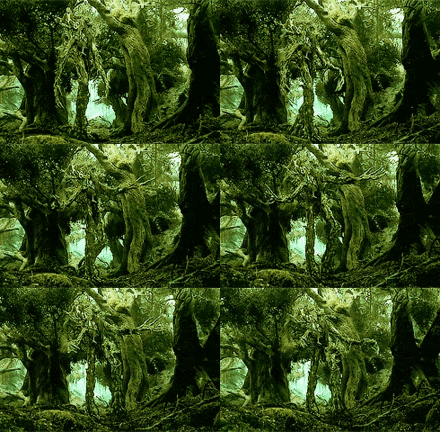
+1 There's some typically Whovian subversion of the good/evil binarism in the plot, as well as some environment-related social criticism (but not as much as I would have liked, as I'll discuss below): The antagonists are alien trees who attack people back when being felled (Whovian Ents, kinda!), and rather than being 2D 'baddies', they have motivations and a backstory behind their violence. And the Doctor speaks Tree - of course he does 😂

Treebeard approves

+-1 This is more of an exploration of the more problematic aspects of the dynamic between the Doctor and Steven more than an actual fault of the audio -  When describing the dynamic from Steven's pov, we see how it is sometimes not as equal or healthy as he (and I) would like - More than once Steven feels like he has to tread carefully in order not to make the Doctor grumpy, and when the danger is over, the Doctor decides when they're going back to the TARDIS, with Steven reluctantly following because if not he would have to put up with a 'barrage of petulance for being late', while thinking about how he would like to 'hang out with more people doing non-threatening things' for a while longer 😕. The series also explored the more fraught aspects of this dynamic at the end of 'The Massacre (of Saint Bartholomew's Eve)', with Steven being fed up at the Doctor's attitude after experimenting several rather traumatic adventures one after the other.

The First Doctor (alongside other incarnations) be often like that, sigh.

And now for the things I didn't like as much from the story 😅:

-1 There's only one female character in the story, the young girl, and she doesn't do much more than be frightened of the whole situation in general :S

+-1 Like I said, Christmas-themed stories are not really my fave genre, as they're often full of highly idealized and normartive issues regarding established societal holidays+the family system. It's nothing particularly overboard in this case, and I actually enjoyed some of the Christmass-y moments (such as the little girl mistaking One for Father Christmas or Steven saying the famous ending line from 'The Feast of Steven' in 'The Daleks' Master Plan' serial - "Merry Christmas to all of you at home" - as a way to finish this story). But yeah 😅

-1 The aspect I found the cringiest in this tale is that the Doctor solves the violent situation between the humans and the trees by invoking these holiday values in a way that I found pretty problematic - The trees got initially violent because the little girl's father had felled one to be the Christmas tree for their cottage, and the Doctor claims...that the trees should not be feeling attacked basically because humans have always thought of Yule/Christmas trees in terms of light, love and hospitality 🙃🤷‍♀️. But that doesn't take away the fact that a sentient tree was killed all the same (and personally, for a reason that's way more unnecessary and problematic than needing timber or fire wood, just saying), and as such, the trees had a pretty valid reason to feel attacked.

That's a bit like telling Treebeard and Co that in Maiar culture Saruman's destruction of trees comes from a place of love and hospitality, so they shouldn't be bothered 😅

I approved of the Doctor's typically epic pacifist speech about how it's not always right to answer violence with violence and how communication is key in order to understand each other, and so on, but in the context of this plot, it rang in a rather oddly fashion in the context of the final lesson of the story - which is that the trees basically end up being all friendly because the Doctor convinces them that sporadically killing them for decoration/superstition/tradition reasons is done in a way that has 'nothing to do with malice, cruelty or wanton destruction', so it's OK! Cringy af. I also personally beg to differ in our real life context about this topic, because, even when they're not sentient, what is felling trees in order to decorate your house for a month, tops, if not falling under the category of wanton destruction, a little bit 😅?  

And the fact that the trees are freaking sentient in this story complicates things even more. I mean, that's a bit like the Doctor concluding that if a person happened to be killed as part of a holiday which was theoretically about "love and light" and all-round "positive values", that would make it all good and no one should feel attacked - which sounds pretty absurd and very un-Doctorly indeed, right? (only, human sacrifices at festivities that are theoretically about light and prosperity have happened historically more than we'd like to think, in too many places 😬).

I would have preferred that the end result would have been that both parties would have simply  apologized for their respective misunderstadings and errors, come to terms with their respective violence, and reached an actual truce where trees are also not happy to provide some of their own for the humans' festivities, because the humans would have understood that..murdering sentient trees because of Christmas is unnecessary and a little bit wrong 🙃. They did reach a truce in this case, but I'm not that much of a fan of a solution along the lines of 'because this religion/holiday actually means well, you shouldn't feel attacked for their actual violence' :S Christmas comes before anything else! Lol nope. 

-1 And finally, the Doctor includes the infamous 'smacked bottom' line in his scolding speech against the trees' violence, and I really hate that (sexist) Hartnell line, so I'm definitely not a fan of that addition, and I don't like the idea that One would say that line often 😑 (ew).


4. A Small Semblance of Home (2018, short trip #8.09, featuring One, Barbara, Ian and Susan). Written by Paul Phipps and performed by Carole Ann Ford (who plays Susan Foreman in Doctor Who). 

3/5. Goodreads review also here.

+1 Engaging and enjoyable narration style by Carole Ann Ford, who played Susan Foreman, the Doctor's granddaughter from Gallifrey, in the series. In this audio she also voices the First Doctor, Barbara and Ian.

The first TARDIS Team!

+1 In this story, the First Doctor searches for tea leaves, planning to include tea in the TARDIS food machine (apparently they didn't have it before! 🤣), in order to make Barbara (and Ian) feel more at home, and it's such a British trope thing to do xDD 

“I know things haven’t been easy, my dear, and that’s why I’ve been looking for this plant, these tea leaves, because I knew it was the one thing I could do to make this silly old ship a little more comforting for you.” (I think that Barbara and Ian would also appreciate it if you knew how to drive the TARDIS and didn't put them in danger every single time, though 😅).

+1 It's also a story that mainly revolves around Barbara and her inner thoughts and feelings about her adventures with the Doctor. And it's always refreshing to encounter a story that focuses on how the female characters feel and think, so yay. 

Yay for Barbara!
In this tale, Barbara expresses her sense of wonder about her adventures, but she also feels tired by the non-stop action and especially disorientated for the relative way in which she's experiencing time (she keeps a notebook in which she tries to keep track of time). She also talks about being pretty tired (as is Ian) of the Doctor's bouts of self-centered 'scientific projects' which have them dragged off from planet to planet non-stop. I feel like it's very interesting and necessary to not only portray and focus on the good, exciting things about time-travelling in the TARDIS, but also show the realism of the companions feeling exhausted by the continuous adrenaline or fed up with some of the Doctor's more inconsiderate traits.

+1 Female bonding, with Susan and Barbara talking about their feelings and experiences in several scenes. This story also includes some backstory of Barbara's life, especially the positive dynamic with her mother (mother-daughter female bonding ftw!), with whom she used to have lunch on Sundays and talk about her week:

“One day, one day I’ll tell you all about my travels, all my adventures through time and space. One day I’ll make you tea and share all of the stories your daughter can tell.”

+-1 While the fact that the Doctor plans to get tea for Barbara and Ian is cute, he also behaves in a problematic fashion in this story, following a trend that he can also see repeated in several of his TV serials, such as 'The Daleks'. In this case, he may have the ultimate intention of making Barbara and Ian feel more comfortable around the TARDIS and less homesick, but the way he accomplishes this is not any different from the way he drags his companions off at any moment's notice to fulfil the rest of his personal scientific projects, without taking into account what their companions might feel like doing, or how tired they might be 😬.

Tell him, Barbara!

Ian and Barbara actually spend quite a section of this story complaining exactly about that issue and confront the Doctor about his more self-centered and inconsiderate attitude when it comes to his 'personal projects'. And there's the problematic fact that the Doctor seems to think that his companions will feel 100% happy and satisfied with the surprise that he plans for them (and especially for Barbara), without the need to change anything about the rest of the situation that bothers them 😬. What's more, Susan also ends up resorting to having to justify her grandfather's behaviour on his behalf, asking Ian and Barbara to basically put up with everything because 'he must have a good reason for it' 🙃. 

 “Doctor, wait! You’ve got to stop this! Barbara’s exhausted, and so am I! Everywhere we land, no matter how cold or how wet, you get us looking for this blasted plant! (…) You’re obsessed! It’s like Skaro all over again”
“I’ve apologized for that. You have no idea about the reasons behind my work. How dare you!”
This was a losing battle. It always was when the Doctor employed his ‘my ship, my rules’ argument.”

Here, I also can't but think of the analogy where this kind of strategy is favoured by many abusive men towards their (most often) female partners, resorting to the easy tactic of offering punctual gifts and surprises - which, being self-planned, can also be more ego power trips than actual consideration towards their partner - to compensate for a problematic behaviour they don't really plan on changing, or believe that they have to change :S. I'm obviously not saying that this is a perfect analogy with One because it isn't by any means - I wouldn't say the Doctor's abusive, but in both cases we can see similar traits based on (often male) entitlement, being inconsiderate and self-centered, and not wanting to be accountable for one's actions. 

Which can make for dysfunctional dynamics, and more than one companion has confronted him (her/them) about it when it gets too blatant or constant, starting with Barbara and Ian themselves (Steven also had several goes at it, as discussed above in 'O Tannenbaum'). Seeing as several (mostly male) incarnations of the Doctor do fall for this behaviour more often than we'd like, it's also nice to see Doctor Who content addressing the titular character's more problematic traits, so Barbara and Ian confronting the Doctor about it was a very good addition, even though the 'I got tea leaves for you' happy ending of this short story did take the very needed accountability off the Doctor's shoulders a little too fast for my liking.

And now have some caring Ian and Barbara as a palate cleanser after that discussion xD

 -1 The adventure portion of the tale features pretty traditional gender roles throughout 😬 The women scream (Susan does, as typically required for her character in the TV series in every single occasion 🙃), and the women get captured, while the men climb trees, defend themselves and try to rescue the women. The antagonists are a group of cavepeople (of caveMEN, because they all seem to be male) with apparently pretty regressive views on the matter as well (which I guess can be expected, but still, always grating). While the TV serials of 60s Who (and later) has depended on traditional gender roles more often than we'd like, undersusing more than one awesome female character as a result, we also know that in spite of those imposed gender roles and behaviour Barbara succeeds in being badass af in more than one occasion, so I found it more than a bit unnecessary to resort to a strictly traditional gender role viewpoint here, when the story is mainly focused on Barbara, too.

Barbara is badass, case in point

 +1 The Doctor starts by trying to have a peaceful conversation with the antagonists and then manages their escape with a non-violent ploy, which is a nice way of critisizing the more violent leanings of the human antagonists of this tale, as per the typical pacifist and anti-war stance in Doctor Who.

+1 Other fun tidbits: Apparently, the Doctor gets in the habit of choosing his companions' (Ian's, at least) clothes for them? xD Especially when it comes to compensating for clothes that got destroyed in alien planet shenanigans xDD 

“Ah, good morning, Chesterton! I see you’ve found the new cardigan I left for you. Very fetching! Very fetching indeed!”