Showing posts with label Equality. Show all posts

Saturday, 22 July 2017

Objectification in fandoms - On the AOS Starfleet minidress uniform and why I hate it

I will be referencing this post multiple times in my AOS Star Trek comic feminist reviews (AOS: Alternate Original Series, the Trek movies from 2009 onwards). Here focusing on the AOS miniskirt female uniform, although I also reference the TOS (The Original Series) version as comparison.

I also note that AOS Star Trek is one of my favourite fandoms, I'm officially obsessed about it and it holds a special place in my heart. But as a feminist, I also find problematic flaws in it, and this is the main one.

-On the Starfleet female miniskirt uniform and why I hate it:

One should definitely not judge a woman for wearing miniskirts or shorter skirts, and I'm firmly against patriarchal modesty mindsets. I firmly think women are entitled to wear whatever they like and feel well in (so long as they're not making an unfeminist 'choice' and 'choosing' to wear a burka or a similarly misogynistic gendered covering, of course). However, the context should also be taken into consideration in order to ascertain if the character is being sexualized or not when wearing a more revealing skirt/dress/outfit. For example, female Starfleet officers shown wearing miniskirts (and sleeveless dresses) is both unrealistic and ridiculous - and thus, objectifying - because the logical thing would be to wear protective and practical clothing in the context of an actual job in outer space with bonus potential accidents and planet away missions! 
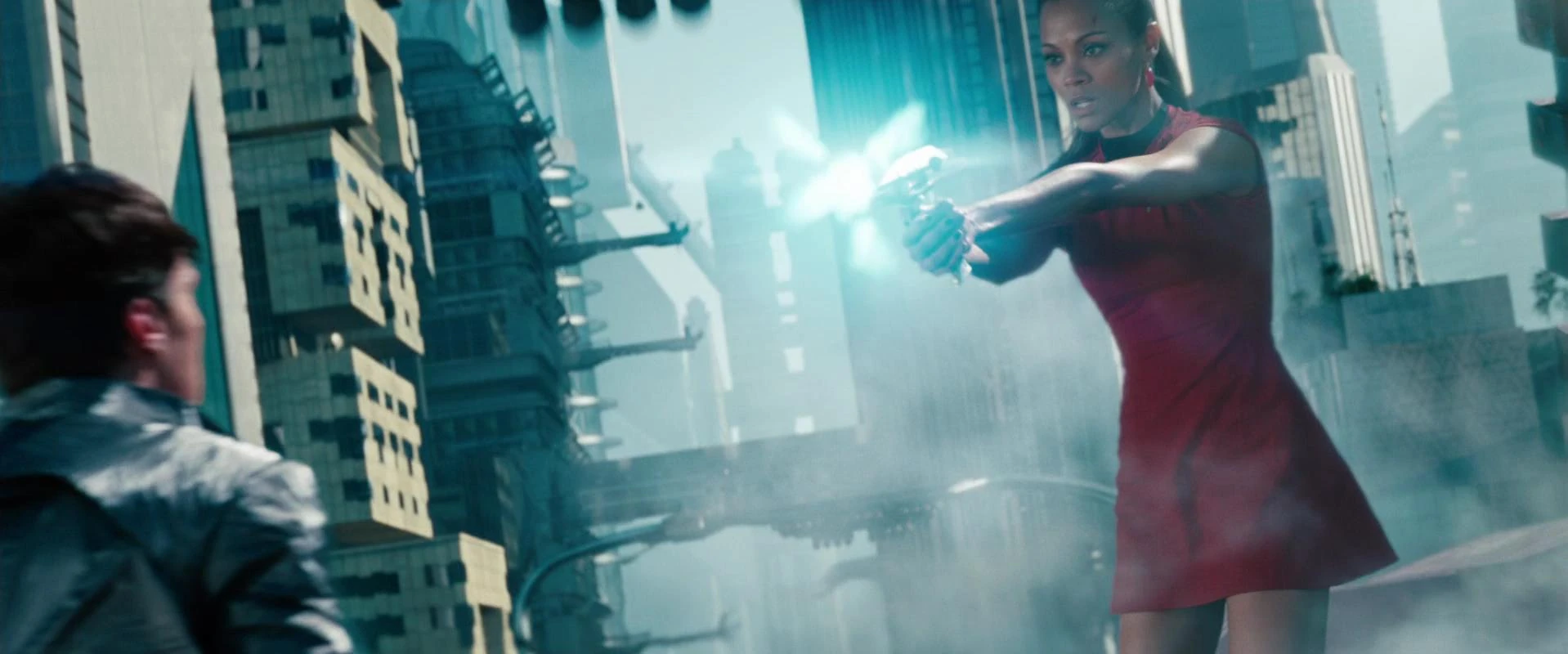
So comfortable and realistic for an action-packed mission!
Weather (exposed skin will be more prone to cold or heat), risk of injury to the exposed and very poorly protected legs and/or arms (no explanation needed here), lack of mobility (when one's underwear is showing so easily one has a limited set of posture choices :/ 'I remember always being exposed', Uhura's Zoë Saldana says. Sounds comfy for (such) a job, right?!),...These are all important factors which make the choice of a (sleeveless) minidress (in the case of AOS without even thin tights beneath -not that those did any protection either!-, even though it's a little bit less ridiculously short as TOS' version) clearly thought for the aims of sexualization and male gaze, as well as promoting the narrow-minded idea of gendered uniforms where women, for the sake of being women, too often automatically have to wear skirts/dresses and more uncomfortable and/or revealing clothing.  
The sexism of this is also of course anachronistic as hell (that in the 23rd Century such gendered uniforms would still exist). Then again, we know that in (male-dominated) science fiction obsolete sexism always ends up making an appearance. This gendered uniform is also particularly infuriating because in real life women have been forced to wear skirts for practically everything, including many jobs where it is impractical and hazardous to do so, and thanks to stupid gender roles, they were also actually forbidden to wear the 'male uniform' (aka actual practical pants) in many cases - Female forest rangers in USA, for example, were not allowed to wear the pant uniform until freaking 1973!! Meanwhile, policewomen had to wear skirt and pumps combos because logical thinking ("Some women wore skirts with a gun belt, pumps, and pantyhose — they really couldn’t do anything.”), or had to make do with the overlarge men-size pants. So yay, liberal feminists, please tell me how this is about 'choice', and especially about 'appreciating femininity' and 'allowing women to be feminine' (like, are women allowed to be anything else??).
The most logical outfit for an away-mission! Obviously. 
And real life example of the exact same situation - This skirt+bare legs combo is so practical and logical when it comes to being a forest ranger!
And if you need more proof (even though I think it's already pretty obvious), just read Zoë Saldana's comments on how uncomfortable her minidress 'uniform' made her, how she couldn't sit in any way without her underwear showing and her male colleagues calling her on it ("I kept being reminded by all my male cast members that I was flashing, I would sit down and it would be like, 'Oh, Zoe, cross those legs.' And I would say, 'They are crossed.' [They would say], 'Well, then put something over that because I'm just seeing everything.'"), and how the costume designer responded to her complaints with male gaze justifications, which win against every discomfort a female lead might have, apparently: "I just remember always being exposed no matter how hard I would try," Saldana said. "I would tell Michael that we had to work on this and [he would say], 'But it looks so cute.'".
 Women's sexualization wins and no surprises there :/, but it bugs me so much that so many female fans actually defend this shit and even call it 'empowering' (f* you liberal 'feminism' >_<)! Or that Beyond's costume designer, who is a woman, decided to keep on using the unrealistic and uncomfortable minidress - even though she added long sleeves and the dress is slightly longer - that caused so much discomfort to the actresses, never mind the characters (and this is the only issue I have with the awesomeness that is Beyond).
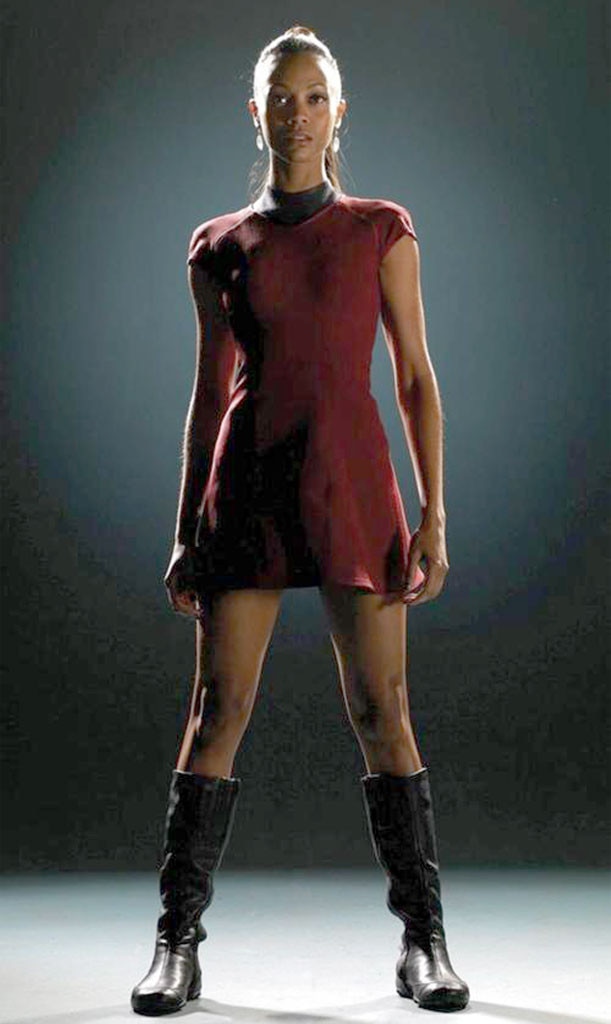
Just the kind of thing you'd wear in order to work in outer space, RIGHT?
This is a TOS female uniform as a comparison - Very similar regarding ridiculousness and sexualization aims :/ The TOS 'uniform' has an even shorter skirt (which however acts as a bathing suit of sorts - uncomfortable and unnecessary af, but at least the underwear wouldn't be as exposed, I guess), and generally includes very thin tights, which add like 1% protection, so no big deal either.
Another essential point to consider about this issue is to see if, by contrast, all male characters are always wearing pants and generally comfy and practical clothing while the women are generally wearing more revealing clothing just because they're women (double standard) and they must be seen as adequately attractive for the male gaze. And yes, this is what's happening regarding Starfleet gendered uniforms: All men wear actual realistic and comfortable uniforms with pants (and reinforced biker-style pants at that!) and, regarding the two first Trek movies where many minidresses are also sleeveless, the male uniforms always sport long sleeves, of course. Men are allowed to be protected! Male leads in movies and male characters in general are also allowed to be handsome and stuff while being protected!
What male privilege looks like
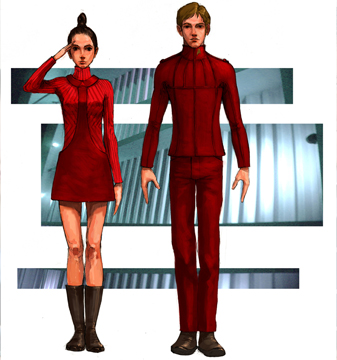
These are some of Michael Kaplan's costume sketches for Star Trek's Academy and duty uniforms. As you can see, the double standards are strong with this one. Men have realistic, reasonably comfy and non-objectified uniforms (they are also depicted in non-sexualized postures), while women are extremely sexualized (regarding both the outfit and the poses) in an illogical, unrealistic and ridiculous way.


Also featuring hypocrisy from the designer's part: "The women had lots of different options for the cadet uniforms: They could wear pants, skirt and a sweater, a skirt and jacket, or a jumper - an over-sweater like a little dress" Where are the 'lots of different options'? They're basically lots of options for wearing miniskirts and dresses, because I literally didn't see one female cadet with pants in the movies or in any production design. If you state that women can wear pants, why aren'y any women wearing them in the Academy? Or do I have to squint more at the screencaps? At least be sexist in an honest way, I don't know :/

Let me stress that gendered uniforms of this kind are inherently sexist and misogynistic af, not to mention narrow-minded in their gender-role glory. Because they're telling you: You're a woman, so your role in life is to wear a uniform that's more uncomfortable, protects you less and limits your mobility, because you must look 'sexy' and attractive at all costs. They brainwash women into thinking this actually is logical and makes sense. And those women who don't get brainwashed effectively usually have to accept it anyway, or lose their job/not go to (a uniform) school/lose their acting job. It's one thing to like miniskirts/dresses, it's another thing entirely to have to wear them as a uniform in the wrong context just because of your gender and because a male designer/male somebody in power said so (Michael Kaplan again: "We loved the idea of sticking to the homage of the 1960s and putting the girls into mini-skirts [he forgot about the 'lots of different options here!]. Zoë Saldana is adorable - it was so much fun to dress her. She has such a great figure for short skirts and the costume - she was the main prototype for the costumes").
 I myself wear miniskirt-and-leggins combos on a regular basis because I like the aesthetic, but I sure as hell wouldn't wear them to work in outer space, or as your standard female uniform to go to uni, and not only because contextually it doesn't make any sense, but also because I resent being sexualized because of my gender, thank you very much. 

In the AOS Trek movies we have a handful of female crew also wearing the long-sleeved pant uniform (in Beyond all female uniforms have long sleeves, but the pant version sports a tunic-like top and most female characters still wear the minidress version :/). Apparently, women in Starfleet can wear the pant version of both the Academy and duty uniforms (why thank you, 23rd Century so full of anachronistic 60s sexism in that respect), but oh surprise!, I haven't seen any female Academy cadet in the movies wearing the pant version, and all women in pant duty uniforms are extras (you can see a handful in all three Trek movies), or secondary characters at most (like Ensign Syl in Beyond).
(click on pics or open in a new tab for larger images)
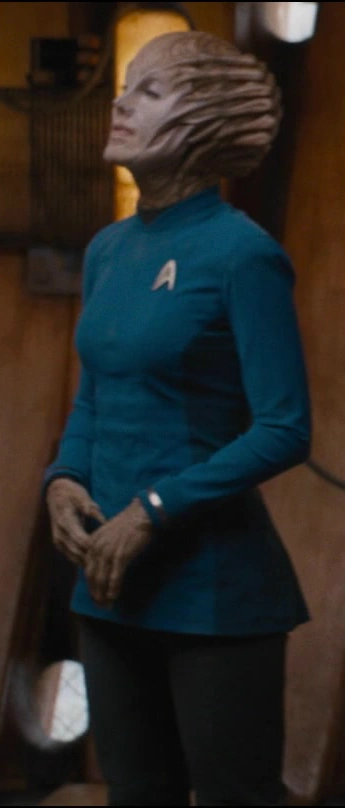
Both pant uniforms, and dresses with long sleeves (which is something - like in Beyond - but still impractical)  


Let us also remember the brief glory of pant uniforms for women in TOS
 
Needless to say, this is the kind of uniform Starfleet women should be wearing, for practicality, comfort, protection, mobility and general equality (why can only men wear pants when it comes to uniforms, when it's the most logical option?). It's high time we taught society that women are not here to decorate men's world and thus should not look sexualized in every freaking situation, and also high time we taught people that not only should women be allowed to wear pants in these situations (it's so surreal to have to say this in the 21s Century, never mind the 23rd) but also- if appearance should even factor - that women and actresses can look just as good as men and male actors in freaking pants. No need to put them in ridiculous miniskirts in order to boost the attractiveness Hollywood selling factor.

Of course, we can't have the (limited) main female characters non-sexualized for our dear male audience (because we also know that female sexualization sells), and also for brainwashed neoliberal feminists! Neoliberal 'feminists' who claim - much to men's comfort, of course - that these women who are depicted with the minidress versions are empowered and not sexualized at all because they have the pants option available and didn't choose it (oh choice 'feminism', you always make so much sense).  How fitting for the male audience that no one main female character and less than 50% (being generous in some cases) of the secondary characters and extras chose the pant version! How fitting that so many women use the word 'choose' for fictional characters whose outfits are generally chosen by (male or brainwashed female) designers and crew!  Bonus points to that other argument they favour - That it's not objectification or sexism because women should be able to be both strong and 'look feminine' at the same time! That a sexualized heroine is actually subversive and empowering! Because by 'look feminine', of course, they usually mean justifying the gratuitous and blatant sexualization of so many female characters for the male gaze (comic characters such as Wonder Woman especially come to mind in this case). Not to mention that as non-binary and as a radfem I'm 100% against 2D simplistic gender constructs of  'femininity' that state that a woman 1) Must always look 'feminine' and that 2) The onlyway to achieve it is through skirts and dresses and other limited gendered options.
 Neoliberal and choice 'feminism' is truly poison and Patriarchy's pawn. They also make like 0% sense, my gods.

The newest Boldly Go Trek comics, as well as some Ongoing issues such as the genderbent 'Paralell Lives' one and some other random cases, made me hope for a change in this respect, seeing as 99% of the women portrayed in the first issues actually wore pants, even Uhura a couple of time :D, so we'll see, although I'm not that hopeful because the media does still rely on objectifying their female characters too much.  But THIS is what we deserve to see everywhere:


In short, I find it so infuriating and ridiculous that I'm here vindicating the right of women to wear comfortable, realistic uniforms in a job that requires lots of mobility and protection (minidresses are all fine and cool but in other contexts thank you), and that it's actually an 'unpopular opinion' *facepalm* 

Friday, 7 February 2014

Oppressed Majority: Tackling sexism in a really powerful way

I discovered this incredibly powerful 11-minute short film yesterday. It's directed by Éléonore Pourriat and it "shows men how it feels to be subjected to sexism and sexual violence". You can watch it here:

I think this is a remarkable video that tackles sexism in an intense and effective way. It describes an alternative society where it is the women who enjoy all the privileges and the men who are oppressed, discriminated and harassed - a 'matriarchy' instead of the 'patriarchy' we are more familiar with in most societies. In this matriarchal society, the women hold the positions of power and lead professional lives while the men are seen taking care of the children and working as assistants. While women are seen freely jogging and walking in the streets bare-chested, male harassment and abuse is all too frequent. In addition to that, the law and religion states that men should wear a balaclava/head-covering to stay modestly dressed and submitted to their wives. A man wearing bermudas and a short-sleeved shirt is deemed provocative and prone to be assaulted.

-IMPORTANT: The English subtitles mistranslate the original when saying "I can't take this fucking feminist society anymore!" "Feminist" is not the same as "matriarchal", which is how the line should have been translated. Feminism fights for women's rights in a patriarchal society and, by extent, it fights for equality for both women and men (in the film, the word "masculinist" is used as the equivalent of "feminist" in a matriarchal society). Feminism, real feminism (unlike what so many people, brainwashed, confused and prejudiced by patriarchal influences, think), doesn't want women's superiority or the creation of a matriarchal society where women would rule, hold all privileges and, by extent, oppress the "opposite sex", in this case the men. A matriarchal society is inherently anti-feminist. ie. anti equality, same as a patriarchal society. The (very low amount, MRAs) of women who want to have dominion over men and oppress them, and call themselves 'feminists', are using the wrong term (there are extremists and fanatics in practically every group, but still, wrong usage, they're "pro-matriarchy", not "feminists").

  As a feminist, I am always at the side of the oppressed in a group. In a patriarchal-based society, as is this one, I side with the women and fight for women's rights, not only because I myself can be oppressed, but because I'm also an INFJ and an activist at heart, and I don't like that other women be oppressed as well (and I do not try to oppress men or take rights from them, nor do I hate the men who mean well). But in a hypothetical matriarchy as this one, I would totally side with the men - because this time they're the ones who are being oppressed and treated in an unfair way. I completely empathise with the male character, a man who's being oppressed in a female-dominated society and who tries to be himself and fight for his rights. How is that "pro-women's superiority" and "man-hating"? I'm just pro-equality.

 So, no matter what the mistranslated subtitle may suggest, this video is nothing but incredibly feminist because it helps address sexism and oppression. By no means does it exalt a society where women oppress men. The gender-reversed alternative society serves as a powerful way to show men (and the women who have bought into the patriarchy's lies) how it feels to be oppressed by the opposite sex and how it is to suffer intense sexism and harassment virtually on a daily basis. Hopefully by seeing it with themselves as the oppressed, they'll be able to begin to realize just how wrong and unfair it is to oppress and harass anyone

 This is by no means unimportant. I'm not saying that every man harasses and/or oppresses women, but it's frightening how so many people seem to take for granted so many mysoginistic aspects of our patriarcal-based modern societies. Practically everything - harassment, sexual assault, obligatory body coverings, and so many other things -are not taken seriously or given some sort of excuse or explanation. "Boys will be boys/men can't control themselves". "Look what she was wearing, she was asking for it!". "You can't take compliments!". "You don't have any sense of humour". "But it's religious freedom, she's covering herself because she chooses to!". "They have to cover themselves so that men aren't tempted, it's for their protection, that way they won't get assaulted".  So many excuses. Too many. 

I wonder if people, watching this video, would have thought that the main character was "asking for it" when he was being harassed repeatedly and assaulted. For having the nerve to go out in a pair of bermudas and short-sleeved shirt! I wonder if they would have thought that it wasn't weird or shocking to see the women to be running bare-chested without opposition (because in a patriarchy we're certainly not accustomed to that). I wonder if they would have thought that the men covering themselves because the law and religion and their wives ordered them to were choosing freely, that this had any logical basis, that this wasn't oppressive. Somehow, I highly doubt it. Then, why so many people think otherwise when it is the women being forced to cover themselves up, or being assaulted when happening to wear a short skirt and tank top? When men run or bathe bare-chested, do we see this as weird, as a provocation and an excuse to assault them? I don't think so.

Oppression is wrong in these two paralell societies, in exactly the same way. And by seeing this paralell comparisons, hopefully this film will help more people realize just how unfair, illogical and wrong our patriarchal mysoginistic problems are. 

 -About the "controversial" issue of head and body coverings: I wouldn't have a say about someone covering themselves up if they really did it because they wanted to, as a pure fashion statement, or because of the weather, or what have you. Same as I wear scarves in Winter and only wear my arms and legs bare when it's reasonably hot. And same as I don't always choose to wear deep necklines. Same as someone might choose to wear a turban one day and their hair loose the next day. Even if they wanted to wear a turban/covering every day, but for reasons that weren't gendered or compulsory. Because people seem to forget that, in this case, there is the belief that women's bodies are inherently shameful and have to be modestly covered, and that they are the property of men and have to be kept as "wrapped candy", only to be unwrapped by their 'rightful owner'. Ew.
 I generally defend everyone's right to wear what they like, but these reasons and beliefs, these are so inherently mysoginistic and oppressive, I am very openly against gendered and enforced body coverings. Sue me. I do not see it as a 'freedom of choice'. I do not see it as 'religious freedom'. I only see oppression and misogyny.

Thursday, 19 December 2013

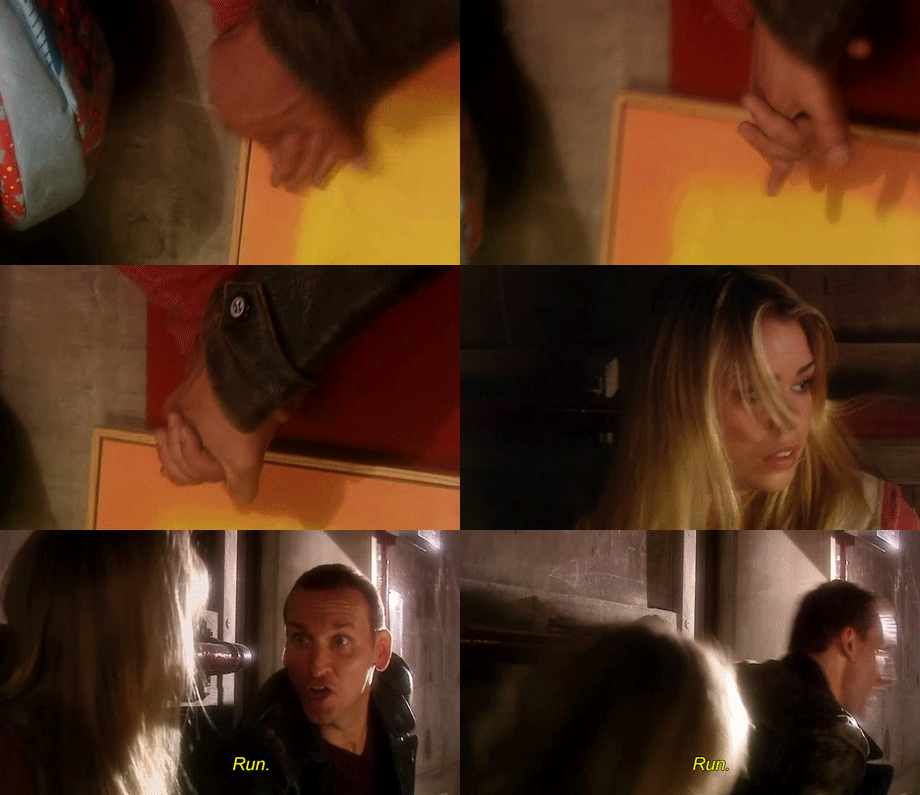
Doctor Who feminist reviews - 'Rose'

UPDATED April-May 2016 and August 2020. Added gifs and pics, changed some of my former views and added a lot more text and detail (damn it, perfectionism xD)

My first Whovian feminist review is going to be about the first episode of the new series of Doctor Who ('Rose'). There will be SPOILERS about the plot of this episode.


                                            New!Who, 2005 series: 'Rose'                  

-Doctor: Ninth 
-Companions: Rose Tyler
-Episode: 'Rose' (New!Who, 2005, Season 1 episode 1)

 Brief summary of the episode in Wikipedia 

      1.   Overall:
  • Things I liked:
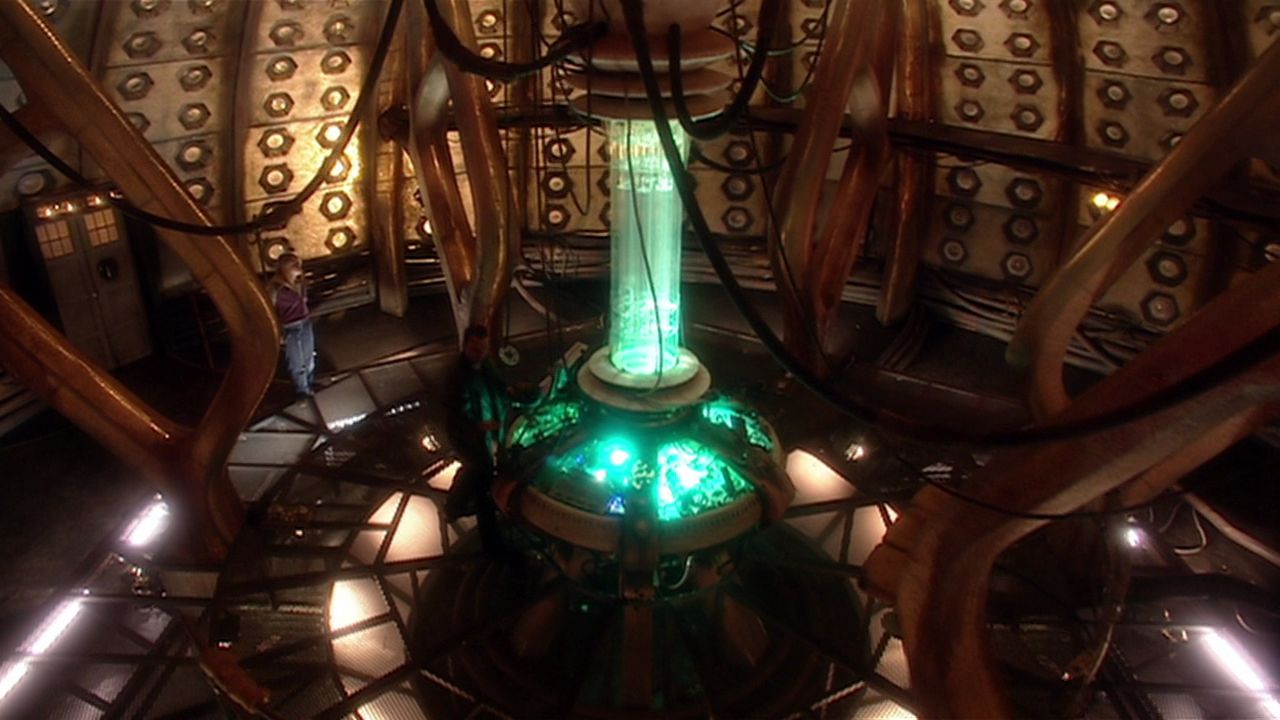
 -The whole time-travelling idea of Doctor Who, and the TARDIS design.

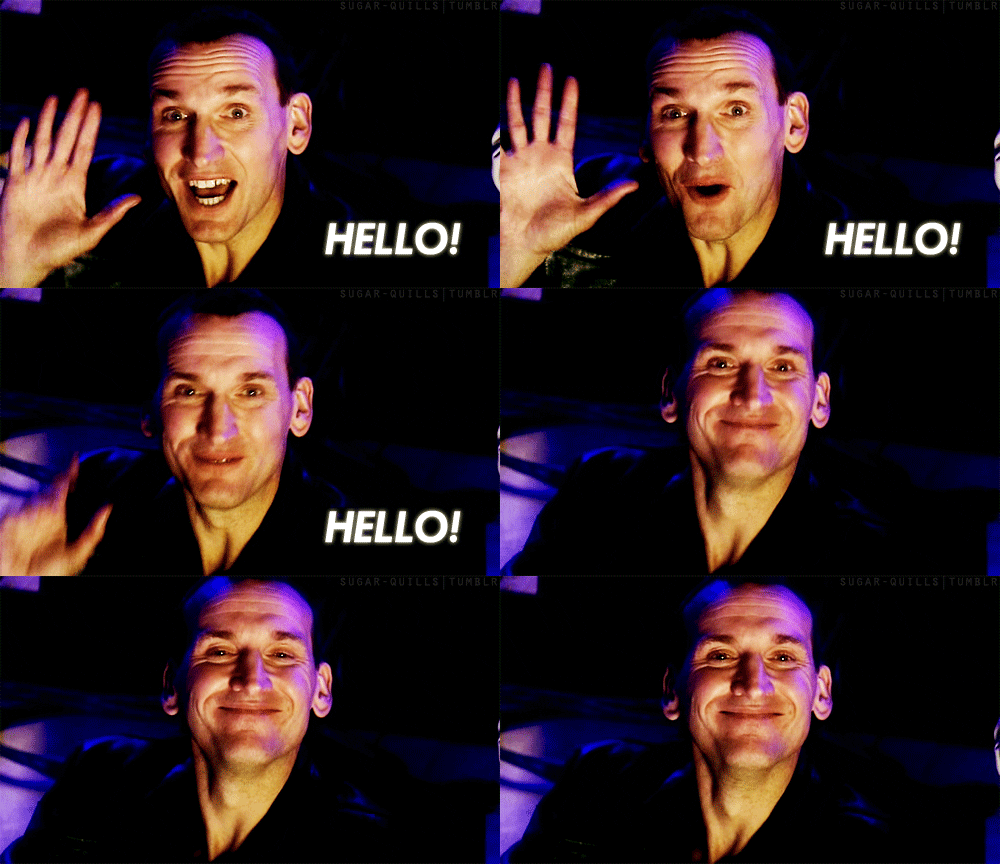
 -Christopher Eccleston's portrayal of the Ninth Doctor is pretty likeable and sassy.
Fantastic!
 -Rose's proactive traits (initiative, wits and sass). In this episode, she is really the one to stop the Nestene Consciousness, plus she saves the Doctor and outwits him (making him consider his former patronizing mode).
You go girl! Rose smashing gender stereotypes
  • Things I didn't quite like:
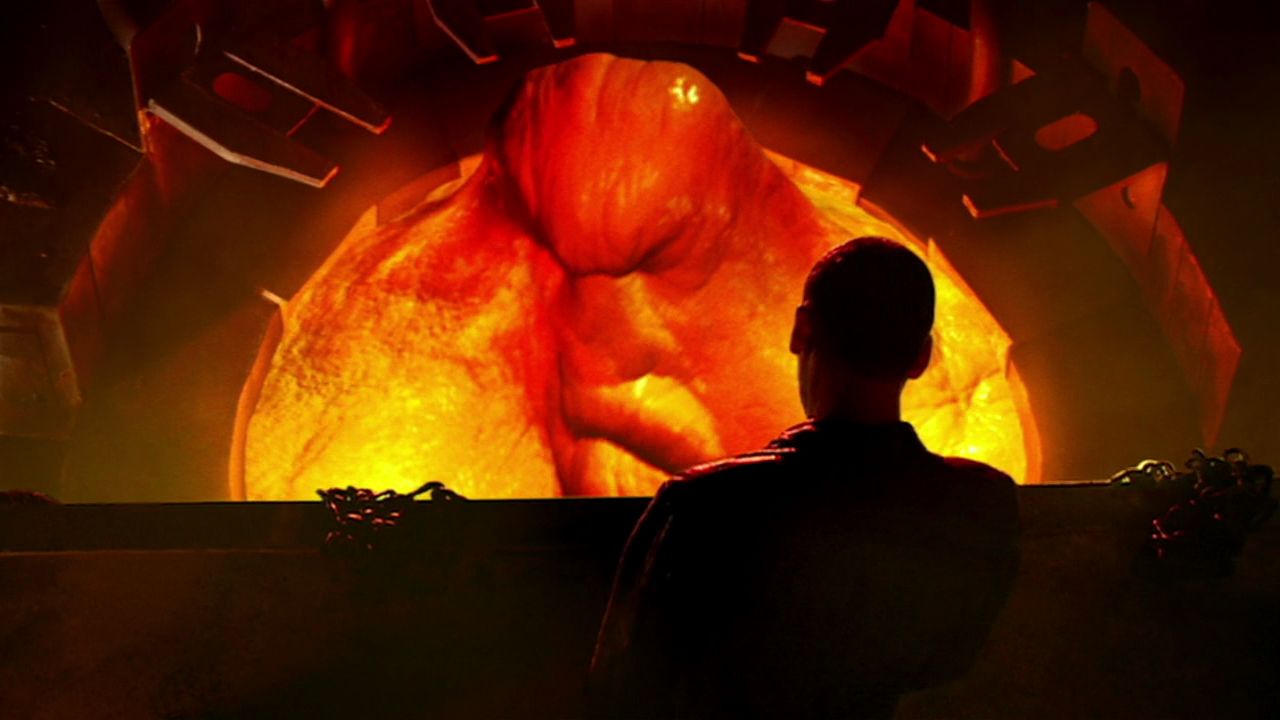
-The special effects. But then again, their budget wasn't very high, so it's understandable, I am grateful for the return of New!Who disregardless :)  
...Yep
-Sometimes the percussion parts of the soundtrack are too loud and it's hard to hear the dialogue.

-The bin-burp. I personally just don't find that type of humour funny.
  • Things I didn't like:
  -Mickey's interaction with his girlfriend in this episode shows a number of questionable traits, some of which can be explained by acquired sexism
 
-Disclaimer: In 2021 several allegations of sexual harassment were tied to Noel Clarke, several while working on the set of Doctor Who. I spoke about it here

Mickey does have character development later on in the series, and doesn't quite again show this level of sexism (the possessive moment in the car, or the "*slaps ass* 'Kit off'" demeaning comment), so I'm going to assume that the relationship portrayed in this episode is an 'objective' depiction - and even a critical view, explaining why Rose feels rather dissatisfied by it-, and not something that is condoned.
Mickey feeling possessive about his girlfriend being out there talking to other men
-The Doctor's patronizing/xenophobic-speciecist comments which arise from time to time.

Thankfully, his comments are never overly mean, can be explained (even if not justified) by his pos-Time War PSTD, trauma and increased cynicism, and his character develops quite a bit in that respect.
That's enough with the 'humans are stupid apes' nonsense, Doctor!
 -I don't like how they started portraying Rose's mother Jackie, even if thankfully the character got more depth and character development throughout series 1, 2 and 4 (and now I love her). In this episode she's shallow (but I'm not at all against her wish to date people casually - I'll talk about that problematic scene later), self-centered, conventional, and seems pretty careless when it comes to the well-being of her daughter (some careless and kinda demeaning comments, not encouraging her to retake her studies, etc).  As a Whovian and having watched all seasons, I now know Jackie's character got so much better and that she actually cares about Rose *a lot*, so yay about that.


Gossip ahoy!
-I quite like Nine/Rose, friendship and well, yes, also ship - the romantic subtext is very clearly there, and I don't dislike that, even though if we look at this pairing from a feminist pov we also have to note that 1) There's a sizeable age gap (if we only look at Nine's apparent age, it's a 20 year gap), and although that doesn't always mean the relationship is going to be unhealthy or lack equality (I actually think Nine/Rose is way more compatible than Rose/Mickey), a big age gap with a younger woman and an older man crops up repeatedly in the media and in real life, and it does often come with a power imbalance factor, so I am wary of seeing that model promoted too often. And 2) It's also worth noting that, following in the footsteps of the 8th Doctor 1996 movie and the newfound interest for romance in DW, the first companion in New!Who is also a love interest.

I also hate triangle clichés - and in this case, we have Mickey/Rose/Nine, as well as  unnecessary romance plots with crappy guys like Adam that only give Rose grief, and they didn't resolve the Rose/Mickey relationship until mid-series 2, which irks me immensely.  

Apart from the fact that I'm against the portrayal of unresolved, ambiguous relationships and potentially cheating scenarios, because that's not 'liberation' or 'equality' or 'empowerment' (unless we're exploring the topic of forced marriages and the like),  people could also be getting the idea that every time a female character goes off on her own (meaning without her heteronormative boyfriend), she's going to flirt with other people  and end up either cheating on him or breaking her relationship with him. And that's a pretty problematic way to see it  (this scenario will reappear with Amy/Rory - to a lesser extent - and Clara/Danny in future seasons).

-Feminism:
   About the Bechdel test, I think that it isn't that exhaustive in terms of feminism. There are films with empowered female characters who don't happen to interact with other women a lot. Are we going to compare a film with really empowered female role-models who don't really talk with other women with a film where two women (not necessarily awesome role-models or anything) happen to have a few lines of conversation together about something other than men? Not that I don't appreciate that people are beginning to worry about female representation, female communication, female bonding and female friendship (I think all of these are really important), but the test is a bit flawed, imo.

  •    Number of female charactes: 3 - Rose Tyler, Jackie Tyler, Caroline (Clive's wife). Main role for Rose, secondary role for Jackie and a minor role for Caroline. All three white and heterosexual (although Rose might actually be bi, because Billie Piper claimed she would also be in love with the 13th Doctor were she to meet her).
  •    Empowered traits in at least one female character? Rose is active, inquisitive, and shows agency in this episode (deducing where the Nestene Consciousness is and actively saving the Ninth Doctor).
  •    Level of sexism:  Mickey shows quite a lot of sexism and entitlement in his interactions with his girlfriend Rose (I'll be talking about that later). Also some stereotypical sexist aspects in the portrayal of Jackie.
  •    Bechdel Test and female bonding: Yes - Rose and Jackie talk together about the explosion incident, plus jobs and other trivia. Mother-daughter relationship and interactions (even though this dynamic isn't at its best in this episode).

-This Tumblr post also addresses this episode from a feminist point of view. We agree on most points.

-Other intersectional issues:
  •    Race/ethnicity. Speciesism: 
-Appearance of a black character, Mickey. Interracial relationship between Rose and Mickey. Mickey's character gets fleshed out and developed throughout series 1, 2 and 4, and it's never treated like a racial stereotype. While it's totally legit to criticize him for his entitlement and sexist behaviour when it arises, it can be also worth commenting that the fact that he will be basically reduced to 'Mickey the Idiot' in series 1 and 2 and treated in a pretty crappy way by the Doctor, while being the only recurring black character in the show, can rightfully rub people the wrong way :S
                                          

-Some patronizing comments from the Doctor about  humans, which can be seen as speciecism resulting from increased misanthrophy after the Time War. Rose is open-minded when it comes to class and race/species, though, and she doesn't mind that the Doctor is an alien (Rose: "Are you alien?" Doctor: "Yes. Is that all right?" Rose: "Yeah"). Mickey does have prejudices about it: "Don't. He's an alien. He's a thing."
  •    LGBTIQA+: The Doctor is canonically a genderfluid alien. Rose Tyler might be canonically bisexual, but there's no explicit mention of that in the series.  And I think the Doctor is being descriptive rather than offensive when saying "That won't last. He's gay and she's an alien".
  •   Social class: The first companion in New!Who is a woman from a middle-low working class. Even though she shares Rose's class status, Jackie questions Rose's ability to get a good job due to her upbringing and (lack of) education, showing some internalized classism when suggesting that she find a job at the butchers because the shop was giving her "airs and graces".
-Integrity and ethicsSubstantial-to-high. 

-The Doctor doesn't seem to show as much empathy as in other episodes, being rather dismissive of humans, but he still tries to stop the Nestene Consciousness in order to save humanity, and his current gruffness and closed-off manner can be explained by the fact that he's more or less recently regenerated after the end of the Time War and it's traumatized and guilt-ridden by it. 
-Rose saves the Doctor (and humanity). 
-Rose worries about Mickey being in danger and the possibility that he was killed. 
-Rose is sickened to hear that Wilson was killed ("That's just not funny. That's sick!").
-The Doctor helps Rose escape the mannequins. 
-Rose phones her mother to warn her about the mannequins. 
-When Rose is assimilating all the information about the TARDIS and Mickey being attacked by aliens and she breaks down, the Doctor says "That's okay. Culture shock. Happens to the best of us".
- The Doctor, following his pacifist and anti-genocide oriented mindset (especially after he thinks he commited double genocide in the war), also tries to negotiate with the Nestene Consciousness instead of killing it outright ("I'm not here to kill it. I've got to give it a chance"). 

     2. Character analysis, from a feminist point of view:
  (All the transcript quotes come from this site)

Thursday, 3 October 2013

Where are all the nerdy t-shirts for women?

                                                         [Traducción española en cursiva, al final, después del salto]

This past Tuesday I was shopping for Winter jumpers with a friend and I entered a C&A shop to take a look. I usually stick to the women's sections, not because I particularly prefer women's fashion over men's (I actually favour several "traditionally-made-for-men" styles and clothing) but because it is very likely that nothing in the men's aisle will fit me, personally. But to the point: That day I felt curious (or maybe disheartened) and decided to take a look at the men's aisle for a change. Well, I did, and this is the very first thing that I saw:

    A Star Trek: Into Darkness T-shirt featuring John Harrison aka Khan. As a nerd girl, a Trekkie in the making, a very hardcore fan of the newest movie, and a Benedict Cumberbatch admirer - well, the first thing that I did was leap around a bit in geeky exultation. Then I realized that I was in the men's aisle, and that the smallest of these shirts was probably wider than me and way longer than I would have liked. There were no geeky T-shirts in the women's aisle at all (and no, Disney doesn't count).
   This isn't the first time this happens to me. The Superman and Big Bang Theory T-shirts at FNAC didn't come in 'female sizes'. The T-shirts that came to the stores as part of The Hobbit: An Unexpected Journey merchandising didn't come in 'female sizes'. And I came across some great R2-D2 T-shirts last year, and guess what - they didn't come in 'female sizes'.
The Hobbit T-shirts, all with the male symbol indicating they're male sizes. The only ones available at the store. When I asked one of the shop assistants why that was...He shrugged as if it was no big deal and looked at me as if I was mad :/
   
  Summarizing:
                                       

Or to be more specific: 99.9 of the nerdy/geeky T-shirts on the stores are made for men.
   Not cool.
Apparently, geek girls don't compute to the majority of the clothing making/nerdy merchandising industry. 

 This other pic I took at the store pretty much summarizes what these kind of shops usually look like: The girls' section features cute, 'feminine' clothing,  the boys' section is all about casual wear and (you can't find these in all the stores) geeky, fun T-shirts. I actually have a liking for short dresses and that sort of thing, even though I dislike the fact that the 'feminine section' often doesn't have a lot of variety. But I also have a liking for nerdy T-shirts.

 It's the blatant sexism and gender bias which gets to me.

 Why can't both men and women (and enbyes) have similar styles in their respective sizes, so as to make it all truly 'unisex' where gender doesn't really matter in clothes, and so that all of us can choose around a bit more? When is the merchandising industry and the society in general going to realize that there are actually a fair share of women who like fandoms and comics and miniatures and all the stuff that can be considered 'nerdy' or 'geeky'? And that the fact that 'geek girls' are still a minority is not because all those hobbies and fandoms are "meant for boys/men", but, to a great extent, because all the 'geekdom' is still blatanly androcentric and offers their products mainly to men?

   People often buy mainly what they are offered. Women who already identify as 'geeks' or 'nerds' will delve in online stores to find products and T-shirts that they can wear (this particular Star Trek T-shirt is actually available in women's sizes, but only online. Which is still discrimination, and includes shipping). But many others won't, because they aren't offered those products, and will stay oblivious to them or will think that because they are only to be found in the boys' aisle, they're not meant for them. Either way, they will loose the ability and the possibility to choose them.

  And now I'm not just speaking about the fact that it's sexism and discrimination and gender bias, and thus wrong and unfair. I also think that the managers who decide these things seem to be so brainwashed with sexism that they don't realize that they are actually loosing money. Let us focus on the Star Trek T-shirt. How are they so sure that only boys would like to buy it? What about enthusiastic geek girls (like me)? What about girls who do not call themselves 'geek' but who like to dress in this style? And what about girls who are not hardcore Star Trek fans but happen to admire Benedict Cumberbatch (and there are a few of those, not all girls like the shallow, unhealthy models that are Justin Bieber and sparkling abusive vampires, society!)? How are they so sure that women would not buy these kind of T-shirts?

    My friend had the idea of writing a customer complaint/suggestion form so that the manager would at least know that someone thinks that they're showing gender bias and discrimination, and maybe something will come of that, but unfortunately, I think that more than one person would have to write suggestion forms and in many shops, and even so, day-to-day sexism has a nasty habit of clinging on for a long time. This is of course not the worst example of day-to-day sexism, but in my experience it is irrational and mightily frustrating. I think that it is high time women were offered geeky T-shirts too, but I'm afraid this still seems to be a long-lasting 'Geek Girl Problem'.

Sunday, 4 August 2013

Feminism is about equality

 [Traducción española en violeta y cursiva]

I found a great quote in Facebook yesterday, and I agree wholeheartedly with it:
 Ayer encontré un cita muy buena en Facebook con la que estoy 100% de acuerdo:


Here is my translation of it:

  "Feminist movements do not want to impose a matriarchy based on violence against men, just as patriarchy has done until now. They do not want to deny them a vote, or rape them in the wars, or mutilate their genitals to uphold a cultural tradition, or confine them in the domestic sphere, or kill them for commiting adultery.
   Feminist movements do not expect men to be the property of their mothers and then of their wives, nor do them wish that men earn lower salaries, and neither would they want to banish them from the media, business and political spheres of power.
   They don't want to traffic with male bodies for the enjoyment of the female ones, nor do they wish that the male children be malnourished or abandoned in orphanages, nor, of course, would they promote their social or economic marginalization.
   They would not ban male children from going to school either, or deny them access to health service and university.
   Understand that all these insane ideas are not what feminist movements promote. Feminist movements have always fought for the equality between women and men."

  Coral Herrera Gómez

Friday, 2 August 2013

Public space sexism: Egalitarian stickers on buses and bathrooms

          Gender bias in public signs: The "woman as nurturer" stereotype.

                                                [Traducción a español en verde y cursiva, al final]


   For years, this had been the reserved seat sticker I had been familiar with every time I took the bus. The one informing us that the front seats are reserved to blind, old and injured people, pregnant women, and women with children.   Then, a year ago, I noticed that this sticker was on one side of the bus' front rows, but that in the other one there was a variation:


  Here the blind person and the old person are not depicted as male, but as female. And while the figure holding a child was female in the classic sign, now it was male. Well, I was very glad to see this. Even if I haven't seen this variation in all the buses (I did see in the underground while in Austria, too, though).

   Because what was wrong with the first sign, equality-wise?  Gender stereotypes.

What does it matter that the blind/old/injured person, or the person carrying a child, be a man or a woman? Only in the case of the pregnant woman could the sex of the person relevant, and not even then (as we know that trans men and afab non-binary people can get pregnant). And yet, the individual depicted carrying a child is a woman. Which means that apparently it is the women who always care after the children, only the women. It is no man's territory. The sign was perpetuating the classical stereotype of the woman as the nurturer, the one who has the obligation to care after the children, because, apparently, it is 'in her nature', all that biology determinism rubbish.  The blind person, the old person, the injured person, those don't really need to be recognized as female, they are either recognised as male or as standard human depictions  - which is the way everyone should be depicted unless sex/gender are really relevant, in my opinion. But apparently the gender of the person looking after the child is relevant somehow. And it is always female.

Which bugs me, because:
 a) It is unfair that women be told that it is in their nature to have full responsibility in looking after their children, leaving the male partner (if we're talking about a heterosexual relationship) free of any duties in this respect.
 
 b) It is equally unfair to say that it is not in men's nature to care after children, because taking on a nurturing, caring role is 'not masculine'. And although things have gotten better, fathers are still either mocked and gaped at for caring after their children openl (or instead praised to no end for doing the bare minimum, which is also a double standard). You know, it's that stereotype where a man with his child in a park is surrounded by mothers and feeling awkard (questioning his manliness, even) because they generally gape at him, surprised at seeing such a rara avis. Reactions go from 'He must be gay' (ie, a man with a nurturer side must loose his masculinity or be considered as gay, yet another stereotype, not to mention the homophobia of these kind of statements) to 'Wow, you're so cute and/or admirable, you're actually looking after children!' - putting the man on a pedestal for doing his duties as a father, same as all mothers are expected to do without any sizeable recognition. 

   Men should have both the same rights and the same obligations as women when it comes to taking care of the children. They should feel that taking care of a child is not going to lower their masculinity, and that they should be able to enjoy showing care and affection, if they wish to. They should also know that caring for one's children is not only the mother's responsibility. The father had a part in it all, too, and should act accordingly.

 The new signs seem to take that into account, which is good. A step towards equality. Little things, but those also matter.

Update, September 2016:  This bathroom sign in Cardiff's Waterstones subverts gender roles and shows equality by depicting the male figure being the one taking care of the children (the sign for the child-caring part of the bathroom, which was a shared bathroom in this case).

 I feel, however, that the fact that so many signs feel that they must specify the gender of the person depicted often only perpetuates gender steretypes. In the case of the first bus sign, they were perpetuating the 'women are the child-carers, not the men' stereotype. It can be solved showing both men and women, in alternate possitions, doing the same things, as they have done here. But is it really necessary to show all those skirt vs trousers variations? The skirt vs trousers issue is another rather unfortunate stereotype used to differentiate between men and women, although yes, it is hard to find a better alternative with such simplified depictions, and a stereotype-free one. And showing the genitalia in the stickers would be problematic as well, not because our society, otherwise highly used to hypersexualization and objectification, might be scandalized about it (the irony), but mainly because that would uphold the limited sex and gender binary and would be very exclusive to trans people, for example. So no easy solution there.

   If the world were as I'd like it to be, signs like these would not need to make a difference between women and men, because we would be simply considered as human-beings, and their sex/gender would only be specified when it were really important (like, for example, in bathrooms signs and the like), and all the rest of the signs would only show human-stick-figures, representing both men and women.  There are quite a lot of apparently 'unisex signs' out there, true, although I sometimes wonder if they're supposed to be humans or just men/male. Because patriarchy has often made "men" a synonim of "humans", something which is widely seen in literature and other writings. So in a way, I do like seeing "trousers" and "skirts" in equal measure...even if these differentiations can easily perpetuate unhealthy stereotypes when used incorrectly. But in an ideal context, I'd much rather see unisex stickers.