A new Doctor Who Goodreads review! I've recently read Volumes #06-#08 of Doctor Who: The Complete History,
corresponding to Hartnell's final run as the First Doctor, including season 3 and the two first
serials of season 4 (from 'Galaxy 4' to 'The Tenth Planet'). So here are some thoughts about all three volumes in a joint review (also on Goodreads here):
1. Doctor Who: The Complete History #06, including the First Doctor era stories 18-21: 'Galaxy 4', 'Mission to the Unknown', 'The Myth Makers', and 'The Daleks' Master Plan'. Written by John Ainsworth.
3.5-4/5. Goodreads review (including thoughts from all three volumes) also here.

2. Doctor Who: The Complete History #07, including the First Doctor era stories 22-25: 'The Massacre of St. Bartholomew's Eve', 'The Ark', 'The Celestial Toymaker', and 'The Gunfighters'. Written by John Ainsworth.
2.5-3/5. Goodreads review (including thoughts from all three volumes) also here.

3. Doctor Who: The Complete History #08, including the First Doctor era stories 26-29: 'The Savages', 'The War Machines', 'The Smugglers', and 'The Tenth Planet'. Written by John Ainsworth.
3/5. Goodreads review (including thoughts from all three volumes) also here.

I appreciate that the Doctor Who: The Complete History series exists alongside TARDIS Wiki because it offers a lot of information on the pre-production, production and post-production stages of the Classic and New Who serials. However, there are instances where I feel that the way that these books are written - only judging by the volumes I've read so far, which is four - glosses over certain more problematic aspects of the production, cast and scripts - often having to do with gendered and racialized topics -, instead of acknowledging both their existence and their problematic nature, which remains problematic even when contextualized in their time, as I'll further discuss at the end of this review (New!Who has had issues that are way too similar sometimes, unfortunately).
1. From a feminist pov: Female characters tropes, discrimination, infidelities and male gaze
 |
| "Well, Dodo, my dear, it's a shame that you'll have your companion exit off-camera mid-serial in an unceremonious manner, but then again, the track record for female companions (and actresses) hasn't been stellar so far" |
Matters having to do with sexist tropes applied to female characters, as well as real-life discrimination directed against actresses, were discussed a bit more often in these, especially in Volume #06, which did comment on how actresses such as Maureen O'Brien (Vicki Pallister) and Jackie Lane (Dodo Chaplet) got the short end of the stick when it came to both the expiration of their contracts (especially in O'Brien's case), and the exits for their companions - following the fantastic (not) tropes of 'I'm leaving to get married to this dude I just met' - Elsa is cringing - and 'I'm leaving mid-serial without even appearing to say goodbye' (sigh).
 | ||
| Elsa, can you please tell this to the men who wrote the shitty af companion exits for Susan and Vicki? |
 |
| 1)
My girl Vicki deserved so much better, honestly her exist was offensive
at a core level; 2) Also, production did Maureen O' Brien so dirty and
that's not OK. |
More than one actress experienced discrimination based on her gender from the production of Doctor Who over the Classic Who years, and that was at least sometimes commented upon. However, the also problematic sexist tropes associated with the all-female Drahvin race in 'Galaxy 4' (described as both blonde bombshells and unfeminine emotionless machines in a violent and misandric 'matriarchal' society - see screenshots at the end of this post for more), as well as the sexist, male-gazey way that male production members described the appearance and character of Sara Kingdom (see here below) were described, quoted and put upon the paper at face value, with no added comment on any tropes or problematic ideas that would contextualize any problematic mindsets in those respects. Some more context was offered for a couple of sexist comments about Polly's character in Volume #07 (reduced to a 'pretty young woman to cater to the dads' and to a 'secretary who should be doing the housechores in the TARDIS', courtesy of both the production and the audience at the time 😖, see screenshots below), but still.
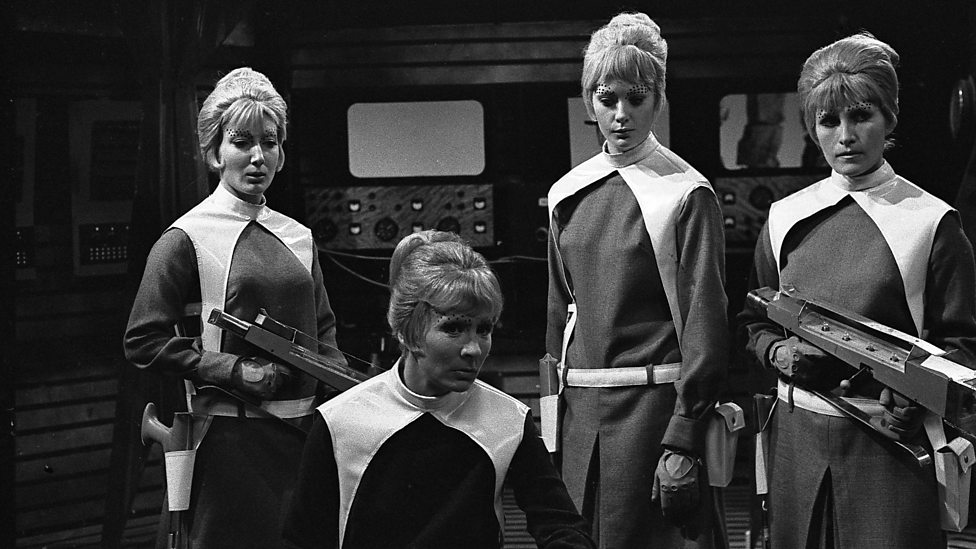 |
| The all-female Drahvin species - Female representation of warrior women with agency, or a blatant display of misogyny and male gaze combined? Call me demanding and ungratreful, but I'm definitely not relating that much to being represented by 2D characters falling under the labels of 'dumb blonde' or 'callous+sexy+incompetent+egotistical leader', and the portrayal of a female species that's defined as 'misandric', 'emotionless' and 'violent' doesn't scream 'girl power' to me either 🙃🤨 |
Contrary to the Drahvins and their strawman misandrist (aka antifeminist) characterization, when I first watched 'The Daleks' Master Plan', I was very pleasantly surprised to see that Sara Kingdom was a female character that had actual agency, independence and badassery going on, and she was dressed in a non-sexualized and practical uniform, to boot, with pants and low-heeled boots and everything! So colour me incensed when I read about the male-gazey and regressive af way that the male script-writers and production members thought of her and talked about her (why are men 😣). Even though she ended up being a much more 3D and much less regressively portrayed female character, their initial idea of Sara is not that far off from the way they looked at the Drahvins, actually (the super beautiful and ruthless combo), and they also wanted to make absolutely sure to be crystal clear about how her agency, leadership and practical outfit didn't 'masculinize' her, but rather made her even 'more feminine' when contrasted with the - apparently naturally masculine - traits that are being in a leadership position ('don't worry, her voice still sounds feminine when she gives commands!') and, gasp, *wearing pants* 🙄 (click on pics or open in new tab for larger size):


2. Race matters: Blackface, yellowface and Hartnell's racism:
Matters having to do with
race, however, were the issues that were most of the time pretty much
literally ignored in these volumes, which honestly baffled me 😐 (other sites including information about the production of Doctor Who, such as TARDIS Wiki and, especially, TV Tropes, do tend to mention most of these instances, for example, if not always in an in-depth way). In
Classic Who we unfortunately see several instances of blackface,
yellowface and a stereotyped use of orientalism, and we can actually see all of these together in season 3: With Mavic Chen in 'Daleks' Master Plan', the Celestial
Toymaker in the serial of the same name, and Jano in 'The Savages'. In
spite of this, there's no mention of the obsolete (and problematic)
characterization of both Mavic Chen and Jano (as portrayed by white actors in yellowface (plus either blackface or 'blueface'), and blackface, respectively), and only a vague (stated at face value) mention of the
Chinese Mandarin costume and stereotyped characterization for the Toymaker (also played by white actor Michael Gough, although not in yellowface) (and let's also not forget that the original version of this serial also included a use of the N word in a nursery rhyme, still considered acceptable in the 1960s 😬). I find the way that these volumes literally ignored most of these issues - or neglected to be minimally critical of them in the scarce moments when they appeared - incredibly baffling, as it's something that current publications should certainly comment upon 😬.
 |
| Kevin Stoney as Mavic Chen in yellowface & blackface/'blueface' (left); Michael Gough as the Celestial Toymaker, dressed as a Chinese Mandarin (centre); and Frederick Jaeger as Jano in blackface (right). |
-On TV Tropes, Mavic Chen from 'The Daleks' Master Plan' falls under 'Yellowface' and 'Yellow Peril': "Mavic Chen has white hair, dark skin, and epicanthic eyefolds. Though this does not come up in the story, Chen represents a future where racial distinctions do not exist (...) In the script, he's even described as "part-Oriental" (...) Some eyewitness accounts claim that he was actually in blueface". None is this is mentioned in Volume #06.
-On TARDIS Wiki, regarding 'The Celestial Toymaker', it is mentioned that "the word "celestial" is itself an old slur used to describe the Chinese.
"The Celestial Toyroom" could therefore be the first episode of Doctor Who
to include a slur in its title. However, "celestial" can also be used
to refer to something relating to outer space (which is where The
Toymaker is from)." In Volume #07, only the fact that Gough's Toymaker is (for some reason) dressed as a 'Mandarin', is mentioned.
-Both TV Tropes and TARDIS Wiki address a very problematic inicial idea for 'The Savages' (even 'for the time period'), and this is only very vaguely mentioned in Volume #08: "The advanced race was originally supposed to be played by actors in blackface (the story's original title was "The White Savages") as a parable about apartheid era South Africa. This got dropped except for the city's leader Jano. Given that it would have given us a race of black-skinned baddies and white-skinned goodies, this could well be viewed as a good thing." Indeed 😬.
 |
| Anneke Wills as Polly Wright (right), and Michael Craze as Ben Jackson (left) |
Volumes #07 and #08 do comment on how Anneke Wills (Polly Wright) and Michael Craze (Ben Jackson) clashed with the very conservative mindset of First Doctor's actor William Hartnell, and especifically with his very blatant racist views, with a quote from Craze stating that Hartnell's racist stance made them both very 'uncomfortable and ashamed', while Wills stated a similar sentiment about Hartnell's very old-fashioned views (see screenshots below at the end of the post).
One particular instance of
this racist mindset, however, is never specified in this volume, and it
was Hartnell's overt opposition to the casting of black actor Earl
Cameron as astronaut Glynn Williams in 'The Tenth Planet', and then his
unprofessional and deeply racist attitude towards him during filming,
according to both Wills and Craze. Cameron was the second black actor
with a speaking role in Doctor Who (the first one being Elroy Josephs as the stereotypically-named and stereotypically-portrayed pirate Jamaica in just the former serial, 'The Smugglers'), and one of the first black actors to
play an astronaut on television. Volume #08, which discusses 'The Tenth Planet', mentions nothing about any
of this, and the breakdown of the serial doesn't really talk about Earl Cameron at all, when I
think that his role is very much worth noting regarding representation,
at the very least, and he would definitely have deserved to be featured in this particular volume alongside the members of the cast and crew who are typically featured at the end of the discussion and breakdown of each serial 😕. He was the obvious choice for this serial's feature, in my opinion.
 |
| Earl Cameron as astronaut Glynn Williams in 'The Tenth Planet' |
Doctor Who magazine 520 (January 2018) featured an interview with the late Earl Cameron, who was then 100 years old, and he commented on the continuous racism that he had to put up with in the film and TV industry, including Hartnell's unprofessional and racist attitude towards him (a non-stop racism that he had learned to live with because there was no other option, so people shouldn't take his words in the interview as any kind of leniency for Hartnell's attitude 😬). There was literally no reason why volume #08 of this collection (2016) didn't mention any of this, seeing as these books feature most important details about the cast and crew, pre-production, production, post-production, publicity, audience reactions and merchandise about each serial:
.png)

3. Discussing these issues is important for any time period:
And
to conclude, why do I think that all this is so important? Because women, BIPOC people,
queer LGBT+ people, and other minorities have been forced to stay silent
about their discrimination and discomfort in the workplace (and other
areas) for decades and centuries, and it's high time that any
informative book talking about the production of a series (or about any other topic) were
completely transparent about these issues - and also, yes, critical
about it, because it's important to be critical of inequality even when
contextualizing said inequality 'in its historical time', and 'it was
how things were done back then/it was a different time/generation' is no valid excuse - Many of these issues
are still happening today, so not talking about them in the past is
making the present worse because the silencing and discomfort, and the
privilege and discrimination and inequality are still going on in most cases, unfortunately, and in too many cases it's still happening in a worryingly similar level. Not being critical of discrimination, anywhere and in any period where it may appear, ensures that a system will continue to legitimize and normalize said discrimination, till it becomes so commonplace we don't even question it.
I feel that the account in these volumes was often sugarcoated, whether consciously or not, by not mentioning many of these issues, or simply by describing them at face value. But hopefully this will not be a trend of the full collection!

And finally, here's some screenshots from the books tackling some of these issues (find them sorted under topic, and click on the pic or open new tab for a larger size, as usual):
- The Drahvins from 'Galaxy 4' are repeteadly described as the both male-gazey and misogynistic combo of "sexy, blonde women" who are "emotionless and callous" in a very "unfeminine" way 🙄😑. Never was a fan (understatement of the year) of the trope that goes 'when women have ostensible power and agency in a species/society, they have to be misandric emotionless machines in a matriarchal society that's the same as a (standard, normalized) patriarchal society, but reversed' - This trope serves as good misogynistic propaganda, but also make them super sexy for the male gaze 😑! (And the fact that it was Verity Lambert's idea to make the Drahvins female doesn't mean that men didn't also write them following this very sexist trope, btw, expressing enthusiasm about working with 'beautiful blondes' instead of providing actual representation). Also, interesting that one aspect of their unfeminine ways is their (romantic) disinterest for men, lol 🙄.


- On Vicki, Dodo and Katarina's companion exits, and the off-screen treatment of Maureen O'Brien:

 |
| Katarina deserved way better too, tbh. |
- Miscelanea: Thanks to Mrs Stroud for keeping the Daleks in Doctor Who 😄

- About Polly and Ben: Featuring more male gaze, with Polly being thought of as a 'pretty and trendily dressed' young woman that would "hopefully attract the dads" as one of her main functions (ew 😖). A female (sigh) member of the public additionally commented on how Polly should be the one doing the housechores in the TARDIS, because she's the woman in the team, and how she's also failing as a woman because her more assertive, trendy characterization would makie more 'more inept at sewing, cooking and cleaning' (wtf 😵) (this line of thought of Polly being the one who should be cleaning the TARDIS was actually brought up as one of the instances of lampshaded 60s misogyny featuring the episode 'Twice Upon a Time' in New Who).
 |
| Why are men, am I right? |


 |
| Polly was much, much more than "a pretty girl for the pervy dads" (ew)! |
- Hartnell's racism, via statements from Anneke Wills and Michael Craze: Both actors talked on several interviews about their strained relationship with William Hartnell, and especially because of his conservative, 'old-fashioned' mindset. They especifically commented on how Hartnell's overt racism made them uncomfortable and ashamed, especially regarding Hartnell's treatment towards black actor Earl Cameron, who worked with them in 'The Tenth Planet'. And like I similarly said above, if Wills and Craze in the 60s were against Hartnell's racist views - why do people excuse the lack of criticism for 60s racism today with 'it was another generation/time'? Nope, there are people who endorse racism (or misogyny, or any other kind of discrimination) and people who don't, everywhere, in every period. And being always critical of it whenever it may appear ensures that the system doesn't uphold any kind of hate speech or discrimination as blatantly as it tends to happen when it becomes commonplace and normalized :S.


 |
| Polly and Ben be judging, rightly so |