Showing posts with label Ártemis-Diana. Show all posts

Sunday, 6 August 2017

Goodreads feminist reviews - Four Greek myth adaptations

Today's review post is about four books with adaptations of Ancient Greek mythological tales in the Spanish Anaya collection 'El Sendero de los Mitos'. The individual reviews can be found in my Goodreads account.  

Warning (kinda): Long post! Also, heavy criticism of Ancient Greek misogyny.

For all four stories:
+1 The version is engaging and enjoyable to read.
+1 I really like the way this collection is illustrated with colour and black-and-white renditions of original Greek art.

1. Atalanta, la de los pies ligeros: 5/5. Review on Goodreads here.


+1 Story revolving about the feats of the huntress and warrior woman Atalanta. Goddess Ártemis and her nymphs also make an appearance.

+1 Feminist content in this version, both narrator and plot: 

-Female bonding and criticism of Greek misogyny: Ártemis curses men for abandoning female children to die in the wild: 
"-(...) ¡Oh, Ártemis, qué crueles son los hombres!" ; "-(...) lo considero como una ofensa personal. Maldito sea el padre que desprecia a su retoño por ser mujer. No se saldrá con la suya."

["(...) Oh, Ártemis, how cruel men are!"; "(...) I consider it a personal insult. Cursed be the man that despises his offspring for being female. He will not get his way."]

-Amazon feminism regarding Atalanta and her warlike and huntress prowess:
"no sólo vencía a las mujeres, sino a los hombres, y no a cualquier hombre, sino a los mejores y más rápidos de su época. Y no sólo eso: además de correr como un gamo, (...) manejaba el arco y la flecha como nadie. (...) se hizo fortísima, y conocía la selva (...) mejor que nadie (...) cuán extraordinaria había de ser la habilidad de Atalanta para que toda Grecia estuviera pendiente de ella".

-Ancient Greek misogyny and gender roles are criticized more than once:
"Naturalmente, estas cualidades - excepto la de la belleza -no se explicarían si Atalanta se hubiera criado como el resto de las niñas de su época, dedicada a las faenas tradicionales de la mujer"; "En aquellos tiempos -como en los de ahora -algunos hombres eran así, extraordinariamente brutos, y creían que una mujer no puede hacer la mayor parte de las cosas que hacen ellos. (...) con un padre así, los problemas no podían tardar mucho"

-1 Emotional dependence and the 'taming of the shrew' cliché: In spite of her misogynistic and abusive father, Atalanta stills wants to gain his approval :/ ("demostrando que ella valía tanto a más que un varón, esperaba que su padre comprendiera su error, y la reconociera por fin como hija suya. (...) [Atalanta no quería casarse] mas, como tampoco quería contrariar a su padre, cuyo amor tanto le había costado conseguir (...)"). 
 
She also ends up being forced and tricked into marriage with a man. Although it's stated that she kept on hunting and stuff with him (woah, thank you nice guy!), she has to end up in a traditional heteropatriarchal marriage even though she had the intention of never marrying ("Atalanta no quería casarse por nada del mundo").

-1 The problematic myth of 'virginity' as undertood by a patriarchal society, and of Atalanta having the obligation to remain 'a virgin' because she was a follower of Ártemis (as opposed to saying that she was simply not interested in men and/or preferred to remain unmarried to retain her freedom in such a restrictive society). Of course, the misogynistic Greeks thought that the logical alternative of not being married in their heteropatriarchal system was to remain 'chaste' and 'a virgin' (a concept which is also extremely heteropatriarchal), without even considering all remaining options.

-1 Goddesses going against women - Ártemis seems keen to protect Atalanta in key moments, but seems to ignore her when she's tricked into having to get married, for example (also, the concept that Ártemis also cares for the 'virginity' of her followers is nothing but deeply patriarchal). Aphrodite helps Atalanta's future husband to trick her into getting married. Cibele punishes Atalanta (and husband) for entering her temple (in other version, it's Aphrodite, who's apparently offended because Atalanta didn't thank her for the gold apples that tricked her into getting married - which is just ridiculous).

  • Feminist infographic:
-Number of women (named): 5- Atalanta, Ártemis, Aphrodite, Cibele, Atalanta's mother Climea
-Other women (unnamed): Ártemis' retinue of  nymphs
-Bechdel: Yes
-Female bonding: Yes (and no, see above)
-Proactive female characters? Empowered traits in at least one female character?:  Atalanta is a huntress and athlete. Ártemis is a huntress goddess.
-Subversion: Atalanta defies and subverts traditional gender roles
-Problematic stereotypes or relationships?: Myth of virginity. Atalanta being tricked into marriage. Atalanta's emotional dependence when seeking her father's approval.


2. Los trabajos de Hércules: 3/5. Review on Goodreads here.

-1 As is the usual norm with Greek myths, there's quite a lot of sexism and misogyny around
I gave this tale a 3/5 instead of a lower rating, though, because, even though the misogyny content is still significant (although lower than in other tales in the collection, such as Apolo's sexual harassment of Daphne, or Helena being seen as the ultimate downfall of Troy), I find this tale to be more adventure-driven and more engaging to read.

+1 Appearance of the Amazons, who in this tale seem not to be described in an overly negative light - as is usually the case of Ancient Greeks, who saw the (originally Steppe) warrior-women as a threat against their patriarchal order and tended to demonize them as much as they could in their myths.
-1 However, in this tale the Amazons are probably not demonized as much because Hippolyta and many Amazons's main role in the plot is to admire Hercules's feats, so much that they're surprisingly compliant when it comes to handing him over Hippolyta's belt. This part of the story also includes the male hero battling the Amazons and acquiring the belt by force later on, so it can also be seen as a male fantasy where the strong male hero defeats the warrior-women who threaten patriarchal order. So the Amazons are not seen in such a good light after all - their main function here is to uphold the male hero's supremacy, and they're also seen as another monster that the male hero has to battle.

+-1 There are, of course, no main female characters, but, apart from Hippolyta and the Amazons, a handful of goddesses make an appearance - Hera, Athena and Artemis, mainly.

-1 However, they are either seen in a bad light (Artemis, Hera) (and so, they're the baddies who oppose our male hero), or, once again, they are used mainly as a means to help the male hero and uphold his supremacy (Athena) (and the gods (xD) know I hate the trope where empowered female characters are just in the story to help men with *their* issues).

Ártemis antagonizes the male hero and is described as "the most vengeful of gods" (which I highly doubt, seeing the excellent options we have with many other gods, especially the male ones, who will destroy your everything if you reject them sexually, for example). In the Ártemis scene, Apollo, the serial rapist and vain entitled brat extraordinaire, is not given any negative comment even though he threatens Hercules alongside his sister (double standards ftw!). 
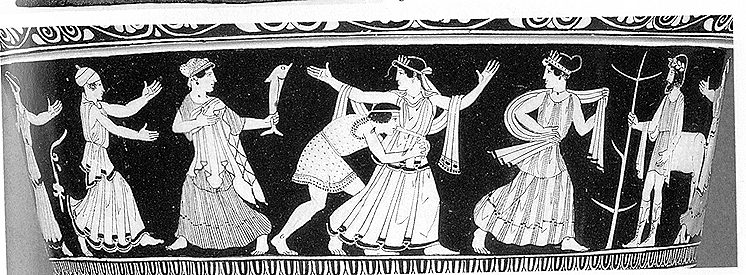
Also note how our dear patriarchal Greek dudes choose to give Ártemis a head-covering in this particular depiction! To the unmarried wlw huntress goddess who gives zero f*s about patriarchal modesty mindsets and gender norms!   
 
Meanwhile, Hera is constantly antagonizing Hercules as a way to get her revenge from Zeus cheating on her with Hercules' mother Alcmena - and yes, she's seen as the 'villain' of the story, the baddie who goes against the male hero, because her husband is a serial cheater and rapist. But she's the bad guy in the equation, of course! (double standards ftw!) (of course, it's also a patriarchal sign that Hera would choose to rain misfortune on the women Zeus harasses and the children they end up having instead of just kicking Zeus' ass and becoming the independent sky goddess she was before patriarchy destroyed Pre-Hellenic goddesses' lives).
Athena and Hera looking 100% done about all those entitled men they have to put up with
 
And then there's Athena, one of the most empowered Greek goddesses, the warlike goddess of wisdom and strategy...who, as is the norm in these patriarchal myths, instead of doing awesome empowered stuff, usually spends whole stories just assisting the male heroes. This version's narration also comments how she does it partly because she is against Hera for some reason or other (yay female bonding) ("Pero allí estaba Atenea, que sin duda debía tener alguna cuenta pendiente con Hera, cuando tanto se empeñaba en ayudarlo"), and how Hercules' reaction to her help is often to dish out compliments to her ("most beautiful Athena", which is certainly the best compliment you can give the goddess of strategic war, wisdom and crafts! Keep it simple!). Also yay to Athena's glorious OoC reaction - the goddess who quite literally shouldn't give a d*mn what men thought of her (not only because she's like 0% interested in them, but also because she'd probably feel offended that they chose to focus on her appearance), feels oh so flattered and probably decides on the spot that she's going to keep on helping the male hero because her priorities are now 100% fulfilled - She's doing it because she's against another goddess, because she's supporting her father's son (who is not only a cheater, but swallowed up her mother because of MRA fears, so you know, so much respect), and now bonus points if said half-brother showers her with positive (and creepy) comments on her appearance! So thank you, Ancient Greeks, for wrecking a perfectly awesome character in so many of your tales.
This depiction pretty much sums up all my rant about Athena and Hercules, actually xD Also, I'm eternally fascinated by the fact that men can walk around with their junk hanging out (and no one assaults them), but the actual goddess of war and strategy is always wearing ankle-length layered tunics.
  • Feminist infographic:
-Number of women (named): 7- Alcmena, Hera, Athena, Ártemis, Admete, Hippolyta, Rhea.
-Other women (unnamed): Amazons
-Bechdel: No 
-Female bonding: No
-Proactive female characters? Empowered traits in at least one female character?:  Ártemis and Athena are warlike goddesses, but all they do is either help or oppose the male hero, so not really. Same with the Amazons.
-Subversion: Not really. Maybe the appearance of the Amazons, who do subvert traditional gender roles.
-Problematic stereotypes or relationships?: Ártemis as 'the most vengeful of gods'. Hera as the baddie who opposes Hercules because her husband cheats on her (but she's the evil one). Athena only there to help the male hero.

3. Helena y la guerra de Troya: 2/5. Review on Goodreads here.

-1 I don't like the inherent misogyny of this mythological tale. I usually give The Iliad a very high rating because it's so well written, even just judging from a translation, but the patriarchal values and misogyny present in the tale merit a heay criticism from a feminist point of view
 
Ancient Greek women are incredibly subjugated, and in this case we also have, with Helen, the infuriating sexist cliché of the woman as the 'home-wrecker', 'bad wife' and 'femme fatale' who brings about the downfall of men and cities because of her beauty and lack of 'fidelity' (such a nice way to excuse the way men can't stop themselves from being violent against women, and from objectifying them). This misogynistic topic sadly appears in many tales and myths as well (Deirdre, Isolde, Gráinne in Celtic myth, for example - although these women are allowed a bit more agency and strength than the deeply subjugated Greek women). I personally see Helen as a clear victim of Patriarchy, forced with dubious consent into a traditional marriage with Menelaus and then used by the equally sexist and entitled brat Paris - and while she is clearly oppressed by both men, who control and objectify her, it is she who is seen as the 'evil one' in the equation ("[Menelao] tiene derecho a matarte. Le has hecho sufrir tanto..."), something which of course suits Patriarchy and men very much.

-1 I'd also like to reference the mentions in the text and depictions in the illustrations to the Greek misogynistic modesty mindset and the head-and-body-coverings women usually had to wear, very similarly to all religious-based gendered coverings of today. Helen is described as veiling and covering herself to go out, and depictons of veiled women and women with head-coverings are to be found in all four books in this collection. See here for more about this issue.


Apart from the portrayal of male violence against women here, see again the fascinating double standard regarding clothing: While women are nearly always wearing ankle-length tunics with most of their body covered, and have to cover themselves with veils,mantles and practically burkas when going outside, men are allowed to wear little clothing with no problems whatsoever - even frankly illogical situations like having their genitalia out when in armour because I don't know, fragile masculinity issues, needing to flaunt their junk in front of their pals? *facepalm* And no one assaults men in these stories for that! I know, it's crazy!
  • Feminist infographic:
-Number of women (named): 4- Helen, Leda, Clitemnestra, Aphrodite
-Other women (unnamed)
-Bechdel: No. Helen talks about Clitemnestra, but about men, so doesn't count; and Aphrodite opposes Helen in a sexist way and it's also about men, so nope either.
-Female bonding: No
-Proactive female characters? Empowered traits in at least one female character?:  Helen tries to get away from her restrictive position, but gets another similar situation with an equally problematic man. So not really :/
-Subversion: No
-Problematic stereotypes or relationships?: Abusive, controlling and problematic relationships (Helen with Menelaus, Helen with Paris). The misogynistic stereotype of the woman as the 'femme fatale' and 'home-wrecker' who 'causes wars'.

4. El laurel de Apolo: 1/5. Review on Goodreads here.

-1 As is the usual norm with Greek myths, there's quite a lot of sexism and misogyny around - In this case we have topics from sexual assault, to victim blaming, to societal pressures to marry and have children.

-1 I especially dislike this tale because it deals with the bratty entitled serial rapist Apollo, who stalks, sexually harasses and tries to assault the 100% unwilling poor nymph Daphne. This version seems to sympathize with Daphne (as it should logically happen), but that is actually not the case of other versions I have read - in some cases, the whole issue is referred as 'tragic romance', claiming that Apollo was 'in love', so poor Apollo, and I don't know in which universe you can call sexual assault 'romantic' and 'being in love' in any way. Especially given that Daphne has to get literally dehumanized and turned into a tree in order to get Apollo to leave her alone.
 
This version, following the original, is full of problematic and potentially quite triggering aspects having to do with Apollo's male entitlement, and stalker-harasser-rapist mode.

-1 I also deeply resent that they somehow try to justify, in this tale, the explicit sexual harassment and assault, by saying that Apollo could not contain himself because he had been struck by Eros' 'love' arrow. Of course, let's keep on promoting the fact that men 'can't control themselves' so we should let them keep on harassing women. They also try to explain Daphne's distaste and fear not because she is logically afraid and repulsed by the rapey Apollo, but rather because Eros has also struck her! With a 'hate arrow' of sorts! Yay patriarchy trying to justify sexual assault everywhere!
It's not harassment and sexual assault if they're being controlled by 'love' and 'hate' arrows! Misogynistic assholes justifying and glorifying rape culture since forever. Also misogyinistic jerks getting off on portraying violence against women since forever :/ (Cornelis de Vos, Apollo Chasing Daphne)

-1 And it's not just about the arrows, it's actually Daphne's fault that people harass her, really! It's totally Daphne's beauty that's to blame, obviously! ("-Eres demasiado hermosa como para que te dejen en paz. Un buen marido te daría el sosiego y la seguridad que necesitas"; "la belleza de Dafne no dejaría de acarrear consecuencias"
It's Daphne's fault for being beautiful, being alone in the woods and not wearing a burka! 

 -1 Daphne's father keeps pressuring her daughter and tries to guilt her into marrying and giving him grandchildren ("-(...) si no por tu propio bien, deberías casarte por respeto a tu padre, que bien merece, en su ancianidad, el premio de ver a sus nietos"), even though she repeateadly states that she wishes to remain unmarried, thank you very much ("-No lo quieran los dioses (...) Sólo de pensar en el matrimonio se me ponen los pelos de punta. No, yo quiero vivir siempre como vivo ahora, y no permitiré que nadie se me acerque") (and given that men usually pounce on you trying to assault you in these tales and also in real life in too many cases, I cannot but totally understand her choices).

-1 I also find it...interesting that when Daphne is being pursued by Apollo, keen on assaulting her, it's her father who 'comes to her aid', and by dehumanizing her - Ártemis was said to have a liking for the nymph earlier in the story, why didn't she help her? Especially given that the attacker is her brother?? Like, she should have been angered and upset?? Why do the Greek people keep wrecking Artemis' character by turning her into a vengeful goddess who doesn't actually care about women in too many instances? And why did Peneus think that the only way to save her daughter was to dehumanize her, couldn't he have done something else? I get it that he's a lower god against an Olympian, but I don't know, do some water tricks or whatever! Distract him so she can escape! And if you can change her to a tree, surely you can also give her super speed or invisibility powers or whatever so that she can safely escape! Her end is also so sexist :/

  • Feminist infographic:
-Number of women (named): 2- Daphne, Ártemis
-Other women (unnamed): Nymphs
-Bechdel: No
-Female bonding: No
-Proactive female characters? Empowered traits in at least one female character?:  Sadly, no.
-Subversion: No
-Problematic stereotypes or relationships?: Sexual assault and harassment issues. Father trying to guilt her daughter into marriage.

Sunday, 30 August 2015

Madrid National Archaeology Museum: Greek gender roles and female invisibility

Ancient Greek women doing house chores (author unknown to me)
A couple of days ago I visited the local National Archaeology museum again, so today's post will be about Ancient Greece, and I'll be writing about the intense gender inequality of ancient Greek society, mostly by commenting the exhibit quotes and descriptions.

 The exhibit descriptions seem to have been written, in general, with the aim of critisizing the intense misoginy and strict gender binary of the ancient Greek society - Which is a good thing, sexism in history should be taken into account and critisized way more often. Especially when we're dealing with a society that's often way too romanticized and where women were recluded to the home, stripped of practically any human rights and relegated to the traditionally 'feminine' roles of house activities, making themselves beautiful for their husbands, and child-bearing. 

But of course, nothing is perfect: The first thing I'd like to critisize about the Greek area of the museum is that there are some examples of sexism by omission in the Spanish versions of some of these descriptions, by referring to the whole of humankind with only male terms: 'Man' vs 'Human', two words which shouldn't be synonyms. 'Man' used in this context is exclusive, seeing as there's no mention of women in the wording. Also, they take gender into account, which isn't necessary, either (the term 'human' doesn't include a gender connotation) - Not only is this excluding women, but people who identify as agender, non-binary and genderqueer as well. And lastly, it introduces ambiguity, because sometimes 'man' used in this context could be read as 'male' - and in a description about gender roles, ambiguity is even the more probable.

Sexism by omission and sexist language: The problem of  'man' as a general term (Source
Another thing I'd like to comment about the Greek exhibit descriptions is that sometimes the texts don't seem to critisize the misogynistic and gender biased aspects of the society as strongly or non-ambiguously as I think they should, and this could be problematic. Given that some statements seem to be written in a purely neutral way, or simply devoid of any direct criticism, they could be interpreted quite literally by people who don't exactly come to the museum to question their patriarchal-based and gender-biased upbringing. Like another blogger said here, people could easily read quotes such as 'I am grateful for being born a man and not a woman', displayed devoid of connotations against the inherent sexism of the quote, as a continued assertion of male superiority rather than as a feminist criticism of the sexism among the Ancient Greeks. In these cases, I think we need direct criticism, not subtlety.  

  • The sexism of the Greek gender binary
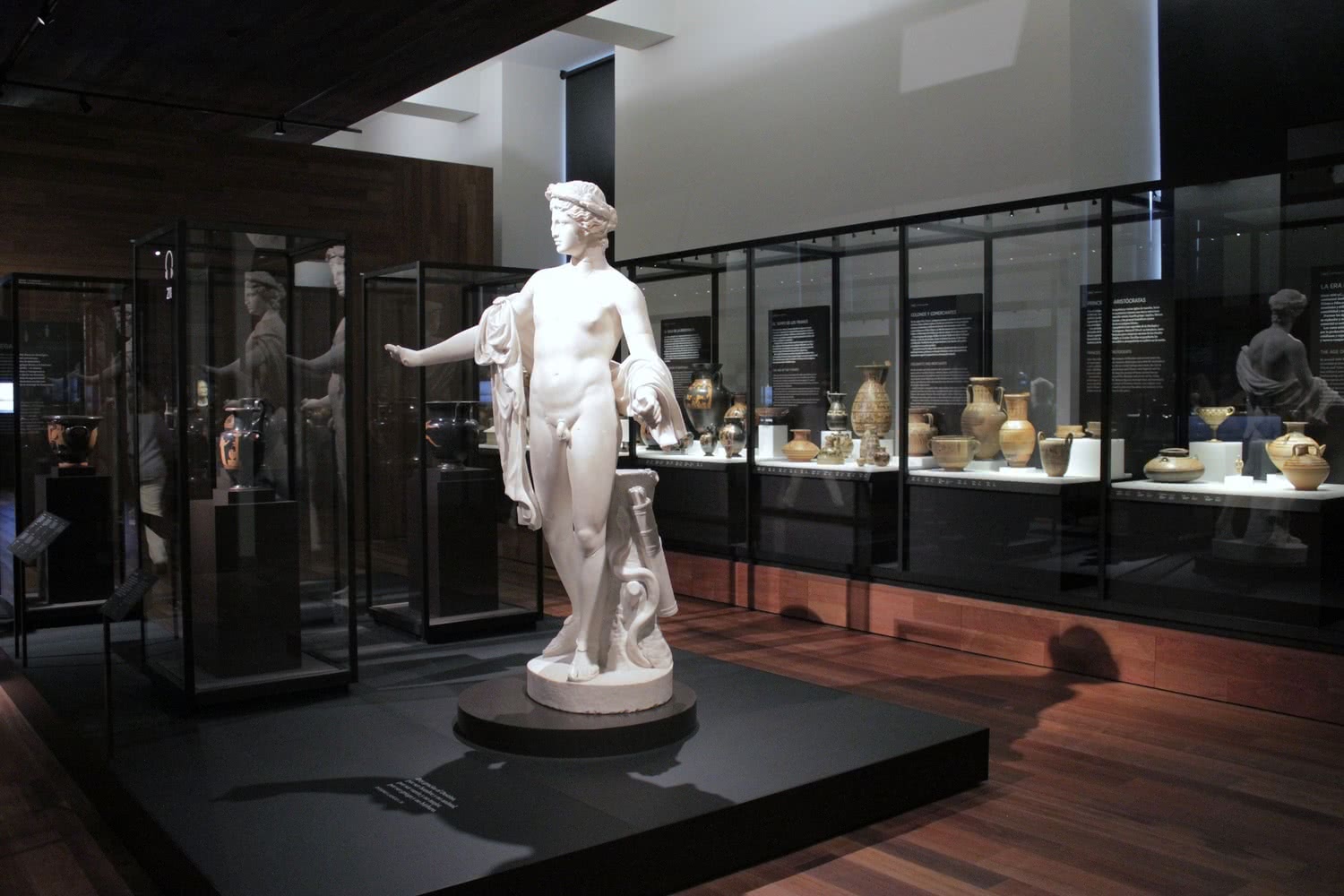
Entering into the Greek section of the museum, we are greeted by a statue of Apollo accompanied by this quote (translation below):

"Doy gracias al Destino,
por ser hombre (un ser humano) y no animal,
por ser varón y no mujer,
 por ser griego y no bárbaro
 (Diógenes Laercio I, 34)"

(Sobre la tradución española: La palabra 'hombre' es usada incorrectamente en lugar de 'ser humano', ejemplo de sexismo por omisión en el lenguaje. Además, en el original griego se diferencia entre 'humano' (ἄνθρωπος, "ánthropos"), la palabra usada en esta cita, y 'varón' (ἀνήρ, "anḗr"). En la traducción inglesa (ver abajo), se traduce correctamente como 'human being'. 

Por otro lado, la referencia a la obra está inacabada: Vida de los filósofos más ilustres, I, 34)

"Hermippus in his Lives refers to Thales the story which is told by some of Socrates, namely, that he used to say there were three blessings for which he was grateful to Fortune: "first, that I was born a human being and not one of the brutes; next, that I was born a man and not a woman; thirdly, a Greek and not a barbarian." [34] "

(Source: Tales de Mileto (ambiguo) citado por Diógenes Laercio en Vida de los filósofos más ilustres I, 34 /Thales of Miletus (ambiguous) quoted by Diogenes Laertius in Lives of Eminent Philosophers, I, 34)

And the Greek original:

Ἕρμιππος δ᾽ ἐν τοῖς Βίοις εἰς τοῦτον ἀναφέρει τὸ λεγόμενον ὑπό τινων περὶ Σωκράτους. ἔφασκε γάρ, φασί, τριῶν τούτων ἕνεκα χάριν ἔχειν τῇ Τύχῃ: πρῶτον μὲν ὅτι ἄνθρωπος ἐγενόμην καὶ οὐ θηρίον, εἶτα ὅτι ἀνὴρ καὶ οὐ γυνή, τρίτον ὅτι Ἕλλην καὶ οὐ βάρβαρος. 16 [34] (Source)

Alongside the statue of Apollo and this magnificently narrow-minded quote, a gem from ancient times indeed, we find texts seemingly critisizing the quote by commenting on 'men', 'women' (both the traditional role and the antithetic role of the Scythian Amazons in 'mythology'), 'animals', and 'foreigners':

"El hombre:
El varón define su identidad a través de conductas que entiende como virtudes. Debe ser agresivo, competitivo, autocontrolado, sociable y respetuoso con los dioses, excelente en suma. Los inmortales, espejo del comportamiento masculino, encarnan estas virtudes en su más alta expresión."

"Men:
The male defined his identity through forms of behaviour which were regarded as virtues: He was supposed to be agressive, competitive, self-disciplined, sociable and respectful to the gods. In sum, he was to be excellent. The immortals - the mirror of male conduct - embodied these virtues in their highest form of expression."


"La mujer:
El mundo femenino representa una amenaza, podría subvertir el orden del varón. La mujer se concibe como irracional y caótica, un ser que se deja llevar por sus impulsos y emociones. Necesita ser socializada a través de la educación y el matrimonio. Sólo el hombre puede inculcar los valores de la femineidad domesticada. Es el contrapunto social."

"Women:
The female world represented a threat, something with the potential to undermine the order of men. Women were regarded as irrational, deranged creatures who allowed themselves to be carried away by their impulses and emotions and had to be socialized through education and marriage. Only men were equipped to inculcate the values of domesticated femininity. Women were the social counter-model."


"Las Amazonas:
Mujeres guerreras que viven en los confines orientales del mundo, las Amazonas rechazan vivir bajo el dominio masculino. Representan la alteridad absoluta frente a la mujer sometida y a la convivencia ordenada de la sociedad griega. Son mujeres salvajes y bárbaras. Son el contramodelo mítico."

"The Amazons:
The Amazons were female warriors who lived at the eastern ends of the world and refused to live under male domination. They represented absolute otherness, the opposite of domesticated women and the orderly coexistence of Greek society. Wild and barbaric, these women were the mythical counter-model."


"The scene depicts the struggle between Theseus, the young Athenian hero, and Hyppolita, Queen of the Amazons. During the years of Pericles' government, this legend was used to simbolize the triumph of civilisation, embodied by Athens, over savagery."

I choose to read phrases such as 'wild and barbaric', 'the orderly coexistence of Greek society' and 'the triumph of civilisation over savagery' as sexism that it's being critisized, but it's highly ambiguous and very poorly worded and expressed, with the problems I was talking about at the beginning of this post: People who don't come to the museum to question gender roles and sexist mindsets could perfectly interpret phrases such as these as not being critical at all, and could exit the museum thinking that 'Yes, the Amazons were wild, barbaric women because they didn't want to obey or be with men, in the orderly Greek society (because gender roles are traditional, have been there for centuries, and rock my socks), and that makes them barbaric and savage. Also, they're wild and barbaric because they were warriors, which is a monstrosity because women aren't supposed to be warriors, dude! They should be having children and staying at home like the civilized and orderly Athenian women!'   Don't tell me we don't have way too many individuals in our modern 'orderly society' who still think like this.
  • Daily life and gender roles:
Ancient Greek women and traditionallly 'feminine' roles: Weaving and making clothes, keeping beautiful for the males (Author unknown to me).

Most of the exhibits were focused on daily life and the often rather ambiguously critisized gender roles having to do with education (the men's world), feasts and parties (the men's world), the home (the women's world), marriage (the women's world, and the turning point of her 'career'), children (the women's world) and death (more or less gender neutral, although the women are the ones who should be lamenting). And like I said before, the descriptions are generally either purely neutral, seemingly critical but ambiguosly worded, and, only sporadically, directly critical.

 This more feminist approach can be found at the very end of the exhibition, at the 'touching objects' area (which is also aimed towards blind people), and very clearly reads "Female invisibility vs Male visibility":

(Female invisibility/ male visibility)


"Las principales actividades de la mujer ateniense tenían lugar en el ámbito del hogar. Bajo la tutela del esposo, después de haber estado bajo la de su padre, se encargaba del gobierno de la casa y de la educación de sus hijos mientras eran pequeños. Rara vez salía del hogar.

Como contrapunto, y frente a esta invisibilidad social de la mujer, el hombre participaba plenamente en la vida pública. Recibía ya desde la infancia una esmerada educación, participaba en el gobierno y en la defensa de la ciudad y podía relacionarse con sus iguales en el gimnasio, el ágora o el banquete, ámbitos específicamente masculinos."


My (free-ish) translation:
"The main activities of the Athenian woman took place at home. First under the guardianship of their fathers and then of their husbands, they were supposed to take care of the house and of the children's education while they were young. They seldom left the house.

As a counterpoint to this female invisibility, men took an active and full part in public life. They received from their childhood a thorough and careful education, participated actively in the government and the defense of the city, and were able to socialize with their equals in the gym, the agora or during feasts, all areas which were exclusively masculine."

Now, I think this is adequately worded as being informative and historically objective, but also critical ('female invisibility', 'male visibility', 'they seldom left the house', 'as a counterpoint men took an active part in public life', 'were able to socialize with their equals',...). This doesn't give the ambiguous vibe that maybe gender roles are cool and acceptable because it 'the ways things were (and are)' and 'part of an orderly society'.

More excerpts from the gendered Ancient Greek daily life shown in the exhibit

"El banquete:
Las relaciones sociales de los varones griegos giran en torno a la bebida en común, la fiesta del simposio. Dentro del ocio colectivo masculino, el simposio reúne a varones de una misma clase social para compartr amistades, intereses y placeres. (...) Las reuniones se prolongan hasta el amanecer, entre cantos, poesías, charlas de filosofía y política. Las heteras, cortesanas, amenizan el banquete. Ellas son también parte del ocio masculino. (...)"

"The banquet:
Social relationships between Greek men revolved around drinking in fellowship, at the symposium.  Part of the male collective leisure activities, the symposium gathers men of a same social class in order to share friendships, interests and pleasure. (...) The reunions go on until dawn, amid songs, poetry, philosophy chats and politics. The hetairai, courtesans, liven up the banquet. They are also part of men's leisure."
Greek  men at a party, entertained by high class female prostitutes (hetairai), dancers and musicians. 'Free' and 'respectable' women were not allowed to take part in these feasts at an equal level, the sole role of women in Greek feasts was to entertain and serve men, catering to their every pleasure (Author unknown to me).

"La buena esposa conviene que mande en los asuntos de puertas adentro de la casa...sin prestar atención a los asuntos públicos...Una esposa de vida ordenada debe considerar que las normas de su marido le han sido impuestas como ley de su vida."
                                       (Pseudo-Aristóteles, Económico, 140-1, Rose)

"A good wife must only govern those matters from within the home...without minding public affairs...A wife with an orderly life must take into account that the rules of her husband have been imposed to her as an inevitable fact of life."

"La boda:
La boda es el rito de iniciación a la vida adulta para las mujeres griegas y la consolidación de su destino social. Representa el abandono de la infancia, de su estado de doncella, y el ingreso en el mundo ordenado y reglamentado del varón. Su papel será dar hijos legítimos y perpetuar la familia. Las etapas de la ceremonia escenifican este cambio: la ofrenda de los juguetes infantiles, el baño ritual, la espera y el rapto nocturno por el novio, el alegre cortejo en carro nupcial hasta su nuevo hogar, en el seno familiar del marido. Allí se despojará de su velo de pureza. El ajuar, la dote y los regalos materializan el lenguaje simbólico y el prestigio social del momento culminante de la vida femenina."

"The wedding:
Marriage was the rite of passage through which a Greek woman entered adult life and confirmed her future social fate. It represented the end of her childhood and maidenhood, and her induction into the rigid, orderly world of the male. The woman's purpose in life would be to bear legitimate offspring and ensure the family's continuity.
The different stages of the marriage ceremony enacted this transition: the offering of children's toys, the ritual bath, the wait and the bride's nocturnal abduction by the groom, the festive procession in a nuptial cart to her new home, where she would be surrounded by her new husband's family and the veil symbolising her purity would be removed. The dowry and wedding gifts expressed the symbolic importance and social prestige of this moment, the high point of a Greek woman's life."

The worrying ritual of 'abducting' the bride glorifies sexual assaults, violence against women and lack of equality in a relationship. The inspiration for this troubling and misogynistic ritual comes from the abduction and rape of the poor Goddess Tethys by the jerk and scumbag Peleus, a human who hasn't been taught anything about consent (we also know that a society is deeply patriarchal when not even goddesses are safe from being assaulted by male humans):
Because abducting and sexually assaulting a woman is so romantic, and something to glorify and to have as the ideal model for every wedding. Naturally.
"El mito de las bodas de Tetis y Peleo:
El rapto de Tetis en presencia de sus hermanas, las Nereidas, es el preludio de la boda más gloriosa de la mitología griega. (...) La imagen idealizada del mito, frecuente entre los regalos nupciales, se utiliza como referencia modélica para la novia ante tan decisivo tránsito (sí, muy "romántico" todo)."

"The myth of the wedding of Tethys and Peleus:
Peleus abducted Tethys in the presence of her sisters, the Nereids.  Afterwards the lovers (ahem...lovers??) celebrated the most glorious wedding in Greek mythology. (...) The idealized image of this myth, commonly featured on wedding gifts, was upheld as a model for the bride in this life-changing transition (oooh, I'm being symbolically abducted, it's soooo romantic!)"


"Las edades de la vida:                                 
El ciclo vital, desde su comienzo, el parto y la infancia, hasta el final, la vejez y el llanto por la muerte, son tareas de exclusividad femenina. La vida se gesta y se cierra en el oikos.
El cénit de la existencia en Grecia es la juventud. En ella se alcanza la más perfecta expresión de la femineidad y la masculinidad. Dos destino diferentes se diseñan para los hijos: la niña, ya mujer, regresará al oikos; el niño, ya hombre, se integrará como ciudadano en la polis
Las distintas etapas de la vida están marcadas por ritos de tránsito, protegidos por Ártemis y Apolo y regulados por códigos sociales y religiosos que sancionan los distintos grupos de edad y de género."

"The stages of life:
The circle of life, from childbirth and infancy to old age and the sorrow of death, was the sole prerogative of women. Life as conceived and came to an end inside the oikos.
In Greece, youth was the zenith of existence, the most perfect expression of femininity and masculinity. Two different fates were reserved for children: The girls, on reaching womanhood, would return to the oikos, while the boys were destined to become citizens of the polis on reaching manhood.
Each stage of life was marked by rites of passage, protected by Artemis and Apollo and governed by social and religious codes that distinguished each age group and gender."
  • Clothing


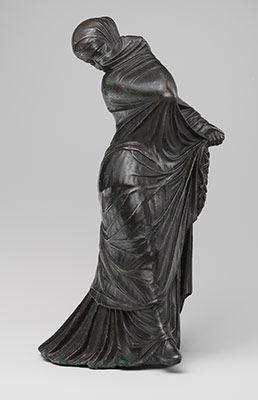
It's also worth mentioning that, while Greek male depictions are often of men with bare torsos, bare legs or fully nude, bare female torsos in the exhibit were pretty rare, mostly associated with female idols or the marriage section (the case of the female torso above). Greek women's clothing was actually very restrictive (patriarchal 'modesty' mindset acting as a way to control and repress women's autonomy and sexuality), something that many people, accustomed to seeing female nudes in Greek statues and idealized depictions of Greek fashion, may not be familiar with. Short tunics were only acceptable in places such as Sparta, ankle-length tunics were the norm. Hairstyles where the hair was partially or completely covered by a cloth or headscarf were also common (open hair or even loose strands were hardly worn), and women, especially married women, had to cover their head at least partially, and wrap themselves in an himation (mantle) when going outwhen they were actually allowed to be out, that is. Not dissimilar to the idea of today's burkas, the himation is 'a garment of decorous modesty' which disguised the shape of the woman's body in public, and which Hetairai also used as 'provocation' (in the same way veiling is used in 'exotic dancing' in the Near East).  This is quite a different idea from the idealized woman wearing the light tunic that we're so accustomed to seeing in Neoclassical and modern depictions of Greek culture, and not at all dissimilar from the religious-based head and body coverings typical of Patriarchal Monotheistic (and also polytheistic) religions. (There's a section on male and female Greek clothing in the pdf below)
Bronze statuette of a veiled dancer wrapped in an himation


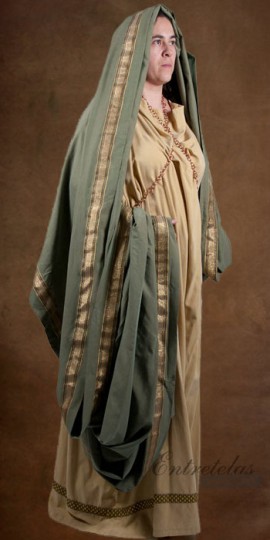
"The Himation is a kind of cape, which can cover the whole body, if necessary. Especially adult, married women use it to cover the head, the shoulders, and the shape of the female body in public. (...) The Himation is a sign of social status and morals, similar to the Palla used later by Roman women." (Source)
Interesting contrast between the men's freedom of clothing (they could have bare torsos, bare legs or be naked) and female clothing (ankle-length tunics and frequent use of headcloths and mantles worn over the head and wrapped around the body when out). (author unknown)
"Outside the house, the hair is always put up and made into a bun on the neck or the back of the head. Additionally, the hair is held back by a band wrapped around the head or by a bonnet/hairnet to keep the hair in place. Very few women are depicted with loose strands or even open hair." (Source)
Janet Stephens' Grecian hair tutorials show how the hair was often partially or completely covered by cloths, as part of Ancient Greece's modesty mindsets for women. Even if the hair was not covered by a cloth/headscarf/hairnet, women usually had to cover their hair with an himation when going out, and it was rare to have loose strands or open hair, as opposed to the idealized depictions that we are accustomed to seeing in statues, 18th and 19th Century art, and movies.


"Greek women were expected to fully cover their bodies. For instance, a woman would not gird up her chiton like a man and display her legs in public." (Source)


And to finish the exhibit, there were some images of the goddesses Athena and Ártemis as a refreshing change from these enslaved and embowered Greek women. Only certain mythological female characters such as these couple of goddesses (who are Pre-Hellenic anyway) are allowed to take some of their own life choices, get involved in crafts, learning and martial arts and remain unmarried while hunting in the woods or taking arms, though. Unfortunately, empowered goddesses in Greek mythology aren't the proof we need to think that Ancient Greek women could do such things in real life.


To finish this post, I'd like to share an excerpt of The Ancient City, by Peter Connolly and Hazel Dodge, about the (oppressive) role of women in Ancient Greek society. My book is in Spanish, so Spanish translation only, sorry!

Wednesday, 19 August 2015

Gender bias and female invisibility at an Archaeological museum shop

Nearly one year ago, my mum and I visited our local Archaeological Museum, which had recently been restored. At the end of the visit, we went to the shop to browse and found a couple of items that we ended up buying: A fabric bag with a print of the Greek huntress goddess Ártemis for me, and a beautiful statutette of the Greek warrior goddess Athena in her chariot that I got for my mum to celebrate her upcoming final Master's proyect presentation :). 

Unfortunately, both of the labels and/or description of these items suffered from gender bias and sexism by omission. They are yet another couple of examples of how so many women - be they mythological, historical or contemporary-, are made invisible in this society, and of how the gender bias mechanism can work in order to promote gender estereotypes and make women - especially empowered or unconventional figures  - literally non-existent:


This is the Ártemis fabric bag, plus a cardboard cut-out of the goddess holding it. Now, I don't know who is in charge of labelling the products in these kind of shops, but to anyone who knows just a bit of Classical mythology, a depiction of a woman with a bow is probably bound to be the goddess Ártemis, an athletic and warlike goddess who hunts and runs in the woods apart from the other deities (and bonus points if she wears a short tunic, has lunar symbology or a tiara on, or is accompanied by a dog or stag). However, this bag was labelled as 'Bolsa arquera' ("Archeress bag"). The figure on the bag is recognized as being female, which is something (I guess the breasts are too obviosuly visible, although that isn't always a sure way to recognize a female figure as female! I've seen figures who are pretty obviously female being labelled as men because it suited the status quo or because the labellers were being blinded by gender bias). She isn't, however, described as the 'Goddess Ártemis', she's just a random woman with a bow. Ignorance, laziness, or, more worryingly, an example of female characters and names being erased just because? I guess ignorance and laziness played a bigger part in this case, although I do think that female invisibility can often also play an important part, if only in a subconscious way.


The Athena statuette is a more worrying and blatant example of gender bias and female invisibility. Once again, to anyone who knows just a bit of Classical mythology, Athena, warrior goddess of wisdom and crafts, should be nearly automatically recognizable because she's just such an iconic image, nearly always represented in the same way, wearing a long tunic, carrying owl symbology and armed with helmet, spear and shield. However, this statuette, which is very much obviously Athena in a chariot, is labelled as being a freaking male warrior (the label originally read 'Guerrero (en) carro', or "Male warrior (on) chariot"). Not only isn't this figure recognized as being the goddess Athena, iconic as she is in her depictions - but she is labelled as being a man even though she is quite obviously a female (from the traditional female tunic to her face and hair). Why? Maybe because the labellers just saw that it was a figure carring weapons and automatically assumed that it had to be a man, because a woman being a warrior just isn't in the traditional gender roles agenda, so it isn't even a possibility? I find this example of gender bias worryingly blatant because there are people who continue assuming that warrior-women are unnatural and even non-existent "in real life", but they at least keep recognizing and accepting that there is a Greek goddess called Athena who's dressed as a warrior and has warlike attributes. It's such an iconic figure, most people have been taught to recognize and accept her, even though they may consider that she's just an exception among women (and yes, warrior-women are not the norm in a male-dominated world with gender roles, not at all, but that does not mean warrior-women did not and do not exist).

And there was an additional incoherence factor in this case, because when we purchased the figure, the item was described as 'chariot of Athena' in the receipt, but it was 'Male warrior (on) chariot' in the description's item, the one everyone could see. 

Fortunately, I went back to this shop this past May and found out that the label of Athena's figure has been changed since then, and now it reads 'Atenea (en) carro' ("Athena (on) chariot"). Given that both me and my mum complained about this issue when we first saw the misgendered and misnamed label, we think our complaint may have been effective and a factor that resulted in the label being correctly changed. If that is so, hey, feminist complaints may turn out to be effective sometimes after all :)!