 |
Fig. 1 - Small-to-medium-sized rough specimens from the haul: From left to right, top to bottom - Fluorite, lepidolite, blue apatite, and green zoisite with pargasite.
|
 |
| Fig. 2 - Small boxed specimens from the haul: From
left to right, top to bottom - Aragonite, rhodonite, rock crystal, green tourmaline with quartz, and hematoid (red) quartz. |
Fifth post in my mineralogy series, talking about my mineral collection ✨💎! This time it's a new haul from December 2023 from a mineral stall at a local mall - Featuring four small to medium-sized pieces (see Fig. 1) - Fluorite, zoisite with pargasite, lepidolite, and blue apatite -, and five small specimens in cardboard boxes: Aragonite, rhodonite, rock crystal (clear quartz), hematoid (red) quartz, and green tourmaline in quartz (see Fig. 2). With this haul I got my first piece with tourmaline crystals; as well as another lepidolite added to my apparent mica subcollection xD; my first zoisite; my largest fluorite specimen so far (and it's a gorgeous one!); my first raw rhodonite; and more quartzs because you can never have too many quartzs, say I 😁👌!
Before an extensive image gallery with all of these new pieces, here are some pictures of the mineral stall ✨💎. This stall offered quite a variety of minerals, from the most commonly found tumbled stones, quartz geodes and amethyst clusters, jewellery and decorative objects (from pyramids and towers, to trees and other carved objects), to a selection of small mineral specimens in collectors' cardboard boxes (which was a pleasant surprise, I love these), and also some larger rough pieces,
including celestine, lepidolite, fluorite, zoisite (mislabelled as
'ruby zoisite', as we'll later see 😅), rose quartz, rock crystal, and
blue apatite. The stall vendor was really nice too, letting us browse to
our heart's content and giving us a freebie with our haul (the small blue apatite) 😊.
 |
Fig. 3 - The mineral stall, featuring quite a lot of collectors' specimens in cardboard boxes, some rough and carved pieces at the back, and tumbles on the right.
|
 |
Fig. 4 - Selecting a zoisite, fluorite and lepidolite at the stall!
|
 |
Fig. 5 - Quite a variety of kinds of minerals at this stall - from small boxed specimens, to rough and carved pieces, pendants, and tumbled stones. Shame about the 'crystal healing' mumbo-jumbo, tho :S
|
The only con that I would list about this stall, apart from the mislabelling problems (we'll get to that later), is the unfortunate ubiquitous presence of the 'crystal healing'/esoteric aspects, especially in the areas of the tumbled stones and some of the rough specimens, with labels indicating the supposed 'properties' of each mineral (see this post to see why 'crystal healing' pseudoscience is such a huge pet peeve of mine 😅). And it's such a pet peeve because it isn't just some harmless mumbo-jumbo that people may want to believe in, it can also effectively (and negatively) affect people's decisions regarding their health. While I was browsing, I overheard a couple of university-age women selecting which tumbles to buy, and they weren't deciding based on such harmless criteria as their collections or their preferences as to colour, shape or luster, no. They were chatting about 'crystal healing' pseudoscience as a statement of fact, and one of them was considering getting a hematite tumble because the label said that this iron ore 'helped with anemia' and she had anemia. Girl, please, forget about the hematite and take some iron supplements instead 😬.
And now, here's for the hefty picture spam, which will be the main highlight of this post, apart from some brief descriptions of each piece 🤩💎. I typically expand on each of the minerals in my collection and show all specimens together in my National Geographic/RBA collection series in this blog (unless any haul minerals happen to not appear on that collection). So, in this case, I'll be expanding on zoisite here, while in future installments of this series I'll be writing in more detail about rock crystal, hematoid/red quartz, lepidolite, apatite, and green tourmaline (verdelite). The rest have already featured in existing posts of the RBA series, as follows:
✨Post 1: Quartz (general introduction), and fluorite.
✨Post 2: General info about the mica group, rhodonite. Also, a section about milky quartz and iron-coated quartz.
So, let's being with the pic spam, first some pics with all the haul together 😃✨:
 |
Fig. 6 - From left to right, top to bottom: Lepidolite, zoisite and pargasite, fluorite, and blue apatite.
|
 |
Fig. 7 - The five new boxed specimens: From
left to right, top to bottom - Rock crystal, hematoid (red) quartz, green tourmaline with quartz, rhodonite and aragonite. More minerals from my collection in the background, featuring malachite, vanadinite, citrine, amethyst, azurite+malachite, and celestine.
|
 |
| Fig. 8 - Same as Fig. 6, in direct sunlight. |
 |
| Fig. 9 - One happy mineral collector with her new haul 🤩💎 |
 |
| Fig. 10 - Said haul 💎 |
 |
| Fig. 11 - The boxed minerals. More minerals
from my collection in the background, featuring amethyst, lepidolite, labradorite, pyrite, smoky quartz, malachite, vanadinite,
citrine, azurite+malachite, and celestine. |
 |
| Fig. 12 - Same as Fig. 2, with flash. |
✨Also, a couple of compilation videos with all of these new pieces together (also on TikTok here and here; bonus slideshow post here; and see longer videos for each of them below as well!):
And now for individual pictures of each of these, alongside a brief description ✨:
1) Fluorite:
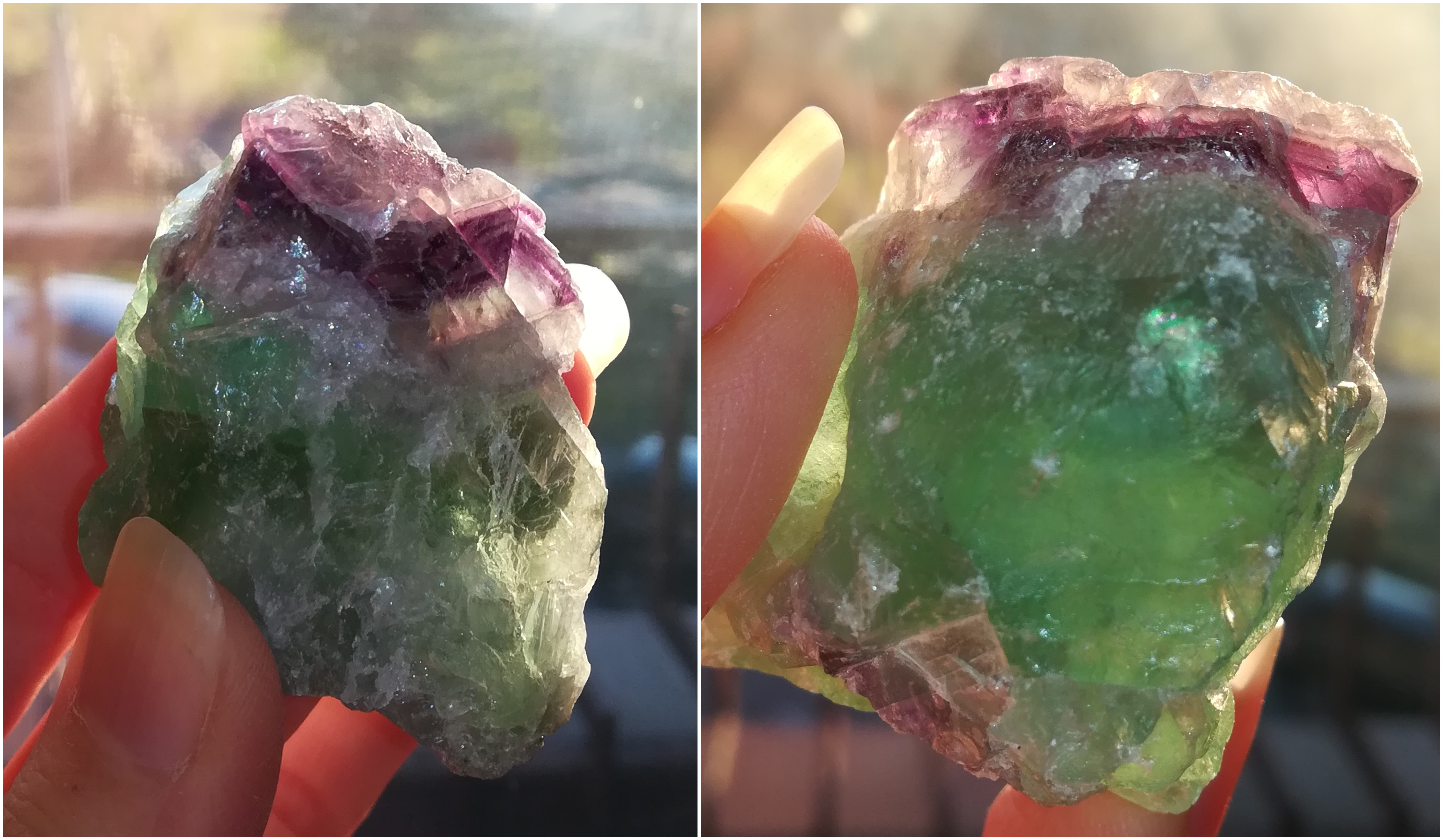
Fluorite (calcium fluoride, CaF2) is definitely one of my favourite minerals, especially because of its stunning array of colours, a result of impurities and exposure to radiation, tinting the transparent and colourless pure form of fluorite into transparent-to-translucent pieces with banding and/or zoning in various colours (where green, purple, blue and yellow are the most common). My fluorite pieces have (several shades of) green as their main colour, with purple, blue and light pink zoning, and they're especially beautiful to look at against the light, as the picture spam below will amply demonstrate ✨😍 xD.
✨Read more about fluorite in this post from my RBA mineral collection series on this blog.
This is the largest specimen of fluorite in my collection so far (as seen in Fig. 17, alongside all my other fluorites), and it's mostly a translucent light green, alongside a couple of purple zones (especially a larger zone at one tip of the piece), and some cyan blue zoning and even some yellow also appear when looking at it against the light (see Figs. 13-19 below, and also Figs. 1, 4, 6, 8 and 10 above). The banding is not so prominent in this piece in contrast to my tumbled fluorites, but you can also see some more subtle purple and cyan banding patterns against the light. The characteristic vitreous luster of fluorite also creates an iridescent effect on the surface for this particular piece (a result of light reflecting and scattering through layers of crystallization or internal fractures, as seen, for example, in Fig. 15 and the videos below), and it's so pretty to look at!
See below for pictures and a video showcasing the luster and beautiful colour zoning of this fluorite ✨:
 |
| Fig. 13 - The largest fluorite in my collection so far, mostly green with a distinct purple zone. |
 |
| Fig. 14 - Green and purple fluorite against direct evening
sunlight. The subtle cyan zoning in this piece is more noticeable here,
close to the purple banding and zoning at the top. |
 |
| Fig. 15 - This specimen of fluorite showcases a lovely vitreous
luster, and also shows some iridescence on the surface at some angles, as a result
of the scattering of the incident light by the translucent crystal
layers. |
 |
Fig. 16 - Green and purple fluorite against direct evening
sunlight. The purple banding and zoning at the top is more defined at this angle.
|
 |
| Fig. 17 - Green and purple fluorite against direct evening
sunlight. |
 |
| Fig. 18 - Green and purple fluorite against direct evening sunlight (featuring a rainbow lens flare on the right). |
✨Video ✨ (also on TikTok here; bonus slideshow post):
2) Lepidolite:
This purple mica is very rich in lithium (Li), and the fact that I keep bumping into lepidolite (I have three so far, as pictured in Fig. 19) is extremely funny to me, because my Astrophysics thesis revolved around studying stellar lithium to calibrate open clusters and estimate stellar ages. So every time I find a lepidolite or other mineral containing lithium, it's highly probable that I will get it (see Fig. 21), if only because of the inside joke 🤣. I also really like the colour purple (the book also, but no pun intended xD), so the range of purples of lepidolite (from lilac to grey-violet, a deeper purple or purplish pink) is another thing that I quite like about this mineral 💜. Lepidolite will also feature in future installments of my RBA mineral collection series!
This is the third lepidolite in my collection (see Figs. 20-23 below, and also Figs. 1, 4, 6, 8 and 10 above), a medium(ish)-sized raw piece featuring a massive habit, its characteristic vitreous-to-pearly luster, and a purple shade that I would describe as lilac-grey, although it does change subtly depending on the lighting (as we can see in the photos, depending on whether there's direct or indirect sunlight, artificial lighting, or camera flash), from a slightly deeper lavender to rosier or more greyish hues.
The video below (in direct sunlight) showcases the vitreous and sparkly luster typical of this mica variety and the delicate lilac shade of this specific lepidolite, ranging to more greyish hues in the early afternoon Sun to rosier tones in late evening direct sunlight✨:
 |
Fig. 20 - A raw lepidolite with a massive habit, here photographing as a rosy lilac-grey.
|
 |
Fig. 21 - The new lepidolite alongside my other two specimens, featuring a smaller and very pale grey-lilac raw piece, and a deeper purple large slab in the scaly aggregate habit in which many micas are found.
|
 |
Fig. 22 - More angles for this lepidolite. The very sparkly nature of this specimen doesn't show as well in photos as in video, but these pictures manage to capture it a bit.
|
 |
Fig. 23 - Showing a deeper lavender in this lighting, with the other two specimens in the background.
|
✨Video (also on TikTok here; bonus slideshow post):
3) Blue apatite:
I got this small raw specimen of blue apatite (a group of phosphate minerals) as a freebie for the other purchases! This is the second apatite in my collection (the other being the specimen from the RBA collection, see Fig. 25, in the background). It's rather more delicate than my other apatite, as I found out when several small pieces started to break off when I was minimally handling it to take pictures of it 😱 (at least that was a good moment to see the conchoidal to uneven fracture of apatite, I guess 😅 xD). It's still got a very interesting shape despite the breakage accident, though, and displays the characteristic luster that's a mix between vitreous and resinous. As for the colour, the typical peacock blue hue of blue apatite appears a bit more intensely in the RBA collection piece, but this specimen (as pictured in Figs. 24-26 below, as well as in Figs. 1, 6, 8 and 10 above) also showcases its bright blue, which is the highlight of blue apatite for me ✨.
✨Apatite will also feature in future installments of my RBA mineral collection series! Also see below for a video where we can see the luster, colour and shape of this blue apatite, in direct sunlight ✨:
 |
Fig. 24 - A small blue apatite, showcasing its characteristic bright peacock blue hue.
|
 |
Fig. 25 - The new blue apatite, alongside my other specimen from the RBA collection (in the background). The latter has a slightly brighter blue shade.
|
 |
Fig. 26 - Different angles of this blue apatite, in direct sunlight.
|
✨Video (also on TikTok here; bonus slideshow post):
4) Zoisite & pargasite:
This green zoisite (chrome-zoisite) with inclusions of black pargasite (see Figs. 27-28 and 31-33 below, as well as Figs. 1, 4, 6, 8 and 10 above) has a curious story about it. At the stall, it was sold as 'ruby zoisite' 🤔, and right off the bat it was quite clear that there was no ruby going on anywhere in any of these pieces, unless they're so tiny I would need a UV torchlight to identify the rubies via fluorescence, as red corundum aka ruby fluoresces very bright red under UV light (I later confirmed with my UV flashlight that there is, in fact, no ruby going on in this piece 😅). But even if this would've been the case, it would be hardly legit to label these pieces as 'ruby zoisite' (aka anyolite, as we'll see below), when, to the eye, it's 'just' a green mineral peppered with inclusions of another shiny black mineral (pargasite, also see below). So I thought (and I was initially right), well, this is just zoisite, and I got it because I didn't have any zoisite pieces in my collection as yet, and it was a very pretty specimen, disregardless of whether it had ruby in it or not. So that was that, it was added to the haul alongside the others!
 |
| Fig. 27 - A bright green chrome-zoisite with inclusions of black pargasite. |
But before delving into the rather amusing identification journey for this piece 😅, I would like to point out that I don't know who was more at fault here with the mislabelling of these zoisites, whether it was the actual stall vendor (who was very sweet and helpful throughout, but also didn't strike me as someone who knew a whole lot about the minerals and pieces she was selling), or whether it was rather the vendor's supplier who sold these zoisites to her already labelled as 'ruby zoisite' (or maybe her boss, if the small business wasn't her own). Might have been one of the latter, but no idea. However it may have happened, it is more than obvious that 'ruby zoisite' catches the browsers' eyes much more effectively than just 'zoisite with pargasite', and it's quite possible that the label itself did not stem from ignorance, but was rather clearly meant to be an intentional clickbait 😬. Who doesn't want to buy a piece that includes rubies, one of the most famous gemstones, and for just 3-4€, no less? What a bargain!
And so, it would be remiss of me not to mention that, even though I didn't care in the slightest about getting a zoisite with no ruby in it and bought it knowing with 99.9% surety that in the piece there were no rubies to be found, many people drawn to a mineral stall such as this one are often not mineralogy experts or long-time collectors who are able to keep honing their identification skills with practice (and we will talk about that honing later on xD). Which means that they may not be able to correctly identify the pieces they're buying and might readily accept the word of the vendors about their nature and origin, trusting in their supposed expertise on the matter (a level of actual expertise which is also relatively absent, in more cases than we would prefer 😬). Whether it might have been more out of amorality or out of ignorance in this particulat case, lack of transparency and unethical and fraudulent practices most certainly exist aplenty in the 'crystal industry', and an example of these practices is to mislabel a lower-value mineral as something that is higher-grade, more expensive or more showy, so as to catch the potential costumers' attention and interest more quickly.
This is done way more often than we'd like, not only by selling lower-grade minerals and gems as higher grade, but also coming in the form of dyed, irradiated and/or completely synthetic minerals (which can also be quite lovely, if only there was more transparency on the matter) being labelled as completely natural, often with the intention of selling them for a higher price because of their rarity in nature. Sigh. As another example of this in this stall, there were some blatantly fake 'emerald' and 'ruby' cabochons hailing from India, imitations which are already infamously known
to the mineral community to a greater or lesser extent, but rather less to the passers-by 😬 (you can see some of these imitation 'emeralds' in Fig 5, in the right). It's also fair to say, however, that this stall wasn't really scamming costumers price-wise because all of the rough pieces and boxed specimens available (including the zoisites) were quite affordable (most of them were 3-4€ each, more than reasonable for their size and quality). But that doesn't cancel out the fact that the mislabelling of these pieces was misleading (a personal pet peeve), and effectively acting as a clickbait, all the same.
 |
Fig. 28 - Fuchsite (left) and chrome-zoisite (right)
|
So that's that on that respect. But not the end of the story on this zoisite, as I then embarked in an unexpected journey of identification doubts for this piece 😅, from thinking it was zoisite with hornblende (it is zoisite and pargasite xD), to zoisite with maybe included biotite instead of pargasite, to 'could it actually be fuchsite instead of zoisite 🤔??' (spoiler, it is not xD), to 'no, it is zoisite, and maybe biotite' again, to, finally, some identification tests and Reddit threads discussing zoisite later, I arrived at 'this is definitely zoisite with pargasite' 😅👍. Quite an annular structure in this journey, overall (all the LOTR and Hobbit puns have been unintended but welcome 🤣).
 |
Me identifying this zoisite like xDD
|
So yeah. I left the stall fully convinced that I had a zoisite in my possession, and a quick research session into this mineral made me conclude that the black inclusions were probably hornblende (specifically, black pargasite), as zoisite is often accompanied by it. So far, so good! but I suppose that the 'ruby zoisite' mislabelling issue, accompanied by the fact that this is my first zoisite (and so I had nothing to compare it to), suddenly made me start to doubt whether this was actually zoisite or if the stall had mislabelled that too xD. To top it off, I then mixed up in my mind two different hardness tests that I had done on the same day with different pieces, which resulted in me wrongly thinking that this piece could be scratched with my nails 😅, and so it had to have a hardness of 2-3 on the Mohs scale (see Fig. 29). Meanwhile, zoisite has a hardness of 6-7, which is quite a leap on the scale xD. This supposed hardness test, alongside the fact that I was then already wondering whether the black pargasite inclusions could be black mica (biotite) instead, made me immediately leap to the wrong conclusion that the main material was of the mica group as well, specifically a green mica, a fuchsite.
 |
Fig. 29 - Mohs hardness scale (Source)
|
I did redo the hardness test, thankfully, and found out that neither the green mineral nor the black inclusions got scratched with my nails by a long shot, that this piece scratched pieces such as apatite (5 on the Mohs scale) and other minerals up to hardness 6, that it also scratched glass (so it had to be higher on the scale than 5.5), and that quartz (7 on the Mohs scale) just barely managed to make the slightest mark. So this piece had a hardness of approximately 6.5 (between 6 and 7), which fits zoisite's listed hardness to a T, and my first call seemed to be about right. With the wrong hardness test results dispelled, however, the rest of the pieces began to click together as well: The difference in look, feel and luster between this zoisite and my fuchsite became apparent (see Fig. 28, where my small rough fuchsite specimen, mixed with silvery moscovite, showcases a more pearly luster and a characteristic cleavage than the zoisite lacks).
 |
Fig 30 - Hornblende (top) vs biotite mica (bottom)
|
Finally, regarding the
conundrum of pargasite vs biotite (see
Fig. 30), the
platy prismatic/tabular crystals of pargasite can be certainly confused to an extent with the characteristic
platy sheets of mica, but the specimen also clearly showcases the
difference in hardness between mica and hornblende (a mica, with a hardness of
2.5 on the Mohs scale, will flake easily when handled, leaving glittery specks on your fingers and strewn on your surfaces, while the pargasite crystals on the zoisite specimen, with a hardness of
5-6, don't even budge xD). And also the
difference in luster, with both being vitreous, but
pargasite also having
a luster that is submetalic rather than pearly (mica).
So I guess that all of this means that 1) Mineral identification is a lot of fun, albeit hard and confusing at times 😅, and that 2) practice makes perfect (well, it makes better xD) when it comes to honing these skills, for sure.
Seeing as zoisite doesn't feature on the RBA kiosc collection I'm organizing most of my mineral posts around (apart from hauls), I will now be talking with a bit more detail about zoisite (and also about pargasite, although hornblende in general will feature on the RBA series as well): And before that, now's the time, finally, for some more pictures and a video showcasing the bright green of this chrome-zoisite and the lovely vitreous luster of the combo of zoisite and pargasite in the Sun ✨:
 |
| Fig. 31 - This chrome-zoisite has a bright green hue and presents inclusions of black pargasite. |
 |
Fig. 32 - Chrome-zoisite and pargasite in direct late evening sunlight.
|
 |
| Fig. 33 - Chrome-zoisite and pargasite. The lighting in these two photos makes the piece looks rather more reddish than it actually is, which can also lead to error. In real life it only presents a small area that seems to be slightly stained on the surface (although UV light might be needed to know if there are any ruby minute inclusions going on xD). |
✨
Video (also on TikTok
here; bonus
slideshow post):
💎A bit about zoisite (and pargasite): Source 1, Source 2, Source 3, Source 4, Source 5, Source 6, Source 7, Source 8, Source 9
- Zoisite (also known as
saualpite) is a calcium aluminum hydroxy sorosilicate with the (lengthy xD) chemical formula
Ca2Al3(SiO4)(Si2O7)O(OH). Being the
orthorhombic polymorph of
clinozoisite (the two minerals are
dimorphs, with the same chemical formula but different crystal structure, see
Fig. 34), zoisite was formerly assigned to the
epidote mineral group but is
no longer considered to be a member of it. In spite of this distinction, both zoisite and clinozoisite have very similar physical properties and are often very difficult to distinguish.
.png) |
Fig. 34 - Zoisite&clinozoisite infographic (Source)
|
Zoisite (alongside clinozoisite) typically forms in metamorphic rocks in high-presssure and low-temperature conditions, and often through the
metamorphic alteration of pre-existing igneous and sedimentary rocks, undergoing chemical changes and recrystallization. In these environments, it can occur in
massive form (granular masses), and as
prismatic crystals in
pegmatites and in veins in
schists and marbles.
This mineral is relatively hard, 6.5 to 7 on the Mohs scale, and exhibits a perfect conchoidal fracture. Zoisite may be colourless or instead occur in a wide range of colours, from green (chrome-zoisite) and blue to pink, yellow, grey and violet. Transparent blue (and violet) zoisite crystals, coloured by vanadium, are known as tanzanite, a rare variant that was discovered in the 1960s in Tanzania (most of it is nowadays produced and sold by heat treating brown zoisites, changing the oxidation state of vanadium to turn the colour to blue). Thulite (or rosalite) an opaque pink manganese-bearing variety, is also rare.
Finally, we have anyolite, or 'ruby zoisite', a rock composed of bright green chrome-zoisite and red corundum crystals (ruby), often also accented by inclusions of black pargasite (or tschermakite, see below). My larger zoisite specimen is pretty much an anyolite without the ruby, so technically not an anyolite at all 😅. Still very lovely, but as we've seen, also mislabelled in a problematic way by the vendors, and the difference between specimens such as mine and actual anyolite (see Fig. 34.1-5) are quite blatant when it comes to the red areas featuring ruby crystals:
 |
Fig. 34.1 - Anyolite (ruby zoisite) with black pargasite (Tanzania). Very similar to my specimen except for the ruby xD (Source)
|
 |
Fig. 34.2 - A ruby zoisite with black pargasite at Expominerales Madrid 2024.
|
As part of an April 2024 haul, I finally got my first piece of actual ruby zoisite (see Figs. 34.3-5), a small tumbled one which is quite lovely, with the green of the chrome-zoisite contrasting with the red ruby zones and the black of the hornblende. And the ruby areas in this tumbled anyolite fluoresce very bright red under my UV torchlight, which was also very cool to see. Also see below for a couple of videos of this anyolite in natural and UV light (on Tiktok here and here):
 |
| Fig. 34.3 - Tumbled ruby zoisite |
 |
| Fig. 34.4 - Tumbled ruby zoisite |
 |
| Fig. 34.5 - Tumbled ruby zoisite |
- Pargasite (and also tschermakite), is a complex inosilicate mineral of the amphibole group, and a member of the extended hornblende group of minerals (specifically, part of the hornblende-ferroschermakite group), with the (even more lengthy xD) chemical formula NaCa2[(Mg, Fe2+)4Al](Si6Al2)O22(OH)2. Amphiboles as a group are inosilicates which typically contain calcium (Ca), aluminum (Al), iron (Fe) and/or magnesium (Mg) in their structures and form prismatic or needlelike crystals. Ferro- and mangano-pargasites (see the formula above) are isomorphs (same crystal structure, different chemical composition), in this case differing in their iron or magnesium content. 'Hornblende' as a term is commonly used informally to refer to any opaque amphiboles, typically dark green to black, which includes tschermakite and pargasite. All individual hornblende minerals have a very similar appearance, and can be practically indistinguishable without individual analysis.
.png) |
| Fig. 36 - Pargasite infographic (Source) |
Pargasite is
one of the most common amphiboles,
typically forming in
high-temperature metamorphic rocks, as well as in volcanic and
ultramafic igneous rocks.
It occurs as
granular masses and as
opaque to transparent prismatic or tabular crystals, with a
vitreous to submetallic luster (such as the ones featured in my zoisite), and includes not only
opaque dark green and black varieties, but also
transparent light-coloured ones, as in the case of the highly sought-out
bright green transparent pargasite crystals. Some of these varieties are recognized as individual minerals, with pargasite actually being the
principal member of its own complex mineral group with a total of
26 species.
✨Some interesting history and STEM trivia about zoisite and pargasite:
- Zoisite was first described by Abraham Gottlob Werner in 1805, who named the mineral after Carniolan (a region that comprised parts of present-day Slovenia) naturalist Sigmund Zois (1747-1819), who financed mineral-collecting expeditions. It had been Zois who had sent Werner specimens of the then unknown zoisite (found by mineral dealer Simon Prešern in 1804), from the locality of Saualpe in Carinthia (Austria). Thus its alternative name, saualpite.
- Pargasite is named after the Pargas Valley, a locality in Finland, where dark green to black specimens of this mineral were first found and described. This name was coined in 1814 by Count Fabian Gotthard von Steinheil.
- Uses of zoisite: Both zoisite and clinozoisite are typically found in small quantities, and thus historically these minerals have not been very well-known or widely used either for industrial purposes or in the gemstone market. In spite of this, transparent and/or colourful specimens, such as tanzanite, thulite and anyolite, have gained popularity and are currently highly valued as gemstones, and used for carvings. jewellery and other ornamental purposes. Its rarer varieties are highly sought-after by gemstone and mineral collectors. Albeit less commonly, zoisite has also several industrial applications: As an abrasive for cutting and polishing other materials, due to its hardness, or used in ceramics or as a filler for other composite materials.
- Pargasite acts as the main water-storage site in the Earth's upper mantle. Although it becomes unstable at depths greater than 90 km, the presence of pargasite in lherzolite-type ultramafic igneous rocks is also of great scientific value in order to study the temperature ranges at which rocks form in the uppermost levels of the mantle.
Finally,
💎 An infographic video on zoisite and pargasite, including and additional clip and featuring mineralogy facts and historical trivia (also on Tiktok here):
5) Aragonite:
And now we come to the five small boxed minerals from this haul! First is a small pinecone aragonite cluster (see Figs. 37-39 below, as well as Figs. 2, 7, and 11-12 above), originating from Cuenca (Castilla la Mancha, Spain). In my collection, I already had larger pinecone aragonites, but this one is still probably in my top three favourites, with beautiful
reddish-brown pseudo-hexagonal prismatic crystals grouped around a central axis (hence the alternative name 'aragonite star clusters').
✨Aragonite will also feature in the upcoming post 4 of my RBA mineral collection series! Also see below for a video showing the lovely crystals and the vitreous luster of this piece in direct sunlight ✨:
 |
Fig. 37 - Pinecone aragonite, in its box.
|
 |
Fig. 38 - Pinecone aragonite with lovely red-brown pseudo-hexagonal prismatic crystals. Also, look at that luster!
|
 |
Fig. 39 - Pinecone aragonite, more angles.
|
✨
Video (also on TikTok
here; bonus
slideshow post):
6) Rhodonite:
The second of the small boxed minerals is my first rough
rhodonite, which joins my tumbled piece from the RBA collection (see
Fig. 44). Both of my rhodonite specimens are from
South Africa, and this one (see
Figs. 40-44 below, as well as
Figs. 2, 7, and
11-12 above) is a raw piece, displaying the
pink hue characteristic of rhodonite, as well as its typical
vitreous luster, becoming more pearly on cleavage surfaces. This specimen is
homogeneously pink and lacks the brown and black patches of my tumbled rhodonite (
corresponding to manganese oxides), but instead includes a
curious green patina at the top, which I tentatively guess as
being a copper-based mineral(?), possibly
malachite (or maybe
conichalcite?). It is a curious combination that I personally hadn't seen before (green coatings in rhodonite specimens can be seen here:
1,
2,
3), but that's my best guess at the moment. The green coating doesn't look like
epidote or
tephroite, the only green minerals I had seen
associated with rhodonite so far.
✨Read more about
rhodonite in
the second post in my
RBA mineral collection series on this blog. Also see below the pictures for a
video with this rough rhodonite in direct sunlight ✨:
 |
| Fig. 40 - Rough rhodonite, in its box. |
 |
| Fig. 41 - This small rough rhodonite displays its characteristic pink
colour, as well as a green patina on the top, possibly malachite or a
copper-based mineral? |
 |
| Fig. 42 - Rough rhodonite showcasing an homogeneous pink colour and a green patina of possibly malachite. |
 |
Fig. 43 - Rough rhodonite, view from the back.
|
 |
| Fig. 44 - Tumbled (left) and rough (right) rhodonites. The
tumbled one shows black and brown patches as a result of manganese
oxides. | |
✨
Video (also on TikTok
here; bonus
slideshow post):
6) Rock crystal:
For our third mineral in this second half of the haul, we have a beautiful rock crystal (clear quartz) cluster (see Figs. 45-49 below, as well as Figs. 2, 7, and 11-12 above), originating from Brazil. In spite of its small size, this quartz cluster displays some gorgeous well-terminated pyramidal prismatic crystals, with some incredible transparency as well ✨.
✨
Rock crystal will also feature in a future installment of my
RBA mineral collection series! In the meantime, you can also read about
quartz in general in
post 1 of this series, and about
milky quartz and
quartz geodes in
post 2. Also see below for a
video where we can see the gorgeous crystals and the transparency and vitreous luster of this quartz specimen, in direct sunlight ✨:
 |
Fig. 45 - Rock crystal cluster, in its box.
|
 |
Fig. 46 - This rock crystal cluster has some gorgeous well-terminated crystals.
|
 |
Fig. 47 - This rock crystal cluster has some gorgeous well-terminated crystals. I especially love the one at the top!
|
 |
Fig. 48 - Rock crystal cluster, more angles.
|
 |
Fig. 49 - Rock crystal cluster, more angles, featuring some really lovely shine on the tallest crystal.
|
✨Video (also on TikTok here; bonus slideshow post):
7) Hematoid quartz:
The fourth boxed mineral is another quartz, this time a red quartz aka hematoid/ferruginous quartz, originating from Morocco (see Figs. 50-53 below, as well as Figs. 2, 7, and 11-12 above). Coloured red by iron inclusions, this hematoid quartz cluster also displays some beautiful well-terminated pyramidal prismatic crystals, as well as a deep red hue and a lovely vitreous luster ✨.
✨Hematoid/red quartz will also feature in other hauls, as well as in a future installment of my RBA mineral collection series! In the meantime, you can also read about quartz in general in post 1 of this series, and about milky quartz, quartz geodes and iron-stained quartz in post 2. Also see below for a video where we can see the gorgeous crystals, vitreous luster and red colour of this quartz specimen, in direct sunlight ✨:
 |
Fig. 50 - Red (hematoid) quartz, in its box.
|
 |
Fig. 51 - Red quartz cluster, also showcasing some gorgeous pyramidal prismatic crystals.
|
 |
Fig. 52 - Red quartz cluster, displaying a deep red colour due to iron inclusions, and a lovely luster.
|
 |
Fig. 53 - Red quartz cluster,more angles.
|
✨Video (also on TikTok here; bonus slideshow post):
8) Green tourmaline & quartz:
And finally, we have a small specimen of green tourmaline (verdelite) crystals in a milky quartz matrix, a piece originating from Brazil (see Figs. 54-57 below, as well as Figs. 2, 7, and 11-12 above). I already have another verdelite as part of the RBA collection, but what I got was a very dark and rather lackluster raw piece that was visually way more similar to an (opaque) black tourmaline than anything else 😅. So I'm definitely happy to now have an specimen with actually greener crystals xD. Even though it's a small piece, there are several prismatic and columnar tourmaline crystals in this specimen (albeit incomplete and half-buried in the quartz matrix), and the combo between the crystals and the quartz matrix is quite lovely. The crystals also show characteristic striations along their long axis, especially when moving the piece to and fro in the light ✨. The main colour of these verdelite crystals is green, but one of them also seems to have a pink zone on the inside when looking at its cross-section (see, for example, Fig. 56). Could this be the closest I've come at the moment to having a watermelon tourmaline, the coveted pink and green bicolour variety? It seems so xD.
✨Tourmaline (both black tourmaline and verdelite) will also feature in future installments of my RBA mineral collection series! You can also read about quartz in general in post 1 of this series, and about milky quartz and quartz geodes in post 2. Also see below for a video where we can see the lovely vitreous shine of the green tourmaline crystals in its quartz matrix, in direct sunlight ✨:
 |
Fig. 54 - Green tourmaline in quartz matrix, in its box.
|
 |
Fig. 55 - Green tourmaline (verdelite) in quartz matrix, with some nice bright green crystals.
|
 |
Fig. 56 - Green tourmaline in quartz matrix. One of the tourmaline crystals has a pink zone when looking at its crossection. The nearest I've come to a watermelon tourmaline so far xD!
|
 |
Fig. 57 - Green tourmaline in quartz matrix, more angles.
|
✨Video (also on TikTok here; bonus slideshow post):
And that's it for this haul! Stay tuned for more mineral content with a next installment of the RBA collection series 😁!




.png)


.png)


