Thursday, 19 May 2016

Tolkien talks - Comparación entre Gandalf y el Doctor/ A comparison between Gandalf and the Doctor (EstelCon 2016)

[Spanish+English versions]

Durante la pasada Mereth Cenagosa organizada por nuestro Smial de la Ciénaga de los Muertos de la Sociedad Tolkien Española (29-30 abril y 1 mayo), presenté una charla comparando los personajes de Gandalf y el Doctor (el protagonista de la serie británica Doctor Who). Experimenté con una presentación más audiovisual (con gifs, imágenes y clips de vídeo) que las que suelo crear para mis conferencias de temas de mujeres en el universo de Tolkien, y la verdad es que me lo pasé muy bien tanto preparándola como presentándola en cosplay del Décimo Doctor :)

During the last Mereth Cenagosa on the 29-30th April and 1st May, a convention organized by our Smial (local delegation) of The Dead Marshes, part of the Spanish Tolkien Society, I presented a talk in which I compared the characters of Gandalf and the Doctor (the main character of the british TV series Doctor Who). I experimented with a more audiovisual approach (with gifs, pics and video clips) than I was used to in my talks about women in Tolkien's universe, and to be honest I had a blast both working on it and presenting it - while cosplaying the Tenth Doctor, of course :)


En la pasada EstelCon 2016 (8-11 diciembre), la convención anual de la Sociedad Tolkien Española, volví a presentar una versión revisada y algo extendida de esta charla. Y esta vez debutando con mi primer cosplay crossover - Space Gandalf :D!

During the past EstelCon 2016 (8th-11th December), the annual convention of the Spanish Tolkien Society, I presented this talk again, a revised and slightly extended version. And this time in my first crossover cosplay - Space Gandalf :D!

Space Gandalf crossover cosplay for the talk xD


En este post he subido la presentación de la charla - en formato .pdf, por lo que los gifs no funcionan :/, y añado los clips de vídeo aparte -, y en el futuro próximo pretendo subir algunas de mis notas, con las citas y referencias utilizadas. 

In this post I've uploaded the talk presentation slides - in .pdf format, so the gifs don't work :/, and I add the video clips below -, and in the near future I'd like to also upload some of my notes, with the quotes and references I used in this talk.

-Si quieres compartir: ¡Gracias! Pero siempre con mi nombre y con un link a este post, por favor. Sobre la utilización de este material en otros trabajos, por favor consulta las Condiciones de Uso.

-If you want to share: Thank you! But always credit me and add a link to this post, please. Regarding the use of this material in other projects, see my Policy.


-Acerca de las ilustraciones: La autoría de todas las ilustraciones utilizadas en esta presentación ha sido citada y acreditada. No hay ningún inconveniente en reemplazar y/o eliminar alguna de estas obras si el/la autor/a así lo desea, por supuesto. Este estudio no tiene ánimo de lucro.

-About the illustrations: The authors of all the artwork shown in this presentation have been duly mentioned and credited. Artists, if you see this and wish for any or all of your works to be substituted and/or removed, please let me know! This study was made with the sole aim of fun and learning. This is a non-profit work in every way.
  • Clips de vídeo de la charla/Video clips from the talk:
-'Un Gandalf espacial' (cortado y subtitulado por mí)
-'A Space Gandalf' (clipped and subtitled by  me):


-El arquetipo del héroe-errante: Sintiendo noltalgia por y recordando su hogar/ The errant-hero archetype: Homesickness and nostalgia about their home:
  • Gandalf describe Valinor cuando habla con Pippin en El Retorno del Rey (clip descargado)
  • Gandalf remembers and describes Valinor when talking to Pippin in The Return of the King (downloaded clip)
  • El Décimo Doctor describe su planeta natal Gallifrey, destruido durante la Guerra del Tiempo, en 'The Sound of Drums' y 'Gridlock' (cortado y subtitulado por mí)
  • The Tenth Doctor talks about his home planet Gallifrey, destroyed during the Time War, in 'The Sound of Drums' and 'Gridlock' (clipped and subtitled by me)

-Actitud ante la guerra y la violencia/Attitude to war and violence:

  • Parte del discurso anti-guerra del Duodécimo Doctor en 'The Zygon Inversion' (cortado y subtitulado por mí)
  • Part of the Twelve Doctor's anti-war speech in 'The Zygon Inversion' (clipped and subtitled by me):
   
  • Gandalf habla a Bilbo sobre 'el verdadero coraje' en Un Viaje Inesperado (clip descargado, subtitulado por mí)
  • Gandalf talks to Bilbo about 'true courage' in An Unexpected Journey (clip downloaded from YouTube, subtitles by me):


 -Compasión/ Compassion:

  • Gandalf habla a Frodo sobre Gollum y la compasión en La Comunidad del Anillo (clip descargado)
  • Gandalf talks to Frodo about Gollum and compassion in The Fellowship of the Ring (clip downloaded):

  • El Duodécimo Doctor salva a su enemigo Davros cuando era niño y le habla de la compasión en 'The Witch's Familiar' (clip cortado y subtitulado por mí)
  • The Twelfth Doctor saves his enemy Davros when he was a child and talks to him about compassion in 'The Witch's Familiar' (clipped and subtitled by me)

- Teoría del Coraje/Theory of Courage:
  • Gandalf hace frente al Balrog para que la Comunidad escape en La Comunidad del Anillo (clip descargado)
  • Gandalf faces the Balrog so that the Fellowship can escape in The Fellowship of the Ring (clip donwloaded)
  • El Undécimo Doctor se enfrenta solo a una entidad maligna para salvar a la gente de Akhaten en ‘The Rings of Ahkaten’ (clip descargado, subtitulado por mí)
  • The Eleventh Doctor faces an evil entity posing as a 'God' on his own in order to save the people of Akhaten in 'The Rings of Akhaten' (downloaded clip, subtitles by me)
                                       
-Todo el mundo es importante/ Everyone is important:
  • El Undécimo Doctor dice que nunca ha conocido a nadie que no fuera importante en 'A Christmas Carol' (clip descargado)
  • The Eleventh Doctor claims that he has never met anyone who wasn't important in 'A Christmas Carol' (downloaded clip)

  • Gandalf habla sobre la valía de la 'gente común' en Un Viaje Inesperado (clip descargado)
  • Gandalf talks about the value of 'ordinary folk' in An Unexpected Journey (downloaded clip)


Wednesday, 30 March 2016

The Wheel of the Year: Ostara (Spring Equinox)


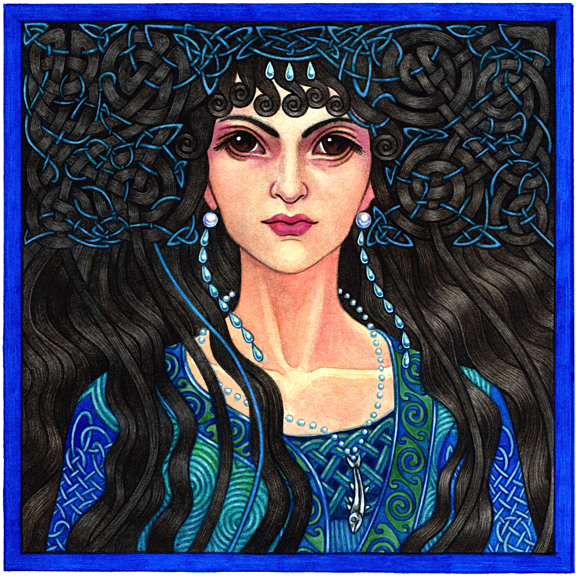
'Ostara', by Helen Nelson Reed

 Going back to the Wheel of the Year posts, here's a  (belated) quotes+pics post about Eostre, the Spring equinox, also called Easter, Meán Earraigh and Alban Eilir.  I personally don't really celebrate Eostre and stick to enjoying a week-full of holidays, eating chocolate eggs and looking at nature (which could actually qualify as 'celebrating Eostre', though xD), but I'm always interested in studying mythology and neopagan feasts, so here it is :)

-Sources and copyright: Sources can be found at the end of the post and images and quotes are credited and used for non-profit aims. Artists, if you don't want your artwork to feature here, please let me know! The authors of some of these pics remain unknown to me. If you know the authorship, or if you are the author, please let me know, and I will credit them. 

-Pagan origin and characteristics:

"Meán Earraigh marks the Spring equinox, when night and day are of equal length and spring officially begins. Birds begin their nesting and egg-laying, and eggs - symbolic of rebirth,  fertility, and immortality- are tossed into fresh furrows or eaten by ploughpeople. They are also carried by those engaged in spring planting." (A Druid's Herbal for the Sacred Earth Year, Ellen Evert Hopman)
Ostara, by Christopher Bell, source
"Ostara, (...) also called Lady Day, is a Pagan holiday, celebrated every year on the spring equinox, usually March 21.     Saxons had a festival every year for their spring and fertility goddess, Eostre, involving variations of many traditions we use today. (...) Eventually, the christians adapted the word 'Easter', and some of the traditions.     The 'Easter bunny' comes from an old sign of fertility, the rabbit. (...) Chicks as well, which emerge from their shells (...). Both animals were sacred to goddesses of Spring annd fertility, and were often honoured around the spring equinox.     Eggs are also symbols of fertility (...) in Old Europe, eggs were decorated and given as gifts, as wishings of abundance in food and prosperity." (Source)

"Most of what people commonly associate with Easter is pagan in origin (...) Pagan roots of Easter lie in celebrating the spring equinox, for millennia an important holiday in many religions. Celebrating the beginning of spring may be among the oldest holidays in human culture. Occurring every year on March 20, 21, or 22, the spring equinox is the end of winter and beginning of spring. Biologically and culturally, it represents for northern climates the end of a “dead” season and the rebirth of life, as well as the importance of fertility and reproduction." (Source)
Eostre by Wenndy Andrew
More about the paralell elements of the polytheistic and monotheistic beliefs and celebrations of the Spring Equinox here. Many people don't seem to know that "a focus of spring religious festivals was a god whose own death and rebirth symbolized the death and rebirth of life during this time of the year", which is another reason why I think that all human religious are the same one with variations depending on the culture of origin - and this is why I find it it utterly ridiculous to fight over which religion is 'the real one' (and among other things, this is also why I am a religious-book-atheist - I don't believe in any deity described by humans in their books and mythologies as 'the real one' -, but a pure agnostic regarding the possibility of the existence of a divine being, because I think that I ca hardly claim the existence or non-existence of such a thing without empirical evidence). 
Pagan holidays turned Christian: Easter. The origin of Easter is Germanic, though, the Celts didn't celebrate it, for them Spring begins with Imbolc.
  • The Goddesses of the Spring Equinox:
-Ostara/Eostre, Germanic Spring and Dawn Goddess:

This Germanic Goddess (Old English: 'Ēastre', Old High German: '*Ôstara', source), a goddess of dawn and the sky, and a 'bringer of light' (related to the idea of the Sun Goddess), is the namesake of the festival of  'Easter'.

 "Pagan Anglo-Saxons had held feasts in Eostre's honor, but that this tradition had died out by his time, replaced by the Christian Paschal month" (Source)

Goddess Eostre/Ostara by Johannes Gehrts

"Ostara, the Spring Equinox, derives it name from the Goddess Eostre. The Earth is now clearly awakened from her slumber. The day and night are equal but the light is gaining (...) This is a time of feasting and celebration. There is a sense of energy and promise personified by the beauty, strength, and freedom of the young virgin Goddess. This is when the clover appears in the fields, a symbol of the rebirth of the Maiden aspect of the Triple Goddess. Significant symbols are the lamb, the hare, and the egg, all universal archetypes of fertility, renewal, and new life (...)" (Source)
Eostre (author unknown to me)
 -About the term 'virgin': About this excerpt, I would like to note than in this context of 'the Goddess' the term 'virgin' simply means a 'young woman' and has empowering connotations of 'strength', 'freedom' and 'power' (the root of the word is actually the same as the one in 'virility', but thanks to Patriarchy men got the 'strength', 'power' and 'freedom' connotations while women were stuck with 'modest', 'naïve', 'inexperienced' and 'sexually untouched by men'). Here 'virgin'  has nothing to do with the goddess's sexuality or sex life (as in 'sexually inexperienced' or 'untouched (by men)'). The later patriarchal connotations, deeply influenced by monotheistic religions such as Christianity (and most ancient and polytheistic societies were generally quite patriarchal and male-dominated as well, even though the women fared better in their myths and religions), are full of oppression: sexism, misogyny, double standards and heteronormativity. The Goddess is both 'virgin' and 'mother', because she can create life without the intervention of males, and she is both 'virgin' and 'lover' because she can have a free sexuality without oppressive notions of 'purity' or 'modesty'.

-Boann, Irish cow goddess:  Associated with fertility and healing (water,cows), creativity, inspiration and wisdom (water, the Salmon of Knowledge, source) and astronomy.

Boann by ThaliaTook

"The female aspect of this festival [Meán Éarraigh, the Neopagan Celtic Spring equinox] is personified by Boand (...), who is sometimes equated with the River Boyne. (...)     Boand is known as "She of the White Cows". It is worthwhile to remember that Brighid was raised on the milk of a white cow with red ears. Otherwordly beasts such as dogs and cows are generally described with this colouring. Sacred kine are often said to emerge from lakes; water is the entrance to the Otherworld.  If you visit the River Boyne, you will find that she is quite maternal, flowing gently (...) like a placid milk cow." (A Druid's Herbal for the Sacred Earth Year, Ellen Evert Hopman)

-Religion-free spiritual aspects of Eostre in Neodruidism:
'Moonlit Hare' by Amanda Clark

"Alban Eilir (light of the earth), the vernal equinox, around March 21
Physically: The time of sowing most seeds and first growth
Magically: The sun gaining in strength over the night; the greening of the earth" (The Path of Druidry, Penny Billington)

"Light overtakes the dark. Rebirth of life. Contemplate new beginnings and fresh ideas. Serious mediation on your hopes and dreams for the coming year. Solar festival of fire, light, and fertility." (Source)
  • Sources:
-A Druid's Herbal for the Sacred Earth Year by Ellen Evert Hopman
-The Path of Druidry by Penny Billington
-Ravens Wyrd - Equinox
-Ostara: Anglosaxon and Germanic vs Christian
-The Pagan elements of Easter 
-Pagan holidays turned Christian
-Eostre (Wikipedia)
-Boann (Wikipedia)
-Boann - The Somathread


Monday, 7 March 2016

Queen Boudica's statue in London

During the Summer of 2014 I was in London for a Sherlockian and Whovian-based trip, and I also had the chance to see the statue of Boudica, the warrior queen of the Iceni, who is among my favourites in the three categories of 'Celtic women', 'warrior-women' and 'historical female figures'.

'Boadicea and her daughters' is a bronze sculptural group by Thomas Thornycroft, erected near Westminster bridge in 1902. More info on the statue here.

"The statue portrays Boadicea, Queen of the Iceni tribe of Britons, accompanied by her two daughters, mounted on a scythed chariot drawn by two rearing horses. The chariot is based on Roman models, not native British or Iceni models, and has a scythe blade attached to each wheel. Boadicea stands upright, in a flowing gown, with a spear in her right hand and her left hand raised. Her daughters with bared breasts crouch in the chariot, one to either side of their mother." (Source)


Although I love the statue, Boudica is depicted in a rather anachronistic way (same as the chariot is based on Roman models), more similar to Victoria and Minerva than to a Briton queen. The Celtic Boudica, according to what we know about Celtic clothing and Dio Casio's description, would have looked more like this (the author of this gorgeous artwork is still unknown to me, if anyone knows who it is, please let me know!):

" “In stature she was very tall, in appearance most terrifying, in the glance of her eye most fierce, and her voice was harsh; a great mass of the tawniest hair fell to her hips; around her neck was a large golden necklace; and she wore a tunic of divers colours over which a thick mantle was fastened with a brooch. This was her invariable attire ...” wrote Dio, who added that she clutched a spear when she spoke to her people." (Source)

Thursday, 11 February 2016

Celtic goddesses: Brigid (final part)

  • Brighid part 4: Brighid as a Sun Goddess. Parallels in other mythologies and religions.
Former posts: 1, 2 and 3.

-Disclaimer: This post is written for cultural fun because I enjoy studying and comparing goddesses from different mythologies, who also serve as empowering role models for women. I don't own any of the images, which were credited to the best of my ability. Religious spam of any kind is not welcome, thanks.

1) Brighid as a solar goddess: 
   Brighid is one of the so-called 'Solar goddesses' present in many mythologies. Solar goddesses are associated with life and light, fertility and healing, sovereignity and protective battle skills and crafts. As 'Solar' goddesses, many of these are directly related to the Sun (Belisama, Brighid, Amaterasu, Sunna and other Sun goddesses). Others are also related to the Moon, the stars and the sky in general (Nut, Isis, Zaria, Varda-Elbereth from Tolkien's legendarium).  

 Life, fertility and healing are common aspects of solar deities (male solar deities such as Belenos and Lugh also have important life-giving and fertility aspects), an easy link to make given their light symbolism. Given the Sun's fiery nature as well as its life-giving qualities, solar deities are also associated with power and strength, and with warfare (Brighid, Athena-Minerva and most solar deities have this aspect) - Although they are normally seen as warrior-protectors rather than deities associated with battle-frenzy and slaughter (such as Mórrígán, Ares or Kali).  Fire and the Sun are also symbols of inspiration and creativity, so many solar deities are patrons and patronesses of craftspeople, poets and artists (Brighid, Athena).

-List of some Solar goddesses (Sun/light/sky, crafts and warrior-protector goddesses):
   Goddesses in parentheses are not 'solar' goddesses per se, but share a fair number of the light/sky/fertility/warrior-protector aspects of solar deities.
A Sun Goddess (author unknown to me)
  • Celtic mythology: Áine, Belisama, Brighid/Brigantia/Britannia, (Ceridhwen), Danu, (Epona), Etain, Sulis/Suleviae, Olwen. (Many Celtic deities have a solar aspect, even if they're not mainly Sun-goddesses).
  • Egyptian mythology: Bast, Hathor, Isis, Nut, Sekhmet.
  • Scandinavian mythology: Freya, Sól/Sunna.
  • Classical/pre-hellenic/Scythian/Etruscan mythology: Alectrona, pre-hellenic Artemis, Athena/Minerva, Eos, Hemera,  (pre-hellenic Hera), Thesan (Etruscan), Victoria, Iris, Medusa.
  • Chinese mythology: Xihe.
  • Japanese mythology: Amaterasu, Marici.
  • African mythology: Anyanwu, Mawu.
  • Australian mythology: Gnowee, Wala, Wuriupranili, Yhi, Djanggawul Sisters.
  • Indian mythology: Aditi, Devi, Saranyu.
  • Baltic mythology: Saule, Zaria.
  • Slavic mythology: Mater Sva, Koliada, Solntse, Xatel-Ekwa.
  • Sami mythology: Beiwe.
  • Alaskan mythology: Akycha
  • Native American mythology: Hekoolas, Uelanuhi.
  • Inuit mythology: Malina.
  • Semitic (Canaanite/Sumerian/Babilonian/Hitite/...) mythology: (Astarte), Arinna, (Inanna/Ishtar), Shapash, Wurusemu. 
  • Tolkien's mythology: Arien/Urwendi, Varda/Elbereth, Ilmarë.
I've chosen four goddesses or divine figures - Athena-Minerva from Classical mythology, Isis from Egyptian mythology and Varda-Elbereth and Arien from J.R.R Tolkien's universe - who in my opinion share quite a lot of traits, aspects and functions with the Celtic Brighid:

2) Brighid and Brigantia vs Athena/Minerva and Victoria (Classical mythology)
            
Left: Pallas Athene (Klimt). Right: Relief sculpture of Brigantia heavily influenced by Minerva (Roman, 3rd Century AD).

"[Brghid's] British and continental counterpart Brigantia seems to have been the Celtic equivalent of the Roman Minerva and the Greek Athena, goddesses with very similar functions and apparently embodying the same concept of elevated state, whether physical or psychological."
(Wikipedia: http://en.wikipedia.org/wiki/Brighid)

Brigantia, the North British warlike version of the Irish Brighid, worshipped mainly by the Brigantes tribe. was equated by the Romans with warlike, lofty goddesses of their own, such as Minerva, goddess of strategical battle, wisdom and crafts, Bellona, the ancient Roman goddess of war, and Victoria, the personified goddess of victory. Roman reliefs of Brigantia show her in depictions heavily influenced by these Classical goddesses, dressed in a long tunic, armed with helmet, spear and shield and carrying a globe of victory in her left hand. The Romans also equated warlike Gaulish goddesses, such as Epona and Belisama, with Minerva.

Other aspects of the Irish Brighid can also easily compared with Classical goddesses, such as Athena-Minerva: Apart from their warrior-protector aspect, both are patronesses of crafts and arts, are associated with laws and wisdom, and they also share fertility symbolisms such as the snake (Athena's status as a 'virgin' or unmarried woman isn't linked to patriarchal ideas of 'virtue' and 'modesty', but rather harks back to her Pre-Hellenic status of life-giving mother goddess, where 'virgin' simply means 'a young woman who is not tied to a man', with no additional connotations of repressive notions of 'modesty' or sexual inexperience - 'virgin' mother goddesses are actually able to create life on their own, and many additionally have an active sexuality).

2) Brighid vs Isis (Egyptian mythology) 

Up: Brighid (author unknown to me as yet). Down: Isis (credited on the pic).

While Athena and Brighid primarily share their protector-warrior and patroness of crafts aspects, Brighid and the Egyptian goddess Isis are very similar in their life-giving, fertility, healing and creative aspects. They share quite a number of near-equal symbolisms: 

As Solar goddesses, they both wear Sun-and-fire-related headdresses - Brighid wears a flame on her brow while Isis wears a Sun disc -, together with other solar symbols (Brighid's solar cross and Isis Solar Barque, for example. Isis is also associated with the wind and stars). Magic is another strong characteristic of Isis, and Brighid, while not as strongly associated magic and called an 'enchantress' per se, can also be linked to magic through her creative and solar aspects. 

While Brighid shares her warrior aspect with other solar Egyptian goddesses such as Sekhmet the lioness (also linked to fertility and the cycle of life and death) or Neith, rather than with Isis, sovereignity is another aspect these two goddesses have in common:  Isis is usually depicted with a throne sign in her head, or seated upon one, and, like many Celtic goddesses, Brighid has an important aspect as guardian of the land (especially in her role as warrior) and a goddess of sovereignity who bestows power upon rulers (this role is also linked to her life-giving fecundity aspect). 

These two goddesses also share common symbols which have to do with life (and the cycle of life and death), fertility and healing in many mythologies and religions: 
-The snake, a recurring fertility and healing symbol.
-Horns and cow imagery: Isis wears horns with her solar disk and assimilates many roles of cow-goddess Hathor, while Brighid's feast Imbolc has to do with the time when ewes get pregnant. Cows are also strong fertility symbols in Celtic myth.
-Water and the Moon: Brighid is primarily a fire solar goddess, but water and the Moon as symbols of fertility (and also the cycle of life and death) are also recurring in Celtic myth. 
-Birds and feathers: The swan (solar animal, transformation, the start of a new day), and the cockerel (which signals a new day) are associated with Brighid, and she is sometimes depicted (as in the image above) wearing feathers in her healing cloak. Similarly, Isis is often depicted with wings and is associated with the vulture (cycle of life and death, renewal),  hawk (rebirth), and swallow (fertility, healing). Both goddesses are also associated with geese (a sacred animal in Celtic culture).

3) Brighid vs Varda-Elbereth and Arien-Urwendi (Tolkien's mythology)
Left: Varda by Hannah Lehmusto ; Right: 'Naked Flame' (Arien) by Iomehir
Brighid by Tattered Dreams

-Varda Elentári (in Sindarin known as Elbereth Gilthoniel) is a character of Tolkien's universe, the most powerful and highest in rank among the Valier (female angelic spirits who dwell on Arda and are heavily inspired by mythological goddesses). Her name means 'The Exalted One' and she is associated with all forms of light, and especially with the sky and the stars, some of which she created. She also took part in the creation of the Sun and Moon. Apart from light and the sky, she is associated, alongside her spouse Manwë, with music and poetry, and with sovereignity.

 Lastly, influenced as she is with solar and sky goddesses from different mythologies, in my opinion Varda also shows a more offensive aspect as warrior-protector. This can be seen in the earlier version of the legendarium (Book of Lost Tales I), where she is described accompanying Manwë in a chariot in pursuit of Morgoth "bearing a blazing star before him as a torch". Morgoth, the Dark Lord of The Silmarillion, is described as fearing Varda above anyone else, and the peoples of Middle-earth (especially Elves and Hobbits such as Frodo Baggins and Samwise Gamgee) worship her and call for her aid when they are in danger, seeking her protection.

"(...) Varda, Lady of the Stars, who knows all the regions of Eä. (...) In light is her power and her joy. Out of the deeps of Eä she came to the aid of Manwë; for Melkor she knew from before the making of the Music and rejected him, and he hated her, and feared her more than all others whom Eru made (...) Of all the Great Ones who dwell in this world the Elves hold Varda most in reverence and love. Elbereth they name her, and they call upon her name out of the shadows of Middle-earth (...)" (Silmarillion, 26)
Varda by ANeDe on DeviantArt
I personally can see a lot of parallelisms between Brighid and Varda-Elbereth: The most important one is the fact that they are strongly associated with light and creation. They also share aspects that have to do with arts (especially music and poetry) and sovereignity. As light deities (Varda is not considered as a 'goddess' per se in the legendarium, but as an angelic spirit, but she's clearly inspired by goddesses), they also share a more offensive aspect as (warrior)-protectors. And lastly, Varda and Brighid's name have the same meaning: Both mean 'The Exalted One'. One of Varda's early names in early Elvish is actually Bridhil, very similar in form to Brighid.  'Bridhil' means 'The Bright One', which is an alternative meaning of the Celtic name 'Brighid' (and Tolkien said he wasn't influenced by Celtic language and culture - One of my life aims is to refute that xD).

-Arien is the Maia of the Sun (Maiar are angelic spirits of lesser rank and power than the Valar) in Tolkien's legendarium. Heavily inspired by Solar goddesses in different mythologies, especially Sunna from Scandinavian myth, Arien is described as a fiery and powerful spirit who guides the vessel of the Sun, Anar.  Her offensive-warrior aspect is another important feature, opposing male forces who wish to take her power or autonomy, such as Morgoth and the spirit of the Moon, Tilion.

"The maiden whom the Valar chose from among the Maiar to guide the vessel of the Sun was named Arien (...) Arien the maiden was mightier than he [Tilion, the Maia of the Moon], and she was chosen because she had not feared the heats of Laurelin, and was unhurt by them, being from the beginning a spirit of fire, whom Melkor had not deceived nor drawn to his service. Too bright were the eyes of Arien for even the Eldar to look on, and leaving Valinor she forsook the form and raiment which like the Valar she had worn there, and she was as a naked flame, terrible in the fullness of her splendour."
(Silmarillion, 99-101)
Maiden of Sunlight by Jerrel Salvatierra
As a Solar goddess, Brighid can be easily compared to Tolkien's Arien - Both of them share Solar-related characteristics, apart from the obvious shared elements of light and fire, such as strength, power, autonomy and creation (more associated with Varda than Arien, though).
  • Brief addition as quotes: Brighid and Saint Brigid
Depiction of Saint Brighid, the assimilated Goddess Brighid in Irish Christianity. She is protrayed with the symbolism she shares with the Goddess: Corn, candles and fire (fertility, creation, inspiration, life-giving aspect), the harp (arts, poetry, inspiration), the sword (her former aspect as warrior protector).

  • Origin from Celtic religion and the goddess Brighid:

"Due to the original differences between the Roman church and that which was once an extremely divergent type of Christianity practiced in the Western Isles, particularly Ireland, many of the older deities made the transition from Gods and Goddesses to saints, some experiencing Church-inflicted gender changes on the way. Often thinly-disguised pagan worship was continued in monasteries and convents which were built on or near the sites sacred to the Celtic pantheon."

(Order of Bards, Ovates and Druids, Brigid: Survival of a Goddess)

"In the Middle Ages, Brigid was syncretized with a Christian saint. According to medievalist Pamela Berger, Christian "monks took the ancient figure of the mother goddess and grafted her name and functions onto her Christian counterpart, St. Brigid of Kildare"
(Wikipedia, http://en.wikipedia.org/wiki/Brigid)

"[Brighid's] evolution from Goddess to saint linked Pagan Celtic and Christian traditions much the same way the Cauldron of Cerridwen and the Holy Grail were combined in Arthurian legend. She acts as a bridge between the two worlds and successfully made the transition back to Goddess again with most of Her traditions retained. The worship of Saint Brigid has persisted up until the early 20th century with Her Irish cult nearly supplanting that of Mary. She is commemorated in both Ireland and the highlands and islands of Scotland."
(Order of Bards, Ovates and Druids, Brigid: Survival of a Goddess)

  • Shared aspects with the Goddess:


Saint Brighid by Kathrin Burleson
 
"Brigid’s role as Mother Goddess was never completely eradicated and reappears throughout Her entire career as a Catholic saint. As Saint Brigid, there are rays of sunlight coming from Her head, as portrayed as a Goddess. Themes of milk, fire, Sun and serpents followed Her on this path, adding to Her ever-growing popularity. Compassion, generosity, hospitality, spinning and weaving, smithwork, healing and agriculture ran throughout Her various lives and evolution."
(Order of Bards, Ovates and Druids, Brigid: Survival of a Goddess)

"Her symbolism as a Sun Goddess remains, also, in the form of Brigid’s crosses (...) One of the stories of Her life as a saint supports Her original attribute as a solar deity."
(Order of Bards, Ovates and Druids, Brigid: Survival of a Goddess)

"Both the goddess and saint are associated with holy wells, at Kildare and many other sites in the Celtic lands."
(Wikipedia, http://en.wikipedia.org/wiki/Brigid)
  • Worship:
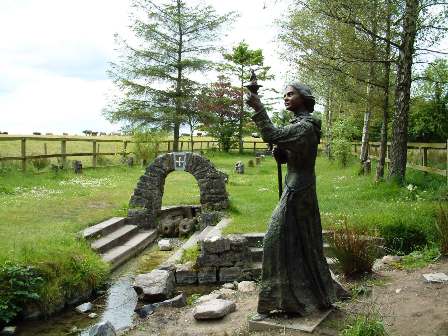
Statue of (Saint) Brighid at Kildare. Sculptor: Annette McCormack

"The eternal flame at Her convent at Kildare suggests its existence as having been pagan and/or Druidic. The shrine at Kildare is assumed to be a Christian survival of an ancient college of vestal priestesses who were trained and then scattered throughout the land to tend sacred wells, groves, caves and hills. These priestesses were originally committed to thirty years in service but, after this period, were free to marry and leave. The first ten years were spent in training, ten in the practice of their duties and the final ten in teaching others, similar to the three degrees of initiation found in most traditions.

These women preserved old traditions, studied sciences and healing remedies and, perhaps, even the laws of state."

(Order of Bards, Ovates and Druids, Brigid: Survival of a Goddess)


"St. Brigid is associated with perpetual, sacred flames, such as the one maintained by 19 nuns at her sanctuary in Kildare, Ireland. The sacred flame at Kildare was said by Giraldus Cambrensis and other chroniclers to have been surrounded by a hedge, which no man could cross. (...) The tradition of female priestesses tending sacred, naturally-occurring eternal flames is a feature of ancient Indo-European pre-Christian spirituality."  
(Wikipedia, http://en.wikipedia.org/wiki/Brigid)

"The shift from Mother Goddess to Virgin Mother to Virgin Saint presented difficulty. Even though it insured Her survival and the emergence of Her power in Neo-Paganism, the emphasis on virginity stemmed completely from the Christian patriarchy. She derived power at the expense of other women, removing motherhood from its revered position in Celtic society."
(Order of Bards, Ovates and Druids, Brigid: Survival of a Goddess)

  • Sources and links:
-Wikipedia, Brighid
-Order of Bards, Ovates and Druids -  Brigid: Survival of a Goddess
-Wikipedia, Solar Deity
-Wikipedia, List of Solar Deities, Solar Goddesses
-Sun Goddesses
-Wikipedia, Brigantia
-Wikipedia, Isis
-Goddess Gift - Symbols of Isis
-Animal symbols
-Essay on Brighid by Susan Morgan Black. Downloadable as pdf.
-J.R.R Tolkien, The Silmarillion
-J.R.R. Tolkien, Book of Lost Tales I
-J.R.R. Tolkien, Morgoth's Ring
-Tolkien Gateway, Varda
-Tolkien Gateway, Arien
-My study about Warrior-women in Tolkien's works (uploads pending).

Wednesday, 6 January 2016

Critisizing Plain Jane part 7: Episode 1 final part

Part 2: Opening credits
At last - The final part of my review-commentary of the first episode of this horrific makeover show...

Part V:

-Summary: Cristen's makeover and training is nearly finished! She has learned that her own choice of comfy clothes and her hobbies make her look like a man (Women can't dress comfy and the only feminine hobbies are make-up and shopping!). She has somehow agreed to go through a ridiculous torture phobia experiment for the viewers' entertainment and a warped vision of what her priorities are in life. She has conformed to a one-choice-only compulsory ideal of how women should be dressing - High heels very much included. She has learned to objectify herself for men in a burlesque club as a key part in her training. And she has learned to flirt with strangers while being zapped like an animal in training.
 Now only her physical makeover remains! Because women, take note: You are never enough, and your hair and face will always need chemical products and make-up in order to make you look attractive.
"This is it! This is the transformation! Big time, OK!"

Are we in the Capitol, by any chance? Nope, Effie is way more awesome. Duh.

As the first part of the physical makeover, the stylist takes Cristen to an 'amazing hair stylist' and a 'stylist to the stars' in order to change her hair.

Cristen is 'terrified', and she says that she 'has never dyed her hair' and judging by her body language and her state of panic, she very obviously doesn't want to. Another similar reaction to the one that she showed in the burlesque club. But we don't care what her boundaries and personal choices are (Louise the stylist jokes 'Look, she is shaking, this is worst than the snails!'), she should 'trust' them and she'll end up loving everything they do to her anyway, because that's what the non-existent logic of the show is about - a logic based on lack of consent, brainwashing, gaslighting and mental manipulation, by the way.
Consent doesn't matter because she's going to love it all anyway
-Discussion-rant: Now, long hair natural haircare is one of my biggest hobbies, and the way society tells women to treat their hair to be considered as attractive totally bugs me. Apart from the use of a lot of needless and potentially harmful chemicals in shampoos, conditioner and various 'hair treatments', it's all about:

 'Let's dye your hair with non-hair-friendly chemicals because your natural hair-colour is not good enough!'

 'Let's change your natural texture, not for fun, but because your own natural texture is not good enough!'

'Let's break and dry out and destroy your hair with heat tools, horrible brushes, backcombing and unnecessary chemical-ridden products! By the way, I’m a professional hair stylist and/or I work with celebrities.
’
And, of course, the classical 'Let's cut your hair shorter, it's too damn long and/or weird and/or apparently not sexy enough!', or the alternative ‘You should grow your hair longer or wear extensions, short hair is not feminine enough!’

This doesn't have anything to do with a woman dyeing, texturing or cutting/adding extensions/growing out her hair, for her own reasons and wishes, without anybody telling her she can only do so-and-so to her hair in order to look 'attractive' and thus 'socially accepted' (even though societal constructs will always have a degree of influence, our choices never come from the void). I can criticize the potentially harmful heat methods and chemical dyes in a general way, but that's about it, and it's her hair anyway, not mine. Not my business. 

What I can't stand is people (and society in general) telling us an interesting variety of lies, such as -

 1) The only way to grow long healthy hair is to buy our expensive and chemical-ridden treatments. Heat methods won't harm your hair as long as you use more chemical-ridden heat protection which doesn't even work. Backcombing the length and ends doesn't cause breakage. Using lots of alcohol-based products such as hairspray in a daily basis isn't bad for the hair. Etc.
(Stylist) 'You've never had (your hair) cut at the salon? This is like a dream come true!'

Because hair salons are sooooo hair-friendly and all the hair stylists are soooo capable and hair-knowledgeable, and because preferring to trim your own hair at home equals an awkward, messy, unattractive personality. I see.

2) And, more importantly, what they're telling us is: You are not good enough, you should conform to society’s idiotic rules all the time, and everything you do is focused on boosting your attractiveness so that men are interested in you and your life has value.
Me neither, Mycroft
Why exactly does Cristen need to dye her hair? She already had lovely dark reddish blonette hair last time I looked. What's this mania of dyeing everyone's hair every time? Is it red(dish) hair-hate, that is 'red and reddish hair is ugly' (something which I'll never be able to comprehend)? That's not particularly boosting anyone's self-confidence, if you're telling me her natural hair-colour is not enough, and her texture is not enough. And you're not taking into account what she wants. It's not because she fancies a change or wants to have fun with her hair. And let's not talk about how you're actually destroying her hair with the chemicals and heat and the tools.

She has "a lot of hair", so she's getting it layered. Naturally. Because thick hair is ugly, right? And if you have thin hair, you get extensions and backcombing and volumizing mousses. Because thin hair is ugly, right? The general message seems to be: Never feel confident about who you are to begin with.

Cristen is in a fit of hysterics (about everything, it seems) about someone changing her hair. Shouldn't this raise a few red flags? 'I've never changed my hair...OK, just do it! Just do it before I change my mind!'

That's interesting. Sounds like she was allowed to make her own mind about anything in the first place! Which she wasn't.

And I repeat, why colour it? Like, why? Does she even need it for a freaking date?  It's not even her choice! The message that she has to change her hair for her crush is freaking oppressive and sexist.

"Hello, brunette, goodbye blond". First of all, her hair-colour is more dark strawberry blonette than just 'blond', in my opinion. But anyway, why exactly has she got to turn brunette in order to get off with this guy? Is she going to look sexier if she's dark-haired? Will she flirt better? Does the guy need to see her changed to like her? Is this the ‘dumb blonde’ stereotype at work? We’re not over it yet, apparently.

"Your skin looks so much better" Nice way to tell this increasingly insecure girl that she’s going to have to keep dying her hair for her whole life because the guy would prefer her like that, and her skin looks so much better! Good job.

Oh, and good to know that apparently brunettes have more fun, because I’m not having a lot of fun right now. All I can say right now is -
Rose Tyler doesn't agree with all this rubbish
 While the 'celebrity stylist' begins ruining her hair needlessly with chemicals, he asks about her date, so we get another scene dedicated to glorify Tye, corny music included.
'He's tall, dark and handsome. He's just a really good guy, everybody likes him, anywhere you take him people always like him (...) And I'm really terrified.'
'He's wonderful in any way, and I'm terrified because I don't know if I'll be able to change enough for him to approve of  me'. How wonderful.

And so far, the only compliment she is getting is being told that she is 'gorgeous' when she conforms to the beauty standards Sexist Stylist and Co. impose upon her.

And like I mentioned before, a makeover includes either a haircut or extensions. I get mixed messages about this. Long hair is "sexy", apparently, but people always end up cutting, because 'too long' hair isn't all that sexy (and here, with too long hair we're talking about...BSL? In long hair forum standards, that’s not ‘too long hair’ at.all xD). But shorter hair isn’t all that “sexy” either, judging by the number of people who are forced to wear extensions in makeovers like this. Not to mention that short hair is deemed 'tomboyish' and 'unfeminine'. Guess there's no point in trying to understand their logic.

And of course, straighten it, then add waves again. Completely logical, I know. Anyway, always change your natural texture (even if you're sorta reverting to it in the end). Why not destroy your hair alongside your confidence and healthy mindset?

(Stylist) 'Thank you (...), this is just what I wanted' You, not her. Interesting that you don't even try to hide that.
"You're not gonna see yourself until the transformation is complete"
"You're my confident, elegant woman. You're my star tonight, you're the princess" 
You're on display, my dear, I'm sorry. Nobody cares about what you think about all these changes. You're supposed to love them, anyway, and they’re not for you, after all.
I'm so happy to be on display and to have my hair forcibly changed just for a guy!
Cristen and the stylist leave in a luxurious limusine car, making Cristen go 'wooooow'. She also gets ready (make-up and dress) in a penthouse suite. Interesting how people bribe and ensnare women into their suffocating gender roles and passive attitudes with pretty dresses, luxurious stuff (cars, penthouses, hotels, trips, cruises, rings, you name it), and parties. The whole structure of weddings and children's fairytales (Cinderella) easily fall into this sort of strategies. Looks like we can't wear a pretty dress or go to a party, without also having to fit into a lot of suffocating feminine roles and social obligations and bindings.

In the limusine, the stylist urges Cristen to really think what's she's going to say to Tye during their date, because she 'only has one shot'. Because Tye is always going to be the one in control of all the decisions, the one who decides if he wants Cristen or not. Like Cristen replies, 'No pressure!' Not only that, but also - Hell of a healthy equal relationship, if you have to undergo an intensive makeover and worry endlessly about the guy maybe not wanting you!

Also, featuring Cristen being brainwashed and, in turn, brainwashing other girls with her warped version of what 'confidence' is:
(Stylist) 'Think about all the things you've learned in the last 48 hours. The new you, the confident you.'
(Cristen) 'I am feeling a lot more confident after all the crazy things you made me do (laughs)! I've started to realize that well, if I can do all these things I didn't think I could do, maybe I can tell Tye.'

The next part of the makeover is, of course, the compulsory make-up session. Because women always have to wear make-up so that men find them acceptably and sufficiently attractive. Fake eyelashes, obviously. Everything she doesn't really need, all in order to make her think she is not enough. Also, on a different note, the stylists and hairdresser's in this wonderful show seem to do a pretty sloppish and slapdash job most of the time, in my opinion. So much for being 'professional'.

Make-up should be a choice and something women did for fun and for themselves, although it's also a 'choice' which has its roots in the femininity construct of our current society, something that choice feminism forgets (issue discussed here). ). Make-up is not a 'feminist' choice, because it does nothing to subvert the status quo, but it certainly shouldn't be something we put on our faces for other people (and mainly men) as the only way to feel attractive and make others see us as attractive.

"Oh my gosh! You look like a princess!" exclaims the stylist as soon as she sees Cristen with her make-up on. The only kind of compliment she needs, and she'll only get it if she dyes her hair and puts make-up on, of course.

Cristen is at last allowed to look in the mirror, now that hair and make-up are all done, and she has her dress and high heels on.  She's now "A sexy brunette" (apparently brunettes are the only ones allowed to be 'sexy') and Cristen, with a corny musical background, exclaims -

"Wow! I don't look like myself (who I was before was all wrong, it wasn't the real me until someone forced all this on me). I kinda look like a movie star"
This is who I wanted to be all along, I just needed someone to force it on me!
No offense, but she actually doesn't look that different, apart from the fact that they have forced a new clothing style (seriously, what a hideous dress *cringes*) and hair-colour on her, and apart from the fact that she is wearing (sloppy) make-up. I actually think she was way more beautiful before (if she had chosen these changes, I woudn’t even state my inner opinion, because I also hate the 'you always look better in your natural state' aggressive approach, but it wasn't her choice).  And pray, continue telling us how this makeover has shown her how she really is, and that all these useful tips she's been getting has made her more confident. Do you forget that this is all for a freaking guy? What is that? That that's women's role in life, to go through makeovers for  men? Oh yes, I see, sorry, didn't realize that.
Basically, what this stylist does is taking impressionable girls and forcing HER own style on them, plus a lot of sexist bullshit >_<
"Is that person sexy? Is that person a woman? Is she confident? She ready to get the man she loves?"
Seriously. Shut up.

-You're  saying she wasn't a woman before (well, she wasn’t, was she, she was a man because she wore plaid shirts and played the guitar and had male friends!).

-You're saying makeovers fix anything. Way to go, telling that to an impressionable young woman.

-You're saying a woman without a makeover is basically not confident or a woman.

-You're saying the word 'love' when you shouldn't even use that word in this freaking shallow, sexist context.

-You're saying that a woman should do all this when she has a crush or wants to date someone. Cristen is only be 'ready to get the man she loves has a crush on' after she's had a makeover.

Has Tye gotten a makeover? Nope. He also doesn't really mind he's going on a blind date. He says he's 'a little apprehensive', but "I guess it could go either way". Yeah, he definitely feels no pressure, he hasn't got to change in any way and he is in power to choose if he wants the girl or not. And I get it, many men have been taught not to make a difference as long as the woman in question is sexy, so what does it matter which woman is presented to him? We learn afterwards that Tye actually liked Cristen in a romantic way, so - Why is he so cool to date a random woman in a blind date? He must really like Cristen all right. Also, he isn't called 'shy' or 'awkward' for not talking to her about it, either.

Oh, enter sickly romantic music and clichéd candlelit dinner scenario. Yay.

Tye is waiting in comfy clothes, seated and drinking wine. Close-up of her high-heels as she goes down the stairs (such an important part of a woman! It's almost as if all those high-heeled close-ups in the media are dehumanized, although I'm sure that isn't the case *sarcasm*).
Because she's a 'woman' now, not a 'guy' in comfy shoes.
Tye, depicted as your stereotypical (and unfortunately, often not that stereotypical) shallow and traditionally 'masculine' guy, gapes and goes "Oh my goodness, you look incredible!" Basically the only thing that matters. Cristen follows his cue, replying with a "Really??" that desperately needs his approval. Hell of a lot of confidence she has gained.
Ideal relationship: Her undergoing a full makeover so that he can only see her as a pretty shell.
Tye keeps on talking about how astounded and satisfied he is about her makeover: "Your hair!  Aaaah! Yeah! Wow! Oh my god! I am astounded! I don't know what to say"

Apart from being astounded by her makeover-red appearance, you mean? Clearly.

Yay gentlemanly chivalry. He has to get the chair for her, handle the champagne. That's the prize you get for having a makeover, girls. Just be pretty and submissive, he'll treat you in a chivalrous (and patronizing) way and ‘do everything for you’ (hell of a role for a man as well). Cristen's role is that of a pretty object who giggles and laughs at his every comment. An ideal role-model and so confident. Meanwhile, our favourite stylist is stalking the whole thing.
Doing everything for him in exchange for him assuming I'm so useless  I can't even sit without help. Seems legit.
'Awwww...He's so cute!!'
Tye keeps an entitled (and very dumb) smirk all the time. Dude is pretty much an idiot, but nothing is expected of him, so that's OK. Cristen, now that she's ready with her makeover, begins telling him she likes him, and once again, we hear how wonderful this guy is. He's a wonderful friend, apparently. Is she a wonderful friend? Is she something more than potentially sexy? We don't get to know it.

And can we please talk about the fact that he apparently had a crush on her for a few years? Why are we not talking about how self-conscious and Plain Joe he is for not talking either? Don't frigging throw me the 'he already liked her and knew her for years, he’s such a Nice Guy' card when he's only prepared to talk about it now she's had a makeover because that kinds paints him as a shallow asshole, not a nice guy.

(Cristen) 'Why didn't you tell me?'
(Tye) 'Why didn't you tell me?' Because I can never be considered the Plain Joe here.

Also, if he had a crush on her before, that included her former self with her former style. Which brings me to the beginning. Is a makeover really necessary, folks? How about teaching people to express themselves in a direct way with no misunderstandings, and I'm talking about both of them? Less imposed flirting and stupid gender roles and more communication, please. The sad thing is, we are not supposed to think 'great communication flaws from both of them'. No, we're supposed to think 'See, it all worked out because Cristen gained confidence by conforming to societal gender roles and had a makeover'. That was what made her tell him. The fact that he stayed silent too, we don't care about that.

So this last paragraph isn't in any way intended to glorify Tye for appreciating the 'true Cristen' in her former self. Also, he's clearly very satisfied with her makeover, and she also keeps on maintaining the stereotypically feminine and attractive look after they start dating.

After this oh-so-romantic revelation, they start dancing.
Happy gender roles for everyone!
"This is so romantic I feel like I'm in a movie"  That strategy I was talking about before, make everything glamorous and interesting and alluring and people will swallow all your gender roles willingly.

Tye can only say: "I'm ecstatic to be here. I can't believe the way you look!"
That’s all he’s processed. All the guys are plain idiotic dumbos in this show. But he had a crush on her before, remember that. Only he chose not to mention it until she went through a whole makeover. That's a coincidence!

'I'm so glad it was you'  But he was open and happy to try it with the random girl anyway!

And of course, Louise has to have her final say: "That's another plain Jane converted. Another wallflower has blossomed and found romance. I'm so happy. My work here is done."
Yuck.
And notice that he isn't called a wallflower or shy because he didn't tell her and that he hasn't had to change anything about himself.

Three  months later. Oh look, she's still allowed to play the guitar and be a woman! But of course, she has to dress feminine and sexy and wear heels while she’s doing it or she will be mistaken for a man again.

But, wait for it, this is what the guitar is for now:
She, singing - "I like thinking of cool stuff to make (you)".
He, singing: "I like eating cookies that you bake" 
Ughghjhdkghjhkjghfkj


She, singing: "I like diamonds even when they're fake" Because a relationship that doesn't end in marriage is worthless!

Oh my gods, oh my gods, *fangirling* such a balanced relationship with so few gender roles, all the feels, oh my gods, it’s so cute and romantic I can’t even!

*EPIC FACEPALM*