Tuesday, 1 December 2015

Doctor Who feminist reviews - 'Mighty Kublai Khan'

-Doctor: First
-Companions: Susan (the Doctor's granddaughter), Barbara Wright (Susan's history teacher) and Ian Chesterton (Susan's science teacher).
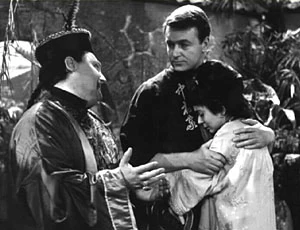
-Episode: 'Mighty Kublai Khan' (Classic Who, 1964. Season 1 Marco Polo story part 6/7). Only some pictures and the audio narration remain.

My first Classic Who review! And yes, I'm starting with part 6/7 because 1) Timey-wimey stuff xD and 2) I read an article in September's Doctor Who magazine (DWM), which led to me watching-listening to the episode, which led to this review.

Synopsis here. This review contains SPOILERS.

-Sexism, feminist content and the role of women:
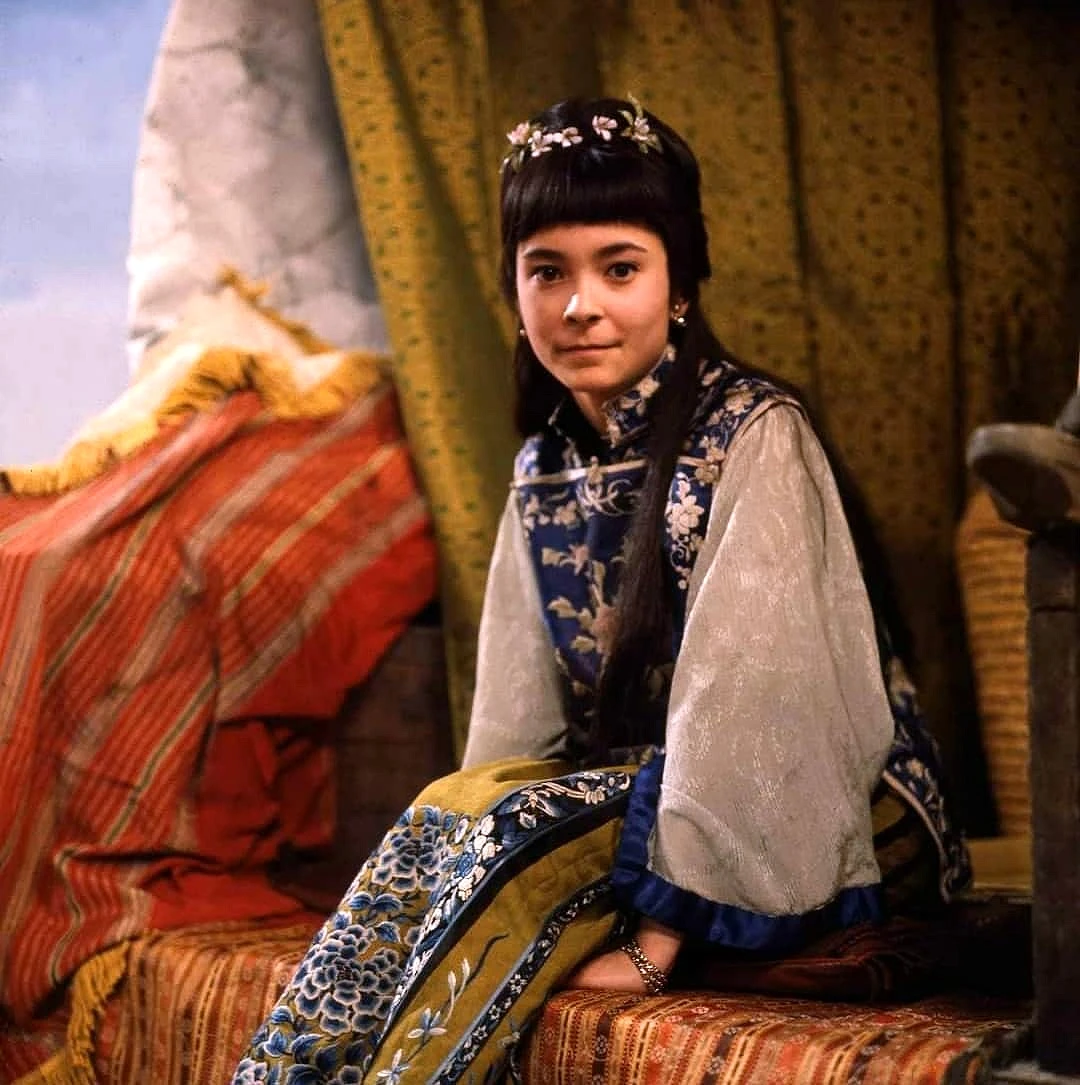
  • Number of women: 3 - Susan, Barbara and Ping-Cho. Court noblewomen in the background.
  • Bechdel test and female bonding: Yes - Susan and Barbara. Susan and Ping-Cho (very briefly, and one-sided, with Ping-Cho saying 'Goodbye, Susan' to a sleeping Susan in the room they share, just as she is ready to escape from the inn).
  •  Empowered traits in at least one female character? Susan and Barbara speak out against a sexist arranged marriage and Ping-Cho shows agency when trying to escape said marriage.
  • Feminist content in the script:  Criticism of arranged marriages. Susan and Barbara speak out against Ping-Cho’s arranged marriage with a man way older than her, and Barbara says that Ian and the Doctor are against the arranged marriage as well:
"TEGANA: Ah, all their sympathies are with Ping-Cho. They are all against this marriage. 
POLO: Then why did Ian go back to look for her? 
TEGANA: Exactly. 
(Susan and Barbara enter, laughing.) 
TEGANA: I'm glad to see that your humour is not impaired by our misfortune. 
BARBARA: What do you mean? What misfortune? 
TEGANA: Well, your friend Ian has not returned. We can only assume that he's failed to find Ping-Cho. 
BARBARA: Oh, you haven't given him enough time yet. 
SUSAN: Anyway, I'm glad. I hope he doesn't. 
TEGANA: Oh, I see. You want to see her alone, do you? Without friends? She might be kidnapped, murdered. 
SUSAN: Well, that won't happen to her. She's got money. She can buy a safe passage home. 
TEGANA: Money! Are we all sit in fear for her, and her intended husband sits in despair? 
SUSAN: Oh, even you couldn't be so cruel as to want her to marry a man four times her age. 
TEGANA: Even I? I thank you, lady. And this is your opinion too, I suppose? 
BARBARA (snarky): I suppose so. 
POLO: One moment. Are you opposed to Ping-Cho's marriage? 
BARBARA: Look, why are we- 
POLO: Answer my question please. 
BARBARA: Yes I am. Completely opposed to it. 
TEGANA: How very unusual for you and Ian to disagree. 
BARBARA: It isn't unusual at all. We don't agree about everything. And in this case, we're in complete agreement. All of us. 
POLO: This marriage has the Khan's blessing. Am I to understand that you oppose it? Am I? 
BARBARA: Yes. 
POLO: All four of you? 
BARBARA: Yes, all four of us."
You go, girls!
  • Role of women in the episode
   - Susan fulfills a pretty passive role, being captured by Tegana at the beginning of the episode and threatened before the Doctor, Ian and Barbara in exchange for the TARDIS (damsel in distress trope). She does show assertiveness later in the episode when speaking out alongside Barbara against Ping-Cho's arranged marriage.
    -Although Ian does most of the action, going back for the escaping Ping-Cho, siding with her to search for the stolen TARDIS and confronting Tegana at the end, Barbara also takes some part in the events, speaking to Ian about the need to convince Marco Polo that they’re time travellers in order to recover the TARDIS ('Listen, we need the TARDIS. You must talk to Marco.'). But, although Ian seems to talk with her in a reasonably equal level and actually seems to want for her to try to convince Marco alongside him, Barbara merely advises Ian on what to do, but probably because, thanks to gender roles, Marco would hardly want to listen to her, not because of a lack of assertiveness: Afterwards, Barbara speaks out in a wonderfuly assertive way, alongside Susan, against Ping-Cho’s arranged marriage.
The damsel in distress trope appear twice in this eppisode, but that doesn't prevent all three female characters from showing some assertiveness and agency at least once!
   - Ping-Cho shows agency when trying to escape her arranged marriage with an older man by fleeing Marco’s caravan and attempting to join another, but is also portrayed as naïve (being tricked by the false caravan member - Kuiju, Tegana's accomplice-, who robs her) and her position in that society is, as expected, one of little power (for example, the man at the Cheng-Ting way station, Wang Lo, grabs hold of her and prevents her escape when he finds out she has run away, and Ian has to come to her rescue - another damsel in distress trope). She continues showing agency when siding with Ian, though. She also confronts Kuiju at the end of the episode, helping to disarm him and asking for her money back.

"IAN: Ping-Cho, why did you do it? 
PING-CHO: The key. And I can't marry a man old enough to be my grandfather. I can't. Please don't take me back. Please."
  • Level of sexism: Women are viewed as inferior in that society and time, as can be expected.
- Patronizing attitudes towards Susan and Barbara from characters such as Marco Polo, Mongol warlord Tegana and Kublai Khan (patriarchal chivalry in the latter's case: 'These gracious ladies also accompany you, Marco?').

- Male characters, such as Kuiju and Wang Lo, call Ping-Cho ‘little one’ and 'foolish child'/'silly child' in a patronizing and demeaning way.   In contrast, Ian treats Ping-Cho in a more equal (or at least respectful) way, and ultimately includes her in his plans to retrieve the stolen TARDIS and sides with her in order to confront Kuiju. 
Ian gains points by including Ping-Cho's in his plans to regain the TARDIS
-The Doctor also addresses Susan in a gruff manner in one occassion ('Oh, do be quiet, child.'). He seems to be like that with everyone from time to time, though, and he shows concern for Susan's safety and affection towards her at the beginning of the episode, handing over the TARDIS key to Tegana and Marco Polo immediately ('Tell that man to take his hands off my grandchild! (...) So long as you're safe, Susan. That's all that matters.').

-Racial issuesMany of the actors portraying Oriental characters are Caucasian or have non-Asian ethnicities. This is addressed by the episode's director, Waris Hussein, in DWM 485: "Waris is relieved to see a few Oriental-sounding names. "Can you imagine! Today they'd be rioting in the streets if we cast all these people as Orientals. I mean, Derren Nesbitt as Tegana. And Kublai Khan was played by Martin Miller, a nice little Jewish guy from Hampstead." "

In the story proper, though, "[Marco Polo's story] showed a mixed-ethnic group rather than a stereotypical collection of one race." (Source)

-Class issues:  
The Doctor opposes the Khan’s order to kneel and humble himself before him, and I loved that part, not only because of the Doctor's snark, but also because I choose to read it as a potential criticism of the classism and ridiculous snobbish attitudes of the 'royalty' sector, and not only as a humourous moment where the Doctor can't kneel down because of his sore back and ends up bonding with the Khan over their shared ailments.
"VIZIER: When great Kublai Khan appears, you will make your obeisance to him. so that he may look kindly upon you, and spare your worthless lives. 
DOCTOR: Pray then, what am I supposed to do, sir? 
VIZIER: Kow-tow. Kneel upon the ground and touch your forehead upon the floor three times. 
DOCTOR: I shall do no such thing! 
VIZIER: Kublai Khan is the mightiest man the world has ever seen. Not to pay him homage will cost you your head. 
DOCTOR: Well, if it breaks my back, then he can take all of me. So why waste time on small items?
(...)
(Everyone kneels down except the Doctor)" 

Bonus Doctor snark:
"KHAN: Doctor? Oh, is he? Are you, perchance, a physician? 
DOCTOR: I am not a doctor of medicine, sire, otherwise I should be able to cure these pains."

-Morals, empathy and integrity: The Doctor doesn't hesitate to hand over the TARDIS key to Marco and Tegana in order to save Susan. Susan, Barbara, Ian and the Doctor express their opposition and distaste about Ping-Cho's arranged marriage. Ian refuses to kill Kiuju ("IAN: I'll kill him. TEGANA: Do so. He is of no importance. (Ian pushes Kiuju away)").

Overall:
  • Things I liked
 -Susan and Barbara critisizing arranged marriages.
-The Doctor's snark and his refusal to kneel before the Khan.
-Ian's conversation with Marco about them being time-travellers.

"IAN: I come from another time. Our caravan, it not only covers distance, it can cross time. 
POLO: Travel into the past and the future? 
IAN: Yes. I know it's difficult to believe, but it's the truth."

Can't really judge about the episode in general (acting, cinematography, etc) without being able to see it, unfortunately, so that ends today's review. As to 'things I didn't like', I guess I'd include everything under the 'level of sexism' section (which is objective historical sexism which was to be expected and can be critisized), plus Tegana's character in general.

Tuesday, 3 November 2015

Visiting the Yorkshire Museum

During a September trip in York, I visited the Yorkshire Museum, so today's post is Celtic and Viking -themed, with a bit of female representation and a  female armour review thrown in.
  • Celtic
The museum's items were mainly Roman, Viking and Medieval, plus an exhibition about extinct species (and because I was reading the Doctor Who novel The Last Dodo at that moment, seeing dodos and dinosaurs there added a Whovian twist to the museum, which is always welcome :)!).

In the Roman section, there were some Celtic items, featuring the Stanwick Horse Mask, a small bronze model of a horse's head from the Iron Age AD 40-80, and horse harness pieces from the Stanwick hoard, part of a Brigantian chariot from the same period.

I had seen this horse model in more than one book about the Celts, and it was awesome to see this lovely piece in person (even though the glass reflection didn't make for the best pics):


Another thing that I liked about this part of the museum was the fact that the info panel about the Roman invasion and the creation of Eboracum (York) actually critisized the Romans' invasion of Britain and their treatment of the Celtic peoples they invaded ("Most tribal leaders accepted Roman rule in exchange for continued control of their land" ; "They also enjoyed the trappings of Roman society" - loving the sarcasm there ; "ruthless measures by the army" ; "to dominate"). 

All cultures are capable of invading other peoples' territories while being barbaric and power-hungry about it, the Celts are certainly no exception, and we shouldn't think in 'good' vs 'evil' or 'light' vs dark' simplistic terms when it comes to history. But too often do I see the British Celts being portrayed in a rather bad light (the 'barbarians' and 'uncivilized' peoples Romans had to fight against and try to 'coexist' with), instead of telling it like it was: The Romans invading the then indigenous peoples in their let's-build-the-biggest-Empire quest (same as the Celts had done centuries before!) and being pretty barbaric, ruthless and narrow-minded (other invaders actually tried to assimilate with the indigenous peoples a bit, like the Vikings in Ireland) during it all.
  • Vikings
Another part of the museum I was excited about was the section about the Vikings, who invaded Anglo-Saxon York in 866 and 867 (because everyone invades everything all the time :/), and renamed it Jorvik when it was given to them as part of the Danelaw.

The items in this part of the museum included weapons, coins, ornaments, buckles, decorated vessels and inscriptions (click for larger pics):


One highlight of the collection is the York helmet, made of iron and copper alloy and dating back to the 8th Century:


Another central item was the Gilling Sword, a two-edged iron sword from the 9th Century:

  • Medieval
And because I love swords, here is another interesting one from the Medieval-Norman part of the exhibit, the Cawood Sword, dating from the 12th Century, borderline between the end of the Viking period and the beginning of the Medieval period. This sword is in remarkable condition and has some kind of inscription in the blade which has not yet been deciphered, as it seems.


  • Female representation and stereotypes in the jousting game:
And to finish with this post about the Yorkshire Museum, I'm going to comment on the jousting game at the end of the Medieval section. In this interactive game you, as patron, choose one knight out of four options and purchase for them three items before seeing them joust (and invariably win, it seems xD). Most of the items you could choose are objects from the museum, so the game explained their background to you as you chose them.

Now, what I liked about this game was the female representation. We're used to seeing strict gender roles when it comes to Medieval settings, with active male knights and passive (and beautiful) damsels. However, even though this was the status quo of the time, history  nearly always seems to forget about all the remarkable women. They might have been a minority (thanks, once again, to the patriarchal status quo, which forbade women from doing pretty much everything), but still there they were: Warrior-women, wise-women and loremistresses, leaders and politicians, artists and writers. Gender bias sistematically ignores those existing women and refuses to create new ones in current Medieval (or other time period)-inspired games, films and other media, thus robbing young girls and women from yet another opportunity to identify themselves with an interesting and powerful female character. In fact, when the media (especially films and videogames) do include a Medieval (or historical)-inspired female character, she's usually clad in unrealistic armour and clothing, suggesting that her role as a 'strong female character' - more like 'sexy love interest' in most cases- is a façade and more male-oriented than anything else.  

In this game, however, out of the four knights one is a woman, Lady Eleanor, described as "an excellent horsewoman highly skilled in the use of a bow" (and apparently also highly skilled in the use of other weapons, judging by the pics and animations, where she is seen carrying a spear, sword - if you buy her one - and another weapons). This female knight also appears in a realistic suit of armour, complete with a reasonable shelf-plate in order to acommodate her bust (instead of the more questionable (and dangerous) 'boob plate'); plus reasonable shoe-wear, and no vital areas exposed (neck, collarbone and chest area, midriff, thighs). Her hair being loose is the most unrealistic part of her design, although there were some male knights who also sported flowing locks. She also lacks any kind of sexualized pose or gaze:


Seeing a woman, clad in realistic armour, as an option in an interactive game in a museum was so refreshing. Young girls (and women!) don't have to invariably choose a male character because there's no other option. And what's more, the female character isn't eye candy for anyone, she's wearing a highly realistic suit of armour and standing in a pose that's as active as the poses of the other male characters. Representation is so important.


Not everything is awesome here, though. The description of Lady Eleanor's character includes some questionable stereotypes as well: 

-For starters, she's described as 'beautiful', while the descriptions of the male knights don't comment on their appearance - Women's appearance, and the demand that they be beautiful, are still considered to be essential in all contexts, apparently. 

-She's also described as being 'too proud', another negative connotation that is too often aimed at active women, and another double standard, because many male characters can be active and capable without pride being their downfall, apparently (even though it often is in these kind of tales!).

-The worst part of the description, though, in my opinion, seems to try to undermine this female knight's warrior abilities by feeding people (and potentially a lot of children) the idea that women primarily use their 'feminine guiles' of seduction in order to get the upper hand. While it is sadly true that women have been, and are, forced to use their attractiveness and sex appeal in order to gain power because in this strictly gendered patriarchal society they literally don't have any other means in too many cases...I think it's sexist to assume that even a capable warrior-woman who seems to be allowed to go jousting in this Medieval-based scenario without having to pass as a man is going to use seduction as a weapon simply because she's a woman. It's also pretty unhealthy to teach children this.

-And to finish, the 'skills' section of the description mentions that Lady Eleanor can 'save her energy' because she has 'many servants to cook and clean for her'. This is omitted in the case of all the male characters in the game (but all nobles, and males more than anyone, all had servants to do stuff for them!). Why is it relevant only in her case and how is this a 'skill'? Another of her 'skills' include the fact that people bring her jewellery (and armour) because she's well-known. How is this relevant, especially the jewellery part, when it comes to her jousting skills, and why is it being called a 'skill'? 

 The 'skills' part of this description is seriously flawed, in my opinion, as awesome as the introduction of a realistic female knight is. Her 'skillset' includes people gifting her jewels (and OK, armour), having servants who cook and clean for her, and using her beauty as a weapon :/. This section definitely needs some work, equality-speaking. 

But apart from that, I was very happy to see more female representation in this historical games area :)

Monday, 19 October 2015

Tolkien talks - El papel de la mujer humana en la Primera Edad / The role of human women in the First Age

[English version below]

Durante la pasada EstelCon (la convención anual de la Sociedad Tolkien Española) en Alicante, organizada por las delegaciones de Edhellond, Mithlond y Umbar, presenté mi tercera conferencia dentro de la temática del feminismo y las mujeres en la obra de Tolkien. El estudio de este año trata el papel de las mujeres humanas en la Primera Edad, una continuación de la conferencia que propuse el año pasado acerca del papel de las mujeres elfas en la Primera Edad (material que aún no he subido a este blog y que tengo pensado subir en el futuro próximo).

En este primer post centrado en mis estudios de feminismo y Tolkien he subido la presentación de la conferencia sobre el papel de la mujer humana en la Primera Edad. En 2-3 posts futuros subiré mis notas con discusiones más amplias acerca de la posición de la mujer humana y cada uno de los personajes que aparecen en la obra, más las citas en las que me he basado en este estudio.

-Si quieres compartir: ¡Gracias! Pero siempre con mi nombre y con un link a este post, por favor. Sobre la utilización de este material en otros trabajos, por favor consulta las Condiciones de Uso.

-Nota rápida acerca de las gráficas: Los histogramas de barras y gráficos circulares que aparecen en la presentación no deben considerarse como un estudio científico de ningún tipo. Es una interpretación "estadística" totalmente subjetiva  (y, por lo tanto, alejada de la ciencia) de los roles y tipos de relaciones de las mujeres mencionadas por nombre en las obras de Tolkien ambientadas en la Primera Edad. Los gráficos con 'porcentajes mencionados' se refieren a aquellos roles mencionados de forma explícita en la obra (teniendo en cuenta para  los porcentajes sólo a aquellas mujeres con trama de las que se describe más que su nombre). En los gráficos con 'porcentajes asumidos', por otra parte, añado mis suposiciones personales acerca de los roles de aquellas mujeres que sólo aparecen mencionadas en la obra, sin ninguna información acerca de vida, historia o roles.


And the English version:

During the last EstelCon (annual convention of the Spanish Tolkien Society) in Alicante, organized by the local delegations of Edhellond, Mithlond and Umbar, I presented my third study about feminism and women in Tolkien's works. This year's study discusses the role of human women in the First Age, a continuation of the lecture I presented last year about the role of Elven women in the First Age (I have not yet uploaded the material from that study to this blog, I plan on doing it in the near future).

In this first post on my studies about feminism and Tolkien I have uploaded the presentation of the lecture I gave during the convention about the role of human women in the First Age. In a couple of future posts I will also be uploading my notes of this study -  my personal thoughts and extended discussions about the role of human women in each of the societies described in the books, and each individual female character mentioned in the stories, plus the citations I have used for the study.

-If you want to share: Thanks! But always including my name and a link to this post, please. On the usage of this material in other works and studies, please check the Terms of Use of this blog.

-A brief note on the graphs: The histograms (bar graphs) and pie charts which appear in the presentation are not to be taken as a scientific study. It's a completely subjective "statistical" interpretation (and thus very far from being 'scientific') about the roles and relationship types of the human women mentioned by name in Tolkien's works set in the First Age. The graphs with  'mentioned percentages' refer to those roles which are explicitly mentioned in the books (and for the percentages I have only taken into account those women about whom we know more than just their name). On the other side, in the graphs with 'assumed percentages', I add my personal assumptions about the roles of those women about whom we only know their name (and no additional information about their lives, story or roles).


-Acerca de las ilustraciones: La autoría de todas las ilustraciones utilizadas en esta presentación ha sido citada y acreditada. No hay ningún inconveniente en reemplazar y/o eliminar alguna de estas obras si el/la autor/a así lo desea, por supuesto. Este estudio no tiene ánimo de lucro.

-About the illustrations: The authors of all the artwork shown in this presentation have been duly mentioned and credited. Artists, if you see this and wish for any or all of your works to be substituted and/or removed, please let me know! This study was made with the sole aim of fun and learning. This is a non-profit work in every way.

Follow the artists and browse their works here:
-Elena Kukanova (Ekukanova)
-Olga G. (Steamey)
-Julianna Pinho (jubah)
-Marya Filatova (Filat)
-alackofghosts
-Jenny Dolfen (Gold-Seven)
-andi-scribbles
-n924
-VenGethenian
-Alan Lee
-Ted Nasmith
-ForeverMedhok
-Matěj Čadil (matejcadil)
-lomehir
-enanoakd
-TurnerMohan
-Murrauddin
-Ainarian
-LOTR Online, Starry Mantle

Sunday, 30 August 2015

Madrid National Archaeology Museum: Greek gender roles and female invisibility

Ancient Greek women doing house chores (author unknown to me)
A couple of days ago I visited the local National Archaeology museum again, so today's post will be about Ancient Greece, and I'll be writing about the intense gender inequality of ancient Greek society, mostly by commenting the exhibit quotes and descriptions.

 The exhibit descriptions seem to have been written, in general, with the aim of critisizing the intense misoginy and strict gender binary of the ancient Greek society - Which is a good thing, sexism in history should be taken into account and critisized way more often. Especially when we're dealing with a society that's often way too romanticized and where women were recluded to the home, stripped of practically any human rights and relegated to the traditionally 'feminine' roles of house activities, making themselves beautiful for their husbands, and child-bearing. 

But of course, nothing is perfect: The first thing I'd like to critisize about the Greek area of the museum is that there are some examples of sexism by omission in the Spanish versions of some of these descriptions, by referring to the whole of humankind with only male terms: 'Man' vs 'Human', two words which shouldn't be synonyms. 'Man' used in this context is exclusive, seeing as there's no mention of women in the wording. Also, they take gender into account, which isn't necessary, either (the term 'human' doesn't include a gender connotation) - Not only is this excluding women, but people who identify as agender, non-binary and genderqueer as well. And lastly, it introduces ambiguity, because sometimes 'man' used in this context could be read as 'male' - and in a description about gender roles, ambiguity is even the more probable.

Sexism by omission and sexist language: The problem of  'man' as a general term (Source
Another thing I'd like to comment about the Greek exhibit descriptions is that sometimes the texts don't seem to critisize the misogynistic and gender biased aspects of the society as strongly or non-ambiguously as I think they should, and this could be problematic. Given that some statements seem to be written in a purely neutral way, or simply devoid of any direct criticism, they could be interpreted quite literally by people who don't exactly come to the museum to question their patriarchal-based and gender-biased upbringing. Like another blogger said here, people could easily read quotes such as 'I am grateful for being born a man and not a woman', displayed devoid of connotations against the inherent sexism of the quote, as a continued assertion of male superiority rather than as a feminist criticism of the sexism among the Ancient Greeks. In these cases, I think we need direct criticism, not subtlety.  

  • The sexism of the Greek gender binary
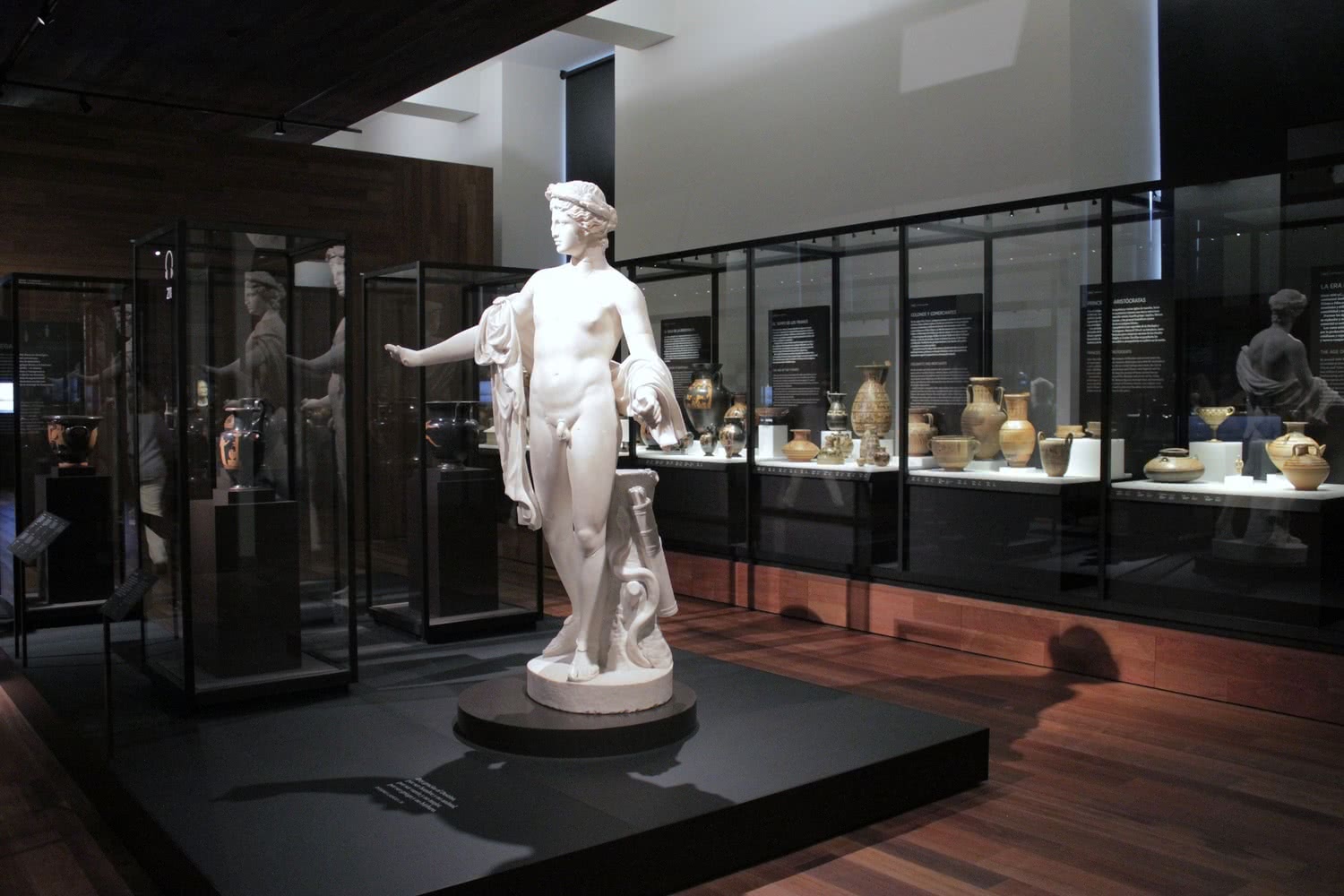
Entering into the Greek section of the museum, we are greeted by a statue of Apollo accompanied by this quote (translation below):

"Doy gracias al Destino,
por ser hombre (un ser humano) y no animal,
por ser varón y no mujer,
 por ser griego y no bárbaro
 (Diógenes Laercio I, 34)"

(Sobre la tradución española: La palabra 'hombre' es usada incorrectamente en lugar de 'ser humano', ejemplo de sexismo por omisión en el lenguaje. Además, en el original griego se diferencia entre 'humano' (ἄνθρωπος, "ánthropos"), la palabra usada en esta cita, y 'varón' (ἀνήρ, "anḗr"). En la traducción inglesa (ver abajo), se traduce correctamente como 'human being'. 

Por otro lado, la referencia a la obra está inacabada: Vida de los filósofos más ilustres, I, 34)

"Hermippus in his Lives refers to Thales the story which is told by some of Socrates, namely, that he used to say there were three blessings for which he was grateful to Fortune: "first, that I was born a human being and not one of the brutes; next, that I was born a man and not a woman; thirdly, a Greek and not a barbarian." [34] "

(Source: Tales de Mileto (ambiguo) citado por Diógenes Laercio en Vida de los filósofos más ilustres I, 34 /Thales of Miletus (ambiguous) quoted by Diogenes Laertius in Lives of Eminent Philosophers, I, 34)

And the Greek original:

Ἕρμιππος δ᾽ ἐν τοῖς Βίοις εἰς τοῦτον ἀναφέρει τὸ λεγόμενον ὑπό τινων περὶ Σωκράτους. ἔφασκε γάρ, φασί, τριῶν τούτων ἕνεκα χάριν ἔχειν τῇ Τύχῃ: πρῶτον μὲν ὅτι ἄνθρωπος ἐγενόμην καὶ οὐ θηρίον, εἶτα ὅτι ἀνὴρ καὶ οὐ γυνή, τρίτον ὅτι Ἕλλην καὶ οὐ βάρβαρος. 16 [34] (Source)

Alongside the statue of Apollo and this magnificently narrow-minded quote, a gem from ancient times indeed, we find texts seemingly critisizing the quote by commenting on 'men', 'women' (both the traditional role and the antithetic role of the Scythian Amazons in 'mythology'), 'animals', and 'foreigners':

"El hombre:
El varón define su identidad a través de conductas que entiende como virtudes. Debe ser agresivo, competitivo, autocontrolado, sociable y respetuoso con los dioses, excelente en suma. Los inmortales, espejo del comportamiento masculino, encarnan estas virtudes en su más alta expresión."

"Men:
The male defined his identity through forms of behaviour which were regarded as virtues: He was supposed to be agressive, competitive, self-disciplined, sociable and respectful to the gods. In sum, he was to be excellent. The immortals - the mirror of male conduct - embodied these virtues in their highest form of expression."


"La mujer:
El mundo femenino representa una amenaza, podría subvertir el orden del varón. La mujer se concibe como irracional y caótica, un ser que se deja llevar por sus impulsos y emociones. Necesita ser socializada a través de la educación y el matrimonio. Sólo el hombre puede inculcar los valores de la femineidad domesticada. Es el contrapunto social."

"Women:
The female world represented a threat, something with the potential to undermine the order of men. Women were regarded as irrational, deranged creatures who allowed themselves to be carried away by their impulses and emotions and had to be socialized through education and marriage. Only men were equipped to inculcate the values of domesticated femininity. Women were the social counter-model."


"Las Amazonas:
Mujeres guerreras que viven en los confines orientales del mundo, las Amazonas rechazan vivir bajo el dominio masculino. Representan la alteridad absoluta frente a la mujer sometida y a la convivencia ordenada de la sociedad griega. Son mujeres salvajes y bárbaras. Son el contramodelo mítico."

"The Amazons:
The Amazons were female warriors who lived at the eastern ends of the world and refused to live under male domination. They represented absolute otherness, the opposite of domesticated women and the orderly coexistence of Greek society. Wild and barbaric, these women were the mythical counter-model."


"The scene depicts the struggle between Theseus, the young Athenian hero, and Hyppolita, Queen of the Amazons. During the years of Pericles' government, this legend was used to simbolize the triumph of civilisation, embodied by Athens, over savagery."

I choose to read phrases such as 'wild and barbaric', 'the orderly coexistence of Greek society' and 'the triumph of civilisation over savagery' as sexism that it's being critisized, but it's highly ambiguous and very poorly worded and expressed, with the problems I was talking about at the beginning of this post: People who don't come to the museum to question gender roles and sexist mindsets could perfectly interpret phrases such as these as not being critical at all, and could exit the museum thinking that 'Yes, the Amazons were wild, barbaric women because they didn't want to obey or be with men, in the orderly Greek society (because gender roles are traditional, have been there for centuries, and rock my socks), and that makes them barbaric and savage. Also, they're wild and barbaric because they were warriors, which is a monstrosity because women aren't supposed to be warriors, dude! They should be having children and staying at home like the civilized and orderly Athenian women!'   Don't tell me we don't have way too many individuals in our modern 'orderly society' who still think like this.
  • Daily life and gender roles:
Ancient Greek women and traditionallly 'feminine' roles: Weaving and making clothes, keeping beautiful for the males (Author unknown to me).

Most of the exhibits were focused on daily life and the often rather ambiguously critisized gender roles having to do with education (the men's world), feasts and parties (the men's world), the home (the women's world), marriage (the women's world, and the turning point of her 'career'), children (the women's world) and death (more or less gender neutral, although the women are the ones who should be lamenting). And like I said before, the descriptions are generally either purely neutral, seemingly critical but ambiguosly worded, and, only sporadically, directly critical.

 This more feminist approach can be found at the very end of the exhibition, at the 'touching objects' area (which is also aimed towards blind people), and very clearly reads "Female invisibility vs Male visibility":

(Female invisibility/ male visibility)


"Las principales actividades de la mujer ateniense tenían lugar en el ámbito del hogar. Bajo la tutela del esposo, después de haber estado bajo la de su padre, se encargaba del gobierno de la casa y de la educación de sus hijos mientras eran pequeños. Rara vez salía del hogar.

Como contrapunto, y frente a esta invisibilidad social de la mujer, el hombre participaba plenamente en la vida pública. Recibía ya desde la infancia una esmerada educación, participaba en el gobierno y en la defensa de la ciudad y podía relacionarse con sus iguales en el gimnasio, el ágora o el banquete, ámbitos específicamente masculinos."


My (free-ish) translation:
"The main activities of the Athenian woman took place at home. First under the guardianship of their fathers and then of their husbands, they were supposed to take care of the house and of the children's education while they were young. They seldom left the house.

As a counterpoint to this female invisibility, men took an active and full part in public life. They received from their childhood a thorough and careful education, participated actively in the government and the defense of the city, and were able to socialize with their equals in the gym, the agora or during feasts, all areas which were exclusively masculine."

Now, I think this is adequately worded as being informative and historically objective, but also critical ('female invisibility', 'male visibility', 'they seldom left the house', 'as a counterpoint men took an active part in public life', 'were able to socialize with their equals',...). This doesn't give the ambiguous vibe that maybe gender roles are cool and acceptable because it 'the ways things were (and are)' and 'part of an orderly society'.

More excerpts from the gendered Ancient Greek daily life shown in the exhibit

"El banquete:
Las relaciones sociales de los varones griegos giran en torno a la bebida en común, la fiesta del simposio. Dentro del ocio colectivo masculino, el simposio reúne a varones de una misma clase social para compartr amistades, intereses y placeres. (...) Las reuniones se prolongan hasta el amanecer, entre cantos, poesías, charlas de filosofía y política. Las heteras, cortesanas, amenizan el banquete. Ellas son también parte del ocio masculino. (...)"

"The banquet:
Social relationships between Greek men revolved around drinking in fellowship, at the symposium.  Part of the male collective leisure activities, the symposium gathers men of a same social class in order to share friendships, interests and pleasure. (...) The reunions go on until dawn, amid songs, poetry, philosophy chats and politics. The hetairai, courtesans, liven up the banquet. They are also part of men's leisure."
Greek  men at a party, entertained by high class female prostitutes (hetairai), dancers and musicians. 'Free' and 'respectable' women were not allowed to take part in these feasts at an equal level, the sole role of women in Greek feasts was to entertain and serve men, catering to their every pleasure (Author unknown to me).

"La buena esposa conviene que mande en los asuntos de puertas adentro de la casa...sin prestar atención a los asuntos públicos...Una esposa de vida ordenada debe considerar que las normas de su marido le han sido impuestas como ley de su vida."
                                       (Pseudo-Aristóteles, Económico, 140-1, Rose)

"A good wife must only govern those matters from within the home...without minding public affairs...A wife with an orderly life must take into account that the rules of her husband have been imposed to her as an inevitable fact of life."

"La boda:
La boda es el rito de iniciación a la vida adulta para las mujeres griegas y la consolidación de su destino social. Representa el abandono de la infancia, de su estado de doncella, y el ingreso en el mundo ordenado y reglamentado del varón. Su papel será dar hijos legítimos y perpetuar la familia. Las etapas de la ceremonia escenifican este cambio: la ofrenda de los juguetes infantiles, el baño ritual, la espera y el rapto nocturno por el novio, el alegre cortejo en carro nupcial hasta su nuevo hogar, en el seno familiar del marido. Allí se despojará de su velo de pureza. El ajuar, la dote y los regalos materializan el lenguaje simbólico y el prestigio social del momento culminante de la vida femenina."

"The wedding:
Marriage was the rite of passage through which a Greek woman entered adult life and confirmed her future social fate. It represented the end of her childhood and maidenhood, and her induction into the rigid, orderly world of the male. The woman's purpose in life would be to bear legitimate offspring and ensure the family's continuity.
The different stages of the marriage ceremony enacted this transition: the offering of children's toys, the ritual bath, the wait and the bride's nocturnal abduction by the groom, the festive procession in a nuptial cart to her new home, where she would be surrounded by her new husband's family and the veil symbolising her purity would be removed. The dowry and wedding gifts expressed the symbolic importance and social prestige of this moment, the high point of a Greek woman's life."

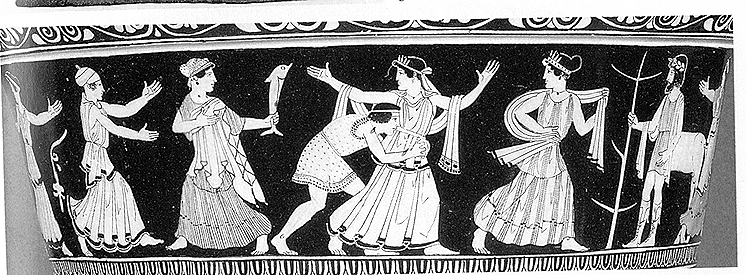
The worrying ritual of 'abducting' the bride glorifies sexual assaults, violence against women and lack of equality in a relationship. The inspiration for this troubling and misogynistic ritual comes from the abduction and rape of the poor Goddess Tethys by the jerk and scumbag Peleus, a human who hasn't been taught anything about consent (we also know that a society is deeply patriarchal when not even goddesses are safe from being assaulted by male humans):
Because abducting and sexually assaulting a woman is so romantic, and something to glorify and to have as the ideal model for every wedding. Naturally.
"El mito de las bodas de Tetis y Peleo:
El rapto de Tetis en presencia de sus hermanas, las Nereidas, es el preludio de la boda más gloriosa de la mitología griega. (...) La imagen idealizada del mito, frecuente entre los regalos nupciales, se utiliza como referencia modélica para la novia ante tan decisivo tránsito (sí, muy "romántico" todo)."

"The myth of the wedding of Tethys and Peleus:
Peleus abducted Tethys in the presence of her sisters, the Nereids.  Afterwards the lovers (ahem...lovers??) celebrated the most glorious wedding in Greek mythology. (...) The idealized image of this myth, commonly featured on wedding gifts, was upheld as a model for the bride in this life-changing transition (oooh, I'm being symbolically abducted, it's soooo romantic!)"


"Las edades de la vida:                                 
El ciclo vital, desde su comienzo, el parto y la infancia, hasta el final, la vejez y el llanto por la muerte, son tareas de exclusividad femenina. La vida se gesta y se cierra en el oikos.
El cénit de la existencia en Grecia es la juventud. En ella se alcanza la más perfecta expresión de la femineidad y la masculinidad. Dos destino diferentes se diseñan para los hijos: la niña, ya mujer, regresará al oikos; el niño, ya hombre, se integrará como ciudadano en la polis
Las distintas etapas de la vida están marcadas por ritos de tránsito, protegidos por Ártemis y Apolo y regulados por códigos sociales y religiosos que sancionan los distintos grupos de edad y de género."

"The stages of life:
The circle of life, from childbirth and infancy to old age and the sorrow of death, was the sole prerogative of women. Life as conceived and came to an end inside the oikos.
In Greece, youth was the zenith of existence, the most perfect expression of femininity and masculinity. Two different fates were reserved for children: The girls, on reaching womanhood, would return to the oikos, while the boys were destined to become citizens of the polis on reaching manhood.
Each stage of life was marked by rites of passage, protected by Artemis and Apollo and governed by social and religious codes that distinguished each age group and gender."
  • Clothing


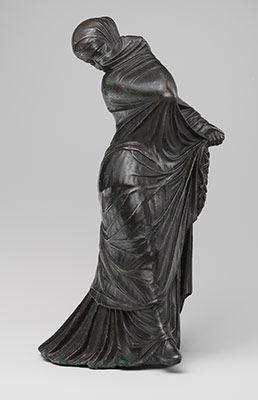
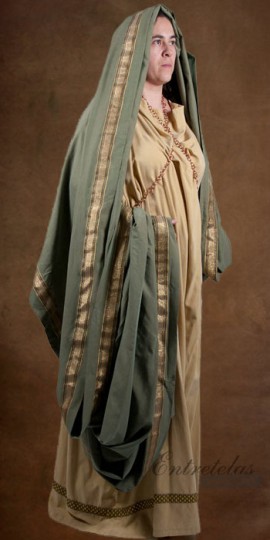
It's also worth mentioning that, while Greek male depictions are often of men with bare torsos, bare legs or fully nude, bare female torsos in the exhibit were pretty rare, mostly associated with female idols or the marriage section (the case of the female torso above). Greek women's clothing was actually very restrictive (patriarchal 'modesty' mindset acting as a way to control and repress women's autonomy and sexuality), something that many people, accustomed to seeing female nudes in Greek statues and idealized depictions of Greek fashion, may not be familiar with. Short tunics were only acceptable in places such as Sparta, ankle-length tunics were the norm. Hairstyles where the hair was partially or completely covered by a cloth or headscarf were also common (open hair or even loose strands were hardly worn), and women, especially married women, had to cover their head at least partially, and wrap themselves in an himation (mantle) when going outwhen they were actually allowed to be out, that is. Not dissimilar to the idea of today's burkas, the himation is 'a garment of decorous modesty' which disguised the shape of the woman's body in public, and which Hetairai also used as 'provocation' (in the same way veiling is used in 'exotic dancing' in the Near East).  This is quite a different idea from the idealized woman wearing the light tunic that we're so accustomed to seeing in Neoclassical and modern depictions of Greek culture, and not at all dissimilar from the religious-based head and body coverings typical of Patriarchal Monotheistic (and also polytheistic) religions. (There's a section on male and female Greek clothing in the pdf below)
Bronze statuette of a veiled dancer wrapped in an himation


"The Himation is a kind of cape, which can cover the whole body, if necessary. Especially adult, married women use it to cover the head, the shoulders, and the shape of the female body in public. (...) The Himation is a sign of social status and morals, similar to the Palla used later by Roman women." (Source)
Interesting contrast between the men's freedom of clothing (they could have bare torsos, bare legs or be naked) and female clothing (ankle-length tunics and frequent use of headcloths and mantles worn over the head and wrapped around the body when out). (author unknown)
"Outside the house, the hair is always put up and made into a bun on the neck or the back of the head. Additionally, the hair is held back by a band wrapped around the head or by a bonnet/hairnet to keep the hair in place. Very few women are depicted with loose strands or even open hair." (Source)
Janet Stephens' Grecian hair tutorials show how the hair was often partially or completely covered by cloths, as part of Ancient Greece's modesty mindsets for women. Even if the hair was not covered by a cloth/headscarf/hairnet, women usually had to cover their hair with an himation when going out, and it was rare to have loose strands or open hair, as opposed to the idealized depictions that we are accustomed to seeing in statues, 18th and 19th Century art, and movies.


"Greek women were expected to fully cover their bodies. For instance, a woman would not gird up her chiton like a man and display her legs in public." (Source)


And to finish the exhibit, there were some images of the goddesses Athena and Ártemis as a refreshing change from these enslaved and embowered Greek women. Only certain mythological female characters such as these couple of goddesses (who are Pre-Hellenic anyway) are allowed to take some of their own life choices, get involved in crafts, learning and martial arts and remain unmarried while hunting in the woods or taking arms, though. Unfortunately, empowered goddesses in Greek mythology aren't the proof we need to think that Ancient Greek women could do such things in real life.


To finish this post, I'd like to share an excerpt of The Ancient City, by Peter Connolly and Hazel Dodge, about the (oppressive) role of women in Ancient Greek society. My book is in Spanish, so Spanish translation only, sorry!

Wednesday, 19 August 2015

Gender bias and female invisibility at an Archaeological museum shop

Nearly one year ago, my mum and I visited our local Archaeological Museum, which had recently been restored. At the end of the visit, we went to the shop to browse and found a couple of items that we ended up buying: A fabric bag with a print of the Greek huntress goddess Ártemis for me, and a beautiful statutette of the Greek warrior goddess Athena in her chariot that I got for my mum to celebrate her upcoming final Master's proyect presentation :). 

Unfortunately, both of the labels and/or description of these items suffered from gender bias and sexism by omission. They are yet another couple of examples of how so many women - be they mythological, historical or contemporary-, are made invisible in this society, and of how the gender bias mechanism can work in order to promote gender estereotypes and make women - especially empowered or unconventional figures  - literally non-existent:


This is the Ártemis fabric bag, plus a cardboard cut-out of the goddess holding it. Now, I don't know who is in charge of labelling the products in these kind of shops, but to anyone who knows just a bit of Classical mythology, a depiction of a woman with a bow is probably bound to be the goddess Ártemis, an athletic and warlike goddess who hunts and runs in the woods apart from the other deities (and bonus points if she wears a short tunic, has lunar symbology or a tiara on, or is accompanied by a dog or stag). However, this bag was labelled as 'Bolsa arquera' ("Archeress bag"). The figure on the bag is recognized as being female, which is something (I guess the breasts are too obviosuly visible, although that isn't always a sure way to recognize a female figure as female! I've seen figures who are pretty obviously female being labelled as men because it suited the status quo or because the labellers were being blinded by gender bias). She isn't, however, described as the 'Goddess Ártemis', she's just a random woman with a bow. Ignorance, laziness, or, more worryingly, an example of female characters and names being erased just because? I guess ignorance and laziness played a bigger part in this case, although I do think that female invisibility can often also play an important part, if only in a subconscious way.


The Athena statuette is a more worrying and blatant example of gender bias and female invisibility. Once again, to anyone who knows just a bit of Classical mythology, Athena, warrior goddess of wisdom and crafts, should be nearly automatically recognizable because she's just such an iconic image, nearly always represented in the same way, wearing a long tunic, carrying owl symbology and armed with helmet, spear and shield. However, this statuette, which is very much obviously Athena in a chariot, is labelled as being a freaking male warrior (the label originally read 'Guerrero (en) carro', or "Male warrior (on) chariot"). Not only isn't this figure recognized as being the goddess Athena, iconic as she is in her depictions - but she is labelled as being a man even though she is quite obviously a female (from the traditional female tunic to her face and hair). Why? Maybe because the labellers just saw that it was a figure carring weapons and automatically assumed that it had to be a man, because a woman being a warrior just isn't in the traditional gender roles agenda, so it isn't even a possibility? I find this example of gender bias worryingly blatant because there are people who continue assuming that warrior-women are unnatural and even non-existent "in real life", but they at least keep recognizing and accepting that there is a Greek goddess called Athena who's dressed as a warrior and has warlike attributes. It's such an iconic figure, most people have been taught to recognize and accept her, even though they may consider that she's just an exception among women (and yes, warrior-women are not the norm in a male-dominated world with gender roles, not at all, but that does not mean warrior-women did not and do not exist).

And there was an additional incoherence factor in this case, because when we purchased the figure, the item was described as 'chariot of Athena' in the receipt, but it was 'Male warrior (on) chariot' in the description's item, the one everyone could see. 

Fortunately, I went back to this shop this past May and found out that the label of Athena's figure has been changed since then, and now it reads 'Atenea (en) carro' ("Athena (on) chariot"). Given that both me and my mum complained about this issue when we first saw the misgendered and misnamed label, we think our complaint may have been effective and a factor that resulted in the label being correctly changed. If that is so, hey, feminist complaints may turn out to be effective sometimes after all :)!