Wednesday, 9 January 2019

Celtic World - Castro of A Garda

Back in September 2011, I visited Galicia for a weekend trip, mostly focusing on the castro culture of the Gallaic Celts (as well as a lovely day trip to the Cíes Islands). The former post featured pics from my visit to the Castro of Vigo, and in this one I'll be posting those from my visit to the breathtaking Castro de Santa Tecla in A Garda (La Guardia). Enjoy!

-Some info about this castro (source): "The Castro de Santa Trega is a Galician fort and archaeological site located on the hillsides of Mount Santa Trega. At 341 meters (1118 feet) above sea level, the fort can be found in the southwestern Galician municipality of A Guarda (Pontevedra). The site is strategically located overlooking the mouth of the river Miño. Belonging to the Castro culture, it is the most emblematic and visited Galician fort."

"Santa Trega is a ‘Castro-Roman’ settlement. which was inhabited between 100 BC and 100 AD, in a period when the process of Romanisation of the northwest of the Iberian peninsula had already begun. Despite this, the construction system reflects techniques that respect the Castro tradition and has seen very little Roman influence. This style is dominated by the use of circular structures. Only a small percentage of the estimated size of the settlement has been excavated so far. At present only the northern part, excavated in the 80s, and some structures at the top of the mountain are open to visitors. It is bordered by a wall which surrounds a stretch of land more than 700 metres (2300 feet) north-south by 300 metres (984 feet) east-west."
 "Barring a few exceptions, almost all of the stone structures are free-standing dwellings with circular or oval foundations. The vast majority of these houses are of small dimensions and sit directly on the bedrock with their walls being covered with a lime and sand mortar. Traces of pigmentation found indicate that the plaster on the walls would have been tinted different colours. Many of the dwellings have a foyer which is considered by experts to be a sign of Mediterranean influence adapted to maintain the characteristics of indigenous construction. Many monolithic door jambs and lintels have been found decorated with intertwined geometric shapes and rope-like moulding. In addition, embedded in the walls, cylindrical monolithic blocks of small dimensions have been found decorated with geometric shapes such as spirals, triskelions, Celtic roses, or pinwheel designs. Other elements such as plinths present similar decorations in addition to representations of animals."

 "Not all of the stone structures discovered at Castro de Santa Trega served a residential purpose. In particular, one type of building appears to be storehouses which possess a less elaborate and less careful construction than the neighbouring houses. Inside these buildings, remains of amphoras, a mill, carving stones, etc. were found. The urban distribution of the settlement is characterized by groups of buildings forming individualized clusters. These clusters are known as “family or household units” and are formed by dwellings and storehouses set around a small, often paved, communal courtyard. The site's urban planning includes a complex network of rainwater drainage channels located under the pathways, as well as sometimes on the surface, sculpted on the base rock and covered with slabs."
 
-Note and clarification: I tag this post as 'Celtic Spain' and 'Gallaic Celts', but it's to be noted that according to Classical authors, the "southwest corner of modern-day Galicia was populated by the Grovii or Grovios community" and that "Pomponius Mela stated that all the populi [of this area] were Celtic, excepting for the Grovii. Pliny also rejected that the Grovii were Celtic, he considered them to have a Greek origin. They cooperated with the local Gallaeci tribes as seen in the aftermatch of Viriatus death" (Source). So if this is true, this castro would not have been populated by a 'Celtic' people. Still, it's a people very much related to Castro culture and influenced by nearby Celtic peoples (the Celtic-style decorations in the houses is a sign of this). This, in addition to the fact that Castro culture is mostly associated with Gallaic Celts and other Celtiberian peoples,  is why I have decided to still tag the post about this specific castro as 'Celtic world' and the like.

And the rest of the pics (for larger sie, click or open in new tab):


Saturday, 29 December 2018

Celtic world - Castro of Vigo

Back in September 2011, I visited Galicia for a weekend trip, mostly focusing on the castro culture of the Gallaic Celts (as well as a lovely day trip to the Cíes Islands). This post will feature my pics from my visit to the Castro of Vigo, and in a future post I'll be talking about the breathtaking Castro de Santa Tecla in A Garda (La Guardia).

-Castro culture: "Castro culture (cultura castrexa in Galician, cultura castreña in Spanish) is the archaeological term for the material culture of the north-western regions of the Iberian Peninsula (present-day northern Portugal together with Galicia, Asturias, Castilla y León, Cantabria and Basque Country) from the end of the Bronze Age (c. 9th century BC) until it was subsumed by Roman culture (c. 1st century BC). It is the culture associated with the Celtiberians, closely associated to the western Hallstatt horizon of Central Europe.  The most notable characteristics of this culture are its walled oppida and hill forts, fortified settlements known locally as castros (from Latin castrum "hillfort"), and the scarcity of visible burial practices, in spite of the frequent depositions of prestige items and goods, swords and other metallic riches in rocky outcrops, rivers and other aquatic contexts since the Atlantic Bronze Age" (Castro culture; Castros)
 

Dolmen statue in the Monte del Castro  at the start of my visit of the Castro of Vigo
Walking down to the castro
Info on the castro of Vigo in Galician
 -The Castro of Vigo (Iron Age): "El castro de Vigo es un poblado castreño situado en una pendiente del Monte del Castro de Vigo, en Galicia. Los restos excavados pertenecen a una pequeña parte del poblado que se extendería por las caras del monte, habitado entre el siglo II a.C. y el siglo III d.C. Fue abandonado pacificamente, probablemente por el traslado de sus habitantes a la zona del Areal, más próxima al mar. Basándose en la información proporcionada por el yacimiento y por otros castros similares, se reconstruyeron tres de las viviendas del poblado, que ilustran un momento inicial de ocupación romana. Estas son una vivienda circular con vestíbulo anexo, un almacén y una vivienda cuadrangular posterior a la conquista romana"  (Wikipedia).

"The castro of Vigo is a castro village situated on a slope of the Monte del Castro in Vigo, Galicia. The excavated remains belong to a small part of the settlement, covering all sides of the mountain, inhabited between the 2nd Century BC and the 3rd Century AD. It was peacefully abandoned after its inhabitants moved to the Areal area, closer to the sea.  Based on the information provided by the site and other similar castros, three of the village houses were reconstructed, depicting their probable appearance at the beginning of the Roman occupation period. These reconstructions include a circular house with an adjoining doorway, a warehouse, and a square dwelling from after the Roman conquest."  (Wikipedia, my translation).

 You can find more info on this castro here.

So without further ado, here are the rest of the pics (click or open in new tab for larger size). I enjoyed this visit very much. The road to the castro in the Monte del Castro park was beautiful; the remains of the castro were very well kept; there were helpful informative panels at hand; and the  reconstructed houses were very well made as well:


2011 Celtic enthusiast me is enjoying herself :D


The info panels at the site (also in Galician):


Next stop, the castro de Santa Tecla in A Garda!

Tuesday, 4 December 2018

Bookstagram storytime - Excerpts from Suffragettes, part 2

Like I mentioned in my review of Suffragettes: The Fight for Votes of Women, an anthology about British female suffrage edited by Joyce Marlow, I screenshot excerpts from each chapter and began posting them in Instagram story format, often including reactions and/or snarky commentary :D xD (still at it on @martaluthien, you can find the story highlight here). I thought it would be interesting to post these excerpts in a couple of posts here as well, so here goes :)

Chapter 2: 1903-mid 1909 suffrage (Open in new tab for full size pics)

  • Suffrajitsu!
Artwork from graphic novel Suffrajitsu by Tony Wolf and Joao Vieira
  • Male allies
-Israel Zangwill (1864-1926): Jewish British author who endorsed feminism and pacifism. He married author and feminist activist Edith Ayrton, who joined the WSPU (Women's Social and Political Union) and helped form the Jewish League for Women's Suffrage (Israel also became a member), which sought both political and religious rights for women.
Edith Ayrton Zangwill and Israel Zangwill

  • Progress, little by little

A group of women students in academic dress, 190o (source)
A chemistry class in 1901, with the small number of female students grouped together in the front row (source)
  • Battle Songs

They sing another suffrage anthem in a scene from the film Suffragette (2015)
  • Subversive chains


-Flora Drummond (1878-1949): "British suffragette. Nicknamed "the General" for her habit of leading Women's Rights marches wearing a military style uniform 'with an officers cap and epaulettes' and riding on a large horse, Drummond was an organiser for the Women's Social and Political Union (WSPU) and was imprisoned nine times for her activism in the Women's Suffrage movement. Drummond's main political activity was organising and leading rallies, marches and demonstrations. She was an accomplished and inspiring orator and had a reputation for being able to put down hecklers with ease." (Source)
'General' Flora Drummond :D

  • The stigma of feminism


  • Erudite prisoners

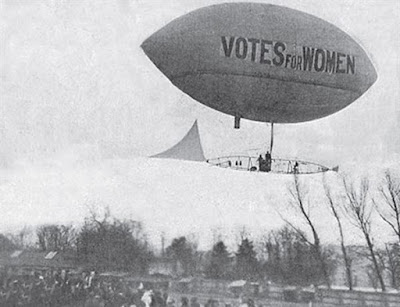
  • Suffragist in an airship
Tackling the Patriarchy from the sky :D

"On 16 February 1909, (...) to gain attention and to promote the suffrage cause, Matters decided to hire a dirigible air balloon (...) and intended to shower the King and the Houses of Parliament with WFL pamphlets (...). With the airship emblazoned with "Votes for Women" on one side and "Women's Freedom League" on the other, it rose to a height of 3,500 ft. Matters scattered 56Ib of handbills promoting the WFL's cause (...) Her balloon tactic made headlines around the world." (Source


-Muriel Matters (1877-1969): "An Australian-born suffragist, lecturer, journalist, educator, actress and elocutionist. Based in Britain from 1905 until her death, Matters is best known for her work on behalf of the Women's Freedom League during the height of the militant struggle to enfranchise women in the United Kingdom" (Source)

  • 'The Suffragettes helped to change my life'


  • MRAs being charming, Edwardian edition
You and me both, Missy
 
  • Feminist counter-snark and satire, Edwardian edition :D


-'Beware! A Warning to Suffragists' is a satirical poem written by suffragist Cicely Hamilton mocking the opponents of female suffrage. This pamphlet was published in 1908 by the Artists' Suffrage League, and illustrated by three leading suffrage artists -

-Mary Lowndes (1857-1929), a British noted stained-glass artist.
-Dora Meeson Coates (1869-1955), an Australian oil painting artist.
 and
-C. Hedley-Charlton (very little is known about her), who produced the front cover image

(Sources: post1, post2 and post3).


-Cicely Hamilton (1872-1952): English actress, playwright and poet,  freelance journalist, suffragist and feminist.  
 "She is now best known for the play How the Vote was Won (...) She is also credited as author of one of the most frequently performed suffrage plays, A Pageant of Great Women (1909), which featured the character of Jane Austen as one of its "Learned Women."" (Source)

"In 1908 she joined the WSPU, but disliked the way Emmeline Pankhurst ran the organisation and soon left to join the Women's Freedom League. She was also a founder member of the Actresses' Franchise League and the Women Writers Suffrage League." (Source)

Some pages of the pamphlet, with the illustrations (all are here):
Not River, that's for sure!


Feminist snark is THE BEST


Missy approves about all this