Saturday, 22 March 2014

Celtic goddesses: Brighid (part 3)

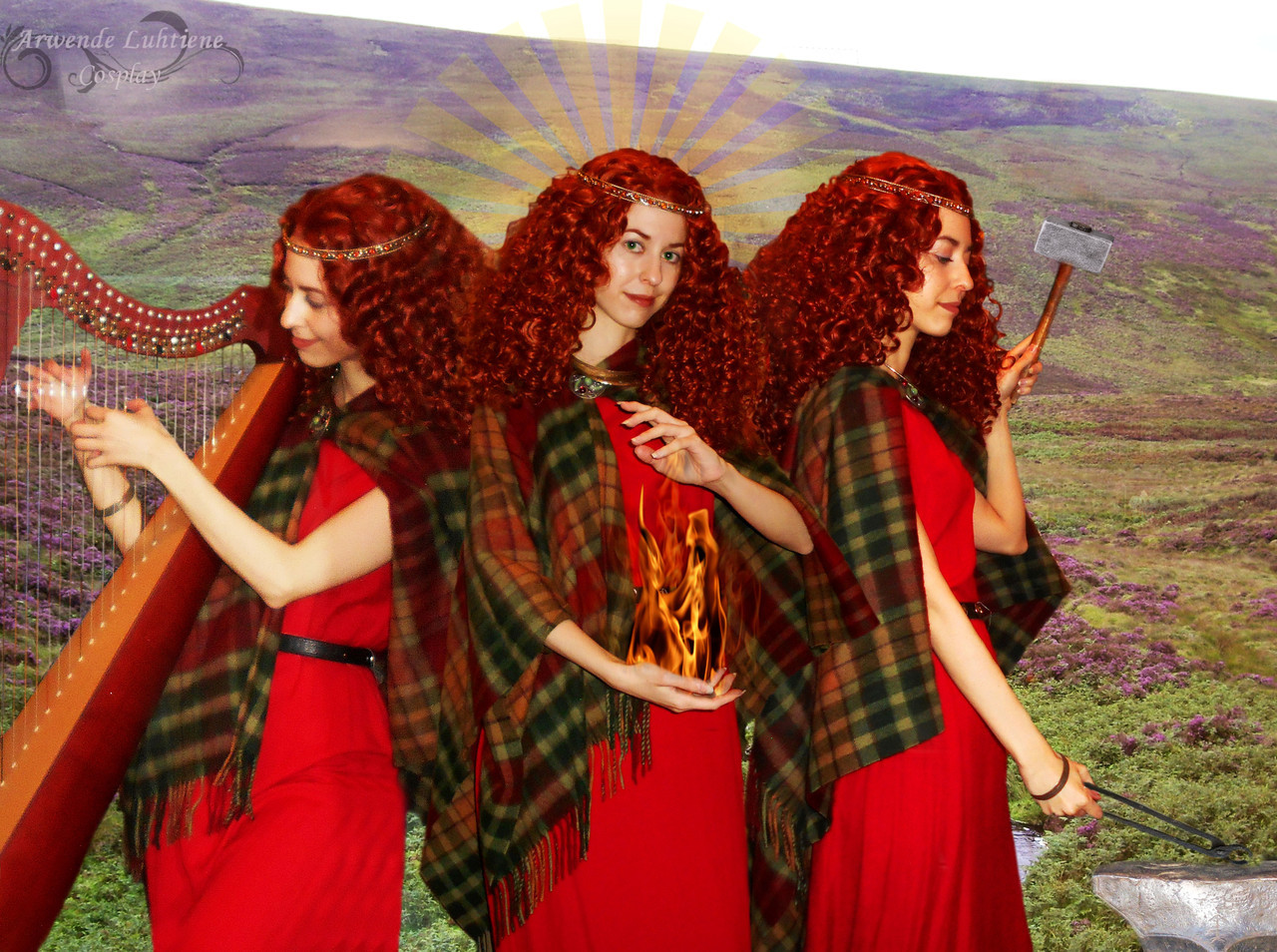
From the Take Back Halloween site (with ideas to cosplay Brigid! :) ): http://takebackhalloween.org/brighid/. The artists of this montage are unknown to me, if you know about them, please contact me!

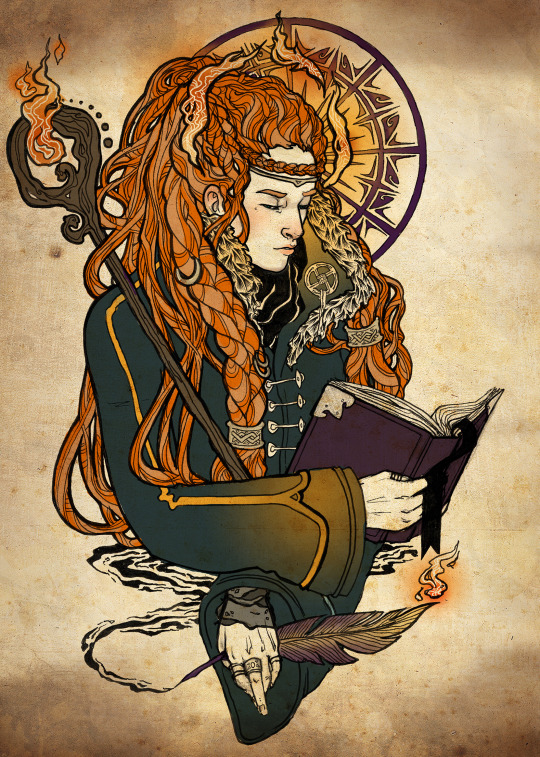
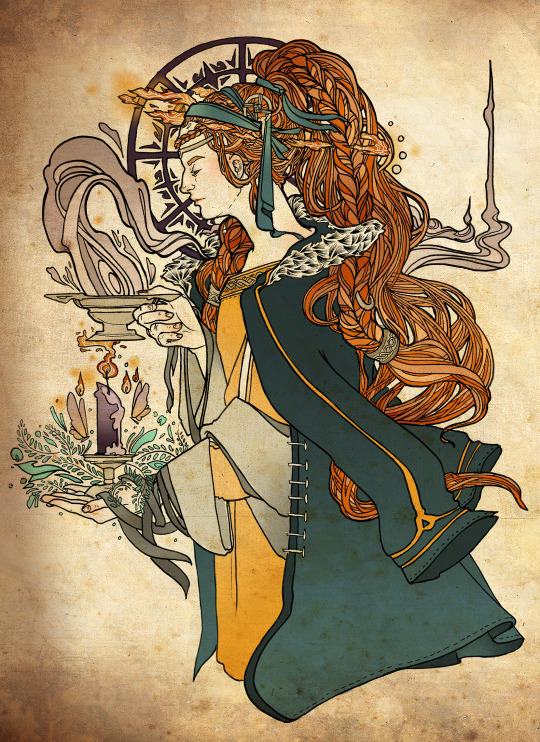
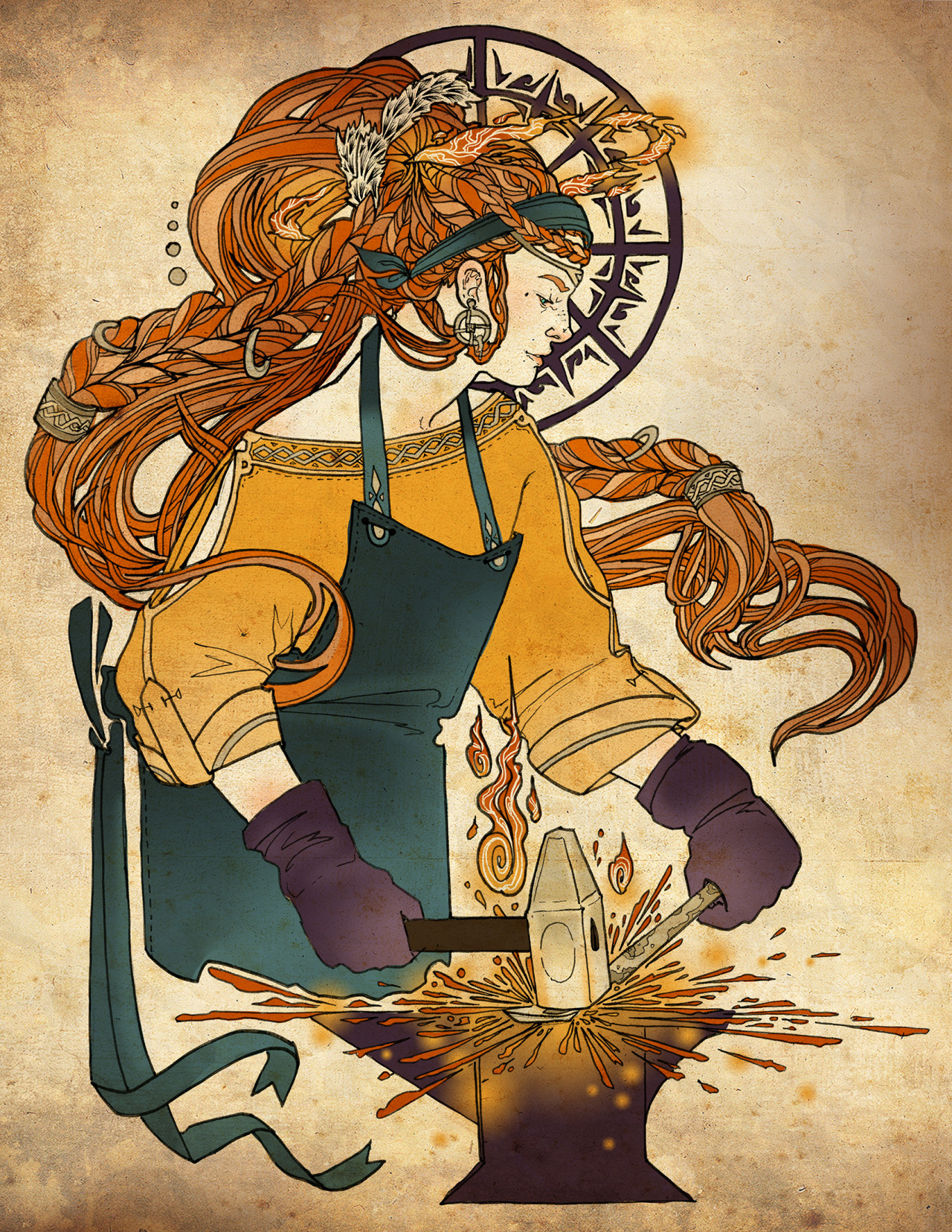
Part 3 of my goddess Brigid tribute is going to be mainly about aesthetics: More artwork and some excerpts and links to songs and poems about this Celtic goddess.

-DISCLAIMER: Same as in the former two parts, I do not own any of the songs/poems or any of the artwork, unless I state so. Poems and songs that do not belong to me are quoted and credited, and the authors of the artwork are credited as well, and in the case of Deviants, I also link to their DeviantArt profile (if you do not want me to show your credited artwork here, please contact me). This is for enjoyment and appreciation only. And once again, please do not spam me about religion.

  • Poems and invocations: I've chosen a few, there are many more on the Internet. 
                                                    'Hail, Brigantia!'  by Patti Wigington
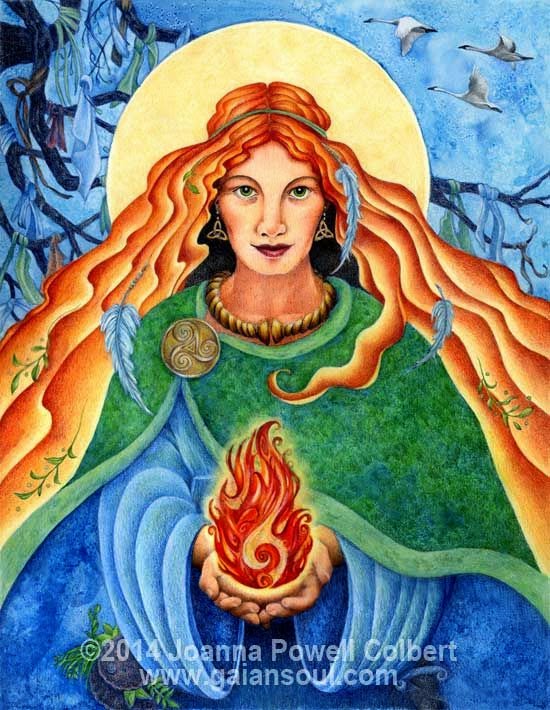
'Brigid's Fire - The Offering' by Joanna Powell Colbert
"Hail, Brigantia! Keeper of the forge,
she who shapes the world itself with fire,
she who ignotes the spark of passion in the poets,
she who leads the clans with a warrior's cry,
she who is the bride of the irlands,
and who leads the fight of freedom.
Hail, Brigantia! Defender of kin and hearth,
she who inspires the bards to sing,
she who drives the smith to raise his hammer,
she who is a fire sweeping across the land."

Invocation of Brighid by Ellen Evert Hopman (Old Irish translation by Alexei Kondratiev)
'Brighid Mother Goddess of Ireland' by Jo Jason.
"A Brigit, a ban-dé beannachtach
Tair isna huisciu noiba,
A ben inna téora tented tréna,
Isin cherdchai,
Isin choiriu,
Ocus isin chiunn,
No-don-cossain,
Cossain inna túatha.

O Brighid, blessed Goddess
Come into the sacred waters
O woman of the three strong fires,
In the forge,
In the cauldron,
In the head.
Protect us.

Protect the people."

          
                                            Excerpt from 'Lady Day', by Susan Morgan Black:
Card  from the "Oracle of the Goddess" Divination Deck, by Gayan S. Winter (also known as Gayan Sylvie Winter), illustrated by Jo Dose (Copyright 2006, U. S. Games Systems, Inc., Stamford, Connecticut). [Thanks to thetarotman for the info!]
"(...) The sacred fires of Brigid
        Are lit.
        Goddess of the blacksmith's forge,
        Of healing wells and
        Bardic wit.

        The Sun is returning,
        Spring is on her way.
        We light the sacred fire,
        For this is Brigid's Day."

Excerpt from 'Invocation to Brigid' by Michelle Skye (http://thetarotman.wordpress.com/tag/lisa-iris/)
I really like the fragment I show, but I'm not a great fan of these kind of invocations where such things as 'let me do your will/bidding' are expressed, as I'm more of an agnostic spiritualist and certainly against serving a deity. 'Inspire us' and 'guide us' are all right, but 'teach me to do your bidding' and 'I serve you' are not so great for my mindset and lifestyle. I prefer to have inspiration and guidance while being my own mistress.
'Brigid media study' by awenbrig on DeviantArt (http://awenbrig.deviantart.com/art/Brigid-media-study-103151288).
"Most blessed Brigid,
Living light,
Bright Arrow,
Goddess of the sun and
Of the eternal fire,
Arise like a shining sun!"
'Brighid' by purplefaerey on DeviantArt (http://purplefaerey.deviantart.com/art/Brighid-197773210).
"Victorious one of shining spear
Come, dear Brigid, come, be here!"
(Excerpt from an ancient invocation, http://www.wicca-spirituality.com/brigid-invocation.html)

  • Songs:

Sunday, 9 March 2014

Celtic goddesses: Brighid (part 2)

My closet reenactment of goddess Brighid

Part 2 of my goddess Brighid tribute :) (part 1) Part two will be about a bit more info and a pic overload of Brigid's aspects.  So if you're interested about mythology, goddesses or Celtic culture, read and watch on!

-DISCLAIMER: As usual, I do not own any of the quotes or any of the images/artwork that are not labelled as specifically mine. The rest are duly credited, unless I was unable to locate the source or artist (in which case, if you know who any of the missing authors/artists are, please let me know and I'll credit them). Also, fellow Deviants, if I you prefer me to remove your (credited) deviation, just notify me.

Before starting, I'd like to redirect potential spammers to the Comments Policy section and remind them that I do not welcome any kind of religious-based spam (and that I will simply delete it, like I did when I published the first part and received some charmingly fanatical Christian spam). This post is about mythology and Celtic culture and in my case it's here for cultural reasons. Although if I were a fully-fledged Neopagan, my reasons would be equally valid. Seeing as I'm not trying to convince or convert anyone to anything with these kind of posts, I ask that you afford me the same courtesy. Live and let live.

 Brighid as patroness of poets, musicians and other artists
By Helen Mask
'Brigid: Bardic Spirit' by Lindowyn on DeviantArt (http://lindowyn.deviantart.com/art/Brigid-Bardic-Spirit-152926171)
  "Brigit is patroness of the filidhacht (poetry and bardic lore) and the filid (bards), who were the oral transmitters of the Celtic culture. This includes storytellers, folklorists, mythologists, balladeers, singers, composers, poets, musicians, particularly harpers, historians and clan genealogists. She provided the "fire in the head" of poetic inspiration."
(Susan Morgan Black, essay on Brigit)
'The Goddess' by ArwendeLuhtiene on DeviantArt, aka me (http://arwendeluhtiene.deviantart.com/art/The-Goddess-sketch-415614089). This is supposed to be a quick sketch of the Celtic goddess in general, embodying various aspects of the main Celtic goddesses. I drew the Sun (solar goddess), the harp (Brighid), the horse (Epona, Rhiannon) and the spear (Mórrígán or Brighid as Brigantia, or the warrior-goddess in general). 
'Brigid making her way' by ElisabethPhillips on DeviantArt (http://elizabethphillips.deviantart.com/art/Brigid-Making-Her-Way-44901398). In her trademark colours (red, green and white) accompanied by the swan (generally a poetic inspiration symbol).

  Brighid as healer and bringer of life
This is one of my favourite artworks of Brighid (unfortunately, I don't know who is the artist). 
Bridid dressed in white in her healing and life-bringer aspect, with her druid rod and Sun rays coming out of her head (by Wendy Andrew)
   "She is the patron of agricultural, pastoral, and domestic fertility and abundance. (...) a Goddess of animal fertility (...) Cattle (...) were sacred to Brigid. (...) A white skinned red eared fairy cow is associated with her. (...) Brigit is also associated with a white snake [a healing and fertility symbol] and with fish that sometimes appear in her healing wells."
(Susan Morgan Black, essay on Brigit)
The fertility aspect of Brigid, with the lamb, the snakes and the bees. By Judith Shaw (http://feminismandreligion.com/2013/01/31/brigid-goddess-of-healing-poetry-and-smithcraft-by-judith-shaw/)

Brighid as life-giving solar goddess by Helen Mask
(Susan Morgan Black, essay on Brigit)"As Water deity, Brigit is the patroness of healers, with many healing springs and wells dedicated to Her throughout the British Isles. Water is also associated with psychic ability, music, and poetry. (...) She taught the properties of herbs, and blessed many springs and wells across the land, that are still venerated today. Her girdle and mantle had healing properties, which she shared with others. (...) These wells were probably dedicated to the earlier Goddess, with a presiding priestess or Druid."
Brigid's Well in Kildare
Brigid as the Maiden goddess and bringer of Spring (ARTIST UNKNOWN to me)                                           
                                 
Brighid the blacksmith and artisan
'Brigid at her forge' by Jane E. Ward (http://janeeward.wordpress.com/author/janeeward/page/5/)
"As a Fire deity, she is the patroness of blacksmiths and poets (a poet's "fire in the head"). The hearth is sacred to her in every home. (...) She inspires the creativity and artistry of the blacksmith craft just as she inspires the creativity of poets. (...)
 Blacksmiths were considered magicians (...) themselves. (...) it was the excellence of Celtic metalwork that differentiated them from all other early cultures and brought them to prominence."
(Susan Morgan Black, essay on Brigit)
Fire goddess by Lorelei Sims (http://www.blacksmithchic.com/)
Brighid as blacksmith by Helen Mask 

                                  Brigid as blacksmith and artisan by Joanna Powell Colbert) (detail)                                 
'Brigid of the forge' by Lindowyn on DeviantArt (http://lindowyn.deviantart.com/art/Brigid-of-the-Forge-153777815)
'Brigid' by faolgarg on DeviantArt (http://faolgarg.deviantart.com/art/Brigid-217285719). Portrayed in her blacksmith and fertility aspects.
                                 

Brighid as Brigantia: Warrior and protector


Brigantia  by Laura Cameron (http://www.lauracameron.net/)

As most Celtic goddesses Brighid has a warrior aspect. She represents female vigour and strength, queenship and sovereignity. Like most solar gods and goddesses, her warlike aspect is associated more with protection than slaughter.
             
            Left3rd Century AD Romano-British relief of the goddess Brigantia, portrayed in a very similar fashion to Roman goddess Minerva (Greek Athena) and to Roman goddess Victoria. Right: Statue of Brigantia by Oberon Zell (http://www.13moons.com/index.php?main_page=index&cPath=180_357). 


 "The symbol of Britain - the Goddess Brigantia or Britannia, is Brigid in her aspect as Goddess of Sovereignity or Guardian of the Land. (...)  In her aspect as Brigantia, she carries a spear, an orb of victory, and wears a war crown (...) [This is the] warlike version of Brighit. (...) Her warlike, protective characteristics are emphasized."
(Susan Morgan Black, essay on Brigit)
Gaulish statuette of Brigantia (2nd Century BCE) in Rennes (Britanny) (found on Wikipedia, entry Brigantia)
Brighid (M. Stanton). Portrayed as animal fertility goddess and as Brigantia the protector (http://www.goddessmyths.com/Amaterasu-Epona.html)
Brigantia (Urban Mystic, I have not been able to trace the artist's source). Shown as a fire goddess and protector of the people.
'Goddess Bridget and Curu' by nienor on DeviantArt (http://nienor.deviantart.com/art/goddess-bridget-and-curu-696651). One of my favourite depictions of Brighid as a warrior. Accurate Celtic fighting attire too, btw: Pants, short tunic and cloak.  
'Brigid' by celticseaturtle on DeviantArt (http://celticseaturtle.deviantart.com/art/Brighid-33567298).  Portrayed with a spear in her warlike aspect (plus the Sun symbolism in the rays and the solar cross).

Sources and more info:
-Wikipedia: http://en.wikipedia.org/wiki/Brigidhttp://en.wikipedia.org/wiki/Brigantia_(goddess).
-'Brigid, goddess of Healing, Poetry and Smithcraft' by Judith Shaw
http://feminismandreligion.com/2013/01/31/brigid-goddess-of-healing-poetry-and-smithcraft-by-judith-shaw/.
-About the blacksmith aspect of Brigid, plus more info about blacksmithing: 
http://brigitssparklingflame.blogspot.com.es/2012/08/blacksmith-practice-manual.html.
-A stock image of the goddess Brigantia as portrayed in the Gallo-Roman depictions by Aseamlessbonds on DeviantArt: http://aseamlessbonds.deviantart.com/art/Brigantia-195000344
-Essay on Brigit by Susan Morgan Black. Downloadable as pdf.

Friday, 21 February 2014

Celtic Goddesses: Brighid (part 1)

Brighid triad cosplay (My IG)
 To start with my goddesses section in this blog, I'd like to dedicate a series of posts to the Celtic goddess Brighid. To read about her festival, Imbolc, you can check these posts: 1 and 2

   Brighid is one of favourite goddesses in mythology. Smith, artisan, healer, musician, poet, bringer of life and light, warrior-protector...She's just so empowering and awesome, an awesome model of a woman complete within herself. Plus she's normally depicted with long red hair (sometimes golden, both refer to her being a solar goddess), so she has it all (as I love red hair)! :) 

    I'd like to focus on a shameless picture overload of my favourite artworks about Brighid (I tend to show a lot of artwork in my posts, I really like the visual component), plus write a bit about her, plus some quotes and links to a couple of poems and Neopagan songs. Saint Brighid, the counterpart of the goddess in the Christian world, will probably feature a bit too, because she's rather remarkable, being an abbess and all.

 It's going to be quite long, but if you're interested, read (and watch) on!

   -Part 1 (this post): The Goddess Brighid: Triple goddess. Some mythology. Symbols and characteristics. 
   -Part 2: Brighid's four main aspects (mainly pic overload).
   -Part 3Poems and songs and more artwork. 
   -Part 4 (and final): Brigid and Saint Brigid of Kildare. Parallels in other mythologies and religions: Solar-protective goddesses. Focusing on Minerva/Atenea. Isis. Varda/Elbereth and Arien.
  
DISCLAIMER: All the quotes and artwork are duly credited. In some cases I don't know who the author or artist is, so if you know, please let me know, and I'll credit them! Fellow Deviants, let me know if you do not wish me to show your (credited) artwork here.


The Goddess Brighid:
"I am Bríd, beloved of Erin, spirit of fire, healer of ills, warrioress of old, protector of life, woman of power, sovereign Mother of all creation. I create, I inspire, I make magick. I am old, I am young, I am eternal. I am the All-Power personified. I am me…Bríd.”  -  (Celtic Myth and Magic – Harnessing the Power of the Gods and Goddesses by Edain Mc Coy, 65.)
Brighid as a Triple Goddess (Miranda Grey). My favourite depiction of Brighid.
Brighid was a very important goddess among the Celtic peoples. She is considered a triple aspect deity, with three main aspects: One of life, fertility and healing; one of poetry and inspiration; and one of crafts and smith-work.  She has also a warrior-protector aspect as Brigantia. 

   Thus, Brigid is primarily the patroness of poets, smiths and healers. She is also the patroness of the Druids, "in her aspects of poetry (Bards), healing and prophecy (Ovates) and blacksmithing (Druids)" [S.Morgan Black]. As a goddess of fertility, Brighid is also the protector of children and farm animals (particularly cows). Apart from smithwork, her crafting sphere includes weaving, brewing and dyeing. 

   Brighid rules the elements of fire and water. Water is associated mainly with her healing aspect and her being a triple goddess related to the the changing Moon. She is also considered a 'Solar goddess' (there are many of these in Celtic religion, like Lugh and Belisama) and as such, she is heavily linked with light, fire, fertility, creativity, inspiration, wisdom, healing and protective warrior skills. 

  "As a Sun Goddess, born at the exact moment of dawn, she bears the gifts of knowledge, inspiration, and the life and healing energy of the sun. She is complete within herpland areself." (Source)

   "She is the goddess of all things perceived to be of relatively high dimensions such as high-rising flames, highlands, hill-forts and upland areas; and of activities and states conceived as psychologically lofty and elevated, such as wisdom, excellence, perfection, high intelligence, poetic eloquence, craftsmanship (especially blacksmithing), healing ability, druidic knowledge and skill in warfare." (http://en.wikipedia.org/wiki/Brigid)

Fire is probably the most powerful symbol of Brighid. It is linked with her three main aspects:
 "1.   Fires of Inspiration – poetry, learning, divination, witchcraft, occult knowledge and prophecy.  In this aspect She appears as a poetess and a muse.
2.   Fires of the Forge – smithcrafts, blacksmiths, goldsmiths, housecrafts. In this aspect she is seen carrying her famous cauldron used for melting metals.  She may even date back to the beginnings of pottery and its firing. Through this forge aspect She is also associated with the martial arts, as a warrior goddess, who forges spears and arrows.  A smith creates anew and fixes broken things.
3.  Fires of the Hearth – medicine, spiritual healing and fertility, midwifery, inner healing and vital energy. In this aspect She is known as the Goddess of Healing." (Source)

 As well as honouring sacred wells, sacred fires were lit in worship of this goddess. In Kildare there were nine priestesses who tended to a sacred fire. This tradition continued in the Christian era, in the form of nine nuns tending to Saint Brigid's fire.

 The name 'Brighid' has various possible meanings: "The Bright One", "The High One"/"The Exalted One", "The Powerful One", and, especially, "A Flaming Arrow". This last name refers to the solar aspect of the goddess, linked with fire and light, symbols of life and poetic inspiration.

 "and Brigit, that was a woman of poetry, and poets worshipped her, for her sway was very great and very noble. And she was a woman of healing along with that, and a woman of smith's work, and it was she first made the whistle for calling one to another through the night.(...) And the meaning of her name was Breo-saighit, a fiery arrow."
(Lady Gregory, Gods and Fighting Men)
My reenactment of Brighid (IG)
  In Irish mythology, Brigid is the daughter of the Dagda (the 'All-father' and protector of the tribe), and her mother is either the war-goddess Mórrígán, or Boann the cow-goddess. She is considered by many a pan-Celtic goddess, a Mother Goddess figure worshipped by many different Celtic tribes. The root of her name can be certainly found in many place names and river names across the continent (like 'Britain', for example, coming from the Brigantes tribe, who worshipped Brigid as Brigantia). It is also found in inscriptions and in myth, folktales and hagiography.

 "She has been worshipped by the Celtic people as a Saint for over fifteen hundred years, and as a Goddess long before the Roman invasion of Britain and the birth of Christ. Her cult was so powerful that the Celtic peoples had to adopt her as a Saint. (...) Brigit is a "pan Celtic" goddess, who was worshipped by both the Giodelic and the Brythonic Celts in the British Isles and beyond.(...) "
(Susan Morgan Black, essay on Brigit) 

  However, there are others who think that this is not all that clear, and that rather than being a pan-Celtic goddess, there might have been different deities with the bríg root (which means 'high' or 'exalted') in their name, given to them as a title. An interesting discussion of this can be found here: http://celticmythpodshow.com/blog/brighid-what-do-we-really-know-by-francine-nicholson/.

Symbols:
-Water. Sacred wells. The changing Moon.
-Fire, candles. The Sun.
-A white snake (healing and fertility)
-Cattle and domestic animals, especially sheep and a white red-eared cow (fertility). Also the ox, boar and ram. Lebor Gabála Érenn says Brigid has two oxen, Fe and Men, that graze on a plain called Femen. She also possessed the 'king of boars' Torc Triath, and the 'king of sheep' Cirb.
-The swan (art and poetic inspiration).
-The hammer and anvil.
-The harp.
-The colours white (healing, life), red (fire) and green (healing, fertility).
-A white wand, sacred woods.
-Wheat and flowers. Bees (fertility, creativity).
-Weapons and an orb of victory (as Brigantia)

Friday, 7 February 2014

Oppressed Majority: Tackling sexism in a really powerful way

I discovered this incredibly powerful 11-minute short film yesterday. It's directed by Éléonore Pourriat and it "shows men how it feels to be subjected to sexism and sexual violence". You can watch it here:

I think this is a remarkable video that tackles sexism in an intense and effective way. It describes an alternative society where it is the women who enjoy all the privileges and the men who are oppressed, discriminated and harassed - a 'matriarchy' instead of the 'patriarchy' we are more familiar with in most societies. In this matriarchal society, the women hold the positions of power and lead professional lives while the men are seen taking care of the children and working as assistants. While women are seen freely jogging and walking in the streets bare-chested, male harassment and abuse is all too frequent. In addition to that, the law and religion states that men should wear a balaclava/head-covering to stay modestly dressed and submitted to their wives. A man wearing bermudas and a short-sleeved shirt is deemed provocative and prone to be assaulted.

-IMPORTANT: The English subtitles mistranslate the original when saying "I can't take this fucking feminist society anymore!" "Feminist" is not the same as "matriarchal", which is how the line should have been translated. Feminism fights for women's rights in a patriarchal society and, by extent, it fights for equality for both women and men (in the film, the word "masculinist" is used as the equivalent of "feminist" in a matriarchal society). Feminism, real feminism (unlike what so many people, brainwashed, confused and prejudiced by patriarchal influences, think), doesn't want women's superiority or the creation of a matriarchal society where women would rule, hold all privileges and, by extent, oppress the "opposite sex", in this case the men. A matriarchal society is inherently anti-feminist. ie. anti equality, same as a patriarchal society. The (very low amount, MRAs) of women who want to have dominion over men and oppress them, and call themselves 'feminists', are using the wrong term (there are extremists and fanatics in practically every group, but still, wrong usage, they're "pro-matriarchy", not "feminists").

  As a feminist, I am always at the side of the oppressed in a group. In a patriarchal-based society, as is this one, I side with the women and fight for women's rights, not only because I myself can be oppressed, but because I'm also an INFJ and an activist at heart, and I don't like that other women be oppressed as well (and I do not try to oppress men or take rights from them, nor do I hate the men who mean well). But in a hypothetical matriarchy as this one, I would totally side with the men - because this time they're the ones who are being oppressed and treated in an unfair way. I completely empathise with the male character, a man who's being oppressed in a female-dominated society and who tries to be himself and fight for his rights. How is that "pro-women's superiority" and "man-hating"? I'm just pro-equality.

 So, no matter what the mistranslated subtitle may suggest, this video is nothing but incredibly feminist because it helps address sexism and oppression. By no means does it exalt a society where women oppress men. The gender-reversed alternative society serves as a powerful way to show men (and the women who have bought into the patriarchy's lies) how it feels to be oppressed by the opposite sex and how it is to suffer intense sexism and harassment virtually on a daily basis. Hopefully by seeing it with themselves as the oppressed, they'll be able to begin to realize just how wrong and unfair it is to oppress and harass anyone

 This is by no means unimportant. I'm not saying that every man harasses and/or oppresses women, but it's frightening how so many people seem to take for granted so many mysoginistic aspects of our patriarcal-based modern societies. Practically everything - harassment, sexual assault, obligatory body coverings, and so many other things -are not taken seriously or given some sort of excuse or explanation. "Boys will be boys/men can't control themselves". "Look what she was wearing, she was asking for it!". "You can't take compliments!". "You don't have any sense of humour". "But it's religious freedom, she's covering herself because she chooses to!". "They have to cover themselves so that men aren't tempted, it's for their protection, that way they won't get assaulted".  So many excuses. Too many. 

I wonder if people, watching this video, would have thought that the main character was "asking for it" when he was being harassed repeatedly and assaulted. For having the nerve to go out in a pair of bermudas and short-sleeved shirt! I wonder if they would have thought that it wasn't weird or shocking to see the women to be running bare-chested without opposition (because in a patriarchy we're certainly not accustomed to that). I wonder if they would have thought that the men covering themselves because the law and religion and their wives ordered them to were choosing freely, that this had any logical basis, that this wasn't oppressive. Somehow, I highly doubt it. Then, why so many people think otherwise when it is the women being forced to cover themselves up, or being assaulted when happening to wear a short skirt and tank top? When men run or bathe bare-chested, do we see this as weird, as a provocation and an excuse to assault them? I don't think so.

Oppression is wrong in these two paralell societies, in exactly the same way. And by seeing this paralell comparisons, hopefully this film will help more people realize just how unfair, illogical and wrong our patriarchal mysoginistic problems are. 

 -About the "controversial" issue of head and body coverings: I wouldn't have a say about someone covering themselves up if they really did it because they wanted to, as a pure fashion statement, or because of the weather, or what have you. Same as I wear scarves in Winter and only wear my arms and legs bare when it's reasonably hot. And same as I don't always choose to wear deep necklines. Same as someone might choose to wear a turban one day and their hair loose the next day. Even if they wanted to wear a turban/covering every day, but for reasons that weren't gendered or compulsory. Because people seem to forget that, in this case, there is the belief that women's bodies are inherently shameful and have to be modestly covered, and that they are the property of men and have to be kept as "wrapped candy", only to be unwrapped by their 'rightful owner'. Ew.
 I generally defend everyone's right to wear what they like, but these reasons and beliefs, these are so inherently mysoginistic and oppressive, I am very openly against gendered and enforced body coverings. Sue me. I do not see it as a 'freedom of choice'. I do not see it as 'religious freedom'. I only see oppression and misogyny.

Wednesday, 5 February 2014

The Wheel of the Year: More about Imbolc

I felt like posting something more about Imbolc, so here goes. I think that one of the best essays I've read about this festival -about its religious and mythological background and about its traditions- comes from Ellen Evert Hopman's A Druid's Herbal of Sacred Tree Medicine. It's a neodruidic book that's basically about the Ogham tree alphabet, but part two also focuses on more general aspects of modern druidism, and in one section she talks about the Celtic fire festivals.

DISCLAIMER: The following are excerpts from said book. No copyright infringement intended, entertainment and culture diffusion purposes only.
 Images are credited duly, unless the artist is unknown (by me) - in which case, if you know the name of the unknown artists, please let me known and I'll gladly credit them.

  ELLEN EVERT HOPMAN - A Druid's Herbal of Sacred Tree Medicine. Part 2 - Celebrate the Celtic Fire Festivals - Imbolc (bold is mine):

 "The festival of Imbolc (in the bag, in the belly), or Oimelc (ewe milk) in Scotland, is celebrated on February 1 and 2, or when the ewes begin to lactate. It is also called Lá Fhéile Bríde in Ireland, because it is also the festival of the goddess Brigid or Bríde, patroness of the flocks, herds, and motherhood. The observance is called Gwyl Mair Dechraur Gwanwyn in Wales, Laa'l Breeshey in the Isle of Man, and Goel Kantolyon in Brittany. The English name for the festival was once Candlemas, which eventually revolved into Groundhog Day festival of modern times.

The Feast Day of Brighid
Depiction of Saint Brigid, with many of the attributes of the former goddess Brigid: The wheat as a symbol of life and fertility,  the candles as a Solar symbol, the harp representing her musical and poetic inspiration aspect, and the sword representing her protective warrior aspect. Artist unknown by me.
Saint Brigid is one of the best known and most venerated of Celtic saints (...) Saint Brigid was said to have been reared on the milk of a white cow with red ears, the typical coloration of a Celtic Otherworld beast. She was said to possess a girdle that could heal all disease.

But long before Brigid the saint there was another Brigid, one whose identity and feast were gradually subsumed by the later historical figure, a goddess who was known as Brigid in Ireland, Bríde in Scotland, and Brigantia in Britain, Daughter of the Daghda, she was a triple goddess, said to always appear as three sisters, each named Brigid. Her spheres of influence were poetry, smithcraft, and healing. She was the patroness of the Druids and Bards. The Brigantes, a British Celtic tribe, honoured Brigantia as the High One and Mother of the Gods. She was the most prominent pan-Celtic female deity. (...) Her mother was Boann, Cow Goddess of the White Moon (...), making cows her sacred animals. She was also associated with the white mare, the serpent, and the red-eared, white-bodied hounds who guide travelers to the Otherworld.

Brighid was especially associated with healing wells and springs, and with sacred fire. As Brigantia she was especially concerned with the flocks and herds and with the produce of the earth.  These spheres were later taken up by Saint Brigid of Kildare, patroness of numerous holy wells, whose fire temple was tended by nine maidens until the Pope declared it heretical and shut it down. (The perpetual fire of Brighid has recently been relit by nuns in Ireland, and Pagans and Christians across the globe are once again tending fires in her name).
(...)
Found on Pinterest

Imbolc marks the midpoint of the dark half of the year. It also marks the beginning of the lactation of the ewes, an all-important milk festival of the ancients. (...) Along with the streams of new milk, Imbolc marks the time when other streams of life are reinvigorated in the land - forest animals begin their mating rituals and serpents begin to stir in their lairs. Farmers test the soil to see if it is thawed enough for the first plowings, and snowdrops spring up in the spots where Brigid's feet have trod.

At this time the Hag of Winter, the Cailleach, who has ruled since Samhain (...) drinks from the Well of Youth and her face is transformed from haggard old age to the serene and youthful face of Brigid. For this reason, Brigid is sometimes called The Maiden of the Rising Sun.
Brigid and her Druid rod. Artist unknown by me.
The Cailleach carries a Druid wand of great power, a white rod (...). With its magic powers she controlls the elements and the weather. Brigid carries a white rod too; but, whereas the Cailleach's rod brings storms and harsh weather, Brigid's brings warmth and new life.

It was said that where Brigid walked over the waters or touched them with her finger the ice melted, and that the land turned green where she spread her mantle upon it or when she breathed upon the hills. Families would leave a cloth outdoors on the eve of the festival to be blessed by the Sun and by Brigid on Imbolc morn. (...) the cloth would be cut into strips to be tied onto a sick person or animal throughout the remaining year.

Tuesday, 4 February 2014

The Wheel of the Year: Imbolc

  
My reenactment of the Goddess Brighid (IG)
 First of all, belated happy Imbolc to all those who celebrate this neopagan/neodruidic feast, or to those who simply feel interested about the Celtic calendar and the goddess Brighid! And for those in the Southern hemisphere, a happy (belated) Lughnasadh as well!
Imbolc blessing. Found on Pinterest.
  As a pure agnostic-atheist neodruidess, I celebrate this feast from a purely seasonal, spiritual (rather than religious) and culturally interested point of view, more than from a neopagan one - although I do like to delve into Neopaganism, as well as Celtic culture and general mythology, and Brighid is one of my favourite goddesses. What I sometimes do on these couple of days (1st-2nd February) is walk in the garden to welcome the first signs of Spring and tie a ribbon in one of the trees on the 31st January (or 1st February sometimes, it depends), following the Imbolc tradition of hanging a strip of cloth or ribbon in a tree to seek blessings and protection from the Goddess. I'm not much into rituals myself, but I quite like this particular tradition and have sometimes done it, it seems like a very druidic and drawn-to-nature thing to do, same as having a small altar of seasonal plants or decorating a Yule tree.
My 2014 Imbolc ribbon.
  So to celebrate one of my favourite festivals in the Wheel of the Year, I've thought about a couple of posts to talk about Imbolc and the goddess Brighid.

  A couple of years ago, on my final year of Irish in the Official Language School (EOI) in Madrid, we organized a couple of shows, and one of them was about the druids and the Celtic calendar This is what my teacher Emily Allen and I wrote about Imbolc (in Irish, English and Spanish), and the Power Point slides I created:

   -Sources include Wikipedia and some books. Irish translation is original. 
My slide. Images from Google.

Tosaíonn Imbolc ar an gcéad lá de mhí Feabhra agus baineann sé le teacht an t-Earraigh, go mbíonn na laethanta níos faide, níl sé chomh fuar, agus feictear na chéad bláthanna ag teacht anuas. Tagann an focal ‘Imbolc’ ón t-Sean-Ghaeilge, “i mbolg”, agus tagraíonn sé do na caoraigh a bheith ag iompar.

Imbolc begins on the 1st of February, and it's related to the coming of Spring, now that the days are becoming longer, it's not so cold and the first flowers begin to sprout forth. The word 'Imbolc' comes from the ancient Gaelic "i mbolg", and it refers to the pregnancy of ewes.

Imbolc comienza el día 1 de Febrero y está relacionado con la llegada de la primavera. Los días comienzan a ser más largos, no hace tanto frío y empiezan a aparecer las primeras flores. La palabra 'Imbolc' viene del Gaélico antiguo, “i mbolg”, y se refiere a la gestación de las ovejas.