Friday, 4 June 2021

Feminist ramblings - Doctor Who and rape culture

Since May 2021, the Doctor Who community has been increasingly vocal about the issues of rape culture, harassment and sexism in the DW sets, the series, and the fandom community. This happened following the news that Noel Clarke, who played Mickey Smith on Doctor Who, abused and harassed multiple women (20 initially spoke out, and quite a few more followed) in various workplace settings, including the Doctor Who set back in 2005. The, I repeat, multiple testimonies of all these women show a wide range of sexist, abusive and predatory behaviour spanning years and including not only various workplaces, but also convention floors. Clarke has until now denied all allegations - As many men accused of harassment and abuse often do, shielded by systemic patriarchy and double standards.

Clarke's multiple cases of sexist workplace harassment were also the cause that allowed the DW community to discuss John Barrowman's (who played omnisexual Time Agent Jack Harkness in the series) own set of inappropiate workplace behaviour (which included continuous flashing on set). This has been know for years now, contrary to Clarke's harassment, but, at least to my knowledge, the fandom community had not really discussed the Barrowman issue till now to the extent I do believe it deserves to be talked about. Barrowman, however, also continues to justify and minimize his behaviour to this day, calling it 'harmless pranks' intended 'in good humour' (???), in spite of more than one set member claiming they felt uncomfortable about the whole situation, and the fact that it is literally completely unprofessional to behave in such a way in the workplace, period. Frankly, I don't care if he didn't intend to be super predatory about it, as it turns out that flashing your junk out and putting it on an actress' shoulder can very much qualify as sexual harassment, and is not just quirky jokester behaviour material.

This last month I've been on Instagram and Twitter (1 and 2) writing a couple of storytimes and threads on these topics, following not only the discussion on Clarke, Barrowman and other predatory DW cast, but also the discovery of several rapists and abusers within the Whovian cosplay community, such as @/redheadedchinny and @/timelordbrett.   I decided to post these threads on here as well, post-format, as rape culture and harassment are topics that have been very relevant to me for years, and many people can often disregard problematic issues when they're presented and normalized as part of their favourite fandoms. So here goes.

PART 1: Clarke, Barrowman and the problem of rape culture and workplace harassment

In this society full of rape culture and sexism, and particularly so in the film and TV industry where toxic workplaces aren't a thing of the past, unfortunately, it's not a rare occurrence to learn about yet another man accused of abuse, harassment and/or assault against women. By more than 20 women in the case of Noel Clarke, no less 😣. It might not take me by surprise, but it's still mentally taxing, especially as a woman, to see so many men abusing women and to see it so normalized it literally takes years and lots of bravery from the survivors to speak out.

And it's even more taxing when a part of the Doctor Who fandom is of course responding with the typical justifications of 'innocent until proven guilty', 'these women are lying' and 'all women definitely lied, but one (1) man saying it's all false is telling the truth, because rape culture rules'. Let's stop that shit already. This is Me Too all over again, and this trend will never stop unless abusers are made accountable for what they are often given free rein to do with no consequences. Fortunately, another part of the fandom was very critical of the behaviour of both Clarke and Barrowman, and they have also been made a bit more accountable by the BBC and other film industries (losing jobs, Bafta awards and/or their participation in ongoing projects).

It's also so important to speak up about this and normalize the fact that it is NOT OK to be sexist assholes to women. That it's not OK that workplaces are still sexist af and unsafe for women. That it's not OK to prioritize an abuser's feelings and 'what about his career' and 'that was in his past' vs what he actually did or is still doing to women. Because so many people, and especially the people in charge, keep accepting their excuses and their word over the testimony of multiple women, and don't demand the accountability they should. And if accountability and consequences and actual rules against sexism and harassment and abuse were more normalized, this would happen less. This also applies to the cosplayer abusers that have been unveiled lately in the DW community.

So even though it's been a rough time reading about multiple men in the DW cast and cosplay community being abusers and creeps and inappropriate and sexist, it's also positive that these issues are being talked about. And I applaud all the women who are speaking up about it most of all 👏👏👏👏 Women are so often silenced for fear of not being believed and being judged and attacked, which is a totally valid fear because it happens *a lot* :S, and I truly think you're all badasses.

Regarding the fact that these two actors have less than desirable behaviour in real life, personally I've never quite liked the character of Mickey (or Adam, or Captain Jack, to be honest). So fandom-wise it hasn't been as painful for me, as the work of separating character vs actor while consuming the fandoms we love can be difficult and hurtful. But still, it's horrible to see that the Doctor Who 2005 series set was full of so many creeps 😫. We can list Bruno Langley (Adam) and John Barrowman as well as Clarke, which makes me think if Billie Piper was OK and whether Christopher Eccleston was referring at least partly to that when he mentioned the toxic working environment which made him leave :S And if RTD and the rest of the team were aware of it all and let it slide :S

Toxic workplace environments are most certainly still not a thing of the past. Not enough has changed since Roddenberry et al abused their female cast on the set of Star Trek TOS in the 60s :/ Which is why we need to speak of this way more often, and stop it with the sexist double standards and the normalization of women being regularly harassed and abused in their workplaces. It happen too often, to too many.

I also have never liked Jack Harkness or John Barrowman very much, which was, at least to my perception, often an unpopular opinion in the DW fandom. And both Barrowman's behaviour on set and the way he often portrays Harkness is the main reason why :S Because Barrowman's portrayal of Captain Jack also seems to share traits with his workplace harassment in real life. The incessant unsolicited flirting, inappropriate comments and non-con kisses are not what being a queer character (or a queer celebrity) should be all about. It's just more harassment.

As an LGBT+ queer woman myself, I can appreciate the queer representation Jack brought to the show early on, but his portrayal also brought a problematic way of normalizing what is plain sexual harassment, as well as problematic queer stereotypes, to be honest :S For example, the idea that "bi/pan, gay and queer people in general are super horny and hypersexual all the time and will kiss you without asking while making inappropriate flirty remarks! Progressive! Representation!". Being flirty and/or queer is not the same as being creepy or inappropriate.

Nor does harassment and non-consensual behaviour, or sexism and misogyny, suddenly become cool and legit once the character or the real life person is queer, and I'm tired of seeing it all mixed up in more than one (usually male) queer character and celebrity in the media, tbh. Intersectionality matters. Well-off white gay men like Barrowman, for example, are obviously oppressed in the sexual orientation intersection, but can also be hella privileged when it comes to the gender, race and class intersections, and can most definitely be sexist, racist, classist and/or inappropiate.

I resented for years that Jack's behaviour was seen as cool and adorkable by (to my perception) quite a lot of people in the fandom. It seemed like I kept seeing fans hyped about Jack kissing Graham without consent or drawing fanart of him kissing Thirteen non-con in expectation of the special. The way the character was idolized for those traits as well, it seemed like not loving Jack was a super unpopular opinion hand in hand with not being able to openly criticize Barrowman to the extent that was needed (and this isn't news like it's more with Clarke :S). Like, I shouldn't be pleasantly *surprised* that he ended up, at freaking last, treating Thirteen and Yaz with respect at the special, and that he ditched the inappropriate innuendo for the most part. That is the bare minimum. I shouldn't give anyone a medal for that.
 
We deserve better queer rep than a non-con kiss between a queer man and a straight man, tbh :S   

We need better queer role models, characters and celebrities both, and we need to hold people accountable for their harassment no matter any other intersections. And we most definitely need to hold MEN accountable for their actions regarding rape culture and harassment.

And I'm not saying you have to hate the characters now! Maybe you still like Mickey Smith and/or Jack Harkness for the positive traits and representation that they also bring to the world of Doctor Who, and that's OK as well. I'm saying that we should also be critical of the questionable traits of both the actors and characters, and talk about how the actors' irl behaviour normalizes sexual harassment and rape culture, especially against women, and how they've been getting away with it for years.

Because they apparently think they still can get away with it, with Clarke denying all allegations (the nerve, ugh) and Barrowman quite literally thanking his fans in a recent video for defending him and supporting his inappropiate workplace behaviour (wtf) 😐.


PART 2: How New!Who also normalizes the problem of rape culture among the DW community

In this second part, I'm expanding a bit on the issue of the normalization of rape culture and harassment in the DW community, focusing on the way the series itself can actually promotes rape culture in its depiction of non-con scenes as either comedic, romantic, empowering, or queer representation.

General disclaimer that of course the DW community is also a wonderful place to be, that there are many wonderful DW cast and set members, and that the DW series and fandom is also full of amazing ethics and messages, and steadily more and more diversity and representation 😊✨🌈 But it's also important to be critical of the more problematic issues within the series and the community. And the issue of how rape culture is sometimes normalized in the series, and how a faction of the fandom reacts to this topic, is one of them. 
 
TW: Non-con kiss gifs and pics below

Why are some Whovians prone to excusing and justifying sexual harassment, and violence against women especifically? Maybe because the show itself - and Rassilon knows I adore Doctor Who - is also culpable of normalizing and legitimizing harassment and rape culture as legit more than once 😬

Apart from the inappropiate and creepy behaviour of some members of the cast in this case, I just wish that the series (and the media in general) would also stop the trend that a non-con kiss (I'm focusing mainly on kiss scenes here, seeing as DW is PG-13) is either funny, romantic, celebratory, or queer representation😐. It's none of these things! It's normalizing what is basically harassment and assault as completely fine. No matter who’s doing the kissing, we’ve got variety in New!Who, and it’s not just Jack Harkness. I’ve always been so frustrated at seeing these moments hyped by the fandom, to be honest, like I mentioned above as well 😬 .

The thing is, men kissing women non-con isn’t romantic, women kissing Tennant or any other incarnation non-con isn’t what agency and girl power should look like, and queer characters kissing others non-con as their MO is not good enough LGBT+ representation. It's just not.

And in the series, just the reaction of the characters to pretty much all instances of non-con kisses and sexual harassment as something used for either romance, female empowerment, comedic purposes, or queer rep helps a lot to normalize this behaviour just plain acceptable and normal. Some examples of this:
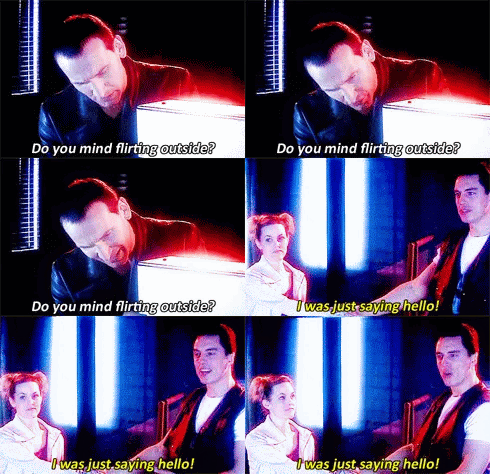
1) When Jack Harkness flirts at complete strangers as a hello, most of them are scripted as reacting favourably ("I don't mind!") or being so dumbfounded they don't say anything. He never gets admonished for his actions, the most he gets is the Doctor jokingly exclaiming 'Don't start!' - Which is more in the line of 'boys will be boys' than anything else. His penchant to sexualize anything that moves and make unsolicited advances is generally seen as a 'fun' and 'adorable' character trait, as well as the way legit queer representation works (not really tho). 
 

2) Scenes abound when the Doctor kisses or is kissed non-con, brushed as either romantic moments, grl power or comedy, with hardly any negative reactions going on either. Some examples:
 
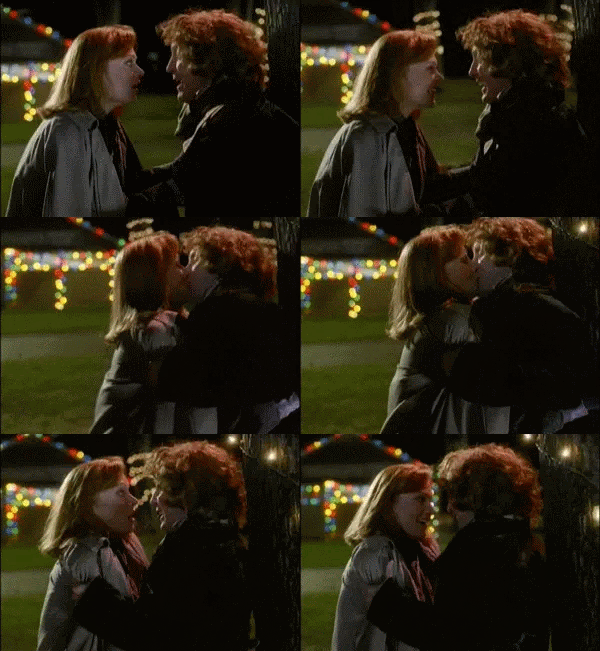
Ten started his (shitty) dynamic with Martha by doing exactly this, and Martha reacts by having a crush on him for the entire series 3. She deserves so much better than this.
 
Rassilon also knows I adore the Eighth Doctor (go listen to Big Finish you fools xD) and actually rather like his dynamic with Grace Holloway, but a low of his TV tenure is having him kissing Grace as a celebratory thing, which also gets another favourable response instantly. I mean, it could be somewhat understandable, at least from a fanfic point of view, that you would be attracted to the concept of an attractive Time Lord in full Byronian aesthetic kissing you, albeit hopefully in a more consensual setting, but maybe let's not normalize the false idea that every woman is thrilled at the "romantic" prospect of being kissed out of the blue by what is technically a random stranger.

 
Plot armour also means that when Nine kisses Rose, she's in Bad Wolf mode and in no state to consent, and actually never even remembers the kiss. Not the best Doctor/Rosse setting for a romantic kiss. Whovians can like Doctor/Rose however much they like (I have dabbled in it myself), but this point still stands 😬

3) Violence against women is still the major societal problem, but it's also troubling how the media thinks it's subversive and empowering to have female characters with agency show that by kissing people without consent, too. The Doctor, mostly. Which he tends to receive either positively or with a 'comically' dumbfounded look, too. Women like Amy, Clara and Missy (even with villains in queer-coded dynamics it isn't a funny trope), written that way by men who don't understand either feminism or consent. At least during those scenes. 
 
Honestly I'm so tired of seeing the non-con kiss move as a grrrrl power trope :S


Hell, people seem to love the 'Doctor gets kissed' trope so much even Donna Noble, the ultimate best pal who doesn't want anything romantic going on, ends up kissing Ten in this way for comedic effects. After all, the best antidote for cyanide is an abrupt snog, am I right?

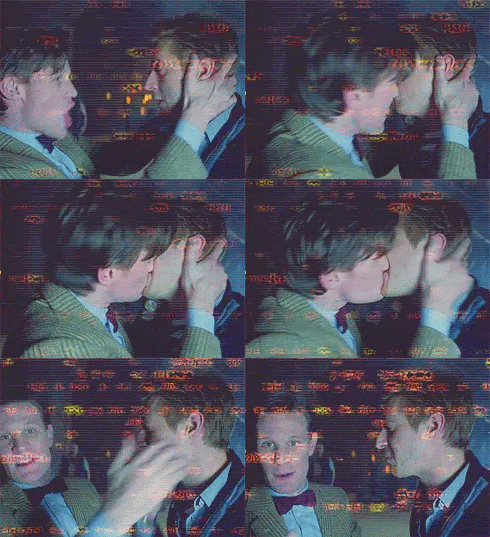
4) Then we have Matt Smith's 11th Doctor, who regrettably spends S7 not only being creepy af with Clara, but also kissing his male companion and his lesbian friend for laughs (some of these kisses were also unscripted 😬). What made you into such a creep all of a sudden, Eleven 😐?


It doesn't matter that Rory makes a disgusted face or that Jenny Flint rightfully slaps him. It's supposed to be funny! Rory is part of a (kinda 'no homo' homophobic) joke about the Doctor's quirks (with another straight character being abruptly kissed for laughs by the always-oh-so-predatory queers - which does check out for Barrowman tho :S 😐). And not only doesn't Eleven ever apologize to Jenny for his creepiness, but the next scene gets her blatantly sexualized by the camera in the following fight, including disturbing screwdriver innuendo courtesy of Eleven (just, wtf). About your lesbian friend. Again. So yeah, joy 😑 
 
 
There's also the fact that it really looks like there are more instances of rape culture and sexual harassment being normalized and played for laughs in New!Who than in more than one era of Classic Who, contemporary in the 1960s of the infamous sexism - both on and offscreen - of Star Trek's TOS o_O

Classic!Who has its share of sexism as well, tho  (we could go on about this whole topic too), including themes of sexual harassment and sexualization. Female cast members were sexualized and probably also harassed on set. And more than one actor was/is dodgy too in these respects, including but not limited to: Patrick Troughton (as much as I love the Second Doctor) and his double lives; Frazer Hines (Jamie McCrimmon) and his cheating and casual pervy comments on female cast members; Richard Franklin (Mike Yates), another rapist and abuser; or Tom Baker (Fourth Doctor) and his pretty blatant sexism when he talks about women in his  interviews. But the thing also is, at least to the point I'm in, the mid-Fourth Doctor era, I've also seen much fewer onscreen instances of rape culture with the First-Fourth Doctor eras than in the freaking whole of New!Who. Which is also kinda troubling.

Fortunately, the series has gotten way better in this respect especially since S9, but we still have moments, like the Jack and Graham kiss from S12, that follow this problematic pattern of making light of sexual assault and harassment. And my perception is that these instances, even if rarer, are still being too celebrated by a part of the community as something harmless, and as legit representation or empowerment :S We deserve female and queer representation, but also need to not normalize rape culture as well.

This is not to say that Doctor Who is as of today unwatchable, not at all. I adore Doctor Who at the same time that I'm also critical of it when it needs to be. And there's definitely also good representation in this respect - Positive female and queer characters, and consensual kisses. Some examples of the latter are Bill Potts and Heather, the second fully consensual takes of Twelve and Missy and Eight and Grace, and the gay couple from S12's 'Praxeus':


In conclusion, in my opinion it's about being critical of the fandoms we consume as well as enjoying them, especially when there's a problematic trend like this one that can pervade real life in the fandom :S It's important to talk about this too, while also enjoying all the good parts, of course 😀 !

Tuesday, 27 April 2021

Quenya translation - Lairë Nerion Imnetyalo: Traducción al quenya de un poema de Sor Juana Inés de la Cruz / Poem by Sor Juana Inés de la Cruz translated into Quenya


(English version, Spanish below) Back in 2020, fellow Tolkienite and feminist Pilar Erika 'Tarmariel Luinilmë' and I worked on a Quenya translation which got published in the Winter 2020 edition of the Estel (no. 94), the biannual magazine of the Spanish Tolkien Society (Sociedad Tolkien Española, STE). We translated excerpts of one of the poems of Sor Juana Inés de la Cruz, a 17th Century Mexican nun who was also a subversive feminist and LGBT+ poetess and writer. We had a blast with this work, as it combines some of our favourite topics - feminism and herstory, Tolkien and fandoms, rare and invented languages, and translating 😊💜📖.

In this essay and translation, which I show as a PDF here in this post (pages 41-46 of the magazine, also posted as a separate file), we have included an intro about the life and works of Sor Juana Inés, as well as the Quenya translation per se and its analysis. The poem we chose to translate is 'Hombres necios', the renowned (and rightly so) poem with its spot-on feminist critique against the hypocrisy of men - A poem which, unfortunately, still rings very true in our 21st Century.
 
If you want to learn more about the awesome Juana Inés, I recommend Pilar Erika's slideshow presentation on her life and works on her Blogger, which she presented as part of a series of talks organized by feminist organization Dando Voz al Silencio in Madrid back in 2018. Her post on this work is also here.
 
This is also my second Quenya post (translating a page of Astérix in Britannia was the first xD), and given my love for rare, ancient and invented languages, I'm totally planning on expanding the language and translation series on here and sharing more Quenya posts, as well as Irish and Vulcan shenanigans!

This essay is, for the moment being, in Spanish only, but I am planning on translating it into English as well sometime in the future 🙂! 
 

(Spanish version) En 2020, Pilar Erika 'Tarmariel Luinilmë' y yo, las dos tolkienianas y feministas, estuvimos trabajando en una traducción al quenya que se publicó en la edición de invierno de 2020 de la Estel (nº 94), la revista bianual de la Sociedad Tolkien Española (STE). Tradujimos unos fragmentos de uno de los poemas de Sor Juana Inés de la Cruz, la poeta y escritora mexicana del siglo XVII que se hizo monja para poder escribir, y que, a pesar de la sociedad tan patriarcal y jerárquica en la que le tocó vivir, era tanto una feminista subversiva como un ejemplo de persona LGBT+ histórica (sin planearlo también llega este post cerca del día de la visibilidad lésbica, el 26 de abril ^^).  Nos lo pasamos muy bien en este trabajo, ya que combina varios de nuestros temas favoritos: El feminismo y la visibilización de mujeres en la historia, Tolkien y los fandoms, las lenguas raras e inventadas, y la traducción 😊💜📖.

En este ensayo y traducción, que adjunto como  PDFs más abajo en este post (en las páginas 41-46 del PDF de la revista adjunta, y también en el fichero por separado), hemos incluido primero una introducción sobre la vida y obra de Sor Juana Inés, y después la traducción al quenya y su análisis. El poema que escogimos para traducir es 'Hombres necios', el famoso poema (y con razón) con su crítica feminista tan acertada acerca de la hipocresía y los dobles raseroes de los hombres. Un poema que por desgracia sigue siendo muy relevante en nuestro siglo XXI. 

Si queréis leer más sobre la genial Juana Inés, recomiendo la presentación de Pilar Erika sobre su vida y obra en su Blogger, que presentó  en 2018 en una jornada de charlas organizadas por la organización feminista Dando Voz al Silencio, en Madrid (yo presenté otra charla centrada en la escritora también feminista Christine de Pizan, del siglo XIV).
 
Este es mi segundo post sobre quenya (la traducción de un fragmento del cómic de Astérix en Britania fie el primero xD), y dado que soy muy fan de las lenguas antiguas, raras e inventadas, está en mis planes totalmente expandir la sección de lenguas y traducciones en este blog y compartir más posts sobre quenya, irlandés y vulcano xD


 PDF of the magazine (our article is on pages 41-46): 

And the separate file:

 
-On the use of my essays, studies and translations: DO NOT use this work without my permission. If you're interested and want to share it or expand on this idea, you're allowed to reference it if you credit me and link to this post. It would also be nice if you contacted me beforehand. DO NOT publish as if it were your own work, always quote and link.

Sunday, 28 March 2021

Goodreads reviews - The Vulcan Language

Book: The Vulcan Language4/5. Goodreads review also here

This book is a compilation from the Vulcan Language Institute which includes a Vulcan grammar, various glossaries, and also a section about Vulcan lore and culture.

Pros
-The geeky factor. I mean, it's a VULCAN grammar, and I'm having a blast learning this language :D . This book and the content on the website is a great opportunity to learn Vulcan.

-There are quite a lot of vocabulary lists, including separate topics (food, occupations, science, etc), as well as a general dictionary.

-Quite a lot of the grammar lessons include exercises, and there are also some sections with Vulcan and English dialogue (both dialogue from the TOS movies and original translations of Star Trek Spock quotes), useful for practice and translations.

-And finally, the last section of Vulcan lore includes interesting info about the history and culture of Star Trek Vulcans.

Cons 

-Although you can learn Vulcan fairly easily with these lessons once you know where everything is, the grammar in this book is often badly disorganized, and the grammar itself does not follow a logical (no pun intended xD) order at all sometimes - Basic topics such as pronunciation and punctuation come after a whole section introducing various topics of Vulcan grammar, the basic copulative sentence also comes after more complex topics such as a whole summary of verbs and verb-to-noun formations, grammar and quote sections are mixed together...

It's definitely not the most logical or helpful way to organize a grammar, and it shows that this book was basically a copy-paste of the website contents of the Vulcan Language Institute which is lacking the very much needed effort of organizing it all together better so that it’s easier to follow and to learn the language :S As a working grammar it does need some work.

-Some topics such as stress were ambiguously explained or missing, and I had to make use of YouTube videos in order to understand it better. Videos are also a great help to learn Vulcan and complement this book nicely, though!

-The culture and lore section could be a bit better organized as well. The rather random order of topics also shows the copy-paste nature of this book, but most of all what I sorely missed was notes and references to where all the lore info came from. While I could recognize the TV series Trek canon that I know when I came across it, I was often left wondering about where many bits of information came from, be it from the series (also, which series), the book and extended material canon, or fanon. The way this section is written and organized, there’s a bit of everything mixed up and it’s hard to know which is which.

Topics such as the kolinahr, pon farr and kul-ut-kal-if-fi (more on Vulcan culture regarding women and feminism will be coming on here sometime in the future, because I have a lot of things to say :S xD) I found to be well-researched in the TV canon (probably because there’s also more material available), and include useful bilingual texts in Vulcan and English. Other topics contain a lot more extended-material-canon and fanon info that I also appreciated as a compilation, and I do think it’s also valid information when it delves deeper into a topic which was not as explored in the series, and especially when it does so without contradicting the series canon – but it kept bugging me a lot not to have notes, references and a bibliography just to know where everything comes from (as Memory Alpha and Beta do).

-Finally, there are also some typos and inaccuracies in this lore section (the stated lore contradicts the TV canon a couple of times, that I could find), and a couple in the grammar section as well.

Overall, I think this is a great way to learn Vulcan and delve into Star Trek's Vulcan lore, and I totally recommend this. I just wish the grammar were better organized in a more practical and (ahem) logical way, and that the lore and culture section included notes and references (and a bibliography for everything) detailing where each piece of information comes from. But apart from that, I'm pretty hyped about learning Vulcan :D Dif-tor heh smusma! 

Sunday, 14 March 2021

Goodreads reviews - Doctor Who audiodramas: I Am the Master

Geoffrey Beevers' Master (promotional pic from Big Finish covers). Palpatine vibes xD

Audio: I Am the Master, a Big Finish short trip written and performed by Geoffrey Beevers.

 5/5. Goodreads review also here

Geoffrey Beevers' engaging monologue as the Crispy Master is equally creepy and charismatic as he recounts, from a literal soundbooth xD, how he came to rule and cause the destruction of a planet.

As well as revelling in his evil power games, the Master also includes in his storytelling a surprising amount of social criticism as he explains how he exploits a series of societal factors for his benefit - from capitalism, politics and environmental issues, to people's hypocritical binary ideas of good and evil, to how distorted ideals for egalitarian and utopic societies can create oppression, war and totalitarian regimes very easily. Loved this take, combining actual legit social critique with an exploration of the Master's amoral logic and pragmatism which he uses to destroy and gain power.

Some quotes of this that I quite liked:

 "Another thing that helps - helps me, that is, which is what ultimately counts - is that life forms can always be convinced that they are the goodies, pure and virtuous, and that some other life form is evil and must be destroyed! That's really the most helpful handle to have if you want to create death and destruction - 'Oh look, over there are some really bad people! They're not good, like you and me! Why don't you go and kill them?' Haven't you noticed how the so-called goodies usually end up killing just as many people as the so-called baddies? So, what does it really matter if  the goodies win, so long as there's lots of destruction (...). I find that's a comfort, when I'm feeling a bit depressed, to remember - evil always originates in the attempt to eliminate evil in others. And the winner of the battle will always call themselves goodies anyway by definition, so I find there's a big area there that I can really exploit. Another ares is the whole thing of unintended consequences. People can start out oh so confident, with all kinds of good intentions, but they just don't think of the terrible side effects. But I mustn't give away all my secrets. I don't want people aware of what I'm doing when I hypnotize them."

"Recently I've become quite interested in the destructive power of ideas. It is evident that the bright ideas of one generation can feed the disasters of the next. All it needs is simplification and distortion. Let me illustrate this with the aid of your own, miserable civilization: 'Love your neighbour' in the right hands can become the Inquisition. 'Men should be equal' [not women, heh] can become Stalinism. Freedom can become - well, you get my meaning. Simplify and distort."

And we also have a bonus final ASMR 'hipnosis-in-progress' session with the Master whispering 'And you will obeeeey meeee' into the in-universe microphone inside his TARDIS disguised as a sound booth lol xDDD  

Beevers' Master's 'crispy' gone-wrong incarnation from "The Keeper of Traken"

Monday, 22 February 2021

Goodreads feminist reviews - Warhammer Fantasy: Blood of Aenarion (Tyrion & Teclis I)

Tyrion and Teclis (©Games Workshop)

Book: Blood of Aenarion. A Tyrion & Teclis novel, by William King.


3.5-4/5. Goodreads review also hereThis is the first part of the Tyrion & Teclis Warhammer Fantasy trilogy, telling the story of the famous High Elf twins Tyrion ('unparalleled swordsman and tactician') and Teclis ('greatest natural sorcerer of the age'). Some (lengthy xD) thoughts below, as always focusing on a feminist pov and tackling points such as representation and female characters, social criticism and other intersections, and other issues that interest me. This review contains spoilers of the plot of this book.

+1 Rereading for the second time, I still found this book to be well-written with an engaging plot, focusing on the teenage years of Tyrion and Teclis, their beginnings as the famed warrior and sorcerer they will become, and their first encounter with Demon N'Kari.

Tyrion leads the forces of Ulthuan (©Games Workshop)
  • Epics, war and the Good/Evil binary

+1 Anti-war and Good/Evil binary critical content: Even though this is a Warhammer epic book focusing on a fantasy society with a heroic ethos and including plenty of battle scenes, some parts of this book also challenged the Good/Evil binary and included some anti-war content:

-"Too many people kill without thinking in this world." White Lion (the elite guard of the Phoenix King) Korhien Ironglaive has more than one conversation with protegé Tyrion about the dangers of idealizing war and battle, the concepts of glory and prowess, and how killing people is not something to be enjoyed. I personally really appreciated these scenes in the context of what is basically a very binary, epic genre which often disregards these matters and amps the glory and honour of battling your enemies. In spite of these pep talks, though, Tyrion - the good guy protagonist with a charming personality - turns out to be one born for war who actually claims to enjoy battle and even killing the ones who oppose him or his country, and will end up conforming more to the epic ethos of the genre :S.

-Dark Elf assassin Urian also offers some critical content of the Good/Evil binary when he muses on the centuries-long feud between the High and Dark Elves and how masquerading as a High Elf noble for decades and living among his enemies has made him see that both groups are not as dissimilar or as black and white as they think they are.

  • Female characters: Representation, roles and sexism

Concept of a high Elf female mage (©Games Workshop, Warhammer Online)

+-1 Warhammer is not the best genre for a lot of (good) female representation, to be honest, as most in-universe societies, and the stories and authors, are overtly male-dominated and sexist tropes and sexualization are often to be found both in the miniature and online game designs/roles, and in the books.

+(-)1 This particular book is still quite male-dominated, but I found to be a bit better regarding positive female representation, even though many women in interesting, subversive and proactive roles are still little more than mentions. Still, contrary to other Warhammer books and *ahem* the miniatures Warhammer Fantasy's range of High Elves offered (which was minimal and literally extended - if I recall correctly - to the Everqueen, her guard, and a mage), there are mentions of female (arch)mages and loremistresses, sailors and captains of ship, huntresses and rangers, archers and warriors, priestesses, and women taking part in political circles. Like I said, most of these roles are little more than mentions, but the bar is so low sometimes in this genre that it's still a refreshing sight :S xD

+1 Female characters with interesting and proactive roles that I enjoyed: The main one is Lady Malene, a mage and loremistress who is also active in political circles and the leader of her House of Emeraldsea apart from her father, and is described as serious, capable, powerful and intelligent. She is the aunt of Tyrion and Teclis and mainly acts as Teclis' mentor in matters of magic. I also liked that she is in a relationship without losing any iniciative or her role being ever reduced to a love interest trope.

 Another character I liked is Joyelle, a ship captain who answers to Malene and is described as capable, tough and stern (in a good way, although Tyrion first wonders at the fact that the captain's answering to Malene instead of her (male) lover and bodyguard Korhien - sigh - and then remarks on the sterness of both women, feeling relieved at seeing smiling sailor girls in the ship as well *le double sigh*). There's also sailor Karaya, who acts as kind of a love interest for Tyrion but is seen as capable in her job and shows plenty of iniciative of her own during her scenes with Tyrion. 

High Elf female mage

-1 Female characters with problematic characterization and tropes: Enchantress Morathi, the Dark Elven Queen, is always a character that's super sexualized in the Warhammer world (often wearing little more than a metal bikini and loincloth), and who follows a lot of femme fatale tropes (even though she is also an intelligent and powerful leader). Her appearance in the intro also included the love/hate relationship with Aenarion, which is not my fave thing. N'Kari the demon is also super sexualized and male-gazey when in female form. And characters such as Lady Malene's daughter Liselle followed the trope of the shallow, vain female character more than anything else and was there mainly to be one of Tyrion's love interests.

-Bechdel test: Pass. Malene and Joyelle talk to each other, and I remember conversations between Malene and Liselle, and between Liselle and another noblewoman called Lady Melissa (although they were talking mainly about Tyrion there, so maybe that conversation doesn't count :S).

+-1 Male characters and their treatment of women: To finish talking about the treatment of women in this book, there's also the theme of how men treat and think of women. Some thoughts -


-Lady Malene's relationship with Korhien the White Lion is quite refreshing and healthy, and she's always seen as the authority figure in her group without question (the ship's crew and her entourage answer to her, for example). Teclis and Lady Malene also get on well in a mentor/pupil dynamic.

-Tyrion is written with the intention of being charming and likeable, but he also revels in violence quite a bit and is quite a womanizer, sometimes bordering on dudebro material. His one-off relationship with the sailor Karaya is a pretty healthy example of a casual encounter, but the one he later has with his cousin Liselle showcases his entitlement and internalized sexism more, as he clearly views her as vain and shallow and later thinks of her in a quite disparaging way, showing he was using her more than anything else. Lady Malene also tells him to make and effort not to extend his womanizing to his close kinswomen, but there he went anyway and with Malene's own daughter no less lol (le sigh).

-Dark Elf assassin Urian is probably the most blatantly misogynistic character in the book alongside fabled ancestor Aenarion (who clearly hates his second wife Morathi but still lusts after her and is quite abusive in the way he goes about it :S). Urian may give us some anti-binarism commentary which makes us relate a bit to him, but he's also a creep who's proud of the "harem of slave girls" he had back home to do as he pleased with (ugh), and who fantasizes about making stern Lady Malene, who dares distrust him, succumb to his (violent) charms. Eww.

-1 A bit related to this, even though I have a higher tolerance for it in reading form than visual, I personally find the gorier and more graphic side of Warhammer so not my cup of tea. Especifically the sections in which the writers indulge and focus too lengthily in torture scenes or anything related to the cult of pleasure of Slaanesh (which is always a good opportunity to also include sexualized women or sacrifice scenes, yay).

  • Poc and LGBT+ representation. Colonialism and xenophobia.

-1 No representation of poc except for very brief mentions of poc humans from the Warhammer equivalents of North Africa and China (merchants, traders and people who live in the foreigners' quartet of the High Elven capital Lothern). As per usual fantasy white-centrism, it is assumed that all High Elves are white (something that in my opinion doesn't make a whole lot of sense if we're talking about a whole species :S, but OK), and all Elves whose appearance is described have fair to very pale skin (Tyrion in book 2 has tanned skin from his journeys, but yeah).

Ulthuan and its colonies in a map of the Warhammer version of the world (©Games Workshop)
 
+1 Some critical content tackling racism and xenophobia between High Elves and humans is explored. Ulthuan (the Elven insular continent) is a nation with a colonialist history which now trades with other races but at the same time is politically aislacionist (more than once this goes hand in hand with the colonialism bit), and consequently off bounds to anyone who is not a High Elf everywhere in the country except in Lothern's "foreigners' quartet", where humans and even some Dwarfs are permitted to live (with the main aim of trading). When Tyrion visits said quartet and sees humans for the first time in his life, these topics of Elven aislacionism, xenophobia and prejudice come to play in the narration. Tyrion's first impression of the humans is coloured by the xenophobic and racist prejudice he has been taught in his society, seeing them as inferior in all things and comparing them to 'apes' and 'monkeys', to the extent that he is then surprised to meet humans who are more intelligent that he and many Elves gave them credit for. He in turn also experiences xenophobic violence and slurs ('elfie', 'cat-eyes' - because of the High Elves' almond-shaped eyes) from some drunken humans, so there's also a bit of that other side as well.

-1 Practically no representation of LGBT+ people. Demon N'Kari can easily be seen as genderfluid, as many demons often are, but is portrayed in a quite problematic light. N'Kari uses 'he/him' pronouns the most, but also appears in female form at least twice. The problem is, when N'Kari is female she is incredibly sexualized and cast in the 'seductive femme fatale' role as per male-dominated fantasy standards. The fact that N'Kari is a demon who serves Slaanesh, the Chaos deity of pleasure and all things lascivious and perverse, is not helping any matters. 

  • Other intersections: Class and ability

+1 There's also some social commentary regarding classism, the hypocrisy and snobbery of the aristocratic classes and the difficulty of learning how to navigate and survive in a world full of protocol and courtly intrigues, as rural-raised Tyrion and Teclis find out when they go to the capital to live with their wealthy relatives for a while.

Teclis (©Games Workshop)

+1 Ableism critical content: While Elves see themselves as the superior race for their beauty, longer life, and the fact that most never get ill, Tyrion's twin brother Teclis is frail and disabled (he gets ill often to the extent of being in the brink of death, has a severe limp and mobility problems, and is considered to be less canonically beautiful), and thus he has experienced constant disapproval and insult from his Elven fellows, who look down on him for being 'inferior'. Compared to his able-bodied, beautiful-even-among-the-Elves brother Tyrion, he feels insecure and bitter, but relies on his intelligence, acerbic wit and remarkable magical ability to shine.

Thankfully, the treatment of this issue was pretty positive, being critical of the classism and ableism of the High Elves from the pov of Teclis, who is never seen in a negative light by the narrator because of his health problems and disabilities. Teclis will also end up being the High Elven character who seems most understanding of humans (also seen as frail, uglier and inferior by the Elves) and one of the few Elves more interested in helping them and sharing his knowledge with them. There's also the fact that even though Teclis ends up gaining more health and mobility that allow him to do adventuring of his own and live a long life to perfect his lore and magic powers, he ultimately also gains a more able-bodied lifestyle mainly by his own agency, choice and powers (as well as receiving help in this book, for example, which is also a positive thing, of course).

+1 And finally, I also like that Tyrion and Teclis maintain a pretty healthy and supportive brotherly relationship in this and other respects, which is a refreshing subversion of the often competitive, love/hate trope dynamic based in jealousy issues of the 'golden, athletic brother pitted against the dark, bitter brother' (hello, Thor and Loki xD - that particular relationship also has its character development and is really interesting, of course, but I could not let that reference slide xD

 And finally, the IG storytime with more or less the same text content, but including direct quotes and a bit more specifics sometimes (also here)

Tuesday, 6 October 2020

Goodreads reviews - Doctor Who: The Monsters Inside (New Series Adventures, #2)

Book: Doctor Who: The Monsters Inside, by Stephen Cole.


2.5/5 Goodreads review also here.

 This is the fourth DW book with Rose and the Ninth Doctor that I've read, and while I quite enjoyed the rest of them, this one didn't quite hook me :S The narration style and quality wasn't my favourite, and even though I think the premise was really promising, I also think the social criticism got derailed quite a lot by the alien menace of the story, which is a shame :S Some spoilers in the points below!

+1 The initial premise of a human-made planetary system serving as a series of concentration/labour camps and prisons for the criminals of the Galaxy, both human and alien, was very promising, and there was some social criticism related to that in the story. The system is corrupted, primarily based on money and people in high ranks gaining power (no surprises there). People are mistreated, tortured and exploited in the labour camps, which also include several science experiment projects using the detainees as test subjects and problem-solvers. Those deemed criminals (it seems that often unjustly or for minor offenses) are sent to long prison terms, with abusive wardens and minimally decent living conditions. There is also some criticism of speciesism and racism/xenophobia in the way the system segregates humans and aliens in different complexes, and seems to mainly exploit the latter for their science projects.

-1 All this background called for way more social criticism than we finally ended up getting, though. Mid-story, the social criticism content that was coming via the Doctor and Rose against this human-made penitentiary system is suddenly basically put on hold indefinitely as the alien antagonists - Slitheen and other Raxacoricofallapatorian families - turn out to be impersonating more than one high rank officer in the complex. From this point, I felt like the Slitheen aliens (the main antagonists are actually not from the Slitheen family, but I'm going to use it this way to avoid saying 'Raxacoricofallapatorians' xD) became the only antagonists in the tale, effectively seeming to shift the blame to them and pretty much forgetting about the *human*-made complex full of freaking labour camps and prison mistreatment :S

The fact that most of the human workers and leaders mentioned are either Slitheen posing as them (these are also the most evil and morally wrong), or described as more greymoral and/or becoming allies of the Doctor and Rose (even though more than one continues to be complicit in the system) doesn't really help matters in this case. The end also reminded me of Kerblam! in this way - The aliens are fully defeated and these greymoral humans who became allies of the Doctor suddenly find themselves in charge of matters and decide to make the system better. Which could sound good and like a very Whovian ending, but it's not fully clear which subjective criteria they are going to implement and if they're actually making the complex less of an authoritarian, capitalist, exploitative torture detainment site and more of a humane set of prisons for those who do deserve a prison sentence. The freaking existence of labour camps are also not really addressed at this point, and the Doctor and Rose seem to only insist on them freeing those detained aliens and human inmates who have helped in the cause against the Slitheen :S.

The fact that the social critique was so suddenly shifted to the bad alien menace of the Slitheen against the not-so-bad-after-all humans does whitewash and diminish the actual problematic issues the story was dealing with in the first place, I think. 

Nine was in this mode until...he just wasn't because the plot decided the sole baddies were the aliens :S
+1 I quite liked how Rose was depicted in the tale. She is well characterized and very proactive, as usual. She spends most of the book on her own and becomes a Doctor-figure at one point with a companion of her own, a low-rank male warden from the prison they sent her to. There is also some female bonding and Bechdel going on, with Rose making friends with her fellow cell inmate, Riz, and also developing alliances and tenous friendly dynamics with scientist warden Flowers and other fellow female inmates.

+-1 However, I felt like the Doctor was more 2D and less interesting to read about in this tale. I quite like the Ninth Doctor, but I don't think he was as fleshed out in this tale as he could have been, even though he has his fair share of social criticism (while it lasts, at least :S), techno babble and action.

-1 Even though I think Rose is well depicted and there are a fair number of female characters in this book, the treatment of the rest of the female characters is sorely lacking in some respects. The descriptions of each and every one of the women in this book scream of 'male writer syndrome' and are full of problematic and pretty sexist clichés - The narrator keeps evaluating their physical appearance in a way that's unsolicited, cringy and a double standard compared to most male characters, and more than one woman, be she a high-ranking officer, a scientist, an inmate or a warden, or even an alien, are helpfully described as being 'fat', 'plain', 'old', 'short', 'jealous of prettier women', or 'with more testosterone than the thin male warden they're comparing her to'. This soured my experience of the book quite a lot.

Me every time yet another female character got described in this way

-1 There are also some problematic jokes having to do with implementing 'mixed-sex cells' with male and female inmates in the teenager prison Rose is sent to, clearly drawing on the sexual assault possibilities :S However, most inmates also choose to behave like prom is coming and making lists of which inmates are hot?? Female inmates also seem to prefer to obsess over handsome male wardens rather than feel miffed about their generally horrible treatment - coincidentally, these are the most humane and sympathetic of the complex, compared to the b*tchy female wardens :S . It's worth mentioning that the evil Slitheen were actually hoping that the 'mixed-sex cells' would lead to the inmates reproducing and giving them more labourers for their exploitative purposes (aka sexual assault in more than one case, and women as incubators, yay :S).

-1 In the same line of thought, scientist warden Flowers, who works in the alien labour camp the Doctor is trapped in and who becomes her companion of sorts in this tale, is depicted as 'plain', nearing early middle age and 'overweight', and thus, horribly insecure, forever jealous of prettier women and desperately 'needing some exercise', and the Doctor himself puts it because she can't keep up with him when running (wow). She's also pragmatic in the moral sense and doesn't really care about exploiting other people if that means her career is going well, but even so all that is brushed aside pretty quickly, and she ends the story with even more control in the complex (after all, the baddie was her female superior who was actually an Slitheen in disguise, not the complicit underlings). But instead of actually making the system better like they claim they want to do, she starts making a list of 'hot male inmates sentenced for minor offenses' so that they can be their personal assistants. WTF. Feminism this is not.

When a female character is butchered with sexist tropes but ends up redeemed for being complicit in the system and not for any correction of said sexist tropes :S

-1 There are also some unfortunate racist touches here and there - The sole female character described as Asian is said to be stereotipically 'petite and delicate, but with a comically low voice' (wat), and the few black and dark-skinned characters are described as 'swarthy', and who even uses that anymore to describe poc, it sounds so cringy??

+-1 There is some greymorality going on, both among the humans in charge of the penitentiary complex and among the Slitheen, which I do appreciate, even though that also becomes a bit problematic when complicit underlings in the system are not really held accountable in the story :S Or that the most sympathetic and humane wardens in the story turn out to be male, which kinda promotes more the archetype of the b*tchy (they're called this in the book more than once) woman in charge :S The actual Slitheen in this book are more greymoral and become tenous allies of the Doctor in most of the story, as they are also against the other Raxacoricofallapatorian family who serves as the main antagonists of the tale. There are also two female Slitheen in the tale with proactive roles.

Rose is also initially bullied and attacked by a pack of female inmates (fully stereotyped as big, burly and rough) who give her a very hard time, but in the end they kind of apologize for it when Rose becomes a hero figure of the prison with her uncovering the Slitheen. She shouldn't have to prove herself in this way to be respected, though - although I kind of loved the idea of Badass Boss Rose Tyler becoming famous in the teenage prison and getting a reputation as the ultimate rebel disruptor xD, and also the fact that Nine tried to get her out of the prison by claiming she was a genious astrophysicist who was needed for the science project the Doctor was made to work on, and Rose actually using her wits to trick the wardens into that assumption in spite of her zero science skills!

I am always here for Baddass Rose Tyler

-1 And to conclude this, the Slitheen are not my fave Whovian alien at all, I actually quite dislike them. Apart from the juvenile 'farts and belches' shenanigans (which I'm not a fan of) and the horrible prosthetics, the rampant fatphobia in their characterization is the main reason for this. The book ends up basically demonizing all fat people because they might be monsters in disguise, and I find that deeply disturbing :S Rose and other characters have to be careful of any fat person in power they encounter because an Slitheen might be lurking inside, ready to chase and kill them, and it's actually a huge plot twist when one of them turns out to be in the body of a *gasp* slim woman.

When I started reading this book, I linked the title, The Monsters Inside to another Whovian critique of how humans can often be the actual monsters rather than the monstrous aliens we're supposed to be thinking about. Especially with the background of a dystopian human complex full of concentration camps and prison mistreatment. But we actually got a very literal meaning of the title, with the murderous, power-hungry Slitheen hiding inside the humans in power and becoming the actual baddies of the tale. Which was pretty disappointing, but ah well. 


If you want to read more reviews of the Doctor Who New Series Adventures:

-The Clockwise Man (New Series Adventures, #1)

-Winner Takes All (New Series Adventures, #3)