I have quite a lot of belated museum pics, so let's get started! Today's pic overload involve pieces of the Celtic, Celtiberians and Iberians in the Spanish Peninsula from the Madrid National Archaeological Museum . The first part is mainly about weapons and jewels and the like, because I'm enthusiastic about Celtic and Celtiberian culture here :D. Then, because this is a feminist blog after all, a rant about archaeological gender bias will make an appearance.
Detailed info about the pieces in the catalogues linked above. Click on pics or open in new tab for a bigger size.


- Intermission - Impromptu discussion about archaeological sexist bias regarding human iconography:
The following rant about gender bias is a result of thinking about the topic while looking at Celtiberian human figures in pots. Bear with me xD
(Disclaimer: In this archaeological context we are talking about what's most probably depictions of cis(sex/gender) people, and thus identifying the figures as male or female according to their portrayed genitalia, sexual secondary attributes or similar, according to the gender binary. Everything stated here is of course talking about this specific context and obviously doesn't seek to extrapolate to other contexts and invalidate the fact that the relation between biological sex (which is not binary), sexual attributes, assigned gender and gender identity can be very different matters for trans, NB and/or other queer people. Just wanting to clarify this. Intersectionality for the win always.)
(Disclaimer: In this archaeological context we are talking about what's most probably depictions of cis(sex/gender) people, and thus identifying the figures as male or female according to their portrayed genitalia, sexual secondary attributes or similar, according to the gender binary. Everything stated here is of course talking about this specific context and obviously doesn't seek to extrapolate to other contexts and invalidate the fact that the relation between biological sex (which is not binary), sexual attributes, assigned gender and gender identity can be very different matters for trans, NB and/or other queer people. Just wanting to clarify this. Intersectionality for the win always.)
It happens all too often that (usually male, probably also female) archaeologists tend to assume that any figure that is depicted in a warlike or active manner is automatically and without any shadow of a doubt a male figure. This of course is a result of sexist bias and gender stereotypes: Men are active, warlike and strong, while women are passive, beautiful and always depicted in 'traditionally feminine' activities. But even though most cultures are regrettably patriarchal and male-dominated, full of these gender roles, depictions of women in warlike, hunting and more active poses do exist, from warrior goddesses and more than one female depictions of Victory to Prehistoric huntresses in cave paintings. And if some cultures (like the Celts or Scandinavians) do have evidence of at least some warrior women, why shouldn't they be depicted in iconography as well? Why is that so difficult to imagine?
Also, it's not always obvious that the figure is male, so bias and stereotypes have more to do in the final decision that 'empirical evidence' - In more than one case, the gender of the figure can seem ambiguous, being depicted in a very schematic way and/or with no genitalia or sexual attributes present, for example (we are talking in the context of binary sex here, of course, which does fit most cases in these contexts, but it's worth mentioning that it's also an added bias that can be considered). Most people will still assume that the figure is male if shown in a warlike attitude or alongside objects such as weapons (and even in the case of being shown with both weapons and more 'traditionally feminine' objects such as mirrors, the figure will still be proclaimed as male).
Also, it's not always obvious that the figure is male, so bias and stereotypes have more to do in the final decision that 'empirical evidence' - In more than one case, the gender of the figure can seem ambiguous, being depicted in a very schematic way and/or with no genitalia or sexual attributes present, for example (we are talking in the context of binary sex here, of course, which does fit most cases in these contexts, but it's worth mentioning that it's also an added bias that can be considered). Most people will still assume that the figure is male if shown in a warlike attitude or alongside objects such as weapons (and even in the case of being shown with both weapons and more 'traditionally feminine' objects such as mirrors, the figure will still be proclaimed as male).
 |
| Estela de Solana de Cabañas (Bronze age). In this case, the figure is probably male because males are often portrayed with a straight, rectangular-shaped torso, but you get what I meant. Gender bias usually has no trouble seeing a mirror - a 'traditionally feminine' object - in a male tomb because there's weapons as well and weapons=male. But there are also female tombs with both weapons and mirrors and other personal grooming related objects! |
In other cases, though, the gender of the figure seems to be less ambiguous: There's a tendency in quite a few cultures and artistic choices - the Paleolithic cave paintings, for example- to depict female figures with wide thighs and/or very thin waists with torsos in an inverted triangle shape, for example (males are also depicted with triangle shaped torsos in some cases, though, this is not a 'definitive sign' of the figure's 'femaleness'), while males have straight torsos in a rectangular shape and thinner legs. Even if no sexual attributes or genitalia are shown it can sometimes be reasonable to assume that a certain figure is male or female judging on these body shapes.
And then there's the case where sexual secondary attributes (such as female breasts), for example, are actually shown, which should make it pretty obvious to assume to gender of the figure depicted, right? Wrong! In too many cases, figures in warlike, hunting or active poses that are very clearly female (breasts, for example) are still labelled and described as being male simply because they have weapons or are in a warlike or hunting or active attitude - A very clear and graphic example of the power of gender bias.
Some examples: This Celtic female rider is called a 'horseman' in a catalogue:

Many people also seem to find it difficult to identify these Paleolithic huntresses as being female despite the very obvious breasts in some cases, and the very obvious inverted triangle torsos and wide thighs:

OK, back to the chase. I was reminded of the topic while looking at these two human figures in Celtiberian pots (below, click for bigger pics). Both are labelled as male, and both are probably males, even though the second one's shape is less straight and rectangular than many males figures are usually portrayed as. The clothing might be a useful sign as well - Iberian women's clothing, for example, involved veiling and head and body coverings as part of a patriarchal modesty mindset. They wouldn't be depicted with bare torsos or exposed legs (But Celtiberian women seemed to be less oppressed regarding clothing, so it could be a possibility).
But disregardless of this, this got me thinking about the priorities of the people deciding the gender of the figures. Did they automatically assume that they're males because they're warriors? Or they did study the way Celtiberians drew their figures as well? Because the way their bodies are drawn are pretty different - While the second figure has a very straight, rectangular-shaped torso, the first warrior has an inverted triangle-shaped torso and pretty wide-ish thighs compared to the second figure, which in quite a lot of cases and cultures is a way of portraying female figures. Of course, this is not a scientific rule- Males are sometimes also portrayed with triangle-shaped torsos (the geometric archaic Greek period, for example, where both men and women are depicted with triangle-shaped torsos -women are usually wearing dresses and longer hair).
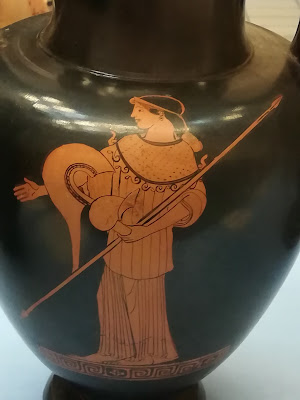
So while I'm not saying that this proves the figure is female (it doesn't, like it was mentioned before the shapes are not definite signs), still, there have been quite a handful of cases where gender bias has ruled over aspects like those. Warrior women -and definitely warrior goddesses- were not unknown among the Celts and, it is to be supposed, also among the Celtiberians, so I wouldn't automatically rule femaleness out as a consequence of gender bias just because a figure was holding a spear or wearing a helmet, like so many people have done and still do (the example of the old labels of the Athena chariot in the museum shop).


 |
| Chapter of druidesses and prophetesses |
 |
| Irish prophetess and druidess Fidelma |

 |
| Drawing of Warrior queen Medb on the upper right |
 |
| Drawing on warrior trainer Scáthach on the bottom left |