Book: Doctor Who: Winner Takes All, by Jacqueline Rayner.
3.5/5 Goodreads review also here.
This is the third book in the Doctor Who New Series Adventures
series, featuring the Ninth Doctor and Rose Tyler. Some thoughts below,
including spoilers:
This book has, in my opinion, an engaging plot, pretty good characterization, a proactive Rose, and features some interesting ethical themes, such as criticizing the violence of video games, anti-war mindsets as per usual, denouncing the behaviour of bullies, and tackling the ethical issue of controlling a person. The story also features a handful of problematic elements I didn't like, though, so full discussion of those will follow as well. Spoilers below!
Female representation:
Rose Tyler is the main female protagonist as Nine's companion, and her mother Jackie Tyler makes a limited appearance as a secondary character (would have liked to see more of her, although the dynamic between her and Rose was lovely). Most female characters in this book, though, are extras, neighbours from the Powell Estate plus some random humans abducted for the game, plus a female Quevvil alien. All of these characters hardly talk or only have a very minimal part in the plot. The one who appears a bit more is incel-teenage Robert's mother Daisy, whom Rose befriends at very nearly the end of the book. Apart from Rose, most of the action and dialogue in this book goes to male characters, from the Doctor to Mickey Smith and his male friends, Robert, local bully Darren Pye, and male Quevvil characters.
+1 Rose is proactive and shows a lot of agency, wits and resourcefulness. She confronts a bully head on, rescues Mickey and the Doctor in a very resourceful way, engages actively in the adventure at hand (which involves saving human beings from aliens who are making them play as part of a video games against their enemies), and, even though she apparently seems to think that in the Doctor's mind she always plays the role of the one who 'needs to be rescued' ('He gets to be the superhero. I get to be rescued'), the truth is that she always tries to find a solution on her own, instead of waiting to be rescued, and is a very proactive companion overall.
 |
I quite enjoy how proactive and assertive Rose always is, both in the series and the extended universe.
|
+-1 In the last third of the book Rose becomes a playable character inside the video game they're trying to put a stop to and all her movements and actions are being controlled by the Doctor, who's very much not happy about it, but it's also worth mentioning that it's the main female character, who has been very proactive so far, who ends up in this more passive position involving a dodgy non-consent issue. At least the plot does explore at length how this loss of control and the feeling of someone else controlling her every move (even if it's her best friend) affects Rose, who describes the feeling as terrifying, uncomfortable and vexing. Even when the videogame effectively transforms her into 'Super Rose', with superhuman strength, speed, agility and stamina, something that she wishes she could be in real life, she still feels massively uncomfortable about the situation as she is unable to make any single choice or movement of her own. For his part, the Doctor continuously rages at the fact that he is forced to control Rose in this way and is very upset about the fact that the Quevvils are making him dehumanize Rose (and the other humans), and the issue of the indignity of treating human beings as puppets and toys is frequently brought up in the book, which I appreciated.
+1 Jackie Tyler also shows her usual upfront side and confronts neighbourhood bully Darren Pye when he has a go at Rose.
 |
We stan badass Jackie Tyler
|
+1 Female bonding and Bechdel: We see several instances of bonding between female characters throughout the book, featuring several women from Rose's neighbourhood, and also the scenes between Rose and Daisy, teenage Robert's mother. I particularly enjoyed the mother/daughter relationship between Rose and Jackie, here portrayed as healthier and more mature than is shown in other books and episodes, and they worry and care about each other in a very lovely way.

Some problematic issues, from a feminist pov:
-1 True to his characterization in the series, Mickey Smith is portrayed with so much male entitlement going on his character is very jarring, even if he also has some better scenes in this book. He neglects the housework in his flat 100%, never seeming to clean anything and, in a grating scene, also expecting his (ex)girlfriend Rose to bring him the groceries his kitchen has been lacking for a good while ('[There won't be any biscuits] since I stopped doing the shopping for you'). In this grating scene, the Doctor goes all 'yay bros' with Mickey and sits down for a videogame session, casually and 'jokingly' telling Rose to 'Go and get us some milk and biscuits, will you Rose?'. Ugh. Just ugh.
 |
Male entitlement and gender roles are so funny, aren't they.
|
-1 Although Rose is labelled as Mickey's 'ex-girlfriend' in one instance, Rose also feels like they haven't properly split up, and, similarly to what happens in the series, the ambiguous triangle between Rose, the Doctor and Mickey frustrates me to no end and doesn't promote anything that's remotely healthy when it comes to relationship dynamics. Mickey is overtly jealous of the Doctor all the time, the Doctor bashes Mickey and has a go at his capabilities at any time he can (even though, to be fair to a character I don't particularly like - with Noel Clarke's real life beahviour also being an important factor why -, Mickey does play an important part in the story when it comes to saving the day with his computer and videogame skills). All in all, the Nine/Rose/Mickey scenario it's a very cringe-worthy situation that I don't particularly enjoy (more about that in my review of New Who's 'Rose').
 |
Can we stop doing the triangle cliché, especially when it just promotes people being really ambiguous about their relationship status and not communicating? Crowley would never to the first one. He and Aziraphale are also not so great at communicating, though, in their own wholesome-r way, but they are also rather more justified because trauma baggage (sobs xD).
|
-1 There are a couple of mentions of domestic violence and feminicides which I feel are
treated a bit more 'humorously' than they should: Mickey's (male)
friends also think that he has more value among his peers for having
dated the 'most beautiful girl of the neighbourhood', and what is worse,
he is also seen as more virile and badass for potentially having
murdered her (and maybe other blonde women), as was suspected of him
during the disappearance in the TARDIS in S1 of New Who. What the actual f. Later on, we
also briefly encounter a man who has wilfully sent his wife/girlfriend
to die because he couldn't stand her, but lately comes to mildly regret
it (poor him, I guess). If one is not going to full on denounce gender violence, I think
that it is better not to mention it in the first place, and even more so seeing as this book was written by Jacqueline Rayner, the only female writer out of the six Nine&Rose novels, and one of the very few female writers in the Doctor Who book series :S.
+-1 Several male characters, especially Mickey and Robert (we'll talk about this incel below) are afraid to show fear and pain, and turn to bragging and creating Gary Stu stories where they're the hero to hide their insecurities. The book does add conscious criticism to these issues, though, with Rose innerly eye-rolling at how Mickey feels embarrassed for expressing vulnerability, and the Doctor at one point claiming that it's OK [for men, and everyone] to cry and be afraid ('It's OK to cry. I cry all the time').
-1 The whole depiction of teenage Robert's character is that of the ultimate incel and he got on my nerves constantly. He feels oppressed because all the pretty girls don't fawn at his feet in adoration, and wallows in self-pity at his lack of social skills to be suave and charming. He ends up being super creepy about Rose and at some point in his incel daydreams he actually wishes he could control and own her (similarly to other girls in his fantasies), something which, especially considering Rose's arc in the last third of the story, is not great. He dislikes his mother with a teenage passion because he feels that she coddles and embarrasses him and spoils his chances to be charming with the girls. All of these traits are combined in his daydream fantasies, Gary Stu fanfics where he's the hero and the Chosen One (ripping off Star Wars, Harry Potter and more) and goes on adventures without his mother, and gets all the girls, of course. There's nothing wrong about fanfics and daydreaming and self-inserts, but Robert fits the incel archetype to a T, and his entitlement and toxic masculinity shows in all of his self-insert adventures in a very obnoxious way. There is also a huge difference between having a crush and wanting said crush to fawn at your feet because you're theoretically entitled to that - that is young boys displaying all the misogyny and entitlement that they have been learning and not deconstructing in the slightest. It isn't adorkable teenage hormones, it's a string of abusive relationships in its making.
 |
Me reading Robert's character
|
Not sure if the author was going for parody/criticism when it comes to this character, it kind of looks like that sometimes, but it can feel ambiguous at times, and in some respects, it actually looks like the character is meant to be kind of flawed but adorkable, with a hero-ish journey and ultimate character development as his intended arc. But because none of his incel traits are really challenged by any of the characters, and he never actually changes in that respect, this character started and ended being supremely cringeworthy to me, intended criticism or not.
-1 Finally there are two rather cringy and gratuitous mentions of 'alien bondage' (wtf) - featuring Mickey browsing the Internet looking for exactly that after a cringe-worthy first scene with the Doctor (and Rose) mentioning the topic.
Ethical issues:
+1 The whole premise of the book revolves around several interesting topics, from the inherent violence of video games and the dangerous effects they can have on people's ethical mindsets, to how human beings will readily turn to violence and bullying in real life more often than we'd like to think. It also tackles the very Whovian topic of a war between alien races which the Doctor will try to stop, and a very Hunger Games-esque plot where one of these alien races uses human beings as 'playable characters' in a videogame that is designed to kill and conquer their enemies.
 |
And I love me some Hunger Games-flavoured dystopia as a social criticism vehicle
|
-1 However, the Doctor seems to think that 'I hate guns (...) which isn't to say that a bit of fantasy violence can't be therapeutic' (as opposed to the story's 'videogame', where the players turn out to be real living beings being killed in real time), and thus is initially happy to engage in killing 'alien baddies' with Mickey. While this statement may be sometimes true, in this particular case, it is also rather throwing under the bus the fact that more than one kind of 'normal' videogames (the kind where you're not actually killing real sentient beings) do normalize real violence in a very problematic way.
 |
'Never-fired-a-gun' Crowley would definitely have some thoughts on this matter
|
+1 Anti-war themes all round, with the Doctor and Rose criticizing the unnecessary conflict between the Quevvils and Mantodeans ('Technology like this, and they use it to further a war').
-1 However, the Doctor actually kind of commits genocide in order to save the human captives (atomizing most of the Quevvils when they're still teleporting) and also ignores the attacked Mantodeans at the end (which seem to have everything in control but even so, he doesn't think about them), going away in his TARDIS as soon as the humans were freed. That is a problematic issue, imo, and not very Doctor-y, especially for the Ninth Doctor, who is fresh out of the Time War and is viscerally opposed to the concept of genocide, to the point of choosing not to destroy the Daleks in 'Bad Wolf'/'Parting of the Ways' in S1. So this would definitely not be his first choice, and the nonchalance with which he did it is also massively out of character.
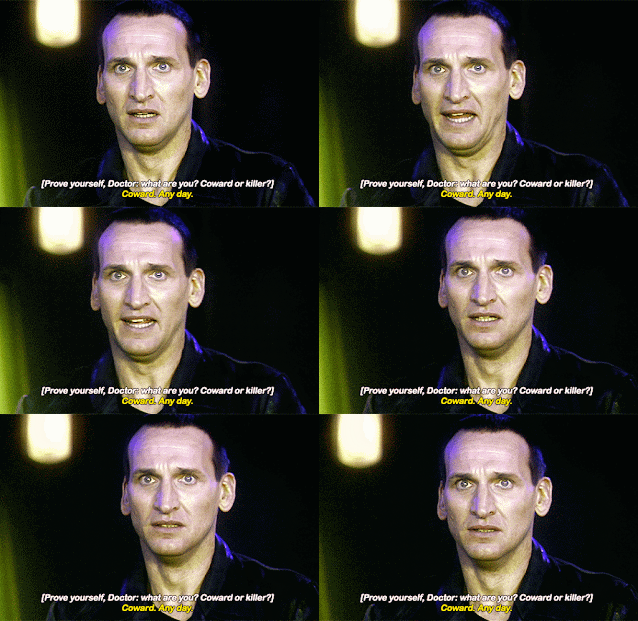 |
I mean, this is definitely one of Nine's best and most defining moments.
|
+1 The Doctor's approach to Rose being happy (but also
guilty about that happiness) when she thinks the bully who attacked her
mother is dead was a very nice, nuanced scene: '(...) it's all right. You're still allowed to hate them. As long as you don't gloat at their downfall, that's all.'
+1 Mickey thinks about how the Doctor just expects him to put himself in danger and/or help him with his plans without asking for his opinion, and it's a very valid point (I hate to agree with Mickey as a rule, but here we are xD). Rose also wonders at some point whether the Doctor sees her as more than the validation he needs to be a hero in the eyes of someone else, and also feels angry at the lack of consideration that Nine sometimes has towards her, her mother or Mickey.
+1 As discussed above as well, this book fully tackles the issue
of non-consent and dehumanization when it comes to controlling a person's movements and
actions (the people in the videogame are real people controlled by
others). The Doctor is forced to control both Rose and a Quevvil and he
rages about the fact that he's controlling another being as if they were
a 'toy' or a 'puppet' ('You don't treat someone like that. You don't
treat a person like that. And they're making me do it, making me
degrade her like that. (...) Making me sink to their level (...) Making
people dance around like puppets, making me take away every scrap of
dignity of my best friend...(...) We'll get out of this (...) But, back
of our minds, it'll always be there'). He also gets angry when the
Quevvils refer to the human victims as 'carriers' instead of seeing them
as individuals. The narrator also shows Rose's point of view about how
problematic that situation is and how helpless and annoyed she feels
while being controlled.
 |
Nine's disgust and anger at the Quevvils' tactics was very much in character, thankfully.
|
-1 Even though this issue is amply discussed, the Doctor and Rose never actually discuss it in person when all is finished, which is not a very healthy decision (and it is their MO, because Nine actually says how they will never discuss it in person because they never do, even though it has left them both traumatized). Also, the Doctor makes a joke that is in very poor taste at the end of the ordeal, when Rose is not present, and to incel Robert of all people, saying that he wouldn't mind from time to time if he were able to control Rose in the way that he formerly raged about being forced to do just before (¿?), because it would lead to a lot less trouble :S. Not-so-great humour as a result of even more repressed, uncommunicated trauma? In any case, such an unnecessary thing to say.
And see what I mean when I said that pretty much none of Robert's incel traits are challenged? The Doctor does teach him about how crying is healthy and several ethical dilemmas in their time together, which is all good, but if anything he is being enabled in this particular scene (ew), and he leaves the TARDIS at the end none the wiser that Rose is not head over heels over him (sigh), because he has fantasized about it from the very first time he saw her, so that's how it is, but from her point of view, Rose has just greeted him politely and met him for all of five minutes, and that's all there is to it. Ah well xD.
 |
The Robert 'character development' arc? Needs some work. He basically needs to start viewing women as people, for a start. Same as he got the crash course on ethics regarding intergalactic alien wars. Can't be harder than that, right? (welp).
|
✨If you want to read more reviews of the Doctor Who New Series Adventures:
-The Clockwise Man (New Series Adventures, #1)
-
The Monsters Inside (New Series Adventures, #2)